
Yangzhou
YangzhouYangzhou, anciently known as Guangling, Jiangdu, and Weiyang, is a prefecture-level city in central Jiangsu Province, on the north bank of the Yangtze River at the southern end of the Jianghuai Plain. It is a central city of the Yan
Yangzhou
Yangzhou, anciently known as Guangling, Jiangdu, and Weiyang, is a prefecture-level city in central Jiangsu Province, on the north bank of the Yangtze River at the southern end of the Jianghuai Plain. It is a central city of the Yangtze River Delta, bordering Yancheng and Taizhou to the east, facing Zhenjiang across the Yangtze to the south, connected to Nanjing to the southwest, bordering Chuzhou of Anhui to the west, and adjacent to Huaian to the north. Total area is 6,591 square kilometers. As of February 2025, Yangzhou administers 3 districts, 1 county, and 2 county-level cities. As of the end of 2025, the resident population was 4,564,900 with an urbanization rate of 74.3%. Yangzhou is one of the first 24 National Historical and Cultural Cities, with over 2,500 years of urban history since King Fuchai of Wu built Han City and dug the Han Canal in 486 BCE. Known as "China's Canal City No. 1," the Grand Canal Yangzhou section is a World Heritage site. Yangzhou has been designated a "World Canal Capital," "World Capital of Gastronomy," and "East Asian Cultural Capital." In 2025, GDP reached 805.675 billion yuan (approximately US$113.3 billion).
Historical Evolution
The area shows human activity dating back 7,000–5,000 years. In 486 BCE, King Fuchai of Wu conquered Han and built Han City and the Han Canal connecting the Yangtze and Huai rivers. The area passed through Yue, Chu, and eventually Qin control. The Han dynasty saw Guangling as a prosperous fiefdom—Prince Liu Bi of Wu minted coins and boiled sea salt, boosting the economy. In 105 BCE, Emperor Wu married Princess Liu Xijun to the Wusun kingdom, over 80 years before Wang Zhaojun's famous marriage alliance.
During the Sui dynasty (589 CE), the area was officially named Yangzhou. Emperor Yang of Sui built the Grand Canal, making Yangzhou a water transport hub. The Tang dynasty saw Yangzhou at its peak—as China's southeastern metropolis, known as "Yangzhou first, Yizhou (Chengdu) second." Arab and Persian merchants numbered in the thousands. The Tang poet Zhang Ruoxu's "Spring River Flower Moon Night" was praised as "a single poem that overwhelms all of Tang poetry."
During the Northern Song, Yangzhou was again a major economic center. The Southern Song used Yangzhou as a temporary capital. The Yuan dynasty restored the canal, reviving Yangzhou's prosperity. The Ming and Qing saw Yangzhou become a major salt trade center—the "Eight Eccentrics of Yangzhou" painting school (including Jin Nong, Zheng Xie, and others) flourished. Emperor Qianlong visited six times, and the city population exceeded 500,000, making it one of China's eight great cities and one of the world's top ten cities around 1800.
After the mid-19th century, canal silting and railway competition caused economic decline. During WWII, the New Fourth Army established anti-Japanese bases in the area. Yangzhou was liberated on January 25, 1949.
Administrative Divisions
Division History
The area underwent numerous administrative reorganizations. In 1983, Yangzhou Prefecture was abolished and the prefecture-level city was established. In 1996, Taizhou was separated as its own prefecture-level city. In 2011, Jiangdu was converted from a county-level city to a district.
Division Details
As of April 2024, Yangzhou administers 3 districts (Guangling, Hanjiang, Jiangdu), 1 county (Baoying), and 2 county-level cities (Yizheng, Gaoyou), plus 3 functional zones. The municipal government is at No. 8 Wenchang West Road, Hanjiang District.
Physical Geography
Location and Boundaries
Yangzhou is in central Jiangsu, between 32°15′–33°25′N and 119°01′–119°54′E, covering 6,591.21 km² (74.46% land, 25.54% water). The urban center is at the junction of the Yangtze River and the Grand Canal.
Topography and Landforms
The terrain is high in the west and low in the east. The highest point is Datong Mountain in Yizheng (149.5 m); the lowest is at the Gaoyou-Baoying-Xinghua border (average 2 m elevation). Hills are in the north, plains along rivers and lakes.
Climate
Yangzhou has a transitional zone between subtropical humid monsoon and temperate monsoon climates, with four distinct seasons, ample sunshine, and abundant rainfall. Winters last 4+ months, summers about 3 months.
Hydrology
Yangzhou has 1,111 rivers totaling 6,060 km, including the Yangtze (80.5 km of shoreline) and the Grand Canal (143.3 km through the city). The canal connects Baima, Baoying, Gaoyou, and Shaobo lakes to the Yangtze. Major rivers include Baoshe, Datong, Beichengzi, and the Tongyang Canal.
Natural Resources
Land Resources
As of 2019: 273,950 hectares of cultivated land (92.9% paddy fields), 4,081 hectares of orchard land, 30,608 hectares of forest land, and 3,516 hectares of wetland.
Mineral Resources
15 discovered mineral varieties with 12 having proven reserves. Oil and gas reserves rank among the province's highest, with the Shaobo Lake area and Lixia River lowlands known as the "water town oilfield." Other resources include brick clay, quartz sand, basalt, gravel, mineral water, and geothermal energy. Basalt reserves are estimated at 250 million tons.
Population
As of the end of 2025, the resident population was 4,564,900 (urbanization rate 74.3%). Registered population was 4,395,200. The population has been gradually declining in registered numbers while urbanization continues to increase.
Politics
Economy
Overview
In 2025, GDP was 805.675 billion yuan (approximately US$113.3 billion), up 5.5%. The industrial structure was 4.3:45.4:50.2 (primary:secondary:tertiary). General public budget revenue was 37.633 billion yuan (up 4.2%). Per capita disposable income was 52,996 yuan (approximately US$7,460, up 5.1%), with urban residents at 62,332 yuan (approximately US$8,770) and rural residents at 35,450 yuan (approximately US$4,990). Total retail sales of consumer goods reached 196.168 billion yuan (up 5.5%). Total import-export was 132.739 billion yuan (up 7.8%). Financial institution deposits reached 1,203.11 billion yuan and loans 1,234.167 billion yuan.
Primary Industry
Grain sown area was 5.897 million mu with output of 2.8961 million tons. Vegetable output was 2.7203 million tons (up 3.0%). "Yangmai 25" and "Yangmai 53" wheat varieties were selected for the national premium crop catalog. Green premium agricultural products accounted for 91.8%.
Secondary Industry
4,493 above-scale industrial enterprises saw added value grow 7.0%. Six pillar industrial clusters grew 5.2%, with automobile and parts up 19.8% and new energy up 10.2%. Above-scale industrial revenue grew 5.5% and profits 26.7%.
Tertiary Industry
Service sector added value was 404.689 billion yuan (up 7.2%). Above-scale service enterprise revenue was 84.72 billion yuan (up 9.7%). Total import-export was 132.739 billion yuan (up 7.8%). Actual foreign investment was US$1.095 billion. Tourism received 132.8517 million visitors with total spending of 114.282 billion yuan. Insurance premium income was 29.234 billion yuan (up 11.9%).
Social Affairs
Education
Yangzhou has 709 schools including 8 higher education institutions, 169 secondary schools, and 173 primary schools, with 677,000 students and 48,600 teachers. All counties achieved national preschool universalization. The city pioneered the "dual system" vocational education reform.
Science and Technology
In 2025, 16,944 patents were granted (3,857 invention patents). 49.38 invention patents per 10,000 people. 3,048 high-tech enterprises. High-tech industry output accounted for 53.2% of above-scale industrial output.
Culture
Yangzhou has 7 cultural centers, 8 public libraries, 18 registered museums (including the China Grand Canal Museum), and 73 city study rooms.
Sports
Yangzhou athletes won 6 gold, 6 silver, and 5 bronze at the 15th National Games. The Yangzhou Marathon was upgraded to a World Athletics "Platinum Label" event. 35+ national-level competitions were held, attracting 350,000+ visitors and generating 4 billion yuan in consumption.
Healthcare
Yangzhou has 2,303 health institutions including 107 hospitals, with 32,513 beds and 38,604 health personnel.
Social Security
35,800 new urban jobs were created. Basic pension insurance covered 3,273,700 people and basic medical insurance 4,323,100. Minimum living allowance is 893 yuan/person/month.
Environmental Protection
PM2.5 was 31.8 μg/m³ (meeting national standards for 5 consecutive years). All national and provincial water quality monitoring sections achieved 100% compliance, with 93.3% of national sections at Class III or above.
Infrastructure
In 2025, Yangzhou added 28.46 km of urban roads, 50 sponge city projects, 16 drainage compliance zones, 104 renovated old residential communities, and 2,478 affordable rental housing units. 3.26 million m² of urban green space was added.
Transportation
Overview
In 2025, total freight was 212 million tons (up 6.0%) and passengers 20.6795 million (up 2.8%). Port cargo throughput was 175 million tons with 805,700 TEU containers. Yangzhou-Taizhou Airport handled 4.1636 million passengers (up 14.1%).
Highways
Multiple expressways intersect including Beijing-Shanghai, Nanjing-Yancheng, Shanghai-Xi'an, and Yangzhou-Liyang. The Runyang Bridge crosses the Yangtze to connect with southern Jiangsu. A 400 km city ring road network has been formed.
Railways
The Lianyungang-Zhenjiang HSR serves Yangzhou with 4 stations (Yangzhou East, Gaoyou, Gaoyou North, Baoying). The North Yangtze HSR (350 km/h) is under construction, and the Nanjing-Yangzhou intercity railway is planned.
Aviation
Yangzhou-Taizhou International Airport is a Grade 4E airport with a 3,200 m runway, serving 74 destinations (60 domestic, 14 international) with 4.1636 million passengers in 2025. Gaoyou Airport is a planned Grade 2B general aviation airport.
Water Transport
Yangzhou Port became a national first-class open port in 1992, with sub-ports at Gaoyou, Yizheng, Jiangdu, and Baoying.
History and Culture
Overview
Yangzhou is one of China's first 24 National Historical and Cultural Cities, with three peaks of glory: Han, Sui-Tang, and Qing (Kang-Qian). The city earned UNESCO designations as "World Canal Capital," "World Capital of Gastronomy," and "East Asian Cultural Capital." Famous visitors include Li Bai, Du Mu, Bai Juyi, Ouyang Xiu, Su Shi, Zheng Banqiao, and Zhu Ziqing.
Historical Sites
As of April 2024, Yangzhou has 529 protected cultural relic sites at various levels.
Intangible Cultural Heritage
Four projects are on the UNESCO "Representative List of Intangible Cultural Heritage of Humanity": Guqin (zither), paper-cutting, woodblock printing, and Fuchun tea pastry making. 20 projects are national-level intangible cultural heritage. In 2014, the Grand Canal (Yangzhou-led application) was inscribed as a World Heritage site.
Folk Customs
Dragon boat racing during the Dragon Boat Festival is a long tradition, particularly thriving during the Tang, Ming, and Qing dynasties. The Qing dynasty saw four major racing venues: Slender West Lake, the urban Grand Canal, Yizheng's Shi'erwei, and Guazhou-Jinshan.
Morning tea (zaocha) culture is an essential part of Yangzhou life—teahouses serve as important social venues where locals gather with friends or business partners over tea and dim sum.
Scenic Spots
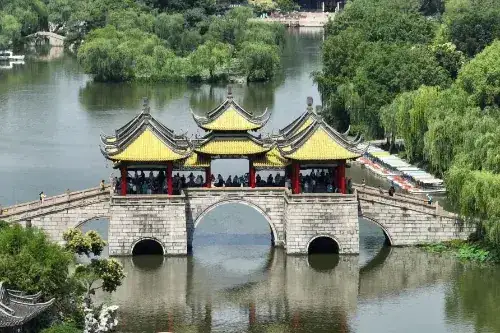
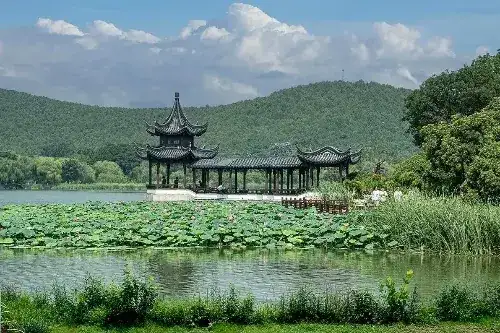
As of the end of 2025, Yangzhou has 62 A-level tourist attractions, 4 provincial tourism resorts, 6 provincial-level nighttime cultural tourism consumption clusters (2 national-level), 12 provincial-level rural tourism key villages (2 national), and 3 tourism leisure streets (2 national). The Slender West Lake (Shouxi Hu) is the city's most famous landmark.
Local Specialties
Notable Figures
External Relations
Honorary Titles
Travel information can change. Check current opening hours, reservations and entry requirements before you travel.
Traveller discussion
Start the conversation with a helpful tip or a question.