
Wuxi City
Wuxi CityWuxi City, abbreviated as "Xi," is a prefecture-level city in Jiangsu Province and a Type I large city. Located in East China and the southern part of Jiangsu Province, it borders the Yangtze River to the north and Taihu Lake to th
Wuxi City
Wuxi City, abbreviated as "Xi," is a prefecture-level city in Jiangsu Province and a Type I large city. Located in East China and the southern part of Jiangsu Province, it borders the Yangtze River to the north and Taihu Lake to the south, neighbors Suzhou to the east and Changzhou to the west, and shares boundaries with Huzhou (Zhejiang Province) and Xuancheng (Anhui Province) to the south and southwest. The Beijing-Hangzhou Grand Canal runs through the city. The total area is 4,627.46 square kilometers. The terrain is predominantly plains with scattered low hills, and the climate is a northern subtropical humid monsoon type. As of July 2025, the city administers 5 districts and 2 county-level cities, with the municipal government headquartered at No. 1 Xinjinkui Road, Binhu District. As of end-2025, the permanent population is 7.5374 million. Wuxi boasts over 3,100 years of written history and over 2,200 years of city-building history, making it a major birthplace of Wu culture, Jiangnan culture, and canal culture. Legend has it that the city was named "Wuxi" (literally "no tin") because the tin deposits on Xishan were exhausted. Wuxi is a key central city in the Yangtze River Delta region, a national historical and cultural city, and a national comprehensive transportation hub. It is a member of the Shanghai Metropolitan Circle and the Su-Xi-Chang Metropolitan Circle. Known as a cradle of modern national industry and commerce as well as township enterprises, Wuxi has produced notable historical figures including Gu Kaizhi, Xu Beihong, Hua Yanjun (Abing), and Qian Zhongshu. Famous attractions include Yuantouzhu (Turtle Head Isle), the Qingming Bridge Historic and Cultural Block, Huishan Ancient Town, and Nianhua Bay. In 2025, Wuxi achieved a regional GDP of 1,677.394 billion yuan (approximately US$233 billion), up 5.1% year-on-year.
History
Wuxi is an important birthplace of Jiangnan civilization, with written records dating to the late Shang Dynasty (c. 12th century BCE). According to tradition, Taibo, eldest son of King Taiwang of Zhou, migrated south to Jiangnan with his brother Zhongyong, settling at Meili (present-day Meicun, Wuxi) and establishing the state of Gouwu. After King Wu of Zhou overthrew the Shang (c. 1066 BCE), he enfeoffed Zhou Zhang, a descendant of Zhongyong, as ruler of Wu. Over subsequent centuries, the area passed through the states of Yue (473 BCE) and Chu (334 BCE).
Wuxi County was formally established in 202 BCE during the Western Han Dynasty. It was renamed "Youxi" during the Xin Dynasty (9 CE) but restored to "Wuxi" in the Eastern Han (25 CE). Under the Western Jin (281 CE), it was assigned to Piling Commandery. The Sui general Wang Shichong captured Wuxi in 613 CE. Under the Tang, it belonged to Changzhou. The Yuan elevated Wuxi to a prefecture (zhou) in 1295 CE.
The Ming Dynasty reduced Wuxi back to county status under Changzhou Prefecture. During the Qing, the county was split into Wuxi and Jingui counties in 1724, both administered from the same city. Taiping forces captured both counties in 1860; Qing forces retook them in 1863. On November 6, 1911, revolutionary forces seized the county yamen and declared independence from Qing rule.
After the 1912 merger, Wuxi County was placed under direct provincial administration in 1927. During the Second Sino-Japanese War (1937-1945), Japanese forces occupied Wuxi on November 27, 1937, burning the city and killing over 2,000 civilians. Communist-led New Fourth Army resistance governments operated in the area.
After liberation on April 23, 1949, Wuxi County was divided into Wuxi City and Wuxi County. In 1953, Jiangsu Province was established and Wuxi became a provincial city. In March 1983, the city-county system was implemented, bringing Jiangyin, Yixing, and Wuxi counties under Wuxi's jurisdiction, with all three later upgraded to county-level cities.
Administrative Divisions
Division History
From 1955, Wuxi administered six districts. Several rounds of reorganization followed. In 1983, the city gained jurisdiction over Wuxi, Jiangyin, and Yixing counties. Jiangyin and Yixing were elevated to county-level cities in 1987 and 1988 respectively. In 1995, Wuxi County became Xishan City. In 2000, Xishan was dissolved into Xishan and Huishan districts, and the suburban area was renamed Binhu District. In October 2015, the three old urban districts (Chong'an, Nanchang, Beitang) were merged into Liangxi District, and Xinwu District was established from parts of Xishan and Binhu.
Current Divisions
As of July 2025, Wuxi administers 5 districts (Xishan, Huishan, Binhu, Liangxi, Xinwu) and 2 county-level cities (Jiangyin, Yixing), with the municipal government at No. 1 Xinjinkui Road, Binhu District.
Geography
Location
Wuxi lies between 31 degrees 07 minutes - 32 degrees N and 119 degrees 31 minutes - 120 degrees 36 minutes E, in the corridor between the Yangtze River and Taihu Lake in southeastern Jiangsu. It borders Suzhou to the east (128 km from Shanghai), Huzhou across Taihu Lake to the south, Changzhou to the west (183 km from Nanjing), and the Yangtze to the north. Total area: 4,627.47 sq km (land: 3,724.98 sq km; water: 902.49 sq km).
Topography
The terrain is predominantly plains with scattered low hills. The southwestern Yixing area features mountains exceeding 500 m, with the highest peak Huangtading at 611.5 m. The highest peak in the urban area is Huishan Sanmaofeng at 328.98 m. The landform took shape through Mesozoic tectonic movements, with the Taihu Basin forming during the Himalayan orogeny approximately 25 million years ago.
Climate
Wuxi has a northern subtropical humid monsoon climate with four distinct seasons, abundant heat, and plentiful rainfall. Summers are hot and rainy under southeastern monsoons; winters are cold with northern winds. Annual average temperature is 16.2 degrees Celsius, precipitation 1,121.7 mm, with 123 rain days and 1,924.3 sunshine hours. July is the hottest month and January the coldest.
Hydrology
Wuxi sits in the Taihu Lake basin with an extensive water network. The Beijing-Hangzhou Grand Canal runs north-south through the city center, while Liangxi River flows westward into Taihu Lake, earning it the title of Wuxi's "mother river." The city has 5,635 rivers totaling 7,328.4 km, with 2,193 in the urban area (3,261.5 km). Lihu Lake, a Taihu inlet shaped like a gourd, is embedded in the urban area.
Natural Resources
Water Resources
Surface water is abundant, with urban reserves of 63.49 million cubic meters and annual recharge of 64.53 million cubic meters. Taihu Lake's total storage capacity is 4.428 billion cubic meters, with an annual average of approximately 5.2 billion cubic meters.
Biological Resources
Wuxi has 950 species of wild vascular plants across 141 families and 497 genera, with herbs comprising 78.32%. Main timber species include bamboo, pine, and fir, with over 400 medicinal plants. The city hosts 170+ bird species, 90+ fish species (including Taihu's signature icefish and whitefish, and the Yangtze's knife fish, Reeves' shad, and pufferfish), and 30+ mammal species such as the South China hare, pangolin, and Siberian weasel.
Mineral Resources
Extractable minerals are mainly non-metallic: clay (industrial reserves exceeding 50 million tons), limestone (estimated 1.7 billion tons), marble (estimated 50 million cubic meters), and coal (industrial reserves exceeding 40 million tons).
Population
As of the 2020 census, Wuxi's permanent population was 7,462,135 (8.81% of Jiangsu's total). By end-2025, the registered population was 5.2307 million (urbanization rate 87.97%) and permanent population 7.5374 million (urbanization rate 83.80%). The Han Chinese account for 99.4% of registered population, with 54 ethnic minorities represented.
Politics
Organizational History
Communist Party activities in Wuxi began in 1923. The CCP Wuxi County branch was established in May 1925, later elevated to a prefectural committee in 1927. During the war years, the party established resistance governments under the New Fourth Army. After liberation on April 24, 1949, the CCP Wuxi Municipal Committee was founded.
Current Leadership
The municipal leadership comprises the Party Secretary, Mayor, and Standing Committee members of the Wuxi Municipal People's Congress. Current officeholder information is maintained by the municipal government.
Economy
Overview
Wuxi is one of China's fifteen economic center cities and the birthplace of modern national industry, township enterprises, and the "Sunan Model." Known as "Little Shanghai," it ranks among China's four major rice markets and is a key manufacturing base in the Yangtze River Delta, with IoT, integrated circuits, biomedicine, textiles, and new energy vehicles as representative industries. In 2022, Wuxi's per capita GDP of 198,400 yuan (approximately US$27,600) ranked first among China's large and medium-sized cities for three consecutive years.
Since the Yuan Dynasty, Wuxi served as a grain transport hub with four major docks (rice, cloth, silk, and money). In the late Qing, industrialists like the Rong and Yang brothers established yarn and flour mills. By 1936, Wuxi's GDP reached 77.26 million yuan, ranking third nationally. Post-reform, township enterprises flourished - Huaxi Village in Jiangyin became known as "the richest village in China." Since the 2020s, Wuxi has pursued industrial transformation toward integrated circuits, biomedicine, IoT, and new energy vehicles.
In 2025, Wuxi's regional GDP reached 1,677.394 billion yuan (approximately US$233 billion), up 5.1%. Per capita GDP was 223,000 yuan (approximately US$30,972). The primary, secondary, and tertiary sectors contributed 14.248 billion yuan (approximately US$1.98 billion), 787.047 billion yuan (approximately US$109.3 billion), and 876.099 billion yuan (approximately US$121.7 billion) respectively, with a ratio of 0.9:46.9:52.2. The private economy accounted for 66.7% of total output.
Fixed asset investment totaled 397.911 billion yuan (approximately US$55.3 billion), down 13.3%. General public budget revenue was 122.539 billion yuan (approximately US$17.0 billion), up 2.0%. General public budget expenditure was 127.484 billion yuan (approximately US$17.7 billion), with 80% allocated to livelihood sectors. Per capita disposable income reached 75,200 yuan (approximately US$10,444), up 4.1% - urban residents earned 83,158 yuan (approximately US$11,550) and rural residents 49,181 yuan (approximately US$6,831). Consumer prices were flat year-on-year.
Primary Industry
Wuxi is one of China's four major rice markets and a major rice-milling center. In 2025, grain output was 570,000 tons, vegetables 1.2718 million tons, tea 4,430.4 tons, fruit 180,100 tons, meat 9,800 tons, and aquatic products 95,000 tons.
Secondary Industry
Manufacturing is the backbone of Wuxi's economy. The city has built 10 industry clusters each exceeding 100 billion yuan, with IoT, biomedicine, and high-end textiles selected as national advanced manufacturing clusters. The "465" industrial system comprises 4 signature industries (IoT, integrated circuits, biomedicine, software and IT services), 6 advantaged industries (high-end equipment, textiles, environmental protection, new materials, new energy, automobiles), and 5 future industries (AI and metaverse, quantum technology, third-generation semiconductors, hydrogen energy and storage, deep-sea equipment).
In 2025, above-scale industrial value-added grew 5.9%. The construction industry generated 87.545 billion yuan (approximately US$12.2 billion) in value-added, with total output of 164.434 billion yuan.
Tertiary Industry
In 2025, total retail sales of consumer goods reached 441.847 billion yuan (approximately US$61.4 billion), up 3.1%. New energy vehicle sales surged 37.5%. Total import-export value was 829.276 billion yuan (approximately US$115.2 billion), up 7.6%, with exports of 575.153 billion yuan (approximately US$79.9 billion, up 14.2%). Actual foreign investment used was US$3.03 billion, with high-tech industries accounting for 35.9%.
Postal and telecommunications revenue totaled 27.132 billion yuan (approximately US$3.77 billion). Express delivery volume reached 1.079 billion parcels. The city had over 33,200 5G base stations and 10.854 million mobile phone users.
Tourism welcomed 163 million domestic visitors and 375,200 inbound overnight visitors, with total spending of 191.634 billion yuan (approximately US$26.6 billion). The city has 44 rated tourist attractions (4 are 5A-level), 17 star-rated hotels (9 five-star), and 323 travel agencies.
Financial institution deposits reached 3,083.18 billion yuan (approximately US$428.2 billion), up 6.6%, and loans 2,725.113 billion yuan (approximately US$378.5 billion), up 8.4%. Insurance premium income was 63.109 billion yuan (approximately US$8.77 billion). Securities trading volume reached 17.93 trillion yuan (approximately US$2.49 trillion), up 47.3%, with 218 listed companies.
Social Affairs
Education
Wuxi has 14 regular universities with 163,900 enrolled students (including 15,000 graduate students), 475,00 secondary vocational students, and 556 kindergartens serving 150,600 children. High school enrollment rate is 99.74%.
Science and Technology
The city hosts 9 provincial-or-above key laboratories (4 national), 32 academician workstations, and 56 provincial-or-above tech incubators (27 national). In 2025, 12,432 invention patents were granted, with 103.37 effective patents per 10,000 people and 77,576 cumulative patents.
Culture
Wuxi is the main birthplace of Wu culture, housing the Jiangnan Cultural Lineage Research Center. The city has 77 performing troupes, 8 cultural centers, 8 public libraries, 48 museums, and 8 comprehensive archives with 5.3 million accessible files. All five major religions (Buddhism, Taoism, Islam, Catholicism, Protestantism) are represented, with 278 registered religious venues.
Healthcare
Wuxi has 3,730 medical institutions, including 56 general hospitals and 110 community health centers, with 73,800 healthcare professionals (30,000 physicians) and 56,700 beds. Total medical visits reached 67.417 million, up 4.69%.
Sports
Per capita sports area is 4.95 sq m, with a national fitness qualification rate of 93.4%. The city hosted 14 international and 66 national events in 2025, including the Wuxi Marathon and World Taekwondo Championships. Sports lottery sales reached 4.593 billion yuan (approximately US$638 million).
Social Security
New urban employment reached 145,900 in 2025. Pension insurance covered 4.2816 million people, medical insurance 4.5192 million, and unemployment insurance 2.6201 million. The monthly minimum living allowance was raised to 1,167 yuan (approximately US$162). The city built 11,847 affordable housing units.
Environmental Protection
In 2025, Taihu Lake water quality met Class III standards year-round, with 97.2% of monitored sections meeting quality standards and 100% compliance at centralized drinking water sources. PM2.5 averaged 26 micrograms per cubic meter (down 3.7%), with 83.8% good air quality days. Daytime and nighttime noise compliance rates were 92.4% and 89.6% respectively.
Transportation
Overview
Wuxi is a major transportation hub in East China with an integrated network of rail, road, water, and air. Total highway mileage is 7,586.14 km (including 325.70 km of expressways). The city has 2.9092 million motor vehicles, with 448,700 being new energy vehicles (up 34.5%). Wuxi Metro operates 5 lines totaling 141.17 km, with annual ridership of 242 million. Passenger volume reached 154 million and freight 267 million tons. Port cargo throughput was 462 million tons, and airport passenger throughput 10.968 million.
Highways
Expressways include the Beijing-Shanghai (G2), Shanghai-Chengdu (G42), Shanghai-Wuhan (G4221), and Changchun-Shenzhen (G25), among others. The Jiangyin Yangtze River Bridge (opened 1999) was China's first bridge with a span exceeding 1,000 meters. The Taihu Tunnel (opened 2021) was China's longest underwater tunnel upon completion.
Railways
Wuxi has a dense rail network forming a "four-horizontal, one-vertical" pattern comprising the Beijing-Shanghai Railway, Beijing-Shanghai High-Speed Railway, Shanghai-Nanjing Intercity, Nanjing-Hangzhou High-Speed Railway, and Xinchang Railway, totaling 296 km. The city has 6 passenger rail stations.
Aviation
Wuxi Shuofang International Airport (4E-class, dual-use military-civilian) in Xinwu District opened civil flights in 2004. It serves 23 airlines with routes to major Chinese cities and international destinations including Hong Kong, Macau, and Tokyo. Yixing Dingshu General Airport (A1-class) opened in November 2022. The local carrier Sunan Ruili Airlines operates 22 Boeing 737-series aircraft.
Water Transport
Wuxi has 1,656 km of waterways with 221 operating shipping routes. Jiangyin Port, 38 km from the city center, has 42 km of deep-water Yangtze shoreline and was China's first inland-port international container transit station. Huangtian Port in Jiangyin serves as a major Yangtze estuary transshipment hub.
Public Transportation
Wuxi Metro opened its first line on July 1, 2014, making Wuxi the 22nd mainland Chinese city with rail transit. As of end-2024, 5 lines operate with 141.43 km of track and 242 million annual passengers. The public bus system operates 343 routes totaling 6,236 km with 1.83 billion annual passengers. A water bus on the ancient canal loop, launched in July 2020, serves both transit and tourism with 8 stops.
History and Culture
Origin of the Name
The origin of "Wuxi" remains debated, with four main theories:
1. Tin Exhaustion Theory: Xishan produced tin during the Zhou-Qin period; by the Han Dynasty the deposits were depleted, hence "Wuxi" ("no tin"). When tin reappeared during the Xin Dynasty, it was renamed "Youxi" ("has tin").
2. Old Yue Language Theory: "Wu" is a phonetic prefix with no literal meaning, and the original meaning of "Xi" is lost. Like many Jiangnan place names, the name derives from the ancient Yue language.
3. Wu Ruins Theory: Meili (present-day Meicun) was the capital of the Wu state for over 600 years. After Yue destroyed Wu in 473 BCE, the capital was razed to ruins ("Wu Xu"). In the Wu dialect, "Wuxi" and "Wu Xu" sound nearly identical, so the Qin-Han government adopted the local pronunciation.
4. Homophone Theory: In Old Chinese, "xi" (tin) could mean "ci" (to bestow). "Wuxi" could mean "no-bestowal lake" - a lake not granted as a fief.
Wu Culture
Wuxi is the birthplace of Wu culture. The Wu state established capitals at Meicun (formerly Meili) and Hudadí (Helü City). The Taibo Temple and Tomb in Xinwu District are major Wu cultural sites, hosting annual temple fairs and ancestral ceremonies. The Helü City ruins and museum in Binhu District are also key sites.
Cultural Relics
Wuxi has 1 World Cultural Heritage site (the Grand Canal), 34 national-level protected cultural heritage sites (56 groups), 74 provincial-level sites (157 groups), and 359 municipal sites (367 groups).
Intangible Heritage
The city has 11 national intangible cultural heritage items (including the Liang-Zhu legend, Wu songs, Wuxi Daoist music, Xiju opera, Wuxi bamboo carving, Huishan clay figurines, Wuxi fine embroidery, Yixing purple sand pottery, and the Taibo Temple Fair), 51 provincial items, and 168 municipal items, with 10 national-level inheritors.
Folk Customs
Dragon boat racing was popular in Wuxi from the Ming-Qing era through the eve of the Anti-Japanese War, with Huangbu Dun and Ehu in Dangkou as major venues. Traditionally, dragon boats were scuttled and stored underwater in dedicated channels between races. Traditional festivals include Lunar New Year ancestor worship, lantern viewing at Lantern Festival, tomb-sweeping at Qingming, and dragon boat racing at Duanwu. Wuxi cuisine favors sweet flavors with rich sauces, and residents drink predominantly green tea.
Dialect
The Wuxi dialect (excluding Jiangyin and Yixing) belongs to the Wu dialect group, in a transitional zone between the Changzhou and Suhu-Jia subgroups. It has 34 initials (18 voiceless, 16 voiced), 48 finals, and 8 tones. The linguist Y.R. Chao noted Wuxi's distinctive rising tone. Regional variation is significant - "different accents every ten li." Since 1949, Putonghua promotion and migration have altered the dialect.
Specialties and Cuisine
Wuxi cuisine is characteristically sweet, featuring Wuxi xiaolongbao (soup dumplings), sweet-and-sour pork ribs, fried gluten puffs, Yangshan honey peaches, the "Three Whites of Taihu" (icefish, whitefish, white shrimp), scallion pastries, and Mashan bayberries. Local crafts include Huishan clay figurines and Yixing purple sand teapots.
Scenic Spots
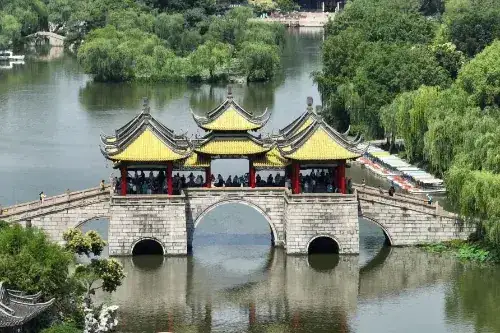
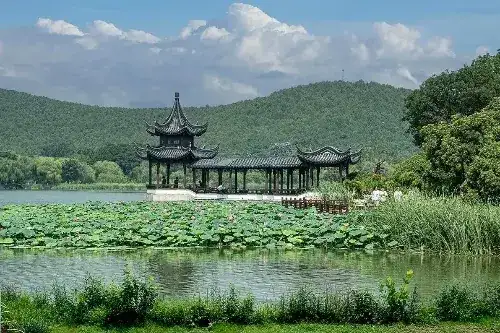
Wuxi has 1 national tourism resort (Taihu National Tourism Resort), 4 5A-level scenic areas, 26 4A-level areas, 2 national forest parks, and 1 national wetland park. Famous attractions include Yuantouzhu (Turtle Head Isle), the Qingming Bridge Historic and Cultural Block, Huishan Ancient Town, and Nianhua Bay.
Famous Figures
Notable historical figures from Wuxi include the painter Gu Kaizhi (Eastern Jin Dynasty), the artist Xu Beihong, the blind musician Hua Yanjun (Abing), and the literary scholar Qian Zhongshu.
Cooperation and Exchange
East-West Cooperation
In June 2022, the National Development and Reform Commission established a partnership between Wuxi and Yan'an, Shaanxi Province (part of the Shaanxi-Gansu-Ningxia revolutionary old base area).
Foreign Exchange
Wuxi maintains sister-city relationships and international cooperation with cities worldwide, supporting economic, cultural, and educational exchanges.
Honorary Titles
Wuxi holds numerous honorary designations as a national historical and cultural city, a national civilized city, and a national model city for environmental protection, among others.
Travel information can change. Check current opening hours, reservations and entry requirements before you travel.
Traveller discussion
Start the conversation with a helpful tip or a question.