
Nanjing City
Nanjing CityNanjing City, abbreviated as "Ning" and also known as "Jinling" or "Jiankang," is a prefecture-level city under Jiangsu Province, the provincial capital of Jiangsu, a sub-provincial city, a megacity, and the core city of the Nan
Nanjing City
Nanjing City, abbreviated as "Ning" and also known as "Jinling" or "Jiankang," is a prefecture-level city under Jiangsu Province, the provincial capital of Jiangsu, a sub-provincial city, a megacity, and the core city of the Nanjing Metropolitan Area. It is designated by the State Council as an important central city in eastern China, an international comprehensive transportation hub, a national advanced manufacturing base, an eastern industrial innovation center, a regional science and technology innovation highland, an eastern modern service industry center, and a regional shipping and logistics center. It also serves as the headquarters of the Eastern Theater Command of the People's Liberation Army. Nanjing is located in eastern China, southwestern Jiangsu, in the lower reaches of the Yangtze River. It has a northern subtropical humid monsoon climate with four distinct seasons, abundant rainfall, short springs and autumns, long winters and summers, and large annual temperature variations. The terrain is dominated by low mountains, hills, and terraces, with a total area of 6,587.04 square kilometers. As of June 2026, Nanjing administers 11 districts. At the end of 2025, the resident population was 9.6385 million. Nanjing is among the first batch of national historical and cultural cities and an important birthplace of Chinese civilization. Since ancient times, it has been the political, economic, and cultural center of southern China, with cultural influence extending across East Asia. It has over 7,000 years of civilization history and over 3,100 years of urban history. More than ten dynasties successively established capitals here, including Eastern Wu, Eastern Jin, Huan Chu, Song, Qi, Liang, Chen, Yang Wu, Southern Tang, Ming, Taiping Heavenly Kingdom, and the Republic of China. Nanjing is a national science and education center, historically valuing education and known as "the literary hub of the world." Its science and education comprehensive strength ranks third nationally, after Beijing and Shanghai. As the only pilot city for comprehensive science and technology system reform, Nanjing ranks fifth globally in the top 10 scientific research cities. Software and information services, new-type power (smart grid), new energy vehicles, intelligent manufacturing equipment, biomedicine, integrated circuits, new materials, and aerospace are pillar and advantage industries. In 2025, Nanjing's GDP reached 1,942.878 billion yuan (approx. $267 billion), a year-on-year increase of 5.2%.
History
Nanjing is the earliest area in the lower Yangtze River where ancient human activity has been archaeologically discovered, with evidence dating back 1-1.2 million years. About 500,000 years ago, early humans known as "Nanjing Man" (Homo erectus) were active in the Tangshan Huludong area. The site yielded skull fragments of Nanjing Man. Around 7,000 years ago, the Hemudu culture appeared in the Pukou area, and agricultural civilization emerged in the Qixia area. About 4,000 years ago, dense primitive settlements known as the Hushu Culture formed along the Qinhuai River basin, establishing the earliest towns in the Nanjing area. Over 3,100 years ago in the late Shang Dynasty, the Changgan Ancient City was built, marking the beginning of Nanjing's urban history.
In 571 BCE, the State of Chu established Tangyi in what is now Luhe District, the earliest recorded local administrative unit in Nanjing. In 333 BCE, King Wei of Chu defeated Yue and built Jinling Yi on Shitou Mountain (present-day Qingliang Mountain), marking the origin of the name "Jinling." In 211 CE, Sun Quan moved his power center to Moling and renamed it Jianye ("establishing imperial enterprise"). In 229 CE, Sun Quan moved his capital to Jianye, marking the beginning of Nanjing's history as a capital. Subsequently, Eastern Jin and the Southern Dynasties (Song, Qi, Liang, Chen) all established capitals here for over 320 years, earning Nanjing the title "Ancient Capital of Six Dynasties." The Jiankang city of the Six Dynasties was the world's largest city at the time, with a population exceeding one million, making it the first city in the world to surpass one million inhabitants. Its axial-symmetry layout pioneered city planning in Chinese history and influenced later capitals including Kyoto and Nara in Japan.
During the Sui and Tang dynasties, Nanjing was politically suppressed but continued to develop economically and culturally. Poets such as Li Bai, Liu Yuxi, Du Mu, and Li Shangyin lived and visited here. After the Tang Dynasty, Southern Tang established its capital in Jinling, bringing over 70 years of peace. During the Five Dynasties and Ten Kingdoms period, Yang Wu elevated Shengzhou to Jinling Prefecture in 920 CE, the first time Nanjing was established as a prefecture. In 937 CE, Xu Zhigao (Li Bian) founded Southern Tang with Jiangning Prefecture as its capital.
During the Song Dynasty, Nanjing was an important political, economic, and cultural center of southern China. Wang Anshi, the Northern Song statesman, served as prefect of Jiangning three times. The Jingkang Incident of 1127 triggered the third great southward migration, making Nanjing an economic center and one of the world's great cities. General Yue Fei defeated Jin forces at Niushou Mountain near Nanjing. In the Yuan Dynasty, Nanjing served as the seat of the Jiangnan Censorate, overseeing judicial and administrative affairs for three provinces. As China's textile center, it had over 6,000 specialized artisan households, and Nanjing cloud brocade was used as imperial fabric.
In 1356, Zhu Yuanzhang captured Jiqing and renamed it Yingtian Prefecture. In 1368, he proclaimed himself emperor, establishing the Ming Dynasty and naming the capital Nanjing, marking both the origin of the name "Nanjing" and its first time as the capital of a unified China. The Ming capital had a population exceeding 700,000, making it the world's largest city. The 27-year construction of the Ming City Wall created the world's largest fortification. In 1405, Zheng He launched his first of seven maritime voyages from Nanjing's Longjiang Pass. In 1421, Emperor Zhu Di moved the capital to Beijing, making Nanjing a secondary capital under the dual-capital system. By the mid-Ming Dynasty, Nanjing's population reached 1.2 million, still the world's largest city. The Italian Jesuit Matteo Ricci marveled at Nanjing's grandeur, comparing it favorably to any European capital.
In 1645, Qing forces captured Nanjing, abolished its capital status, and renamed it Jiangning Prefecture. During the Kangxi and Yongzheng reigns, the population reached one million. The Jiangning Imperial Textile Manufactory produced silk for the imperial court. In 1853, the Taiping army captured Jiangning, renamed it Tianjing, and made it their capital. In 1842, after the First Opium War, the Treaty of Nanjing, China's first unequal treaty in modern history, was signed aboard a British warship in Nanjing's waters.
On January 1, 1912, Sun Yat-sen was inaugurated as Provisional President in Nanjing, establishing the Republic of China. In 1927, the Nationalist Government established Nanjing as the capital. The decade from 1927 to 1937 was known as China's "Golden Ten Years," during which large-scale capital construction laid the foundation for Nanjing's modern urban development. On December 13, 1937, Nanjing fell to Japanese forces, followed by the Nanjing Massacre, in which over 40 days of mass killings occurred. On September 9, 1945, the surrender ceremony for the China Theater of World War II was held in Nanjing. On April 23, 1949, Nanjing was liberated.
After the founding of the People's Republic of China, Nanjing became a centrally administered municipality. In 1953, it was designated the capital of Jiangsu Province. In 1994, it was designated a sub-provincial city. In 2016, the Yangtze River Delta Urban Agglomeration Development Plan positioned Nanjing as a "megacity."
Administrative Divisions
Division History
(Details are available in the "Administrative Divisions of Nanjing" entry.)
Division Details
As of June 2026, Nanjing has 11 districts under its jurisdiction (plus one national-level new area, the Nanjing Jiangbei New Area, which is a functional zone rather than an administrative division). It has 95 sub-districts, 6 towns, 932 communities, and 322 villages. The municipal government is located at No. 41 Beijing East Road, Xuanwu District.
Natural Resources
Water Resources
Nanjing is located at the lower reaches of the Yangtze River, Shuiyang River, Qinhuai River, and Chuhe River, with abundant transit water. In 2015, the transit water resource volume was 920.6 billion cubic meters, of which the Yangtze River accounted for 911 billion cubic meters. In 2022, total water resources were 1.09 billion cubic meters, down 60.7% from 2021. Annual precipitation was 862.3 millimeters, down 26.2% from 2021.
Land Resources
As of 2022, Nanjing had 1,521 hectares of wetlands, 141,641 hectares of cultivated land, 152,683 hectares of forest land, and 153,532 hectares of urban, village, and industrial/mining land. As of March 2024, forest coverage reached 31.96%, ranking first in Jiangsu Province for six consecutive years. The built-up area greening coverage rate was 44.96%, with 16.2 square meters of park green space per capita.
Biological Resources
From October 2021 to May 2024, a citywide biodiversity survey recorded 3,672 species, including 1,742 terrestrial vascular plants, 410 terrestrial vertebrates, 699 terrestrial insects, and 712 aquatic organisms. Notable protected species include the Yangtze finless porpoise and baer's pochard. The survey discovered two new insect species globally and three new national insect records. The city has 1,410 ancient and notable trees, including 943 trees over a century old.
Mineral Resources
Nanjing has rich mineral resources across four metallogenic belts. As of 2020, 49 mineral types (58 sub-types) had been discovered, with 31 having proven reserves. Key metallic minerals include iron, copper, gold, lead, zinc, strontium, and germanium. Strontium (celestite), attapulgite clay, basalt, and gypsum hold leading positions in China. Proven reserves include 600 million tons of iron ore, 385,000 tons of copper, 611,000 tons of strontium, and 1.06 billion tons of cement-grade limestone. Geothermal resources are also abundant, with the Tangshan and Tangquan geothermal fields.
Physical Geography
Location
Nanjing is located in southwestern Jiangsu Province in the lower Yangtze River, spanning from 31°14′N to 32°37′N and 118°22′E to 119°14′E, with a maximum east-west width of about 70 km and north-south length of about 150 km. The total area is 6,587.04 square kilometers.
Geological Structure
Nanjing belongs to the northern margin of the Yangtze Old Land. Its basement consists of lightly metamorphosed schist and volcanic rock, approximately 864-1,031 million years old. Nanjing has over 700 million years of geological history, experiencing three marine-to-continental transitions, one major mountain-building event, and two intense volcanic eruptions.
Topography
Nanjing is known as a "natural geological museum," with diverse landforms including Yangtze floodplains, water-rich soft soils, terraces, and karst features. Low mountains, hills, and terraces account for about 60.8% of the total area, while plains, lowlands, rivers, and lakes comprise about 39.2%. The Zhongshan main peak, Beigaofeng, at 448.9 meters, is the highest point of the Ningzhen Mountains.
Climate
Nanjing has a northern subtropical humid climate with four distinct seasons, abundant rainfall, short springs and autumns, long winters and summers, and significant annual temperature variations. Winter is dominated by northeast winds, with a January average of 2.7°C and a record low of -14.0°C (January 6, 1955). Summer is dominated by southeast winds, with a July average of 28.1°C and a record high of 43.0°C (July 13, 1934). Average annual rainfall is 1,106.5 mm over 117 rainy days, with a frost-free period of 237 days. The plum rain season occurs from late June to early July.
Hydrology
Water bodies cover 11.4% of Nanjing's total area. The Yangtze River flows through the city for about 93 km, with nearly 200 km of shoreline. Major rivers and lakes include the Qinhuai River, Jinchuan River, Xuanwu Lake, Mochou Lake, Shijiu Lake, Gucheng Lake, and Jinniu Lake. The city has 120 waterways of various sizes. The Yangtze River section in Nanjing has an average flow of 28,200 cubic meters per second, with a navigable depth exceeding 10.5 meters year-round, capable of accommodating 10,000-ton seagoing vessels.
Soil Types
Nanjing's soils include zonal soils and cultivated soils. Zonal soils are yellow-brown earth in the north and central areas, and red earth in the south at the boundary with Anhui. Cultivated soils are predominantly paddy soils, accounting for 78% of cultivated land. A 1980-1987 soil survey identified 7 soil orders, 13 sub-orders, 30 soil genera, and 66 soil types, totaling 416,300 hectares.
Population
At the end of 2025, Nanjing's resident population was 9.6385 million, an increase of 61,500 from the previous year (up 0.64%). The urban population was 8.4337 million, with an urbanization rate of 87.5%. The birth rate was 5.39 per thousand, the death rate 5.04 per thousand, and the natural growth rate 0.35 per thousand. Nanjing is a multi-ethnic city with all 56 ethnic groups represented, with a resident ethnic minority population of about 140,000.
Politics
Economy
Overview
Nanjing has been consistently ranked among China's top cities for investment environment and comprehensive strength. Its pillar and advantage industries include software and information services, new-type power (smart grid), new energy vehicles, intelligent manufacturing equipment, biomedicine, integrated circuits, new materials, and aerospace. Software and information services and new-type power (smart grid) were selected as national advanced manufacturing clusters. Under the Nanjing Industrial Strengthening Action Plan (2023-2025), Nanjing is building a "2+6+6" cluster architecture to enhance global competitiveness in two major clusters and seize domestic leadership in six industrial clusters and six future industry tracks.
In 2025, Nanjing's GDP reached 1,942.878 billion yuan (approx. $267 billion), up 5.2%. The primary industry added value was 33.85 billion yuan (approx. $4.65 billion), up 3.4%; the secondary industry 587.307 billion yuan (approx. $80.6 billion), up 3.7%; and the tertiary industry 1,321.721 billion yuan (approx. $181.5 billion), up 6.0%. The three sectors accounted for 1.7%, 30.2%, and 68.0% of GDP respectively. Per capita GDP was 202,220 yuan (approx. $27,770), up 4.7%.
Primary Industry
Nanjing is an important agricultural and commercial grain base in China, and a significant freshwater fishery base. Major cash crops include rapeseed, cotton, tea, and fruit. Notable agricultural products include Longchi crucian carp, salted duck, Yuhua tea, Gucheng Lake crabs, Baima blackberry, and Hengxi watermelon.
In 2025, total agricultural, forestry, animal husbandry, and fishery output value reached 56.92 billion yuan (approx. $7.82 billion), up 2.6%. Grain sown area was 2.147 million mu (about 143,100 hectares), up 0.6%, with total grain output of 1.008 million tons, up 0.5%. The city had 286 municipal-level and above leading enterprises, 3,955 farmer cooperatives, and 7,214 family farms. Leisure agriculture received over 50 million visitors, up over 10%.
Secondary Industry
Nanjing is the cradle of China's modern industry. The establishment of the Jinling Arsenal in 1865 marked the beginning of Nanjing's modern industry. After 1949, Nanjing developed petrochemicals, automobile manufacturing, iron and steel, and mechanical equipment as pillar industries. It is one of China's three major electronic industry bases and a major petrochemical base, with comprehensive production capacity ranking second nationally. The smart grid industry is a key advantage; in 2023, Nanjing's smart grid industrial cluster exceeded 360 billion yuan (approx. $49.5 billion), ranking first nationally with 80% market share.
In 2025, above-scale industrial value-added grew 5.8%. By ownership type, state-controlled enterprises grew 8.2%, joint-stock enterprises 9.3%, and private enterprises 11.1%. Advanced manufacturing products saw rapid growth, with industrial robots up 35.4%, new energy vehicles up 99.0%, integrated circuits up 28.2%, and optoelectronic devices up 66.6%. The construction industry completed total output of 469.09 billion yuan (approx. $64.4 billion), down 8.7%.
Tertiary Industry
Nanjing is designated by the State Council as an "important regional financial and business center." In the 2012 China Financial Center Index, Nanjing ranked sixth nationally. In 2016, financial industry value added reached 124.176 billion yuan (approx. $17.06 billion), accounting for 11.8% of GDP, ranking fourth nationally. The software and information services industry is Nanjing's largest dominant and pillar industry. In 2018, revenue reached 450 billion yuan (approx. $61.8 billion), ranking fourth nationally. Nanjing has 15 unicorn companies, 95 cultivating unicorns, and 312 gazelle companies, ranking seventh globally and fifth nationally by number.
The convention and exhibition industry is also important. In 2014, Nanjing ranked third nationally in number of exhibitions and fifth in exhibition area. In 2025, total retail sales of consumer goods reached 813.585 billion yuan (approx. $111.7 billion), up 3.5%. Total goods imports and exports were 538.09 billion yuan (approx. $73.9 billion), with exports of 348.65 billion yuan (approx. $47.9 billion). Actual utilized foreign investment was $1.312 billion. Tourism revenue totaled 239.02 billion yuan (approx. $32.8 billion), up 9.3%, with tourism foreign exchange earnings of $990 million, up 27%. The city received 200.528 million domestic and international visitors, up 10.6%.
Fiscal revenue in 2025 reached 162.091 billion yuan (approx. $22.25 billion), up 1.6%. Financial institution deposits in domestic and foreign currencies reached 6,568.844 billion yuan (approx. $902 billion), up 15.3%, and loan balances reached 6,320.198 billion yuan (approx. $868 billion), up 7.5%. The city had 167 listed companies and insurance premium revenue of 127.93 billion yuan (approx. $17.56 billion), up 10.1%.
Social Affairs
Education
Nanjing has been a city valuing education since ancient times, known as "the literary hub of the world" and "the foremost academy of the southeast." The earliest recorded school was established in 30 CE. The Southern Dynasty Song-era Jiankang Imperial Academy was the world's first university with a departmental system. During the Ming Dynasty, the Nanjing Imperial Academy was the world's largest institution of higher learning, with nearly 10,000 students including international students from Japan, Korea, and Vietnam.
Nanjing is one of China's three major higher education centers, with science and education comprehensive strength ranking third nationally. The city has 54 regular institutions of higher education with 868,700 students (excluding postgraduates) as of end-2025, and 230,100 postgraduate students. It has 290 regular secondary schools, 400 primary schools, and 959 kindergartens. Nanjing has 2 Project 985 universities and 8 Project 211 universities, ranking third nationally after Beijing and Shanghai. Nearly 200 academicians of the Chinese Academy of Sciences and Chinese Academy of Engineering have come from Nanjing. In December 2025, higher education enrollment in Nanjing surpassed one million students.
Science and Technology
Nanjing is a national science and education base with comprehensive scientific strength ranking third among Chinese cities. In the 2025 Nature Index - Science Cities, Nanjing ranked fifth globally and third in China, maintaining its national third position since 2018. The city has 618 provincial-level and above engineering technology research centers, including 15 national-level ones. In 2025, patent authorizations totaled 58,938, including 31,109 invention patents. Effective invention patents reached 179,291, with 187.21 per 10,000 people. Technology contract transactions reached 109.772 billion yuan (approx. $15.07 billion). The Zijinshan Laboratory released the world's first 6G integrated communication-sensing field trial network.
Cultural Affairs
As of end-2025, Nanjing had 181 municipal-level and above cultural industry parks, 14 cultural centers, 15 public libraries, 101 cultural stations, and 70 museums. The city has 669 municipal-level and above cultural heritage protection units.
Sports
Nanjing is the birthplace of modern Chinese sports. In 1910, it hosted China's first National Games. The 2014 Nanjing Youth Olympic Games was the first Youth Olympics held in China. In 2025, Nanjing hosted 9 international events including the World Athletics Indoor Championships. The Nanjing Olympic Sports Center recorded a single-match attendance of 62,329 for the "Su Chao" league, setting a record for Chinese amateur football.
Healthcare
Nanjing is a national medical and pharmaceutical center. During the COVID-19 pandemic in 2020, Nanjing became the first major city to achieve zero active cases, taking 49 days from first patient to last discharge. In 2025, Nanjing was selected for the fourth batch of central government-supported public hospital reform projects. The city added 3 national clinical key specialty projects, and resident life expectancy first exceeded 85 years.
Social Security
In 2025, Nanjing created 219,100 new urban jobs. Per capita disposable income was 78,243 yuan (approx. $10,745), up 4.1%, with urban residents at 86,320 yuan (approx. $11,850) and rural residents at 40,471 yuan (approx. $5,560). Per capita consumption expenditure was 46,040 yuan (approx. $6,321). Pension insurance covered 4.0053 million people, and 39,700 people received minimum living guarantees with a unified monthly standard of 1,115 yuan (approx. $153).
Environmental Protection
Nanjing is the only major city in the world where wild Yangtze finless porpoises stably inhabit a urban river section. The Nanjing Yangtze Finless Porpoise Provincial Nature Reserve, established in 2014, spans 44.8 km with a planned area of 86.92 square kilometers. As of end-2023, the porpoise population was stable at approximately 62 individuals. In 2025, the city completed 895 emission reduction projects. PM2.5 annual average concentration was 27.1 micrograms per cubic meter, with 87.4% good air quality days. All surface water monitoring sections met Grade III or above standards.
Transportation
Overview
Nanjing is a national comprehensive transportation hub, designated by the State Council as an international comprehensive transportation hub city. It integrates railway, highway, aviation, inland waterway, seaport, and pipeline transport. In 2025, motor vehicle ownership reached 3.8173 million, including 2.853 million private automobiles.
Highways
As of 2022, Nanjing had 538 km of expressways with a density of 8.2 km per 100 square kilometers, ranking first in Jiangsu. The national highway network forms a radial pattern centered on Nanjing, with 5 national expressways and 4 national highways connecting to surrounding provinces. In 2025, highway freight transport reached 269.147 million tons, up 8.6%, and passenger transport reached 81.7036 million, up 8.9%.
Railways
Nanjing is a major national railway hub connecting north, east, and central China. As of 2020, it had 476 km of operating railways with a "one ring, two crossings, eight lines" pattern. The city has 32 railway stations, with 6 high-speed rail stations in operation. Nanjing Station is one of China's top ten railway hubs, and Nanjing South Station is one of Asia's largest railway stations. The new Nanjing North Station is under construction and planned for operation in 2027. In 2025, railway passenger departures reached 89.385 million, up 3.1%.
Aviation
Nanjing is one of China's earliest cities to establish civil aviation, having built 13 airports over its history. Nanjing Lukou International Airport, in operation since 1997, is a national major trunk airport and Class I aviation port. In 2025, civil aviation cargo transport reached 74,200 tons (up 17.8%), and passenger transport reached 14.8704 million (up 10.0%). Airport passenger throughput was 31.3782 million, up 0.6%.
Water Transport
Nanjing is an important shipping center and Yangtze River international shipping logistics center. As early as the Three Kingdoms period, it had military and commercial ports. During the Six Dynasties, it established the East Sea route of the Maritime Silk Road. The Nanjing Port is a national major hub port and Class I open port. The 12.5-meter deepwater channel project made Nanjing Port the inlandmost international deepwater seaport in China. In 2025, port container throughput reached 4.0133 million TEUs, up 8.2%.
Metro
Nanjing Metro's predecessor dates to the 1907 Jingshi Railway, making Nanjing the first Chinese city with urban rail transit. The first metro line opened in 2005, making Nanjing the sixth mainland city to operate a metro. As of April 2026, the system has 14 lines, 283 stations, and 579 km total length, covering all 11 districts plus Jurong and Ma'anshan. Nanjing is the first Chinese city with metro service in all districts. In 2025, the metro carried 1.134 billion passengers, up 3.4%.
Public Transit
In 2012, Nanjing became one of the first "Transit Metropolis" cities. It pioneered responsive-stop bus services on 78 routes, reducing peak travel times by 2-4 minutes. The city also operates 33 "Little Whale" micro-circulation bus routes with over 30,000 daily passengers. Nanjing has 2 tram lines: the Hexi Tram (7.76 km, opened 2014), the world's first contact-wire-free section tram, and the Qilin Tram (8.95 km, opened 2017).
History and Culture
Overview
Nanjing culture is an important component of Chinese culture, blending ancient and modern, east and west. Its cultural genes belong to the distinctive Yangtze River culture, including the Beiyinyangying Culture of the Neolithic Age, the Hushu Culture of the Bronze Age, and the Wu, Yue, and Chu cultures. Over its long evolution, Nanjing culture developed traits of innovation, inclusiveness, perseverance, reverence for education, openness, and sacrifice.
Origin of the Name
Historically, over 70 names have been used for the Nanjing area, a rarity both in China and worldwide. These fall into official designations (nearly 30, including Jinling, Moling, Jianye, Shitoucheng, Jiangning, Jiankang, Yingtian, etc.) and informal names (over 40, including Yecheng, Yuecheng, "Dragon Coiled and Tiger Crouching," etc.). The oldest name, Yecheng, traces to the Spring and Autumn period when King Fuchai of Wu built a smelting workshop. The name "Jinling" originated in 333 BCE when King Wei of Chu built Jinling Yi on Shitou Mountain. The name "Nanjing" was first used in 1368 when Zhu Yuanzhang established the Ming Dynasty capital here.
City Symbols
Nanjing's city flower is the plum blossom, its city tree is the cedar, and its city song is "Jasmine Flower." The citizen spirit is "open and enlightened, sincere and trustworthy, compassionate and elegant, entrepreneurial and innovative." The tourism logo, adopted in 2005, features a dragon-tiger design inspired by the phrase "Dragon Coiled, Tiger Crouching."
Historical Sites
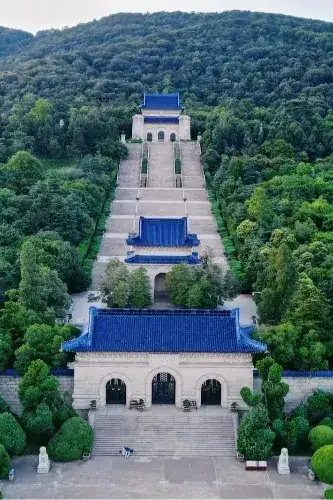
Nanjing has numerous historical sites, including the Tangshan Huludong ancient human fossil site, the Six Dynasties capital ruins, and the Ming Dynasty city wall, which is the longest city wall in China and one of the world's largest brick walls. The Ming Xiaoling Mausoleum is China's best-preserved ancient imperial tomb. Important modern historical sites include the Taiping Heavenly Kingdom Palace, the Presidential Palace, Sun Yat-sen Mausoleum, Yuhuatai Martyrs' Memorial, and the Memorial Hall of the Victims in Nanjing Massacre by Japanese Invaders. As of September 2023, Nanjing has 1 World Cultural Heritage site (Ming Xiaoling), 55 national-level key cultural heritage protection units, 114 provincial-level units, and 11 historical and cultural streets.
Cultural Heritage
As of February 2023, Nanjing has 5 items on the UNESCO Representative List of Intangible Cultural Heritage, 13 national-level representative items, 76 provincial-level items, and 277 municipal-level items.
Folk Customs
Nanjing's folk traditions include lantern festivals, dragon dances, and various regional performances. Traditional customs include climbing city walls, eating black rice, the Wuchang dance, and the Jinling Lantern Festival.
Dialect
Nanjing dialect originally belonged to Wu Chinese, later evolving into Jianghuai Mandarin. During the Ming Dynasty, Nanjing pronunciation became the standard official language. The dialect preserves five tones, including the entering tone from ancient Chinese. Today, both "old Nanjing dialect" and "new Nanjing dialect" coexist, with the latter closer to Mandarin becoming dominant.
Arts
Nanjing is a UNESCO City of Literature, where China's first "literature hall" and foundational works of literary criticism were born. Over 10,000 literary works are closely associated with Nanjing. The city is also a major center for painting and calligraphy, home to the Jinling Painting School. Local performing arts include Nanjing Baiju, Nanjing Baihua, and the Jinling Qin School. Traditional crafts include Nanjing cloud brocade, gold foil, velvet flowers, carved velvet, and gold-lacquered folding fans.
Religion
Nanjing has five major religions: Buddhism, Taoism, Islam, Catholicism, and Protestantism, each with municipal-level religious organizations. Nanjing has over 1,780 years of Buddhist cultural history, being one of the earliest cities in China with Buddhist activity. The Jinling Sutra Engraving Center is the only surviving institution of its kind in China. Nanjing is also the source of Buddhism's introduction to ancient Baekje (Korea) and subsequently Japan. Islam's scripture hall education in Nanjing produced the Jinling School of Islamic scholarship. The Shigu Road Catholic Church is the cathedral of the Catholic Nanjing Archdiocese. The Amity Foundation and Amity Printing Company, the world's largest Bible printing enterprise, are both located in Nanjing.
Scenic Attractions
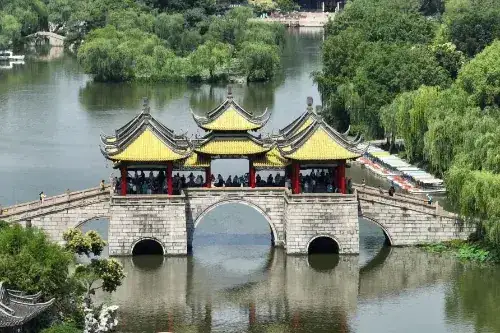
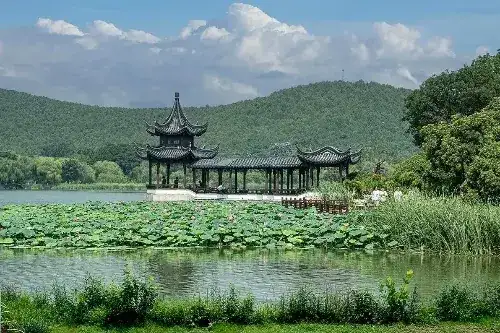
Nanjing has been known since ancient times for its "Forty Scenes of Jinling." As of December 2023, the city has 52 national-rated tourist attractions, including 2 AAAAA-rated and 27 AAAA-rated scenic areas. The Ming Xiaoling Mausoleum is a World Cultural Heritage site. In the first half of 2024, Nanjing received 232,000 inbound overnight tourists, up 83.2%, with tourism foreign exchange earnings of $380 million, up 45.8%.
Local Cuisine
Food Culture
Nanjing's cuisine is known as Jinling cuisine, one of the four representative styles of Jiangsu cuisine. Jinling cuisine originated in the pre-Qin period, gained fame during the Sui and Tang dynasties, formed a distinct school by the Ming and Qing, and peaked during the Republic of China era. It is characterized by rigorous ingredient selection, precise preparation, elegant presentation, and balanced flavors.
Snacks
Local Specialties
Notable local specialties include salted duck, Yuhua tea, and Nanjing cloud brocade.
Notable Figures
External Exchange
As of October 2023, Nanjing has established sister city relationships with 23 international cities. As of 2021, it had established friendly cooperation city relationships with 76 international cities.
Honorary Titles
Travel information can change. Check current opening hours, reservations and entry requirements before you travel.
Traveller discussion
Start the conversation with a helpful tip or a question.