
Heihe City
Heihe CityHeihe City is a prefecture-level city under Heilongjiang Province, China, historically known as Aihui. Located in the northern part of Heilongjiang Province at the eastern end of the Daxing'anling Range and the northern part of th
Heihe City
Heihe City is a prefecture-level city under Heilongjiang Province, China, historically known as Aihui. Located in the northern part of Heilongjiang Province at the eastern end of the Daxing'anling Range and the northern part of the Xiaoxing'anling Range, it features rolling mountainous terrain and a mid-temperate continental monsoon climate, with a total area of 68,726 square kilometers. As of October 2022, the city administers 1 municipal district, 2 counties, and 3 county-level cities. By the end of 2024, the resident population was 1.211 million and the registered population was 1.499 million. Heihe has a long history with archaeological evidence of human activity since the Paleolithic period. On February 8, 1993, Heihe was upgraded from a prefecture to a prefecture-level city. Separated by the main navigation channel of the Heilongjiang River, it faces Blagoveshchensk, capital of Russia's Amur Oblast, directly across the river. The two cities form the largest, highest-ranking, most comprehensive, and closest pair of corresponding cities along the Sino-Russian border, with the nearest point only 750 meters apart. Heihe is rich in cultural resources, including Aihui ancient city ruins, Jin Dynasty city ruins, Sunwu war relics, historical figure activity sites, and ethnic minority cultural attractions. In 2025, Heihe achieved a regional GDP of 74.23 billion yuan (approximately $10.3 billion USD), a year-on-year increase of 4.4% at constant prices.
History
Heihe has a long and rich history. Archaeological evidence confirms human activity since the Paleolithic period, forming the foundation of ancient indigenous peoples. By the late Paleolithic, ancient humans were living and multiplying across the vast Heilongjiang River basin.
In the 16th century BCE, tribes such as the Donghu and Huimo, inhabiting the Nenjiang River basin north of present-day Heihe, maintained tributary relations with the Shang Dynasty. In the early Western Zhou period, the Sushen people of the middle and lower Heilongjiang already paid tribute to the Zhou king. During the Three Kingdoms period, the area belonged to Fuyu.
Under the Tang Dynasty, the middle and lower Heilongjiang was inhabited by the Heishui Mohe. In 725 CE, the Tang court established the Heishui Military Governor's Office, appointing officials directly. In 792 CE, another military governor's office was established to strengthen control over the Shiwei people's territory. Under the Jin Dynasty, the area belonged to Puyu Route under Shangjing Route. Under the Yuan Dynasty, it fell under Kaiyuan Route and Shuidada Route of Liaoyang Province, with many postal relay stations established to connect the interior with the Heilongjiang basin. Under the Ming Dynasty, the Nurgan Regional Military Commission was established, governing the Jurchen and Khitan peoples; most of Heihe's territory was designated as Sahalian territory, also called Heilongjiang territory.
In 1684, the Qing government established the Heilongjiang Yamen in old Aihui City to resist Tsarist Russian aggression. In 1685, the Heilongjiang General's Yamen relocated to new Aihui on the right bank, present-day Aihui Town in Aihui District. In 1690, it moved to Mergen (present-day Nenjiang City). During the Republican era, Heihe was mostly administered by the Heihe Circuit. Japanese forces occupied Heihe on January 25, 1933, and a puppet Heihe Province was established in December 1934. Heihe was liberated in August 1945. After several administrative reorganizations, the State Council decided on February 8, 1993, to dissolve Heihe Prefecture and establish Heihe as a prefecture-level city.
Administrative Divisions
As of October 2022, Heihe administers 1 district (Aihui District), 2 counties (Sunwu County and Xunke County), and 3 county-level cities (Bei'an, Wudalianchi, and Nenjiang), totaling 34 townships (including 7 ethnic minority townships), 567 administrative villages, 70 urban communities, and 74 town communities. The municipal government is seated at No. 2 Tongjiang Road, Aihui District.
Geography
Location
Heihe is situated in China's northeastern frontier in northern Heilongjiang Province, between 47 degrees 42 minutes and 51 degrees 3 minutes north latitude, and 124 degrees 45 minutes and 129 degrees 18 minutes east longitude. It borders Yichun and Suihua to the southeast, Qiqihar to the southwest, Inner Mongolia Autonomous Region across the Nenjiang River to the west, the Daxing'anling Area to the north, and faces Russia's Amur Oblast across the Heilongjiang River to the northeast. The total area is 68,726 square kilometers.
Topography
Heihe sits at the eastern end of the Daxing'anling Range and the northern part of the Xiaoxing'anling Range. The terrain is mountainous with deeply carved valleys, higher in the northwest and gradually descending southeast. Mountainous areas cover approximately 44,225 square kilometers (64.3% of the total), with elevations of 300 to 800 meters. The southern part forms the northern end of the Songliao Plain, covering 24,051 square kilometers (35%).
Climate
Heihe has a mid-temperate continental monsoon climate spanning four accumulated-temperature zones. Springs are warm and windy; summers bring simultaneous rain and heat; autumns cool rapidly; winters are cold and dry. Annual precipitation averages 500 to 550 mm, average temperature ranges from minus 1.3 to 0.4 degrees Celsius (extremes: 38.2 and minus 40 degrees), and the frost-free period lasts 90 to 120 days.
Hydrology
The Xiaoxing'anling Range runs north-south through Heihe, dividing its rivers into the Heilongjiang and Nenjiang systems. There are 631 rivers of various sizes, with 242 having drainage areas exceeding 50 square kilometers. The Heilongjiang River, forming the China-Russia border, has major tributaries including the Fabielazi, Gongbielazi, Xunbielazi, and Kuerbin rivers. The Nenjiang River, forming the border with Inner Mongolia, has tributaries including the Nemoer and Keluo rivers.
Natural Resources
Water Resources
Total surface runoff is 10.594 billion cubic meters, with groundwater reserves of 3 billion cubic meters. The city has 11 hydropower stations with a total installed capacity of 139,900 kW and 99 reservoirs with a total capacity of 2.451 billion cubic meters.
Biological Resources
Heihe is one of Heilongjiang's three key forest areas. Forestry land covers 3.277 million hectares, with forested area of 2.07 million hectares and standing timber stock of 129 million cubic meters, yielding a 48.2% forest coverage rate. Main tree species include Korean pine, Xing'an larch, white birch, and Mongolian oak. Heihe marks the northernmost natural distribution of Korean pine in China. Grasslands cover 905,430 hectares.
Mineral Resources
Heihe has identified 95 mineral types, with 33 having proven reserves. Reserves of 22 minerals, including gold, copper, lead, zinc, tungsten, platinum, iridium, and silver, rank first in the province. Proven coal reserves reach 783 million tons. The Duobaoshan Copper Mine is the largest in Northeast China, and the Cuihongshan iron polymetallic mine is the province's second-largest iron mine.
Population
Population Size
As of end-2024, the resident population was 1.211 million (825,000 urban, 386,000 rural). The registered population was 1.499 million (752,000 male, 747,000 female). Birth rate was 3.1 per thousand, death rate 10.5 per thousand, and natural growth rate minus 7.4 per thousand.
Ethnic Composition
Heihe is home to 44 ethnic groups, including Han, Manchu, Daur, Oroqen, and Ewenki, with ethnic minorities totaling nearly 40,000.
Politics
Current Leadership
Information not available in source material.
Sister Cities
Information not available in source material.
Economy
Overview
In 2025, Heihe's regional GDP reached 74.23 billion yuan (approximately $10.3 billion USD), up 4.4% at constant prices. The primary, secondary, and tertiary sectors grew 3.6%, 1.8%, and 5.8% respectively, with value-added of 23.2 billion, 10.49 billion, and 40.53 billion yuan. After final verification, the 2024 GDP was 71.14 billion yuan (approximately $9.9 billion USD), up 3.3%.
In 2023, the CPI rose 0.8% year-on-year. In 2024, fixed-asset investment grew 5.7%, with primary industry investment surging 150.9%. Public revenue was 5.25 billion yuan (approximately $729 million USD), up 10.2%; public expenditure was 29.07 billion yuan (approximately $4.0 billion USD), up 4.3%.
Primary Industry
In 2024, total agricultural, forestry, animal husbandry, and fishery output was 40.88 billion yuan (approximately $5.7 billion USD), up 4.6%. Grain sowing area covered 27.969 million mu, with output of 11.88 billion jin (5.94 million tons), up 2.8%. Soybeans covered 19.821 million mu and corn 7.601 million mu. Livestock slaughtering included 737,000 pigs, 184,000 cattle, and 421,000 sheep. Total meat output was 111,000 tons and aquatic products 21,000 tons.
Secondary Industry
In 2024, industrial value-added above designated scale fell 5.6%, with heavy industry down 6.8% and light industry up 12.7%. Key products included 48,000 tons of beverages (up 18.8%), 23,000 tons of wheat flour (up 35.5%), and 1.449 million tons of coal (down 54.9%). Construction industry output fell 7.1%.
Tertiary Industry
In 2024, total retail sales of consumer goods grew 4.0%. Total import-export value reached 31.35 billion yuan (approximately $4.35 billion USD), up 19.1%, with exports of 6.91 billion yuan and imports of 24.45 billion yuan. Year-end financial institution deposits stood at 167.4 billion yuan (approximately $23.3 billion USD), up 9.9%. Heihe received 21.703 million tourists (up 32.3%), generating tourism revenue of 15.96 billion yuan (approximately $2.2 billion USD), up 86.2%.
Social Affairs
Science and Technology
In 2023, 429 patents were granted, including 26 invention patents, 305 utility models, and 98 designs.
Education
In 2024, full-time higher education enrollment was 13,146; regular secondary schools had 49,458 students; vocational schools 3,420; and primary schools 42,263. Net enrollment rates for primary and junior secondary schools were both 100%.
Culture and Sports
By end-2024, the city had 7 cultural centers, 6 public libraries, 6 broadcasting stations, and 15 sports venues. Athletes won 34 gold, 28 silver, and 27 bronze medals at provincial-level and above competitions.
Healthcare
In 2024, Heihe had 902 health institutions (including 521 village clinics), 64 hospitals, and 72 health centers, with 9,031 beds and 10,903 health professionals, including 4,213 licensed physicians.
Social Security
As of December 2024, 12,898 new urban jobs were created. Urban-rural pension insurance covered 389,000 people, enterprise pension insurance 292,900, unemployment insurance 144,200, urban-rural basic medical insurance 695,600, and employee medical insurance 209,000.
Transportation
Since the 2008 three-year highway construction campaign, Heihe has formed a 2-hour transportation circle. Major highways G202, S301, S310, S311, and S209 converge in the city. The Beihei Railway connects Heihe to Harbin, Qiqihar, Changchun, Shenyang, and Dalian. In 2024, total freight transport was 19.287 million tons (down 2.8%); passenger transport reached 20.117 million trips (up 274.3%).
Heihe Aihui Airport (IATA code HEK), 17 km from downtown, is a 4C-level civil airport with a 2,500-meter runway handling Boeing 737 and Airbus A320 aircraft. Wudalianchi Dedu Airport is another 4C regional airport. Numerous general aviation airports serve the area. On June 10, 2022, the Heilongjiang Bridge, the first cross-border highway bridge between China and Russia, officially opened, along with the Heihe Highway Port. The city also operates hovercraft services across the Heilongjiang River during freeze-thaw periods, transporting approximately 3,000 passengers daily.
History and Culture
Festivals
The Wudalianchi Water Drinking Festival is the grandest local holiday, with three consecutive days off. At midnight on the Dragon Boat Festival, people gather at spring wells to drink holy water believed to bring good fortune and cure ailments. The festival features opening ceremonies, performances, open-air films, Daur folk bonfire dances, cultural exhibitions, and dragon and yangge dances. The Wudalianchi Volcano Ice and Snow Festival runs from New Year's Day to the second day of the second lunar month, featuring ice tours, winter swimming competitions, skiing, and winter fishing.
The China-Russia Cultural Fair builds a platform for bilateral cultural exchange, product exhibition, and project promotion. The 8th edition was held June 22 to 26, 2017, simultaneously in the twin cities of Heihe and Blagoveshchensk.
City Symbols
On May 21, 2023, Heihe released its city symbols: city trees (Sorbus and white birch), city flowers (Rhododendron dauricum and lilac), city song ("Dear Heihe"), and city emblem.
Cultural Relics
On June 13, 2025, the Heihe Cultural Heritage Protection Center announced 37 new anti-Japanese war sites discovered during the Fourth National Cultural Relics Census, including 12 sites related to the Northeast Anti-Japanese United Army, providing physical evidence for studying the history of the Chinese People's War of Resistance.
Scenic Spots
Wudalianchi Scenic Area
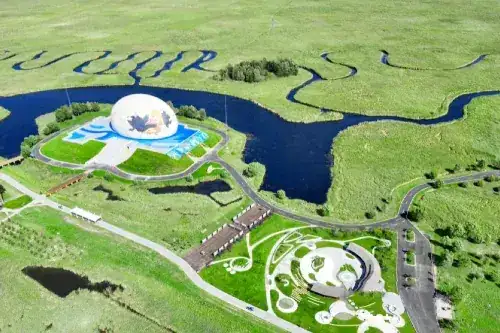
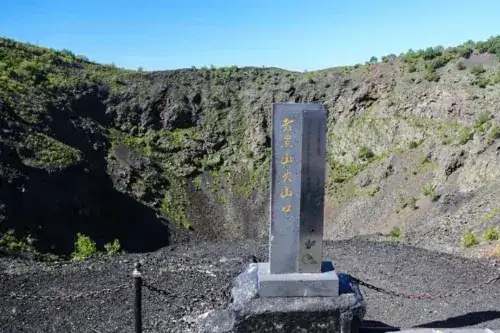
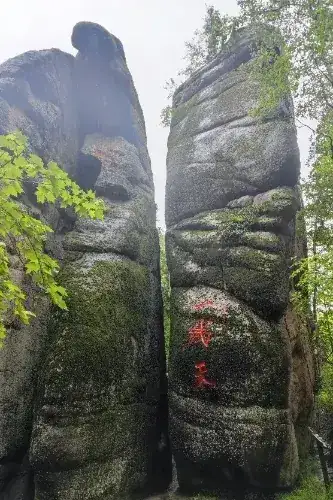
A world geological park, world biosphere reserve, and national 5A-level tourist attraction in northern Heilongjiang, featuring Heilongshan (Black Dragon Mountain), Longmen Stone Fortress, Wenbo (Warm Pool), North and South Springs, and Yaoquan Mountain. It has received numerous honors including World Geopark, National Key Scenic Area, and National Natural Heritage.
Nenjiang Gaofeng Forest Park
Located 9 km south of Nenjiang City, this park features five scenic zones with observation towers, historical ruins, forest bathing areas, and recreational facilities.
Dapingtai Rime Ecological Tourism Area
Near Dapingtai Township in Xunke County along the Kuerbin River, this area features rime formations lasting up to 4 months with daily duration up to 10 hours. The rime forest spans 15 kilometers, covering 300 square kilometers.
Dazhanhe National Forest Park
A national 4A-level scenic area in the northern Xiaoxing'anling Range, featuring over 400 species of wild economic plants across its vast and fertile landscape.
Shankou Lake
A comprehensive water project covering 84 square kilometers with 1 billion cubic meters capacity, serving power generation, flood control, irrigation, tourism, and water supply. It is a national 4A-level tourist attraction and provincial nature reserve, home to 252 vertebrate species and protected birds including red-crowned cranes.
Aihui History Museum
China's only specialized museum dedicated to the comprehensive history of Sino-Russian eastern relations. It is a national 4A-level tourist attraction covering 100,000 square meters with a 3,800-square-meter exhibition hall, situated at the Aihui New City ruins, a national key cultural heritage protection unit.
Specialty Products
Wudalianchi mineral water, Hongxing sauerkraut, Xunke agate, Sunwu sea buckthorn, and Sunwu hemp.
Famous People
Information not available in source material.
Honorary Titles
Information not available in source material.
Travel information can change. Check current opening hours, reservations and entry requirements before you travel.
Traveller discussion
Start the conversation with a helpful tip or a question.