
Shuangyashan City
Shuangyashan CityShuangyashan, also known as the "Coal City," is a prefecture-level city in Heilongjiang Province, located in the northeastern part of the province at the northern foot of Wandashan and the southern edge of the Sanjiang Plai
Shuangyashan City
Shuangyashan, also known as the "Coal City," is a prefecture-level city in Heilongjiang Province, located in the northeastern part of the province at the northern foot of Wandashan and the southern edge of the Sanjiang Plain. It faces Russia across the Wusuli River to the east, between 130°38'57"–134°20'20" E and 45°47'08"–47°34'28" N, with a total area of approximately 22,500 square kilometers. As of December 2024, Shuangyashan administers four municipal districts and four counties, with a total population of 1.346 million. It is an important production base for coal, electricity, chemicals, steel, and grain in Heilongjiang Province, renowned as the "Capital of Black Soil Wetlands, Green Eco-City." The city has a long history dating back to the Shang and Zhou dynasties as the activity area of the Sushen people. The Shuangyashan Mining Bureau was established in 1947, and Shuangyashan City was formally established in 1956. The city is a National Forest City and an important node connecting the Belt and Road Initiative and the China-Mongolia-Russia Economic Corridor. It is the birthplace of China's earliest jade culture and a representative area of Hezhen ethnic culture. Notable scenic areas include Qixingshan National Forest Park and Dadingzi Mountain Forest Park. In 2025, the city achieved a regional GDP of 57.11 billion yuan (approximately $7.9 billion USD), a year-on-year increase of 4.2%.
History
During the Shang and Zhou dynasties, the Shuangyashan area was inhabited by the ancient Sushen people. In the mid-Western Han period, the Sushen were renamed the Yilou. During the Southern and Northern Dynasties, the Yilou became the Wuji, with the area belonging to the Funie tribe. In the Sui dynasty, the Wuji of the eastern Heilongjiang River basin became the Mohe. During the Tang dynasty, the area was part of the Huaiyuan Prefecture of the Bohai State. In the Liao dynasty, it belonged to the Jurchen Five Tribes. During the Jin dynasty, it was under the Huligai Circuit of Shangjing Circuit. In the Yuan dynasty, it was under Kaiyuan Circuit of Liaoyang Province, later transferred to the Shuidada Circuit. During the Ming dynasty, it belonged to the Futi Guard of the Nurgan Regional Commission.
During the Qing dynasty (1644–1912), the area underwent numerous administrative reorganizations. Initially under Shengjing, it was placed under the Ningguta General in 1653, then the Jilin General in 1757. In 1906, Lijiang Prefecture was established, and in 1909, Fujin County was created, incorporating the Shuangyashan area.
During the Republic of China period, the area was administered under Fujin County, Jilin Province. After the September 18 Incident of 1931, northeastern China fell under Japanese occupation. Following Japan's surrender in August 1945, the Hejiang Provincial Government was established in Jiamusi. In 1946, Jixian County was established, and on June 5, 1947, the Shuangyashan Mining Bureau was founded as a provincial enterprise at Lingdong (the former Fu'an Coal Mine).
In 1949, the Mining Bureau relocated from Lingdong to Jianshan. In 1951, it became a state-owned enterprise. In December 1953, the Shuangyashan Mining District was approved as a county-level administrative unit. On May 25, 1956, the State Council formally established Shuangyashan City. In 1958, it was placed under Hejiang Prefecture, and in 1966, it returned to direct provincial administration. In 1980, the Shuangyashan Municipal People's Government was formally established. Since 1987, administrative divisions have been progressively expanded to their current form.
Administrative Divisions
Division Evolution
Administrative divisions evolved gradually from 1953 alongside coal resource development. Districts were renamed and reorganized multiple times: from district offices (1954) to street offices (1956), economic zones (1959), sub-districts (1961), mining district revolutionary committees (1970), district revolutionary committees (1971), and finally district people's governments (1980), with five districts established: Jianshan, Lingdong, Lingxi, Sifangtai, and Baoshan. In 1987, Jixian County was transferred from Jiamusi to Shuangyashan, and Lingdong and Lingxi districts were merged. In 1991, Baoqing and Youyi counties were transferred. In 1993, Raohe County was added.
Division Details
As of December 2024, Shuangyashan administers four municipal districts (Jianshan, Lingdong, Sifangtai, and Baoshan) and four counties (Jixian, Youyi, Baoqing, and Raohe), along with seven state-owned coal mines, twelve state-owned farms, and sixty state-owned forest farms. The municipal government is seated at No. 70 Shiji Avenue, Jianshan District.
Geography
Location
Shuangyashan is located in northeastern Heilongjiang Province, at the northern foot of Wandashan and the southern edge of the Sanjiang Plain, facing Russia across the Wusuli River to the east. It borders Khabarovsk and Bikin (Russia) to the east; Hulin, Mishan, and Huanan to the south; Jiamusi and Qitaihe to the west; and Fujin, Tongjiang, Fuyuan, and Huachuan to the north. The city covers an area of 22,050.927 square kilometers between 130°38'57"–134°20'20" E and 45°47'08"–47°34'28" N.
Topography
The city is situated in a low mountain and hilly area at the northern foot of the Wandashan range, featuring gentle slopes and low peaks with fertile soil supporting broadleaf and coniferous-broadleaf mixed forests. The terrain is higher in the southwest and lower in the northeast, with an average elevation of 450 meters. The southern part is mountainous with elevations of 500–600 meters; the highest peaks are Qixinglazi (852m) and Shi'erdaoban Nanshan (755m). The northern part features rolling hills with elevations of 200–300 meters. The city has 101 peaks of various sizes and five rivers winding through, roughly described as "80% mountains, 5% water, 1.5% farmland."
Climate
Shuangyashan has a mid-temperate humid continental monsoon climate. Winters are cold, dry, and long under polar continental air masses; summers are warm and rainy with concentrated precipitation. Spring is short with rapid warming and frequent winds; autumn is brief with sharp temperature drops and early frost. Raohe County has a semi-maritime climate influenced by the Sea of Okhotsk and the Sea of Japan.
Hydrology
The city has 60 rivers of various sizes, belonging to the Songhua River and Wusuli River systems. Of these, 44 rivers have catchment areas over 50 square kilometers. Major rivers include the Wusuli River, Naoli River, Qixing River, Anbang River, Liushu River, and Hadami River. All river channels are in their mature stage with narrow beds and no natural lakes.
Natural Resources
Water Resources
The city's average annual water resource volume is 3.696 billion cubic meters, including 3.022 billion cubic meters of surface water and 1.363 billion cubic meters of groundwater. There are eight main reservoirs, with the larger ones including Dingguoshan Reservoir (catchment area 250 sq km, storage 5 million cubic meters) and Shanhe Reservoir (catchment area 49 sq km, storage 5 million cubic meters, irrigation capacity 20,000 mu). Groundwater is abundant, mainly carbonate water of good quality, recharged primarily by atmospheric precipitation.
Plant Resources
The forest coverage rate is 40%. The local forestry system has 23 state-owned forest farms with a total forest area of 263,700 hectares and standing timber volume of 17.62 million cubic meters as of 2015. Vegetation is temperate coniferous-broadleaf mixed forest, with main species including larch, Scots pine, Korean pine, spruce, maple, linden, elm, birch, poplar, Manchurian walnut, Manchurian ash, and Amur cork tree. Edible fungi include wood ear, lion's mane mushroom, and hazel mushroom. Wild medicinal plants number over 150 species, with about 60 commonly used, including Schisandra, ginseng, and Gentiana.
Animal Resources
Mammals include Siberian tiger, black bear, red deer, sika deer, roe deer, fox, leopard, lynx, wild boar, badger, and otter, most of which are protected species. Bird species total over 70, including magpie, crow, wild goose, mandarin duck, cuckoo, pheasant, owl, and wild duck. Fish include carp, crucian carp, loach, and grass carp.
Mineral Resources
Over 50 types of minerals have been discovered, with 12 having verified reserves across 69 deposits and 223 mineral occurrences. These fall into four categories: energy minerals (coal, including anthracite, bituminous coal, and lignite), metallic minerals (iron, tungsten, gold), non-metallic minerals (graphite, feldspar, limestone, granite, marble, peat), and hydro-gas minerals (mineral water). Additional building materials include granite, gabbro, basalt, sandstone, and clay, with scattered occurrences of copper, lead, zinc, and tin.
Population
As of end-2022, the permanent resident population was 1.170 million, with 810,000 urban and 360,000 rural residents, and an urbanization rate of 69.2%. As of end-2023, the registered population was 1.3460 million, down 12,200 year-on-year, with an urbanization rate of 63.95%. Those aged 0–17 accounted for 9.34% and those aged 60+ for 29.52%. The birth rate was 2.65 per thousand, death rate 5.96 per thousand, and natural growth rate -3.31 per thousand. The city has 36 ethnic minorities totaling 30,126 people (2.49% of the population), predominantly Manchu, Korean, Hui, Mongol, Hezhen, Miao, Zhuang, and Xibe.
Politics
Current Leadership
The city is governed by the Municipal Party Committee and Municipal People's Government under the leadership of the Heilongjiang Provincial Party Committee and Provincial Government.
Friendly Cities
Shuangyashan maintains friendly city relations with several domestic and international cities.
Economy
Overview
In 2025, the city's GDP reached 57.11 billion yuan (approximately $7.9 billion USD), up 4.2% year-on-year. The primary, secondary, and tertiary sectors contributed 20.40 billion yuan (approximately $2.8 billion USD), 11.47 billion yuan (approximately $1.6 billion USD), and 25.24 billion yuan (approximately $3.5 billion USD), respectively. In 2024, GDP was 55.74 billion yuan (approximately $7.7 billion USD), up 3.4%, with the three sectors contributing 19.61 billion, 11.94 billion, and 24.18 billion yuan respectively.
Primary Industry
In 2024, total agricultural, forestry, animal husbandry, and fishery output was 33.21 billion yuan (approximately $4.6 billion USD), up 3.3%. Grain output reached 6.27 million tons, with rice, corn, and soybean at 2.41 million, 3.23 million, and 625,000 tons respectively. The planting area was 1.5521 million mu. Livestock included 549,000 slaughtered pigs, 41,000 cattle, and 138,000 sheep. Agricultural machinery power reached 2.47 million kilowatts with a comprehensive mechanization rate of 98.77%.
Secondary Industry
In 2024, above-scale industrial value-added grew 7.4% year-on-year. Total profits reached 1.20 billion yuan (approximately $166 million USD), down 16.7%. The six major industries—coal, electricity, steel, grain processing, coal chemical, and building materials—saw combined value-added growth of 9.7%. Coal grew 8.7%, steel surged 27.5%, and coal chemical increased 27.2%. Construction output was 1.79 billion yuan (approximately $247 million USD), down 14.9%.
Tertiary Industry
In 2024, total retail sales of consumer goods reached 9.90 billion yuan (approximately $1.37 billion USD), up 7.6%. Insurance premium income was 4.094 billion yuan (approximately $565 million USD), up 5.27%. Total import-export value was 3.0 billion yuan (approximately $414 million USD), up 7.5%. Contracted foreign investment was $11.15 million and actual utilized foreign investment $7.48 million. Domestic capital utilized reached 27.28 billion yuan (approximately $3.76 billion USD), up 44.1%. Fixed asset investment grew 15.6%. As of end-2024, financial institution deposits reached 164.14 billion yuan (approximately $22.6 billion USD) and loans 113.14 billion yuan (approximately $15.6 billion USD).
Social Affairs
Science and Technology
In 2024, the city launched the "Light of Enterprise" science and technology innovation action plan. National high-tech enterprises reached 36. Three technology roadshows were held, 11 achievements were commercialized, and technology transaction volume reached 218 million yuan (approximately $30 million USD).
Education
As of 2024, the city has 323 basic education and secondary vocational schools with 97,970 students and 13,003 staff. This includes 174 kindergartens, 122 compulsory education schools (62 primary, 41 junior high, 19 nine-year), 17 regular high schools, 7 secondary vocational schools, and 3 special education schools.
Culture
As of end-2024, the city's nine comprehensive archives hold 434,579 volumes. Radio and television coverage both reach 100%. China Broadcasting Shuangyashan Branch had 48,000 cable digital TV subscribers and 7,600 5G users. Shuangyashan Daily published 3.64 million copies in 2024.
Healthcare
As of end-2024, the city has 1,081 healthcare institutions, including 26 secondary-and-above facilities (3 tertiary, 23 secondary), 36 first-level hospitals, 992 grassroots institutions, and 19 professional public health institutions. Total beds number 10,580, with 10,155 healthcare personnel including 3,817 physicians and 4,479 registered nurses.
Sports
In 2023, the city hosted youth short-track speed skating competitions and winter sports activities involving 41 communities and 11,325 participants. In 2024, events included the Baoqing Marathon and the China-Russia Youth Volleyball Invitational, with 158 mass sports events attracting 55,569 participants.
Social Security
In 2024, 700,400 people participated in basic pension insurance, 247,900 in urban-rural pension insurance, 178,700 in unemployment insurance, and 197,200 in work injury insurance. Basic medical insurance covered 861,400 people. Welfare institutions provided 6,554 beds with 3,131 residents. Urban low-income assistance covered 30,709 people, rural 32,574, with 7,912 temporary assistance cases.
Transportation
Overview
In 2024, total freight volume reached 12.41 million tons (12.40 million by road, 11,400 by water), and passenger volume 17.41 million (17.40 million by road, 16,700 by water). Highway mileage totaled 4,199.7 kilometers.
Highways
As of 2010, the city had 34 high-grade roads with total highway mileage of 4,962.4 km. The Shuangjia Expressway (2008) and Shuangtong Expressway (2010) are major arteries. Shiji Avenue, the city's main thoroughfare, is 44 meters wide and 3.4 km long with two overpasses. The Hongqiao Highway Long-distance Bus Station (national first-class) covers 24,000 square meters.
High-Speed Rail
The Mudanjiang-Jiamusi High-Speed Railway opened on December 6, 2021, reducing travel time from Shuangyashan to Harbin from 12 hours to 3.5 hours.
Railways
One national railway line runs through the city, extending 79 km westward to Jiamusi. Shuangyashan Station is a first-class passenger station under the Harbin Railway Bureau, with direct trains to Beijing, Dalian, and Harbin. The Mining Group operates eight urban rail lines.
Public Transportation
As of 2010, the city had 2,100 taxis (Jetta and similar 1.6L+ models), all GPS-equipped. Fares start at 6 yuan for the first 2.5 km, then 1.6 yuan/km up to 12 km, and 1.9 yuan/km beyond.
Scenic Spots
Qingshan National Forest Park (AAAA): Located in Lingdong District, 18 km from the city center, covering 28,485 hectares with 82% forest coverage. Attractions include Jiufeng Zen Temple, Pudu Temple, Shifo Mountain, Xingyue Lake, and a sunshine beach.
Anbang River National Wetland Park (AAAA): Located in Jixian County, 54 km from the city center, covering 310 hectares. Features include the wetland education center, cultural corridor, Beidahuang folk customs exhibition, wildlife rescue center, lotus lake, and boat docks.
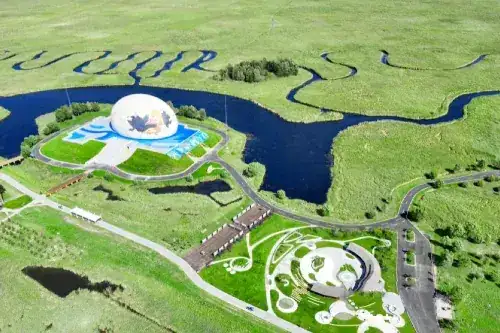
Yanwo Island Wetland Eco-Tourism Area (AAAA): Located in Baoqing County, 200 km from the city center. Built around the Yanwo Island wetland, it includes an eco-museum, winding corridors, water park, and Beidahuang Spirit Education Hall. The site also has a stone inscribed by Dong Biwu and 800-year-old Jurchen ruins.
Qianniao Lake Tourist Resort (AAAA): Located in Raohe County, 300 km from the city center. Features a central square, flower gardens, picking garden, observation deck, and boat docks. Designated as a national natural ecological reserve in 2002.
Dadingzi Mountain Forest Park (AAA): Located 19 km northwest of Raohe County town, with a peak elevation of 801 meters—the second highest in Raohe. Famous for its Azalea blossoms, particularly the Xing'an rhododendron.
Youyi Museum (AAA): Located in Youyi County, 54 km from the city center, with 4,000 sq m building area and 2,500 sq m exhibition space. Showcases Yilou people history, the construction of Youyi Farm with Soviet assistance, and the Beidahuang reclamation spirit.
Famous People
Shuangyashan has produced notable figures throughout its history, particularly in mining, agriculture, and cultural fields.
Honorary Titles
Shuangyashan has been designated as a National Forest City and is recognized as the "Capital of Black Soil Wetlands, Green Eco-City."
Travel information can change. Check current opening hours, reservations and entry requirements before you travel.
Traveller discussion
Start the conversation with a helpful tip or a question.