
Hegang City
Hegang CityHegang is a prefecture-level city in Heilongjiang Province, China, located in the northeastern part of the province. It is connected to Tongjiang City by the Songhua River to the east, borders Yichun City to the west, shares a bo
Hegang City
Hegang is a prefecture-level city in Heilongjiang Province, China, located in the northeastern part of the province. It is connected to Tongjiang City by the Songhua River to the east, borders Yichun City to the west, shares a boundary with Tangyuan County of Jiamusi City to the south, and faces Russia across the Heilongjiang (Amur) River to the north. The total area is 14,700 square kilometers, comprising two border counties (Suibin and Luobei) and six municipal districts (Dongshan, Xing'an, Xiangyang, Gongnong, Nanshan, and Xingshan). As of end-2023, the registered population was 935,000, and the local dialect is Northeastern Mandarin. Hegang is situated in the low mountain and hilly terrain at the eastern foot of the Xiaoxing'anling (Lesser Khingan) range and in the plains where the Songhua and Heilongjiang rivers converge. The terrain slopes from high northwest to low southeast, with four landform types: low mountains and hills, rolling ridges, plains, and valleys with floodplains. Except for the Jiayin River (part of the Heilongjiang system), all rivers belong to the Songhua River system, including 18 major rivers such as the Wutong and Heli rivers. The city has a mid-temperate continental monsoon climate with an average annual temperature of 1-4.6 degrees Celsius.
Hegang was established as part of Tangyuan County in 1905, became Xingshan Town in 1929, was founded as a city in 1945 under the name Xingshan, and was renamed Hegang in November 1949. It was transferred to Heilongjiang Province in 1954, upgraded to a prefecture-level city in 1960, and placed under direct provincial administration in 1966. Hegang is a city that rose through coal mining -- one of the birthplaces of Heilongjiang River basin civilization, a regional center in northeastern Heilongjiang, an important energy industrial city, and a key gateway for opening to Russia. Its unique location makes it an important economic area in the northern Sanjiang Plain, known as the "Golden Triangle." In 2024, Hegang's GDP reached 37.63 billion yuan (approximately $5.23 billion USD), with the primary industry at 9.53 billion yuan, secondary industry at 8.39 billion yuan, and tertiary industry at 19.71 billion yuan.
Historical Evolution
Since ancient times, Hegang has been home to Chinese ancestors.
- Zhou Dynasty: Territory of the Sushen people.
- Tang Dynasty: Under Hebei Circuit's Heishui Duhufu.
- Liao Dynasty: Part of Dongjing Circuit's Wuwei Yuque tribe.
- Jin Dynasty: Under Shangjing's Huligai Route.
- Yuan Dynasty: Under Liaoyang Province's Jurchen Shuidada Route.
- Ming Dynasty: Within the Nurgan Regional Commission.
- Qing Dynasty: Under the Heilongjiang General's Hulan Deputy Lieutenant. In 1905, Tangyuan County was established. In 1906, the area east of the Hua'er River and west of the Wutong River was designated the "He Section."
During the early Republic of China, Hegang belonged to Suilan Circuit, Tangyuan County, Heilongjiang Province. In April 1946, it came under Hejiang Province; in October, transferred to Heli County. In 1947, placed under the Fourth Commissioner's Office of Hejiang Province. In 1948, under Hejiang Provincial Government.
In May 1949, Hejiang Province merged into Songjiang Province, and Xingshan City was renamed Hegang City. In 1954, Songjiang Province merged into Heilongjiang Province. In 1958, Hegang came under the Hejiang Commissioner's Office. In September 1958, the Hegang People's Commune was established. In December 1960, Hegang was upgraded to a prefecture-level city with 9 districts. In 1962, Xinhua District was abolished. In February 1966, Hegang was placed under direct provincial administration. In November 1987, Luobei and Suibin counties were transferred to Hegang.
Administrative Divisions
As of October 2022, Hegang has 8 county-level administrative divisions: 6 municipal districts (Xiangyang, Gongnong, Nanshan, Xing'an, Dongshan, Xingshan) and 2 counties (Luobei, Suibin). The municipal government is at No. 1 Youyi Road, Xiangyang District.
Geographical Environment
Location and Extent
Hegang is located in northeastern Heilongjiang Province at the eastern foot of the Xiaoxing'anling range. Geographic coordinates: 129 degrees 39 minutes 50 seconds to 132 degrees 31 minutes 00 seconds East, 47 degrees 03 minutes 30 seconds to 48 degrees 21 minutes 00 seconds North. Total area: 14,684 square kilometers; urban area: 4,575 square kilometers.
Topography
The terrain slopes from high northwest to low southeast, transitioning from the Sanjiang Plain to the Xiaoxing'anling mountains. The northwestern mountainous area covers 3,300 square kilometers (72% of the urban area) and is the primary forest zone. Major peaks: Xiaobaishan (1,022 m), Jiefangshan (964 m), Beiyingshan (897 m), Motianling (846 m), and Jindingshan (840 m), with 34 additional peaks above 200 m. Eighteen major rivers flow from northwest to southeast. The southeastern plains are the main agricultural zone. Luobei County has mountains in the northwest and marshes in the southeast. Suibin County, at the confluence of the Songhua and Heilongjiang rivers, is entirely flat at 52-63 m elevation.
Hydrology
The city has 18 major rivers including the Wutong, Heli, Alingda, and Jiayin. It borders the Songhua River to the east and the Heilongjiang River to the north.
Climate
Hegang has a northern temperate continental monsoon climate. Average annual temperature: 3.8 degrees Celsius; extremes: 37.7 degrees Celsius (max) and -34.5 degrees Celsius (min). Average annual precipitation: 651.5 mm. Average frost-free period: 147 days. Winters are cold and long; springs are dry and windy; summers have concurrent rain and heat; autumns see early frost.
Natural Resources
Water Resources
Water area covers 109,500 hectares with two boundary rivers and 112 rivers of various sizes. Average annual runoff: 3.05 billion cubic meters. Total utilizable water resources: 2.675 billion cubic meters (surface: 718 million cubic meters; groundwater: 1.957 billion cubic meters). The city has 12 reservoirs.
Plant Resources
Over 80 valuable medicinal herbs (ginseng, schisandra, goji, astragalus), 40+ wild vegetable species, and 20+ wild fruit species. Forest area: 850,000 hectares (58% of total area), with timber reserves of 52.57 million cubic meters and annual production of approximately 270,000 cubic meters.
Animal Resources
Over 30 species including sika deer, musk deer, wild boar, brown bear, marten, and red-crowned crane. Honey resources: 250,000 kg annually. Fish farming covers 50,000 mu with annual production of 6,276 tons. Sturgeon and huso sturgeon yield approximately 15 tons annually.
Mineral Resources
Thirty mineral types discovered (22.9% of provincial total), with 24 proven reserves (31.17%). Coal, graphite, and cement-grade marble are the dominant minerals.
Population
As of end-2023, Hegang's registered population was 935,000, with 756,000 urban residents.
Politics
No detailed content available in source.
Economy
Overview
In 2024, Hegang's GDP was 37.63 billion yuan (approximately $5.23 billion USD), down 2.9% year-on-year. Primary industry: 9.53 billion yuan (up 3.8%); secondary industry: 8.39 billion yuan (down 21.7%); tertiary industry: 19.71 billion yuan (up 3.4%).
In 2023, CPI rose 0.5%. Urban per capita disposable income: 28,712 yuan (approximately $3,990 USD), up 5.1%; rural: 21,413 yuan (approximately $2,974 USD), up 5.9%. Average wage for urban non-private sector employees: 79,501 yuan (approximately $11,042 USD).
Fixed asset investment fell 29.9%. Total fiscal revenue: 5.91 billion yuan (approximately $821 million USD), up 9.1%; general public budget revenue: 3.22 billion yuan (approximately $447 million USD), up 4.7%. General public budget expenditure: 13.69 billion yuan (approximately $1.90 billion USD), up 1.6%.
Primary Industry
In 2023, total agriculture, forestry, animal husbandry, and fishery output: 20.58 billion yuan (approximately $2.86 billion USD), up 3.5%. Grain planted on 8.401 million mu, total output: 3.22 million tons. Pig slaughter: 741,000 head (up 2.1%); cattle: 26,000 head (up 16%); sheep: 53,000 head (up 8.6%); poultry: 66.2 million head (up 5.9%).
Secondary Industry
In 2023, industrial value-added above designated size fell 0.5%. Coal mining grew 1.6%, power and heat supply grew 3.3%, non-metallic mining grew 27%. Raw coal: 13.179 million tons (down 2.5%); washed coal: 8.341 million tons (down 10.9%); fertilizer: 315,000 tons (up 12.2%). Industrial revenue: 29.09 billion yuan (approximately $4.04 billion USD), down 20%; profit: 860 million yuan (approximately $119 million USD). Construction output: 2.33 billion yuan (approximately $324 million USD), down 14.1%.
Tertiary Industry
In 2023, total retail sales of consumer goods: 9.59 billion yuan (approximately $1.33 billion USD), up 7.7%. Postal and telecommunications revenue: 970 million yuan (approximately $135 million USD), up 5.4%. Financial institution deposits: 119.2 billion yuan (approximately $16.56 billion USD), up 8.6%; loans: 65.9 billion yuan (approximately $9.15 billion USD), down 1.8%. Insurance premiums: 3.25 billion yuan (approximately $451 million USD); claims: 1.117 billion yuan (approximately $155 million USD).
Social Affairs
Education
In 2023: 1 full-time university (4,500 students), 8 vocational schools (3,125 students), 51 middle schools (30,903 students), 33 primary schools (26,701 students), 2 special education schools (211 students), 133 kindergartens (10,558 children).
Culture
9 cultural centers, 5 museums, 2 theaters, 3 public libraries (617,360 volumes), 1 professional arts troupe (43 performances, ~50,000 audience), 305 community arts groups (897+ performances, 263,883 audience). Radio coverage: 100%; TV coverage: 95%.
Healthcare
650 health institutions (43 hospitals, 21 health centers, 4 maternal/child centers). Total beds: 8,599. Licensed physicians: 3,147. Disease prevention centers: 9 (162 staff).
Sports
1 sports arena, 1 fitness center, 3 training halls, 22 full-time coaches, 632 registered athletes, 280 certified referees. 4 competitive events (1,306 athletes) and 30 fitness events held.
Social Security
In 2023, pension insurance covered 197,700 people; work injury insurance 121,600; unemployment insurance 89,000. The city had 112 eldercare institutions with 6,581 beds serving 3,050 seniors (31 private, 3,108 beds, 1,646 seniors).
Transportation
In 2023, highway freight: 8.97 million tons; railway freight: 2.058 million tons; passengers: 2.31 million (highway) and 902,000 (railway). The city had 153,000 motor vehicles. Three major highways connect to Harbin (4 hours), Luobei port (1 hour), and Jiamusi Airport (under 1 hour). The G11 Hegang-Harbin Expressway was approved in 2022. Rail access requires transfer through Jiamusi or Harbin; a direct Hegang-Tianjin train opened in 2009.
Hegang is a national gateway to Russia along the China-Mongolia-Russia economic corridor. The Luobei port, a national first-class port with 500,000-ton annual capacity, is 1.5 km from Russia's Amurzet port -- 7 minutes by boat in open water, 5 minutes by vehicle when frozen. The Heilongjiang golden waterway accommodates 5,000-ton vessels, enabling river-sea transport to the Sea of Japan and onward to South Korea and Japan.
Scenic Spots
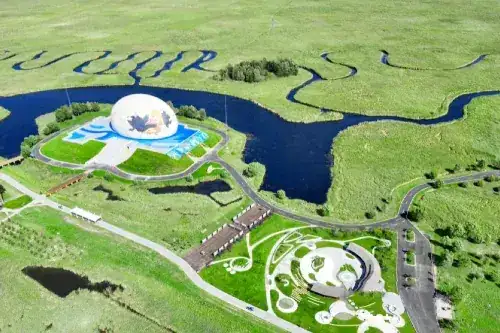
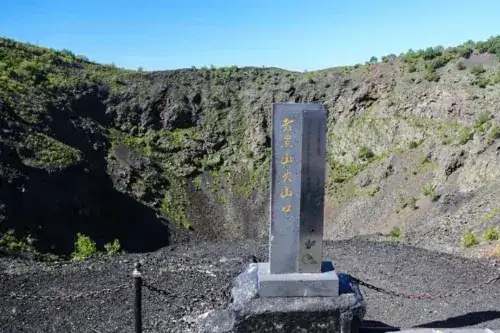
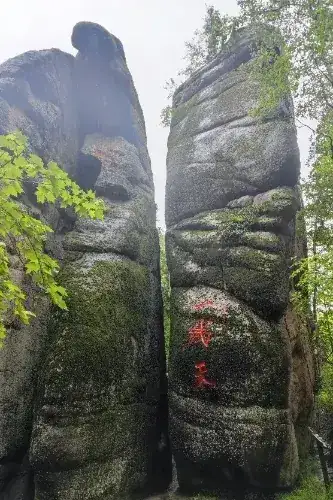
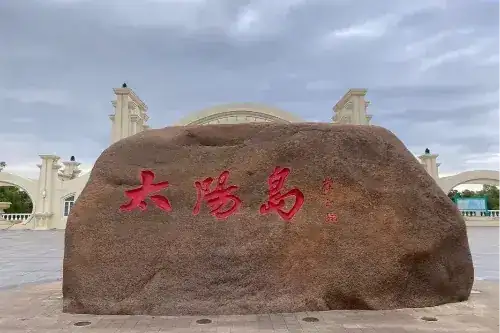
Notable attractions include the China-Russia Heilongjiang Three Gorges, Hegang National Mining Park, and the Tongzigou primeval Korean pine forest.
Famous People
No entries listed in source.
Honorary Titles
No entries listed in source.
Travel information can change. Check current opening hours, reservations and entry requirements before you travel.
Traveller discussion
Start the conversation with a helpful tip or a question.