
Jixi City
Jixi CityJixi City is a prefecture-level city in Heilongjiang Province, China, named after its location at the western foot of Jiguan Mountain. Located in southeastern Heilongjiang, it lies in the heart of the Sanjiang Plain, one of the wor
Jixi City
Jixi City is a prefecture-level city in Heilongjiang Province, China, named after its location at the western foot of Jiguan Mountain. Located in southeastern Heilongjiang, it lies in the heart of the Sanjiang Plain, one of the world's three major black soil belts, with a total area of 22,500 square kilometers. As of February 2024, the city administers 6 municipal districts, 1 county, and 2 county-level cities. The Jixi dialect belongs to the Jiaoning sub-dialect of the Jishen branch of Northeastern Mandarin. As of the end of 2024, Jixi had a registered population of 1.5932 million. The terrain consists mainly of mountains, hills, and plains, described as "four parts mountain, one part water, one part grassland, four parts farmland," with a mid-temperate continental monsoon climate and four distinct seasons. As early as 6,000 years ago, the Sushen people lived and multiplied here, creating the ancient Xinkailiu fishing and hunting culture. During the Tang Dynasty, Jixi formally came under central administration when the Balhae Kingdom established Dongping Prefecture here (headquartered in present-day Mishan City). On December 18, 1956, the State Council approved the establishment of Jixi City (prefecture-level) under direct Heilongjiang provincial administration. Jixi is also known as the "Coal City" and "Graphite Capital," and is a designated national energy base. Its graphite concentrate output accounts for about one-third of the national total (as of May 2026). Xingkai Lake, the Sino-Russian boundary lake, is the largest freshwater boundary lake in Asia. The Xingkai Lake, Zhenbao Island, and Dongfanghong wetlands are listed as internationally important wetlands. In 2025, Jixi achieved a regional GDP of 64.85 billion yuan (approximately $9 billion USD), a year-on-year increase of 3.7% at constant prices.
Name Derivation
Origin of the Name
Jixi City is named after its location at the western foot of Jiguan Mountain. On September 1, 1941, the puppet Dongan Province of Manchukuo established Jining County at Jixi Street. On May 1, 1949, Jining County was placed under Songjiang Province, and on July 30 of that year, it was renamed Jixi County.
Folk Legends
Long ago, Jixi was an unknown place plagued by a giant turtle spirit that caused havoc. One day, a rooster arrived and bravely fought the turtle spirit. The turtle was defeated, but the rooster, having exhausted its strength, perished. Its body became the earth, its head became Jiguan Mountain, and its blood became the Muling River. To commemorate the rooster, the people called the western side of Jiguan Mountain "Jixi" (literally "rooster west") and the eastern side "Jidong" ("rooster east").
History
The Jixi area has been inhabited since pre-Qin times. During the Warring States period (300 BCE), the State of Yan established commanderies including Liaodong, under which Jixi fell. Under the Qin and Han dynasties, the area continued under Liaodong commandery. During the Northern Wei period (386 CE), the area was governed by the Funie tribe of the Wuji people along the Muling River basin.
During the Sui and Tang dynasties, the Sumo Mohe chief Da Zuorong established the Zhen Kingdom in 698 CE, later renamed the Balhae Kingdom. Jixi was part of Dongping Prefecture under Balhae. The area subsequently came under Khitan (Liao), Jin, and Yuan dynasty administration.
During the Ming Dynasty (1368), Jixi was under the Nurgan Regional Military Commission. Under the Qing Dynasty, it was administered through the Ningguta Vice-Commandant. In 1907, the Qing government converted Manchuria's military-general system to provincial administration, and in 1908, established Mishan Prefecture, which governed Jixi area villages.
During the Republic of China period, administrative reorganizations repeatedly changed Jixi's affiliations. Under Japanese occupation (1931-1945), puppet provinces were established, and in 1941, Jining County was created at Jixi Street. After Japan's surrender in 1945, the area came under the Hejiang provincial government. In 1949, Jining County was renamed Jixi County under Songjiang Province.
After the Founding of New China
On October 1, 1949, Jixi County came under Songjiang Province. In 1954, Songjiang and Heilongjiang provinces merged. On December 18, 1956, the State Council approved the establishment of Jixi City (prefecture-level) under Heilongjiang Province. In 1964, Jidong County was carved from parts of Jixi, Mishan, and Boli counties. In 1992, Mishan City was placed under Jixi's administration, followed by Hulin County in 1993. In 1996, Hulin County became Hulin City (county-level).
Physical Geography
Location
Jixi is located in southeastern Heilongjiang, bordered by Russia to the east across the Ussuri River and Songacha River, adjacent to Mudanjiang to the west and south, and connected to Qitaihe to the north. It sits at the intersection of the Laoye and Zhangguangcai ranges of the Wandashan Mountains. Geographic coordinates: 130 degrees 24 minutes to 133 degrees 56 minutes east longitude, 44 degrees 51 minutes to 46 degrees 36 minutes north latitude. The maximum east-west span is 275 km and the maximum north-south span is 192.5 km. The total area is 22,500 square kilometers.
Topography
The terrain features mountains, hills, and plains, described as "four parts mountain, one part water, one part grassland, four parts farmland." Low mountains and hills (400-600 m elevation, highest peak 880.6 m) occupy the north, west, and south. The central basin tilts northeastward, with valley plains (180-300 m elevation) along the Muling and other rivers providing fertile agricultural land.
Climate
Jixi has a mid-temperate continental monsoon climate. The average annual temperature is 3.7 degrees Celsius, average annual precipitation 537.5 mm, annual sunshine 2,709 hours, and the frost-free period averages 147 days. Summers are short with concentrated rainfall; winters are cold, long, and dry. Summer precipitation accounts for over 60% of the annual total.
Hydrology
The Muling River, Jixi's largest river, flows 691.5 km total (457.7 km within Jixi). The city has 1 river (the Ussuri, a Sino-Russian boundary river), 112 streams, 2 lakes, 87 reservoirs, and 104 ponds. Xingkai Lake, shared with Russia (two-thirds Russian, one-third Chinese), is the largest freshwater boundary lake in Asia. There are 48 reservoirs including the Hadabe Reservoir, completed in 1971 for irrigation with a capacity of 94.6 million cubic meters.
Soil
Jixi has 9 soil types. Dark brown forest soil covers 748,000 hectares (39.9%), albic soil 565,000 hectares (30.1%), bog soil 200,000 hectares (10.6%), meadow soil 100,000 hectares (5.3%), river alluvial soil 96,000 hectares (5.1%), and paddy soil 44,000 hectares (2.3%).
Natural Resources
Water Resources
The Muling River and Xingkai Lake are the largest water bodies. Total water resources amount to 539.3 billion cubic meters, with groundwater reserves of 9.84 billion cubic meters and exploitable reserves of 940 million cubic meters.
Land Resources
Total land area is 22,453 square kilometers, including 554,000 hectares of arable land (30.9%). The fertile land produces rice, wheat, corn, soybeans, tobacco, and sugar beets, favoring green and specialty agriculture.
Mineral Resources
Jixi has 25 proven mineral resources, with 11 currently being developed. Key resources include coal (proven reserves 6.578 billion tons, a major national coal base), graphite (proven reserves 976 million tons, about 32.6% of Heilongjiang's total, ranking among the world's largest), sillimanite (38.648 million tons), potassium feldspar (176 million tons), and marble (595 million tons).
Biological Resources
Jixi has 706,900 hectares of forest with 36.27 million cubic meters of standing timber and 29.8% forest coverage. There are 691 species of higher plants (including 9 national Class II protected species) and 231 wild medicinal herbs such as perilla, acanthopanax, schisandra, and scutellaria. The city has 360 vertebrate species including 41 mammals, 68 fish, and 238 birds. Protected species include sable (Class I) and red-crowned crane (Class I bird). There are 16 nature reserves and forest parks totaling 803,980 mu.
Administrative Divisions
As of February 2024, Jixi administers 6 districts (Jiguan, Hengshan, Didao, Lishu, Chengzihe, and Mashan), 1 county (Jidong), and 2 county-level cities (Hulin and Mishan), with 48 townships and 459 villages. The municipal government is located at 18 Hongqi Road, Jiguan District.
Population
Population
According to the 7th National Census (November 2020), Jixi had a resident population of 1,502,060, with males accounting for 50.40% and females 49.60%. This represented a decrease of 360,105 (down 19.34%) from the 2010 census. As of the end of 2024, the registered population was 1.5932 million, including 1.0006 million urban residents. The birth rate was 2.78 per thousand, death rate 6.93 per thousand, and natural growth rate minus 4.15 per thousand.
Ethnic Groups
Jixi is home to 37 ethnic minorities totaling 94,000 people, with the Korean ethnic group being the largest (47,000+), followed by the Manchu (30,000+).
Language
The Jixi dialect is classified as the Jiaoning sub-dialect of the Jishen branch of Northeastern Mandarin in the Language Atlas of China (2nd edition).
Politics
Administrative and political governance follows the standard Chinese prefecture-level city system, with the municipal People's Congress and People's Government as the primary governing bodies.
Economy
Overview
In 2024, Jixi achieved a regional GDP of 62.26 billion yuan (approximately $8.6 billion USD), a decrease of 1.1% year-on-year at constant prices. By sector: primary industry 20.26 billion yuan (+2.2%, 32.5% of GDP); secondary industry 11.62 billion yuan (down 16.1%, 18.7%); tertiary industry 30.38 billion yuan (+4.0%, 48.8%). General public budget revenue was 5.14 billion yuan (approximately $715 million USD, +3.4%). Fixed asset investment declined 8.2%, though equipment purchases surged 92.2% driven by government stimulus policies.
Primary Industry
In 2024, the total output of agriculture, forestry, animal husbandry, and fisheries was 32.02 billion yuan (approximately $4.5 billion USD, +2.5%), with all sub-sectors showing stable growth.
Secondary Industry
Industrial output declined 23.2% and value-added fell 23.9% in 2024. Manufacturing grew 21.2%, while mining fell 39.8%. Jixi has positioned graphite as a pillar industry, building toward a 10-billion-yuan-scale (approximately $1.4 billion USD) production base. As of May 2026, the city hosts 66 graphite enterprises (30 above-scale), with concentrate output accounting for about one-third of the national total. Nine industry chains have been established covering green mining, energy storage materials, and refractory materials.
Tertiary Industry
In 2024, total retail sales of consumer goods reached 24.13 billion yuan (approximately $3.4 billion USD, +2.5%). Foreign trade totaled 6.2 billion yuan (approximately $860 million USD), with exports of 4.97 billion yuan (down 49.1%) and imports of 1.23 billion yuan (+128.9%). Financial institution deposits reached 193.32 billion yuan (approximately $27 billion USD, +6.3%) and loans 107.55 billion yuan (approximately $15 billion USD, +3.8%).
Social Services
Education
As of the end of 2023, Jixi had 1 university (10,430 students), 1 technical school, 8 vocational schools, 20 senior high schools, 76 junior high schools, 52 primary schools, 3 special education schools, and 311 kindergartens.
Science and Technology
Jixi had 20 scientific research institutions, 52 inspection and testing organizations, and 493 patent grants in 2023.
Healthcare
The city had 1,086 medical and health institutions (including 63 hospitals and 46 township health centers), 13,533 beds, and 12,524 health professionals, including 4,814 licensed (assistant) physicians and 5,609 registered nurses.
Culture
Jixi had 1 performing arts troupe, 12 cultural centers, 4 public libraries, 12 museums, and 48 township cultural stations. Radio coverage reached 99.98% of the population.
Sports
In 2023, Jixi athletes won 88 medals at provincial-level and above competitions, including 32 gold, 28 silver, and 28 bronze.
Social Security
As of the end of 2023, Jixi had 126 elderly care institutions with 10,244 beds, 133 urban community service stations, and welfare lottery sales of 131.84 million yuan.
Transportation
Overview
Jixi shares a 641-km border with Russia, with two national-level land ports (Mishan and Hulin) handling 3.1 million tons of cargo and 1.6 million passengers annually. The Xingkai Lake Airport operates routes to Beijing, Shanghai, Guangzhou, and other cities. In 2023, total freight transport was 32.083 million tons (+5.9%) and passenger transport 15.083 million (+8.5%).
Highways
Jixi is a junction of the Heda Expressway (Hegang-Dalian), Jianji Expressway, and Fanghu Highway. Long-distance buses reach Beijing, Dalian, Shenyang, Qingdao, Harbin, Changchun, and Ussuriysk (Russia).
High-Speed Rail
The Mudanjiang-Jiamusi high-speed railway opened on December 6, 2021, with Jixi West Station entering simultaneous service.
Railways
Jixi is the junction of the Linmi and Chengji railway lines. The city has 359 km of railway, 30 stations, and 19 provincial railway transport enterprises.
Aviation
Jixi Xingkai Lake Airport is located in Hadab Town, Jidong County. It is a 4C-class domestic regional airport with a 2,300 m x 45 m runway, 2 C-class parking stands, and a 2,588 sqm terminal. It opened on October 16, 2009.
Culture and Humanities
Urban Civilization
Jixi's cultural identity encompasses six key historical roles: the birthplace of the Sushen people (ancestors of the Manchu, from 6,800 years ago); a century-old coal mining center (since 1903); the site marking the end of World War II (Hutou Fortress, August 26, 1945); the birthplace of the Chinese People's Air Force (1946); the origin of the "Beidahuang Spirit" (1956); and the site of the Zhenbao Island incident (1969). The city's cultural character combines Sushen, anti-Japanese resistance, Beidahuang, and mining cultures.
Special Cuisine
Jixi Cold Noodles: A fusion of Chinese and Korean cuisine, originally a Korean ethnic dish made from buckwheat or wheat flour, served cold with beef slices, chili, kimchi, fruit, and beef broth.
Jixi Spicy Dishes: Developed from traditional Korean spicy pickled vegetables, featuring over 50 varieties of spicy-mixed dishes including dried tofu, kelp, fern, beef, and pork.
Jixi Knife-Cut Noodles: A local specialty originating from Shanxi knife-cut noodles, adapted with a unique spicy broth made from chili, Sichuan peppercorn, and beef, created by a Shanxi chef on Sijie (Fourth Street) in Jixi.
Cultural Relics and Sites
As of August 2017, Jixi had 123 identified cultural relic sites, including 9 ancient tombs, 15 ancient city sites, and 15 revolutionary heritage sites. Seven sites are provincial-level protected units, and 11 are county or municipal-level protected. Nearly 3,000 artifacts have been collected, including 1 national first-grade artifact, 8 second-grade, and over 90 third-grade.
Intangible Cultural Heritage
The Jixi Korean-style cold noodles tradition began in 1952 when the couple Jin Fengyuan and Jiang Zhenshu opened the first cold noodle shop on Hongjun Road. After the shop was nationalized, the second-generation inheritor Zhuang Deying refined the recipe by blending Korean traditions with local Han Chinese tastes, creating the distinctive sweet, sour, and spicy flavor profile. The craft was recognized as a provincial-level intangible cultural heritage.
Scenic Spots
Overview
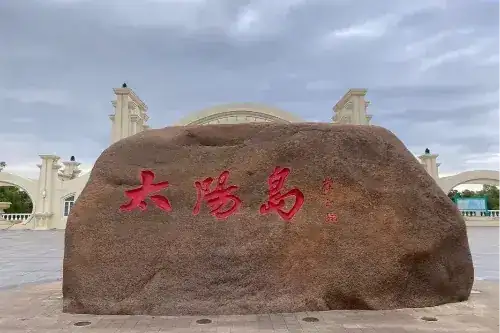
As of August 2021, Jixi has 21 A-level scenic areas, including 1 5A-level (Hutou Zhenbao Island Scenic Area) and 6 4A-level areas (Xingkai Lake Xinkailiu, Dangbizhen, Qilin Mountain, Tiexi Forest Park, Beidahuang Calligraphy Gallery, and Dongfanghong). The city also has 30 nature reserves and parks covering 1.3488 million mu, including the Xingkai Lake National Nature Reserve, a UNESCO World Biosphere Reserve and internationally important wetland.
Hutou Tourist Area
A national patriotism education demonstration base and 5A-level scenic area (since 2019), featuring the World War II Termination Memorial Garden, the Hutou Fortress (a national cultural heritage protection unit), and the Binjiang riverside area. Notable attractions include the Guinness-record "World's First Tiger," the "First Tower on the Ussuri River," and the "First Guandi Temple of the East."
Xingkai Lake Xinkailiu Scenic Area
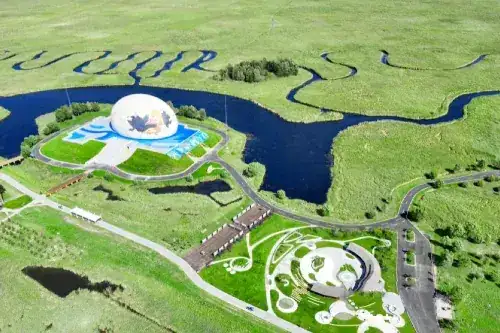
Located on the central lake ridge between Greater and Lesser Xingkai Lake, featuring a 7,090 sqm observation platform, cruise terminal, natural history museum, and wetland park. The platform can accommodate over 1,000 visitors simultaneously.
Dangbizhen Scenic Area
A 4A-level resort established in 1985, located 120 km from Jixi on the western end of Xingkai Lake's golden beach. Attractions include the Mishan Port, Beidahuang Development Memorial Hall, water park, and ecological agriculture park.
Qilin Mountain
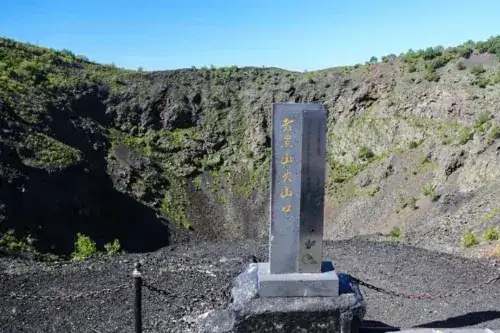
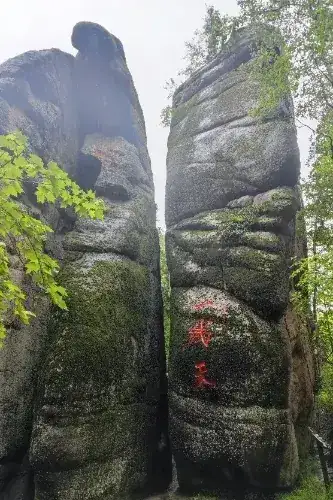
A 4A-level scenic area (elevation 550 m) located 42 km from Jixi in Xingnong Town, Jidong County, themed around Chinese Qilin (kylin) culture.
Dongfanghong Wetland
A national-level wetland nature reserve in Hulin City, established in 2001, combining ecological protection, research, tourism, and education. Listed as an internationally important wetland in October 2013.
Tiexi Forest Park
A 4A-level national wetland park covering 120,000 mu, located 34.8 km northwest of Mishan. It features four lakes (530,000 sqm), over 1 million sqm of wetland, and 20,000 sqm of wild lotus.
Beidahuang Calligraphy Gallery
Located 10 km from Mishan by the Qingnian Reservoir, this 4A-level scenic area covers 120,000 sqm and was established in 1996. Over 35 million yuan has been invested in its development. The gallery houses over 3,000 calligraphic stone inscriptions by 1,600 calligraphers, making it the largest and highest-quality modern calligraphy stele forest in China.
Notable Figures
The Jixi area has produced notable figures throughout its history, though specific biographical details are not extensively documented in the source material.
Important Honors
- April 2020: Named to the "2020 China Summer Resort City List"
- October 20, 2020: Designated a National Double Support Model City
- December 25, 2020: Awarded the "Advanced Blood Donation City" by the National Health Commission
- June 2022: Included in the 2022 Central Financial Support Inclusive Finance Development Demonstration Zone List
Travel information can change. Check current opening hours, reservations and entry requirements before you travel.
Traveller discussion
Start the conversation with a helpful tip or a question.