
Qiqihar City
Qiqihar CityQiqihar City, also known as Crane City (Hecheng) and Bukui, is a prefecture-level city under Heilongjiang Province in Northeast China. Located on the Songnen Plain at the junction of Heilongjiang, Jilin, and Inner Mongolia, it b
Qiqihar City
Qiqihar City, also known as Crane City (Hecheng) and Bukui, is a prefecture-level city under Heilongjiang Province in Northeast China. Located on the Songnen Plain at the junction of Heilongjiang, Jilin, and Inner Mongolia, it borders Daqing and Suihua to the east, Baicheng (Jilin) to the south, Hulunbuir and Xing'an League (Inner Mongolia) to the west, and Heihe and Daxing'anling to the north, covering 42,469 square kilometers. As of November 2025, it administers 7 districts, 8 counties, and 1 county-level city. As of end-2025, the registered population totaled 4.936 million. Designated by the State Council as an important industrial base, the central city of western Heilongjiang, and a key commercial grain base, Qiqihar is also a National Historical and Cultural City. It features Ang'angxi civilization, industrial heritage, ethnic folk culture, religious culture, and centuries of frontier exile culture. Historical sites include the Heilongjiang General's Residence, military yamen, Tazicheng, the Jin Dynasty Great Wall, and century-old Chinese Eastern Railway stations. The Zhalong Nature Reserve is renowned as "World's Great Wetland, Home of Chinese Cranes." In 2025, Qiqihar's GDP reached 140.21 billion CNY (approximately $19.47 billion), up 3.5% year-on-year, with an industrial structure of 29:17.6:53.4.
History
During the Xia, Shang, and Zhou dynasties, the area belonged to the Suoli Kingdom. In the Qin and Han dynasties, it was part of the Fuyu Kingdom. During the Wei, Jin, and Northern and Southern Dynasties, it was ruled by the Xianbei and Doumolou. In the Sui and Tang, it was under the Shiwei Governor's Office. During the Liao and Jin, it belonged to the Shangjing and Dongjing circuits. In the Yuan Dynasty, it was under Kaiyuan Route and Shuidada Route of the Liaoyang Secretariat. During the Ming Dynasty, it was first under the Daning Regional Military Commission, then the Nurgan Regional Military Commission.
In the early Qing Dynasty, the area was under the Shengjing Imperial Household Department, then the Ningguta General. From 1683, it came under the Heilongjiang General. In 1685, the Bukui postal relay station was established, gradually becoming the center of western Heilongjiang's relay network. In 1691, the Qing court approved building Qiqihar City at Bukui Station. In 1699, the Heilongjiang General's Yamen moved to Qiqihar, remaining until the end of the Qing Dynasty. In 1905, the Heilongjiang Circuit was established; the following year, the Qiqihar Vice Commander was abolished. In 1907, the Qing government replaced the Heilongjiang General with Heilongjiang Province, converting Heishui Hall into Longjiang Prefecture.
In 1924, the Heilongjiang Provincial Capital Municipal Affairs Office was established. In 1929, it was reorganized as the Provincial Capital and Treaty Port Municipal Bureau. After the September 18 Incident in 1931, Japanese forces occupied Qiqihar. In 1936, the puppet Qiqihar Municipal Office was established—marking the formal founding of Qiqihar as a city. After Japan's surrender in 1945, a democratic municipal government was established under Nenjiang Province. From 1947 to 1949, the city successively belonged to the Heilongjiang-Nenjiang United Province and Heilongjiang Province.
In 1954, the provincial capital moved from Qiqihar to Harbin. In 1958, Qiqihar was placed under Nenjiang Prefecture. In 1960, the city adopted the county-administration system. In 1964, it became a province-administered city again. In 1967, the Municipal People's Committee was replaced by the Municipal Revolutionary Committee, renamed the Municipal People's Government in 1980. In 1984, the State Council abolished Nenjiang Prefecture, transferring 11 counties to Qiqihar. In 1992, Lindian and Dorbod Mongolian Autonomous County were transferred to Daqing.
Administrative Divisions
As of November 2025, Qiqihar administers 16 county-level divisions: 7 districts (Longsha, Jianhua, Tiefeng, Fula'erji, Ang'angxi, Nianzishan, and Meilisi Daur), 8 counties (Gannan, Longjiang, Keshan, Kedong, Yi'an, Baiquan, Tailai, and Fuyu), and 1 county-level city (Nehe). The Municipal People's Government is located at No. 27 Xinming Street, Jianhua District.
Geography
Location
Qiqihar lies on the Songnen Plain in Northeast China, between 122-126 degrees E and 45-48 degrees N. It is 359 km from Harbin, 328 km from Suihua, 282 km from Baicheng, 524 km from Hailar, and 483 km from Heihe. Total area: 42,469 square kilometers, with elevations generally 200-500 meters.
Topography
The geological structure sits at the junction of the Neocathaysian second subsidence belt and third uplift belt, with the Nenjiang Fault running through the plain. Terrain slopes from north to south: the north and east are foothills of the Lesser Khingan Range, while the center and south form the Nenjiang alluvial plain. Two major landform types exist: alluvial plain (the dominant type) and low mountains and hills (8% of the urban area, in the west). This structure provides excellent conditions for groundwater storage and mineral formation.
Climate
Qiqihar has a temperate continental monsoon climate with distinct seasons: dry and windy springs, hot and rainy summers, brief autumns with early frost, and long, dry, cold winters. Average annual temperature ranges from 0.7 to 4.2 degrees C. The frost-free period lasts 122-151 days. Annual precipitation is 400-550 mm, with over 85% falling during the growing season (May-September). Favorable conditions include abundant radiation and synchronized rain and heat; unfavorable conditions include drought, flooding, low temperatures, early frost, and wind.
Hydrology
89% of the urban area belongs to the Nenjiang River basin and 11% to the Wuyur River basin. The Nenjiang is an outer-flow river, while the Wuyur is an inner-flow river. The urban area has abundant surface water, including the Nenjiang main stream and tributaries (Alun, Yin, Ergou, Kule, Yalu, and Wuyur rivers), plus over 160 lakes. Most rivers are plain-type with gentle gradients, developed meanders, and wide valleys. Rivers freeze for about 5.5 months in winter with ice about 1 meter thick. All rivers have two flood seasons: spring snowmelt and summer-autumn rainfall.
Natural Resources
Water Resources
Qiqihar has over 170 rivers (including the Nenjiang, Nuomin, Yalu, Handahan, Wuyur, and Yin rivers) and over 800 lakes. The city has 15 groundwater aquifers with strong storage capacity and shallow burial depths. Natural water quality meets drinking water standards.
Land Resources
Main soil types include dark brown earth, black soil, chestnut soil, meadow soil, swamp soil, meadow alkaline soil, and sandy soil. Most soils have high heat content, good permeability, light texture, and flat terrain.
Mineral Resources
Discovered minerals fall into 5 categories with 47 varieties. Non-metallic minerals include 19 varieties (stone, sand, earth, ash) with total reserves of 13.9 billion cubic meters, including quartz sand, limestone, marble, volcanic stone, zeolite, medical stone, basalt, granite, diatomite, and bentonite. There are also considerable petroleum and natural gas reserves near the urban area.
Population
According to the Seventh National Census (November 2020), the permanent population was 4,067,489, a decrease of 1,299,514 (down 24.21%) from 2010, with an average annual growth rate of -2.73%. As of end-2025, the registered population totaled 4.936 million, including 3.104 million rural and 1.832 million urban residents.
Politics
Economy
Overview
In 2024, GDP reached 135.31 billion CNY (approximately $18.79 billion), up 2.7%. The primary, secondary, and tertiary industries contributed 39.25 billion, 24.34 billion, and 71.72 billion CNY respectively, with a structure of 29.0:18.0:53.0. Per capita GDP was 35,656 CNY (approximately $4,952), up 5.6%.
In 2025, GDP reached 140.21 billion CNY (approximately $19.47 billion), up 3.5%. The three industries contributed 40.64 billion (+2.7%), 24.65 billion (+0.2%), and 74.92 billion CNY (+5.3%), with a structure of 29:17.6:53.4. Per capita GDP was 37,946 CNY (approximately $5,270), up 6.3%.
Fixed asset investment fell 3.9%, with private investment up 3.3%. Local fiscal revenue was 10.78 billion CNY (approximately $1.50 billion), down 6.8%. Total fiscal expenditure was 70.23 billion CNY (approximately $9.75 billion), up 5.8%. Urban per capita disposable income was 34,799 CNY (approximately $4,833), up 4.1%; rural was 20,403 CNY (approximately $2,834), up 6.1%.
Primary Industry
In 2025, total agricultural, forestry, animal husbandry, and fishery output value was 73.31 billion CNY (approximately $10.18 billion), up 2.8%. Grain was planted on 37.285 million mu with total output of 25.42 billion jin (approximately 12.71 million tons), up 4.1%. Livestock: 4.449 million hogs slaughtered (+5.0%), 754,000 cattle (-3.3%), 2.567 million sheep (-20.3%), and 44.072 million poultry (-4.2%). Raw milk output was 1.485 million tons.
Secondary Industry
In 2025, above-scale industrial value-added fell 1.6%. By sector: equipment +1.2%, food -3.7%, metallurgy -1.7%, energy +8.0%, pharmaceuticals -41.3%, petrochemicals -0.8%, forest/building materials -12.5%. The city had 448 above-scale enterprises with revenue of 111.27 billion CNY (approximately $15.45 billion), down 3.1%, and profits of 6.5 billion CNY (approximately $903 million), up 102.2%. The construction industry had 311 qualified enterprises with total output of 5.85 billion CNY (approximately $812.5 million), down 11.3%.
Tertiary Industry
In 2025, total retail sales of consumer goods reached 51.46 billion CNY (approximately $7.15 billion), up 3.3%. Urban retail grew 3.7%, rural 1.0%. Actual foreign investment utilized was $11.79 million, down 37.68%, with 13 new foreign-invested enterprises. Total import/export value was 9.01 billion CNY (approximately $1.25 billion), down 9.6%; exports 6.37 billion CNY (+5.1%), imports 2.64 billion CNY (-32.4%).
Real estate development investment was 1.61 billion CNY (approximately $223.6 million), down 22.4%. Commercial housing sales area was 619,000 square meters (-0.6%), average price 5,134.7 CNY/sqm (-5.5%).
The city received 55.01 million tourists (+20.3%), with total tourism spending of 37.13 billion CNY (approximately $5.16 billion), up 21.5%. Financial institution deposits reached 435.77 billion CNY (approximately $60.52 billion), up 9.2%; loan balances were 200.63 billion CNY (approximately $27.87 billion), up 1.2%.
Social Affairs
Education
As of end-2025, the city had 1,007 schools with 43,600 staff and 386,000 students, graduating 126,600. This included high schools (6,164 staff, 65,526 students), junior highs (15,028 staff, 81,039 students), and primary schools (9,051 staff, 113,496 students).
Science and Technology
In 2025, the city implemented 348 municipal science and technology projects, registered 790 achievements, validated 428 results, and certified 378 technology contracts.
Culture
As of end-2025, the city had 1 circus, 1 opera theater, 1 drama troupe, 14 libraries, 1 mass art center, 16 cultural centers, and 19 museums. There were 190 cultural heritage protection units (12 national, 47 provincial, 54 municipal, 77 county-level).
Healthcare
As of end-2025, the city had 2,894 health institutions (131 hospitals, 2,710 primary care, 43 public health). Licensed beds: 30,923 (30,287 actual), with 37,500 health professionals including 14,451 licensed physicians.
Sports
The city had 6 stadiums (500+ seats), 7 sports fields, 29 sports associations, 86 clubs, and 1,121 ranked athletes. In 2025, athletes won 80 national-level or above medals (55 gold, 18 silver, 7 bronze). The Crane City Stadium, originally built in 1956 and rebuilt in 1984-1985, is a landmark ice sports venue. The Qiqihar Comprehensive Gymnasium, with its distinctive blue-glass crane-shaped design, symbolizes the city's sporting aspirations.
Social Security
As of end-2025, 1.663 million people participated in urban employee basic pension (845,000 active, 818,000 retirees); 1.621 million in urban-rural resident pension; 3.656 million in basic medical insurance; 244,000 in unemployment insurance; 382,000 in work injury insurance; and 287,000 in maternity insurance. The city had 213 eldercare institutions (24 public with 5,876 beds, 189 private with 18,749 beds), including 19 with integrated medical-care services.
Transportation
Overview
As of end-2025, the city had 52,083 road transport vehicles (800 passenger, 39,482 freight, 11,801 taxis). Annual rail freight was 15.672 million tons with 7.461 million passengers; road freight was 81.304 million tons with 45.091 million passengers.
Rail
Qiqihar is the railway hub of western Northeast China. Qiqihar Railway Station is the largest station in the region and a major national rail junction, classified as a Special Grade Station. Qiqihar South Station is the terminus of the Harbin-Qiqihar high-speed railway, connecting to most Heilongjiang cities plus Manzhouli, Hulunbuir, Beijing, Changchun, Shenyang, Dalian, and Tianjin. The city is served by the Harbin-Qiqihar HSR and four conventional rail lines: Binzhou, Pingqi, Qibei, and Fuxi.
Highway
Major highways include the Suiman, Qineng, Qitai, and Qigan expressways, plus National Routes 301, 231, and 202. As of end-2020, total highway mileage reached 24,661 km.
Aviation
Qiqihar Sanjiazi Airport is a regional trunk airport in western Heilongjiang with 56 routes. Domestic routes cover Beijing, Guangzhou, Shanghai, Shenyang, Dalian, Xi'an, Jinan, and Shenzhen. International routes reach Khabarovsk, Vladivostok, Abakan, Yakutsk (Russia), Niigata, Osaka (Japan), and Seoul (South Korea).
Water Transport
Located on the upper Nenjiang River, waterway transport is navigable upstream to Nenjiang County (Heihe) and downstream to Harbin. Fula'erji has two 1,000-ton berths with annual throughput capacity of nearly 260,000 tons.
History and Culture
Festivals and Exhibitions
Museums
Qiqihar Museum, located at the northeast corner of Bukui North Street and Zhonghua Road, was completed in 2002. With over 14,000 square meters of floor area, it is the largest newly built municipal museum in Heilongjiang Province.
Arts Troupes
Qiqihar Circus, founded in 1952, is one of China's renowned large-scale circus and acrobatic troupes, known for thrilling high-altitude acrobatics, traditional acts, and animal performances with distinctive northern Chinese style. The China Qiqihar SOS Children's Village, built in 1992 with international SOS support, provides family-based care for orphans across 37,000 square meters, comprising 15 residential buildings, a nursery, 3 youth apartments, and a service center.
Scenic Spots
Overview
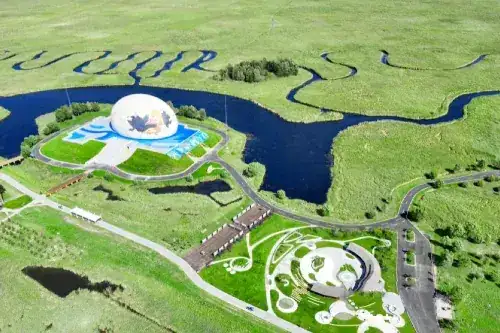
As of end-2025, the city had 57 A-level or above scenic areas (1 at 5A, 11 at 4A). Notable attractions include the Zhalong Nature Reserve (home of red-crowned cranes), Mingyue Island, Longsha Park, the Neolithic Ang'angxi Culture Site, Dacheng Temple, the Mosque, Guandi Temple, and Tazicheng.
Landmarks
Foreign Relations
Famous People
Honorary Titles
Travel information can change. Check current opening hours, reservations and entry requirements before you travel.
Traveller discussion
Start the conversation with a helpful tip or a question.