
Harbin City
Harbin CityHarbin City, also known as the "Ice City," is located in northeastern China, in the southwestern part of Heilongjiang Province. It is the provincial capital, a sub-provincial city, and a mega-city, serving as the political, econo
Harbin City
Harbin City, also known as the "Ice City," is located in northeastern China, in the southwestern part of Heilongjiang Province. It is the provincial capital, a sub-provincial city, and a mega-city, serving as the political, economic, and cultural center of northern Northeast China and the core city of the Harbin-Changchun city cluster. Harbin administers 9 districts, 7 counties, and 2 county-level cities, with a total land area of 53,076.4 square kilometers. As of end-2024, the registered population was 9.33 million. Harbin is situated in the Songhua River basin, on the eastern edge of the Songnen Plain, with terrain higher in the east and lower in the west. It has a mid-temperate continental monsoon climate with brief, cool summers and long, cold winters. Human activity in the Harbin area dates back 22,000 years. In 1115 CE, it became part of the Jin Dynasty's capital region. In 1932, Japan occupied Harbin. On April 28, 1946, Harbin was liberated. The city is designated by the State Council as an important central city in Northeast China, a national famous historical and cultural city, an international comprehensive transportation hub, an advanced manufacturing base, a portal for northward opening, and an international ice and snow tourism destination. Harbin's leading industries include deep processing of agricultural products, advanced equipment manufacturing, and modern biomedicine. In 2025, the city's GDP reached 618.85 billion yuan (approximately $85.3 billion USD), up 4.6% year-on-year at constant prices.
Name and Etymology
The place name "Harbin" first appeared in Qing dynasty local administrative records. After the Qing army entered the Shanhai Pass in 1644, the area was under the jurisdiction of the Alechuka (Acheng) Vice-Commandant. It was colloquially called "Halabin," later "Harbin." From the late Qing period through the 1970s, the name was widely accepted as Manchu for "sun-drying net ground." In 1980, a new theory emerged suggesting it derives from Jurchen "Alejin," meaning "honor" or "glory." Other interpretations include Manchu for "fertile river bend," "flat island," Mongolian for "flat land," Manchu for "ferry crossing," and Jurchen for "swan." Multiple theories coexist.
History
Pre-Qin Period
Human activity in the Harbin area dates back 22,000 years (late Paleolithic). Around 5,000 years ago, the area entered the Neolithic Age. Around 3,000 years ago (late Shang dynasty), it entered the Bronze Age, belonging to the Baijinbao culture. From the time of Emperor Shun through the Xia, Shang, and Zhou dynasties (23rd to 5th century BCE), the area was the homeland of the Sushen people.
Qin-Han through Southern and Northern Dynasties
During the Han dynasty, the Sushen were renamed Yilou, with Harbin on their western edge. Through the Han, Wei, and Jin periods, the area belonged to the Fuyu kingdom. In the 5th century CE, the Wuji conquered Fuyu and established the Anchegu tribe along the Ashi River, becoming one of the seven major tribal alliances.
Sui-Tang through Song-Yuan Periods
In 691 CE, Tang forces defeated the Heishui Mohe. In 698 CE, the Mohe established the Zhen state (renamed Bohai in 713), and Harbin became part of Bohai's Mojie Prefecture. After Bohai fell to the Khitan in 926, the Jurchen rose. In 1115, Jurchen chief Aguda defeated the Liao and established the Jin dynasty, designating Shangjing (Harbin's Acheng) as the capital. During the Yuan dynasty, the area became the fief of Genghis Khan's third brother, Timuge Otchigin's family.
Ming-Qing Period
In 1395, Ming forces subdued the Jurchen, and the area formally came under Ming rule. After the Qing dynasty was established, the northeast was governed under a military system. By the mid-to-late Qing, policies of "moving banner people to reclaim land" brought large numbers of Manchu and Han settlers. By the late 19th century, Harbin had dozens of villages with about 30,000 residents. In 1896, Tsarist Russia secured rights to build the Chinese Eastern Railway, and in 1898, Harbin was designated as the railway's hub and management center. By the early 20th century, Harbin had become an international commercial port with over 160,000 foreign residents from 33 countries and consulates from 19 nations.
Republic of China Period
In 1926, the Harbin Special Municipal Bureau was established. On February 5, 1932, Japanese forces occupied Harbin. After Japan's surrender on August 15, 1945, Soviet Red Army entered Harbin on September 18. On April 28, 1946, Harbin established a people's government, becoming the first major liberated city in China.
After the Founding of the PRC
In 1953, Harbin became a centrally administered municipality. In 1954, after the merger of Songjiang and Heilongjiang provinces, Harbin became the capital of the new Heilongjiang Province. During the First Five-Year Plan, 13 Soviet-aided key projects transformed Harbin from a consumer city to an emerging industrial one. In 1996, the Songjiang Region merged with Harbin. Administrative adjustments continued through 2014. As of end-2022, Harbin administered 9 districts and 9 counties/cities. In October 2024, the city designated June 28 as "Harbin National Famous Historical and Cultural City Protection Day."
Administrative Divisions
As of July 2024, Harbin administers 9 districts, 7 counties, and 2 county-level cities. The municipal government is located at No. 1 Shiji Avenue, Songbei District.
Natural Geography
Location
Harbin is located in northeastern China, southwestern Heilongjiang Province, on the southeastern edge of the Songnen Plain, between 125 degrees 42 minutes and 130 degrees 10 minutes east longitude, and 44 degrees 04 minutes and 46 degrees 40 minutes north latitude. It borders Jiamusi, Qitaihe, and Mudanjiang to the east, Daqing to the west, Suihua and Yichun to the north, and Jilin Province to the south. The total land area is 53,076.4 square kilometers, making it the largest provincial capital city in China by area, with an urban area of 10,198 square kilometers.
Climate
Harbin has a mid-temperate continental monsoon climate with brief, cool summers and long, cold winters. The average summer temperature (June to August) is 22.3 degrees C, while winter (December to February) averages -14.6 degrees C. The hottest month is July (average 24.7 degrees C, extreme high 36.4 degrees C), and the coldest is December (extreme low -38.1 degrees C on January 4, 1970). Annual precipitation averages 494 to 651 mm, concentrated in July and August. The frost-free period is 145 days, with annual snow cover of 110 to 129 days.
Geology
Harbin is located on the eastern margin of the Songliao rift, within the central subsidence zone and southeastern uplift of the Songnen depression. Major active faults include the Songhua River, Hulan River, and Ashi River faults, trending northeast and northwest.
Topography
The terrain is higher in the east and lower in the west, sloping from southeast to northwest. The Songhua River flows through the city from southwest to northeast. North of the river, the Mulan, Tonghe, and Yilan areas belong to the Lesser Khingan Mountains, with elevations generally around 500 meters. South of the river, the Wuchang, Acheng, Bin, Shangzhi, Yanshou, Fangzheng, and Yilan areas belong to the Zhangguangcai Range. The western urban area and Shuangcheng are part of the Songnen Plain, with elevations of 120 to 250 meters. The highest peak is Datudingzi Mountain at 1,696 meters.
Hydrology
Harbin lies in the Songhua River basin. The main river is the Songhua River, with tributaries including the Hulan River (523 km, basin area 30,977 square km) and Ashi River (257 km, basin area 3,545 square km). As of end-2021, the city had 70 irrigation areas over 10,000 mu, 252 reservoirs with total capacity of 4.26 billion cubic meters. Major reservoirs include Longfengshan (12.3 million cubic m), Mopanshan (25.3 million cubic m), and Xiquanyan (21.9 million cubic m). The Sanjiang Governance Project, the largest water conservancy project in Heilongjiang's history, was completed in 2018, raising Harbin's flood prevention standard from 1-in-100-year to 1-in-200-year floods.
Natural Disasters
Harbin experiences severe weather including gales, heavy rain, hail, thunderstorms, blizzards, and sandstorms, as well as cold damage, drought, and floods. Gale-force winds occur mostly from March to May (85% of occurrences). Heavy rain concentrates in July and August (92%). Sandstorms peak in March to May. Major floods originate from the Nen River and Second Songhua River, with peak flows mostly in July to September. In August 2023, 12 districts and counties suffered flooding affecting 270,581 people and 90,050 hectares of cropland. Geological hazards include debris flows (concentrated June to August, especially July), landslides, and bank collapses.
Natural Resources
Water Resources
As of end-2022, Harbin's multi-year average total water resources amount to 11.423 billion cubic meters, with surface water at 9.897 billion cubic m and groundwater at 3.626 billion cubic m. Per capita water resources are 1,186 cubic m, half of China's national average. The area faces challenges including declining rainfall, increased evaporation from climate warming, over-extraction of groundwater, and uneven spatial distribution.
Land Resources
As of end-2022, total land area is 5,307,643 hectares, of which state-owned land accounts for 54.04% (2,868,342 hectares). This includes 465,380 hectares of cultivated land, 2,076,233 hectares of forest land, and 143,558 hectares of water areas.
Mineral Resources
As of end-2022, 65 types of minerals have been discovered. 23 are listed in the Heilongjiang reserves table, including coal, iron, copper, lead, zinc, tungsten, molybdenum, pyrite, and marble for cement. As of end-2020, 80 mining areas were listed, including 15 large, 21 medium, and 44 small. Mineral resources are characterized by concentrated distribution, many small deposits, and abundant building materials.
Wetland Resources
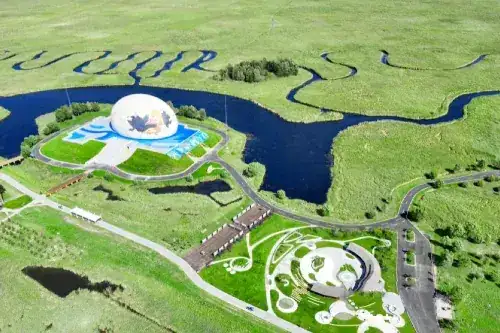
Harbin has rich wetland resources including riverine, marsh, lacustrine, and artificial wetlands. In 2018, Harbin was named the first "International Wetland City" by the International Wetland Organization. In 2020, the Hadong Riverine Wetland Reserve was designated as an internationally important wetland. As of end-2023, the city has 15 wetland parks covering 20,300 hectares, including 13 national-level parks, and 8 provincial-level wetland nature reserves covering 101,700 hectares.
Biological Resources
As of end-2023, Harbin's forest area covers 2.205 million hectares with 2.6 billion cubic m of growing stock and 41.5% forest coverage. The city has 23 nationally protected wild plant species, including Korean pine, Manchurian ash, and Dahurian lily. There are approximately 450 species of terrestrial wild animals, including 345 bird species, 78 mammal species, and 9 species under national Class I protection (including Siberian tiger, musk deer, sable, red-crowned crane). As of end-2022, the city has 79 nature reserves, forest parks, scenic areas, wetland parks, and geoparks covering 848,400 hectares (16% of the territory).
Notable protected areas include Heilongjiang Fenghuang Mountain National Nature Reserve (703 plant species, 343 animal species, including Siberian tiger and golden eagle), Alejin Island National Wetland Park (4.19 square km, 71.1% wetland ratio, 1,144 species), Hulan Estuary National Wetland Park (38.5 square km, the largest urban wetland among Chinese provincial capitals), and Hadong Riverside Nature Reserve (an important stopover for over 20,000 waterbirds during migration, including endangered Oriental white stork and red-crowned crane).
Politics
Population
Population Size
As of end-2024, the registered population was 9.33 million, including 5.259 million urban residents. The population includes 5.519 million in the nine districts and 3.811 million in the nine counties and cities. The birth rate was 3.7 per thousand, death rate 5.7 per thousand, with a natural growth rate of -2 per thousand.
Ethnic Groups
Harbin is a multi-ethnic city with 45 ethnic minority groups, primarily Manchu, Korean, Hui, Mongolian, and Xibe. In 2016, the minority population exceeded 600,000. The city has 14 ethnic minority townships and 218 ethnic minority villages.
Language
Harbin dialect belongs to the "Zhaofu sub-group" of the "Hafu group" of Northeast Mandarin. Due to historical migration from Shandong and Hebei, the local dialect closely approximates standard Mandarin, making Harbin one of China's most linguistically accessible cities.
Religion
Harbin has Buddhism, Daoism, Christianity, Catholicism, Islam, and Eastern Orthodoxy. As of 2020, there were 321 religious activity venues and over 520,000 believers. Buddhism spread to the area during the Jin dynasty; the Jile Temple, built in 1924, became the Buddhist center. Islam arrived in the 1770s with Hui migrants. Catholicism was established in 1901, and Protestant Christianity in 1901. Eastern Orthodoxy arrived in 1898 with Russian railway workers; the St. Sophia Cathedral was built in 1907. Harbin's Orthodox community was once the largest among the three major Chinese dioceses (Beijing, Shanghai, Harbin).
Economy
Overview
Harbin's "4567" modern industrial system targets four new economic models (digital, bio-economy, etc.), five strategic emerging industries (aerospace, electronics manufacturing, new materials, etc.), six traditional advantage industries (medicine, energy, automotive, etc.), and seven service industries. In 2025, GDP reached 618.85 billion yuan (approximately $85.3 billion USD), up 4.6%. The three-sector structure ratio was 9.2:23.0:67.9.
Primary Industry
Harbin's agriculture is centered on five supply chains: corn, soybean, rice, dairy, and meat. Known as the "Rice Capital," Harbin's Wuchang rice brand value reached 71.3 billion yuan (approximately $9.8 billion USD), ranking 4th among regional brand geographical indication products nationally for 8 consecutive years. In 2023, grain output reached 23 billion jin (11.5 million tons), with 1.138 million mu of certified green and organic farmland. In 2024, agricultural, forestry, animal husbandry, and fishery gross output was 104.39 billion yuan (approximately $14.4 billion USD), up 3.5%.
Secondary Industry
Secondary industry focuses on food, medicine, automotive, and chemicals, while developing billion-yuan-scale pillar clusters in aviation, energy equipment, and biomedicine. Harbin was approved as a national bio-industry base in 2008, and its biomedical cluster was listed among the first national strategic emerging industry clusters in 2019. Key enterprises include Harbin Pharmaceutical Group, Kuihua Pharmaceutical, and Yuheng Pharmaceutical (7 listed companies). In aerospace, Harbin Aircraft Manufacturing, China Aero-Engine Dongan, and Northeast Light Alloy are leading enterprises. In 2024, industrial output value reached 116.5 billion yuan (approximately $16.1 billion USD), up 3.2%.
Tertiary Industry
Tertiary industry centers on cultural tourism, information services, finance, and modern logistics. In 2023, the city issued 174 million yuan (approximately $24 million USD) in government consumption vouchers, generating 6.3 billion yuan (approximately $869 million USD) in sales. Tourism revenue reached 169.25 billion yuan (approximately $23.3 billion USD), with 135 million visitor arrivals, 2.5 and 3.4 times the previous year respectively. Harbin was named "2023 Summer Tourism Preferred Destination" and topped the national ice and snow tourism rankings for 7 consecutive years. The city established trade relations with 178 countries, with total import-export volume of 49.53 billion yuan (approximately $6.8 billion USD), up 27.7%. Russia trade exceeded 10 billion yuan for the first time, reaching 11.79 billion yuan (approximately $1.6 billion USD), up 78.8%.
Economic Functional Zones
Shenzhen (Harbin) Industrial Park
Located in the Harbin New Area, the park focuses on five areas: information innovation, advanced graphite, smart sensors, high-end equipment and robotics, and modern agriculture. As of April 2024, 639 enterprises had registered, including Huawei's "one headquarters, two centers" and the Harbin Institute of Technology AI Research Institute. In January to September 2023, the park achieved output of 3.17 billion yuan (approximately $437 million USD), up 26.8%.
China (Heilongjiang) Pilot Free Trade Zone, Harbin Section
Located at the center of Northeast Asia, the zone connects the China-Mongolia-Russia Economic Corridor and serves as an aviation hub linking Eurasia and North America. It focuses on strategic emerging industries (new-generation IT, new materials, high-end equipment, biomedicine) and modern services. In 2023, import-export volume reached 9.521 billion yuan (approximately $1.3 billion USD), up 25.5%; Russia trade reached 4.26 billion yuan (approximately $587 million USD), up 98.9%. The zone hosts over 1,000 high-tech enterprises (26.3% of Heilongjiang's total) and over 130 Russia-oriented cooperation enterprises.
Social Services
Education
As of end-2024, Harbin has 49 regular higher education institutions with 815,000 students, 82 secondary vocational schools with 69,000 students, 109 regular senior high schools, 345 junior high schools, and 370 primary schools. The literacy rate dropped from 1.66% to 1.05% between 2010 and 2020.
Healthcare
As of end-2024, Harbin has 5,562 health institutions including 360 hospitals, with 94,000 beds and 90,000 health professionals (32,100 licensed doctors, 40,000 registered nurses). Annual consultations reached 41.92 million visits.
Science and Technology
Harbin boasts strong scientific and educational resources, including Harbin Institute of Technology and Harbin Engineering University, contributing to national projects including Shenzhou spacecraft, Chang'e lunar missions, and Jiaolong submersible. As of end-2024, the city has 69 independent research institutions, 15 national-level enterprise technology centers, and 231 provincial-level centers. Patent grants reached 17,868. In February 2024, the "Space Environment Ground Simulation Facility," China's first major national science and technology infrastructure in aerospace, passed acceptance in Harbin.
Culture
As of end-2024, Harbin has 69 museums, 19 cultural centers, 18 public libraries with 143 branches, and 6 professional performing arts troupes. Notable museums include the Heilongjiang Provincial Museum (national first-class), the Unit 731 Crimes Exhibition Hall, and the Jin Shangjing History Museum. The city promotes a nationwide reading program and was named a "National Top 100 Reading City."
Sports
Harbin has 37 stadiums, 46 gymnasiums, 69 swimming and diving venues, and 18 indoor ice hockey rinks. It has produced Olympic champions including Shen Xue, Zhao Hongbo, and Zhang Hong. The city hosted the 3rd Asian Winter Games and the 24th Universiade Winter Games. In July 2023, Harbin won the bid to host the 2025 Asian Winter Games, becoming China's first "double Asian Winter Games city."
Environmental Protection
In 2023, Harbin had 304 days of good air quality (83.3%), with PM2.5 at a historic low of 36 micrograms per cubic meter. All 25 national monitoring sections achieved water quality compliance (100%), with 88% rated as good quality, the best on record. The city achieved zero landfill for household waste, with 100% harmless treatment and over 80% resource utilization.
Social Security
In 2023, urban enterprise pension insurance covered 3.223 million people; urban and rural resident pension insurance covered 2.298 million; unemployment insurance covered 1.119 million; basic medical insurance covered 7.107 million. The urban minimum living allowance was 850 yuan per month per person in districts and 689 yuan in counties. The city has 466 elderly care institutions with 43,000 beds.
Transportation
Overview
Harbin is positioned at the center of Northeast Asia, serving as China's northeast opening gateway, the core hub of the China-Mongolia-Russia Economic Corridor, and a national comprehensive transportation hub. As of end-2021, it has 79 stations. Major hubs include Harbin Railway Station, Harbin West Station, Harbin East Station, Harbin North Station, Harbin Taiping International Airport, and Harbin Port.
Highways
As of end-2021, Harbin has 24,993 km of highways, including 877 km of expressways. The city has 7 cross-river channels. In 2023, highway freight transport reached 78.59 million tons (up 6.4%), and passenger transport reached 22.65 million (up 56.5%). Private car ownership reached 1.99 million, with 34,468 new energy vehicles (up 156.5%).
Railways
Harbin is known as "the city pulled by trains" and is a major rail hub. It has 5 conventional railways and 6 high-speed railways, including the Harbin-Dalian HSR (China's first high-cold-region HSR) and the Harbin-Yichun HSR (China's highest-latitude HSR, 318 km at 250 km/h design speed). In 2023, railway passenger transport reached 38.094 million (up 178.4%). Harbin Station is a special-class station with 8 platforms and 14 tracks.
Aviation
Harbin Taiping International Airport, built in 1979, is a 4E-class airport 33 km from downtown. It is the largest international aviation port in Northeast China by passenger throughput and the first city in the northeast to open fifth-freedom rights. In 2023, it handled 20.805 million passengers (ranking first in the northeast) and 13,100 tons of cargo. It operates 266 routes (15 international, 251 domestic).
Water Transport
Harbin Port is one of China's 28 major inland ports and a national first-class open port. Its waterways connect the Songhua, Heilong, Wusuli, Nen, and Second Songhua rivers, and link to Russian Far East ports. In 2023, waterway freight reached 1.109 million tons (up 6.4%).
Public Transport
As of November 2024, Harbin Metro operates 3 lines (Lines 1, 2, 3) with 78 stations and 91.57 km of operating mileage. In 2023, the metro network carried 281.28 million passengers. The city also operates an Autonomous Rapid Transit Line 1 (18.9 km, 7 stations). As of end-2022, the city had 364 coded bus routes totaling 8,467.7 km, with 7,428 operating vehicles and 460 million annual passenger trips. In 2022, there were 17,000 cruise taxis and 5,038 ride-hailing vehicles.
Culture and Society
Overview
With just over a century of development, Harbin blends northern minority culture with Central Plains, Jin, Jing-qi, Russian emigre, and Jewish cultures. It is the birthplace of China's beer industry, honored as "China's Beer Capital."
Cuisine
Harbin's cuisine integrates Russian, Manchu, Beijing-Tianjin, Shandong, and local traditions, forming a distinctive "Harbin-style" culinary system. Signature dishes include Guo Bao Rou (sweet and sour crispy pork), iron pot stew, "Kill Pig Dish" (pork offal platter), and frozen pears. The cuisine emphasizes large portions, big plates, and big appetites.
Specialties
Six representative specialties: Modern ice cream, Harbin red sausage, Northeast soybean paste, kvass, dalieba (large Russian-style bread), and Harbin beer. Harbin red sausage, introduced from Lithuania via the Chinese Eastern Railway, is smoked with traditional hardwood. Dalieba bread is circular, weighing 2.5 kg with a 25+ cm diameter.
Art
Ice and snow sculpture, combining ice carving and snow sculpting, is a Heilongjiang provincial intangible cultural heritage. Harbin is China's earliest city to embrace European classical music, home to the country's first symphony orchestra and first music school, designated by UNESCO as Asia's only "Music City of the World." The Harbin Summer Concert has run for 63 years across 36 editions, making it China's longest-running national-level music event. Architecturally, Harbin preserves over 400 historic buildings in Art Nouveau, Renaissance, Eclectic, and Baroque styles, earning it the titles "Eastern Moscow" and "World Architecture Museum."
City Symbol
The lilac (Syringa) is Harbin's city flower, designated in April 1988. The city has over 50 lilac varieties, creating a distinctive urban landscape when they bloom each May.
Intangible Cultural Heritage
As of end-2023, Harbin has 278 intangible cultural heritage projects, including 6 national-level (Fangzheng paper-cutting, Wuchang Northeast Drum), 112 provincial-level, and 160 municipal-level projects, with 252 heritage inheritors. Longjiang Shadow Puppetry, centered in Harbin, is known as the "Jiangnan school" of Heilongjiang shadow play, combining light, music, carving, and visual arts. Fangzheng paper-cutting dates back to the mid-Qing dynasty, recognized as "China's Folk Paper-Cutting Art Town" in 1993. Wuchang Northeast Drum blends Manchu musical elements, including shamanic chants.
Scenic Spots
Harbin is known as the "Ice City," "Eastern Moscow," and "Eastern Little Paris." In 2023, it received 135 million visitors with tourism revenue of 169.25 billion yuan (approximately $23.3 billion USD), a record high. The city has 71 A-level tourist attractions and 10 S-class ski resorts.
Major Attractions
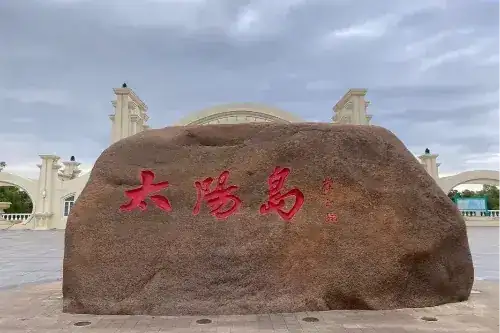
Key attractions include: Sun Island Scenic Area (88 square km, a national 5A attraction and UN ecological demonstration island); Central Street (1,450 meters, China's first pedestrian street, featuring 62 historic buildings); St. Sophia Cathedral (the largest Eastern Orthodox church in the Far East, 53.35 meters tall, built 1923 to 1932); Flood Prevention Memorial Tower; Harbin Ice and Snow World (established 1999, receiving over 1 million visitors annually); Yabuli Ski Resort (snow season of 170 days, ski season of 150 days, national-level tourism resort); Northeast Tiger Forest Park (1.44 million square m, housing nearly 1,000 purebred Siberian tigers); Songfeng Mountain (an 800-year-old Daoist sacred site); and the Jin Shangjing Historical Museum. The Unit 731 Crimes Exhibition Hall documents Japanese wartime biological weapons research and human experimentation (1936 to 1945), with 27 key heritage sites.
Foreign Exchange and Sister Cities
Consular Institutions
Historically, 19 countries established consulates in Harbin during the early 20th century. The city maintains extensive international exchanges as a key node for China-Russia cooperation.
Notable People
Major Honors
Harbin has received numerous honors including "International Wetland City" (2018, first cohort), "Music City of the World" (UNESCO), "China's Beer Capital," and the top-ranked ice and snow tourism city for 7 consecutive years.
Travel information can change. Check current opening hours, reservations and entry requirements before you travel.
Traveller discussion
Start the conversation with a helpful tip or a question.