
Songyuan City
Songyuan CitySongyuan City, also known as "Bodune" or "New City," is a prefecture-level city under Jilin Province, located in west-central Jilin within the Song-Liao Basin. It borders Changchun to the east, Siping to the south, Tongliao (In
Songyuan City
Songyuan City, also known as "Bodune" or "New City," is a prefecture-level city under Jilin Province, located in west-central Jilin within the Song-Liao Basin. It borders Changchun to the east, Siping to the south, Tongliao (Inner Mongolia) to the southwest, Baicheng to the northwest, Daqing (Heilongjiang) to the north, and Harbin to the northeast. It has a mid-temperate continental monsoon climate, with a total area of 22,000 square kilometers. As of August 2024, it administers 1 district, 2 counties, 1 autonomous county, and 1 county-level city. As of end 2024, the permanent resident population was 2,090,000. Songyuan is the central city of western Jilin, a national energy strategic base, and an important transportation hub in the Harbin-Changchun-Daqing triangle. Known as one of "China's Northern Economic Growth Four Dragons" (with Baotou, Hohhot, and Ordos), it was built on and thrives on oil, with Jilin Oilfield located here. It is on the 45th parallel golden corn and rice belt, and is China's largest distribution center for coarse grains and beans. In 2025, the gross regional product was 103.06 billion yuan, up 3.8%.
History
In the early Western Han Dynasty (202 BC–220 AD), the Fuyu Kingdom, Northeast China's first local agricultural state, was established in this area. During the Qing Dynasty (1644–1912), the area was under the Bodune Vice Commander's jurisdiction. In 1682, Bodune Station was established. In 1811, Bodune Subprefecture was established. In 1906, it became Xincheng Prefecture. In 1913, renamed Fuyu County. In 1992, prefecture-level Songyuan City was established. In 2013, Fuyu County was re-established as county-level Fuyu City.
Administrative Divisions
Division Details
As of August 2024: 1 district (Ningjiang), 2 counties (Changling, Qian'an), 1 autonomous county (Qianguo'erluosi Mongolian Autonomous County), and 1 county-level city (Fuyu), with 31 subdistricts, 43 towns, 34 townships, and 1 ethnic township. Plus 1 national-level and 7 provincial-level development zones. The City People's Government is at No. 339 Yanjiang East Road, Ningjiang District.
Geographical Environment
Location
Songyuan is in west-central Jilin on the Songnen Plain between the Songhua and Nen rivers, between 123°6'–126°11' east longitude and 43°59'–45°32' north latitude. Total area: 22,000 square kilometers. Built-up area: 89 square kilometers.
Topography
Located in the Song-Liao Basin at the junction of the central depression and southeastern uplift, with conjugate NE and NW structural features favorable for seismic energy accumulation. The Songhua River fault and Song-Liao Basin central fault pass through the urban area. Basement: Paleozoic low-grade metamorphic rocks, covered by thick Mesozoic sediments and Quaternary loose sand-gravel.
Climate
Mid-temperate continental monsoon climate. Spring: dry with rapid warming; summer: hot with concentrated precipitation; autumn: cool, rapid temperature changes; winter: long, cold, dry. Annual average temperature: ~4.5°C. Extreme minimum: -36.1°C, maximum: 37°C. Annual sunshine: ~2,900 hours. Frost-free period: 135–140 days. Annual precipitation: 400–500 mm, concentrated in July–August.
Hydrology
Three rivers, one stream, and one lake define the water system. The Songhua River flows 120 km through the north. The Second Songhua River (from Changbai Mountain) flows 188 km through the center. The Nen River flows 61.7 km from the northwest. The Lalin River flows 84 km through the east. Chagan Lake (259 km², 600+ million cubic meters) is one of China's top 10 freshwater lakes.
Natural Resources
Water Resources
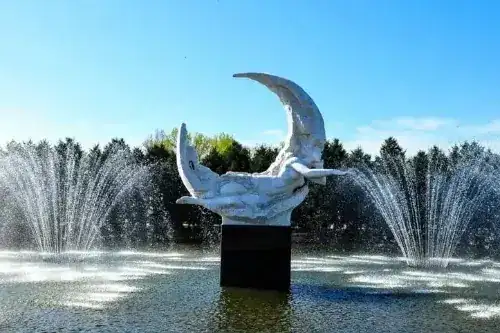
Four major rivers with total runoff of 41.2 billion cubic meters. Total water resources: 1.557 billion cubic meters (surface 222 million, groundwater 1.335 billion). 26 large and medium lakes (9 usable, 47,269.7 hectares). 14 ponds over 10,000 mu including Chagan Lake, Dabusu Lake, and Moon Lake.
Mineral Resources
Energy: petroleum (27 billion tons resources, 15.1 billion tons proven), natural gas (3 trillion cubic meters resources, 300 billion proven), oil shale (76.6 billion tons). Non-metallic: 9 types including ceramic shale, bentonite, salt, and natural alkali. Jilin Oilfield is China's 6th largest onshore oilfield. Also: CO2 (100 billion cubic meters), mineral water (2,500 tons/day).
Biological Resources
Mammals: fox, hare, badger, hedgehog, weasel. Birds: wild goose, pheasant, duck, owl, eagle, lark. 4 Class I protected species ( Oriental stork, red-crowned crane, hooded crane, great bustard) and 22 Class II species. 559 wild plant species in 129 families, including 271 medicinal, 46 edible, 181 forage, and 34 ornamental/nectar plants.
Grassland Resources
At the junction of Horqin Grassland and Songnen Plain. 2.1548 million mu of grassland producing ~200,000 tons of hay annually. Three quality grades: Class I (35%, >1,500 kg/ha, mainly Chinese wildrye), Class II (40%, 600–1,500 kg/ha), Class III (25%, <600 kg/ha, degraded).
Forest Resources
Total forest land: 317,038.06 hectares. Forest area: 222,639.67 hectares. Forest coverage: 10.83%. Standing timber: 19.46 million cubic meters. Main species: poplar (dominant), willow, elm, pine. Five forest types: timber, protection, economic, special-purpose, and fuelwood.
Population
According to the Seventh Census (November 1, 2020): 2.253 million. As of end 2024: 2,090,000 (urban 1,059,300, 50.68% urbanization rate). Birth rate: 5.46 per mille; death rate: 9.39 per mille; natural growth rate: -3.93 per mille. Gender ratio: 98.5 (female = 100).
Politics
Economy
Overview
In 2025, the gross regional product was 103.06 billion yuan, up 4.2%. In 2024: 100.218 billion yuan, up 3.8%. By industry: primary 24.109 billion, up 3.8%; secondary 23.772 billion, up 0.5%; tertiary 52.337 billion, up 4.9%. Structure: 24.1:23.7:52.2. Per capita GDP: 47,544 yuan. Fixed-asset investment down 5.1% (infrastructure down 62.0%, private up 64.5%). Total fiscal revenue: 11.139 billion, up 36.7%. Local revenue: 6.964 billion, up 65.0%. Fiscal expenditure: 36.127 billion, up 16.2%.
Primary Industry
Agricultural added value: 24.983 billion yuan, up 3.8%. Total agricultural output: 48.102 billion, up 3.9%. Grain area: 1,042,500 hectares (corn 852,800; rice 134,800). Grain output: 7.9675 million tons, up 2.0% (corn 6.6324 million tons; rice 1.1904 million tons). Pork: 273,400 tons. Beef: 52,200 tons, up 9.7%. Mutton: 37,800 tons, up 11.5%. Pig inventory: 2,208,900.
Secondary Industry
Total industrial added value: 23.873 billion yuan, up 1.7%. Above-scale industrial added value down 1.6%. Oil and gas extraction: 60.4% of above-scale (down 1.5%). Construction added value: 2.395 billion, down 6.7%. Construction output: 9.074 billion, down 18.3%.
Tertiary Industry
Total retail sales: up 2.4%. Foreign trade: 1.086 billion yuan, up 0.3% (exports 1.079 billion, up 1.5%). Total deposits: 232.266 billion, up 17.594 billion. Total loans: 123.816 billion, up 8.989 billion. Insurance premiums: 5.734 billion, up 3.6%.
Social Affairs
Science and Technology
663 patent authorizations, including 53 invention patents.
Education
140 primary schools (96,000 students), 136 junior high (66,488), 25 high schools (51,354), 14 secondary vocational (9,717), 379 kindergartens (28,432), 4 special education (311). Higher education: Songyuan Vocational Technical College.
Culture
7 cultural centers, 6 state-owned art troupes, 5 public libraries (1.3586 million volumes), 10 museums (396,200 visitors). The "Three Cultural Venues" complex (16,000 m²) opened in 2011 at Zhongshan Square, offering free cultural activities, exhibitions, and services.
Healthcare
18,039 health workers (7,435 physicians, 7,949 nurses). 3,036 health institutions with 13,456 beds (78 hospitals with 12,091 beds).
Sports
38.2% regular exercise participation. 5.2647 million m² of sports venues (2.48 m² per capita). 6,407 venues. Five major facilities: stadium, ice sports center, fitness center, riverside stadium, and high school sports hall. 44 medals in 2024 (20 gold, 9 silver, 15 bronze).
Social Security
Employee pension: 528,600, up 1.9% (309,900 active). Unemployment: 172,800. Work injury: 215,800. Minimum living: 56,000 households, 85,300 people, 373 million yuan. Urban standard: 660 yuan/month; rural: 440 yuan/month. Medical assistance: 504,800 person-times, 186 million yuan.
Transportation
Highways
6 national/provincial highways (Beijing-Harbin, Tumen-Ulanhot, Baicheng-Changchun, Shenyang-Mingshui, Kaiping-Fangzheng, Changchun-Harbin). Total mileage: 14,248.16 km (735.59 km expressway). Highway freight: 65.2488 million tons. Highway passengers: 6.5241 million.
Railways
27 railway stations. 6 trunk lines: Beijing-Harbin, Chang-Bai, Ping-Qi, Tong-Rang, Harbin-Dalian HSR, and Song-Tao. Songyuan Station: 149 km from Changchun, 184 km from Baicheng.
Aviation
Songyuan Chaganhu Airport (IATA: YSQ): 4C-level domestic tourism airport, 36 km from city center. 5 airlines operating 5 routes to 7 cities (Beijing, Shanghai, Chengdu, Hefei, Guangzhou, Shijiazhuang, Xi'an). In 2024: 162,667 passengers (up 66.1%), 13.4 tons cargo.
Water Transport
351 transport vessels and 1,703 fishing boats. 1 freight dock, 1 passenger dock, 22 ferries. Songyuan Port (built 2004, 800,000 tons/year capacity) can directly navigate to Russia and Japan via the Songhua River to Heilongjiang River.
Public Transportation
6,719 passenger vehicles: 798 scheduled buses, 149 tourist coaches, 4,940 taxis, 832 city buses.
History and Culture
Dialect
Northeastern Mandarin, Jilin-Changchun dialect, Zhaofu sub-branch. Close to standard Mandarin, with high Mandarin proficiency nationwide.
Intangible Cultural Heritage
Wuriger: Mongolian storytelling art formed in the late Ming to early Qing Dynasty, performed in three styles: oral, with chor accompaniment, and with sihu (four-stringed fiddle) accompaniment.
Matouqin (Horse-Head Fiddle): Mongolian bowed string instrument. Qianguo'erluosi matouqin music is widely practiced; the county was named "China's Matouqin Hometown."
Chagan Nur Winter Fishing: Traditional ice fishing on Chagan Lake, dating to 1211 when Genghis Khan worshipped at the lake. The annual winter fishing ceremony includes lake worship and net awakening rituals.
Manchu Xincheng Opera: Developed in the late 1950s from Manchu octagonal drum (bajiaogu) folk art. Named after Xincheng Prefecture (former name of Fuyu). Listed as national intangible cultural heritage in 2021.
City Symbol
In 2017: City emblem "Songjiang Dragon Soaring," city tree "Elm," city flower "Lilac."
Scenic Spots
Local Specialties
Pao Sheng Yu (sliced raw fish), Mongolian roast whole lamb, toasted millet, milk skin, milk tofu, Korean-style cold dog meat, corn grits, lotus seed rice, potato noodles, reed products, buckwheat flour, millet, "Four-Grain Red" peanuts, and sunflower oil.
Famous People
External Exchange
International
1 sister city relationship as of October 2022.
Domestic
3 domestic sister city relationships as of 2024.
Honorary Titles
National Garden City, National Hygienic City, "Most Investment-Potential Chinese City in the Eyes of Multinationals," "Top 10 Charming Cities in Northeast China."
Travel information can change. Check current opening hours, reservations and entry requirements before you travel.
Traveller discussion
Start the conversation with a helpful tip or a question.