
Jilin City
Jilin CityJilin City, also known as "River City of the North," is a prefecture-level city under Jilin Province, located in central-eastern Jilin in the Northeast interior. It borders Yanbian to the east, Changchun and Siping to the west, Ha
Jilin City
Jilin City, also known as "River City of the North," is a prefecture-level city under Jilin Province, located in central-eastern Jilin in the Northeast interior. It borders Yanbian to the east, Changchun and Siping to the west, Harbin to the north, and Baishan, Tonghua, and Liaoyuan to the south. Situated in the transition zone from Changbai Mountain to Song-Liao Plain, it has a "distant view of Changbai, surrounded by Songhua" landscape. Northern temperate continental monsoon climate with four distinct seasons. Total area: 27,120 square kilometers. As of end 2023, it administers 4 districts, 1 county, and 4 county-level cities. As of end 2024, the permanent resident population was 3,494,800. Jilin City is a sub-provincial center, a national historical and cultural city, and an important industrial base. It is one of the birthplaces of prehistoric civilization, with human activity dating 160,000–230,000 years ago. The city was formally established 2,200 years ago in the early Western Han Dynasty as the capital of the Fuyu Kingdom. It served as Jilin's political, economic, and cultural center for 278 years until the provincial capital moved to Changchun in 1954. Known as the "Rime Capital, Ski Paradise," it has 7 national-level intangible cultural heritage items. In 2024, the gross regional product was 163.32 billion yuan, up 5.0%.
Name Evolution
The name "Jilin" has two theories: (1) from "jilin" (chicken forest) due to abundant wild pheasants, later homophonized; (2) from the Ming Dynasty shipyard established here, later called "Jilin Ula" (Manchu: "city along the river"). The alias "River City" comes from Emperor Kangxi's poem about warships anchored on the Songhua River.
History
Pre-Qin to Northern and Southern Dynasties
Human activity dates to 160,000–230,000 years ago. During the Xia, Shang, Zhou, and Qin periods, the area was inhabited by Huimo and Sushen (Manchu ancestors). In the early Western Han, it was the capital of the Fuyu Kingdom. In 494, the Wuji conquered Fuyu. In 410, Goguryeo built Longtan Mountain City.
Sui-Tang to Song-Yuan
In 668, the Tang Dynasty (618–907) destroyed Goguryeo. In 713, the area came under Balhae. In 926, the Liao conquered Balhae. During the Jin (1115–1234), it was under Huining Prefecture. The area was under the Eastern Xia Kingdom (13th century) and then the Yuan Dynasty (1271–1368).
Ming-Qing
During the Ming (1368–1644), shipyards were established. In 1673, Jilin City was built. In 1676, the Ningguta General moved here, making Jilin the political and military center of Northeast China, second only to Shenyang. The city contributed to the second Battle of Yaksa (1686). During the Qing (1644–1912), Yongji Zhou was established (1727), later becoming Jilin Prefecture.
Republic of China
In 1913, Jilin Prefecture became Jilin County. In 1929, renamed Yongji County. In 1931, occupied by Japan. In 1948, liberated. The provincial government moved from Yanji to Jilin City.
People's Republic of China
In 1949, the Jilin provincial government remained in Jilin City. In 1954, it moved to Changchun. In 1958, five counties were placed under Jilin City.
Administrative Divisions
As of end 2023: 4 districts (Changyi, Chuanying, Longtan, Fengman), 1 county (Yongji), and 4 county-level cities (Shulan, Panshi, Jiaohe, Huadian). The City People's Government is at No. 65 Songjiang Middle Road, Chuanying District.
Natural Geography
Location
Jilin City is in central-eastern Jilin, on the Songhua River in the Changbai-to-Songnen transition zone, between 125°40'–127°56' east longitude and 42°31'–44°40' north latitude. Total area: 27,120 square kilometers.
Geology
Complex geological history spanning Archean, Proterozoic, and Neozoic cycles. The area belongs to the Jilin-Yanbian stratigraphic sub-region with well-developed Carboniferous and Permian strata. Tectonically, it is a eugeosynclinal fold belt with frequent Indosinian and Yanshanian magmatic activity. Cenozoic volcanic activity included multiple eruptions, with the Gangyao volcanic group at the Yongji-Shulan boundary.
Topography
Transition zone with four landform types: medium mountains (central-eastern, 110 peaks above 1,000 m, highest: Nanlou Mountain at 1,404.8 m), low mountain hills (300–700 m), gorge-lake area (formed by three cascade hydropower stations), and river valley plains (170–220 m). Average elevation: 196 m. Lowest: Loushang Village at 162 m.
Climate
Northern temperate continental monsoon climate. Annual average temperature: 3–5°C. January average: -18 to -20°C; July average: 21–23°C. Extreme maximum: 36.6°C. Annual precipitation: 650–750 mm (64% in June–August). Frost-free period: 130 days. Annual sunshine: 2,500 hours. Frozen period: 170–190 days, maximum frost depth: 1.9 m.
Hydrology
Rivers belong to the Songhua River basin (84%), Lalin River (15%), and Mudan River (1%). Total river length: 7,064.1 km. The Songhua River main stream flows 405 km through the city (49% of upstream length). Major tributaries: Huifa, Yinma, and Lalin rivers.
Soil
11 soil types, 25 subtypes, 50 genera, 150 species. Dark brown soil is most widespread (60% of total area), followed by albic soil (20.76%) and paddy soil (4.97%). Vertical distribution: gray-brown above 500 m, albic at 300–500 m, alluvial below 300 m.
Natural Disasters
Main hazards: floods, drought, hail, cold damage, earthquakes, and debris flows. Historical floods are frequent, especially July–August. The 2023 Shulan flood caused 14 deaths and affected 130,000+ people. Seismic activity: the city is on a NW-trending seismic belt, with Wulajie in Yongji County in a Level I earthquake risk zone.
Natural Resources
Water Resources
Total water resources: 7.554 billion cubic meters (surface 7.062 billion, groundwater 1.328 billion, with 836 million overlap). Plus 8.736 billion cubic meters of transit water. Per capita: 3,875 cubic meters (1.8x national average). 5 large and 21 medium reservoirs.
Land Resources
Total: 2.7711 million hectares (cultivated 922,200; forest 1,561,000; water 112,000; construction 116,200).
Forest and Grassland
Key forestry area with 1.7277 million hectares of forest land. Forest area: 1.559 million hectares. Standing timber: 192 million cubic meters. Forest coverage: 55.61%.
Biological Resources
360+ terrestrial wildlife species (10 amphibians, 12 reptiles, 290+ birds, 52 mammals). Class I protected: Siberian tiger, leopard, sika deer, sable, Chinese merganser, golden eagle, white-tailed eagle, hooded crane, red-crowned crane. 1,500+ wild plant species (676 medicinal, 188 edible, 54 timber, 200+ fungi).
Mineral Resources
105 mineral types discovered (84 with proven reserves, 76 being exploited, 59 in provincial database). 343 proven solid mineral sites (62 energy, 133 metallic, 148 non-metallic). Lead, molybdenum, antimony, graphite, and refractory clay rank first in Jilin Province. Nickel, wollastonite, and cement limestone rank second.
Politics
Population
Population Size
As of end 2024: 3,494,800 (urban 2,333,900, 66.78% urbanization rate). Registered population: 3,919,000. Birth rate: 3.0 per mille; death rate: 5.6 per mille; natural growth rate: -2.6 per mille.
Ethnic Groups
Han: 88.2% (3.5436 million). 46 ethnic minorities totaling 474,200 (11.8%), with Manchu (58.04% of minorities), Korean, Hui, and Mongolian. 34 Manchu townships. Also China's largest scattered Korean population (~137,000).
Language
Jilin dialect: Northeastern Mandarin, Jilin-Shenyang sub-group, very close to standard Mandarin. Notable feature: more extensive use of retroflex endings (erhua) than standard Mandarin, including the ability to connect multiple retroflex endings.
Religious Beliefs
Five major religions (Buddhism, Taoism, Islam, Catholicism, Christianity) coexist with folk beliefs combining Confucian, Buddhist, and Taoist elements. Buddhist and Taoist adherents concentrate around temple complexes at Beishan, Longtan Mountain, and Zhuque Mountain.
Economy
Overview
National key industrial base since the First Five-Year Plan, with petrochemical, automotive, metallurgy, energy, agricultural processing, carbon fiber, equipment manufacturing, and biotechnology industries. In 2024: GDP 163.32 billion yuan, up 5.0%. By industry: primary 20.01 billion (12.2%), secondary 59.07 billion (36.2%), tertiary 84.25 billion (51.6%). Per capita GDP: 46,511 yuan. Total fiscal revenue: 26.96 billion, up 7.3%. Local revenue: 10.33 billion, up 25.6%. Fixed-asset investment up 5.5%.
Primary Industry
High-quality rice and corn production area with 5 major grain-producing counties. 2024: agricultural output 38.49 billion yuan (up 5.0%). Grain area: 677,000 hectares. Grain output: 4.764 million tons (up 2.0%; corn 3.661 million, rice 995,000, soybeans 84,000). Meat output: 393,000 tons. Pig inventory: 1.32 million; cattle: 705,000.
Secondary Industry
Known as China's "Chemical City." Jilin Petrochemical is New China's first large chemical industrial base. Above-scale industrial added value up 4.2% (mining up 22.0%; manufacturing up 1.8%; electricity/heat/gas/water up 14.6%). High-tech industry added value up 18.0% (6.1% share). Construction added value: 9.54 billion, up 5.4%.
Economic Functional Zones
2 national-level development zones: Jilin High-tech Industrial Development Zone (GDP 7.92 billion, 2023) and Jilin Economic and Technological Development Zone (GDP 4.49 billion, 2023, China's national carbon fiber industrialization base). Plus 15 provincial-level zones.
Social Affairs
Education
669 kindergartens (40,686 children), 177 primary (144,057), 145 junior high (82,480), 38 high schools (59,015), 31 secondary vocational (19,955), 10 special education (1,170). 6 universities and 3 colleges.
Healthcare
3,842 health institutions: 163 hospitals, 97 health centers, 1,462 clinics, 1,348 village clinics. 37,471 health workers (15,378 physicians, 17,463 nurses). 25,888 authorized beds.
Science and Technology
692 technology contracts worth 1.88 billion yuan. 290 high-tech enterprises, 254 technology-based SMEs. 2,690 valid invention patents. 2,540 patent authorizations (529 inventions).
Culture
10 libraries, 11 cultural centers, 40 museums. 6 cultural industry demonstration bases (1 national). 3 nighttime culture-tourism consumption clusters (1 national).
Sports
24 gold, 17 silver, 7 bronze medals. 2 athletes won 1 silver and 1 bronze at the Paris Olympics. 11 golds at the 14th National Winter Games. 118 fitness facilities built.
Environment
Air quality excellent: 323 days (88.5%). PM2.5: 34 micrograms/m³. Surface water quality: 94.7% excellent.
Social Security
Urban-rural pension: 408,000. Employee pension: 902,000 (482,000 active). Unemployment: 236,000. Work injury: 314,000. Medical insurance: 3,158,000. 103,000 minimum living recipients (39,000 urban, 63,000 rural). 15,000 special hardship recipients. Lottery sales: 440 million yuan.
Transportation
Overview
Located at the Northeast Asia geographic center with rail, road, water, and air transport. Changchun Longjia Airport and various highways and railways form a comprehensive network.
Highways
5 expressways (475 km), 6 national highways, 9 provincial highways. Total mileage: 15,394 km (2nd in Jilin). "Two vertical, four horizontal, nine connections" trunk road network.
Railways
7 railway lines: Chang-Hun intercity, Chang-Tu, Shen-Ji, Ji-Shu, Shu-Yu, La-Bin, and Yan-Bai. 3 HSR stations (Jilin, Jiaohe West, Shuangji) and 5 standard stations. Jilin Station (built 1912): 55,000 m² building, intersection of 4 railways.
Aviation
Jilin Ertazi Airport: Former military-civilian 4C airport, suspended civil operations in 2005. Resumption and expansion planned in the 14th Five-Year Plan. Changchun Longjia International Airport: Shared airport, 30 minutes from Jilin via intercity rail. 2023: 15.4837 million passengers, 92,300 tons cargo.
Water Transport
Passenger-focused, 18 routes, 319 vessels. Main sections: Songhua River, Songhua Lake, Hongshi Lake, Baishan Lake. Navigable mileage: 384 km, primarily tourism.
Public Transportation
8 Class III+ passenger stations, 48 township stations. 100% village bus coverage (1,382 villages).
Culture
Overview
Birthplace of prehistoric culture and Manchu heritage. "Second Hometown of Peking Opera" (earliest opera school founded by merchant Niu Zigeng in late Qing). 40+ folk arts including root carving, paper cutting, and Korean dance.
Customs
"Walk the New Year": Spring Festival temple visits at Beishan. The bell-ringing tradition dates to the Qing Dynasty. River lantern floating: Ancient custom from the Ming-Qing era, using red paper lotus lanterns with wax bottoms and candle wicks, released on the 15th of the first lunar month and Dragon Boat Festival.
Art
Manchu Embroidery: Traditional needlework on everyday items (wrappers, clothing, pouches) with diverse motifs and techniques.
Peking Opera: Introduced in the late Qing, with local troupes performing since the 1920s, producing notable performers.
City Symbols
City flower: Rose (symbolizing peace, happiness, friendship, love). City tree: Weeping Willow (rime landscape carrier, symbolizing beauty and prosperity). City emblem: "Boatman" (symbolizing solidarity and progress).
Cultural Relics
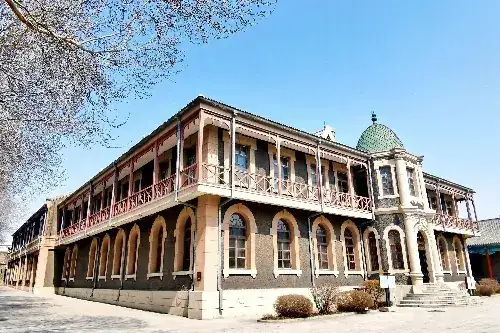
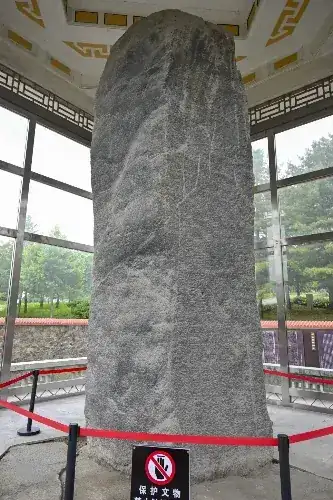
2,114 immovable cultural relics (200 listed). 39,728 movable relics (14 national Class I). Jilin Confucian Temple: One of China's four major Confucian temples, 16,354 m², national protected site. Jilin Machine Bureau: First modern industrial enterprise in Northeast China (late Qing Westernization Movement), national protected site since 2019.
Intangible Cultural Heritage
307 municipal or above items. National-level: Manchu Pearl Ball (traditional sport from pearl-diving, "Nychuhe" in Manchu, listed 2008), Ula Manchu Yangge (traditional dance from Ula Street, listed 2021).
Scenic Spots
Overview
"Rime Capital, Ski Paradise" with "one river, two wonders (rime and meteorite), three lakes, four sacred mountains." 37 A-level scenic areas (13 at 4A). Nine rime viewing belts, nine hot spring zones, year-round tourism.
Important Scenic Spots
Songhua Lake Scenic Area: National key scenic area, 569.09 km², featuring "wide water, secluded mountains, beautiful forests, fine snow." Camel Peak, Phoenix Dance Pool, Five Tiger Island.
Beishan Scenic Area: National 4A, "Nine Dragon Holy Land," known for folk temple fairs ("Beishan temple fair surpasses Qianshan").
Jilin City Museum: Founded 1962, 26,150 m². China's only public meteorite museum, national 4A, national Class I museum.
Food Specialties
Manchu cuisine: bean paste rolls (sachima), sticky bean buns. Korean cuisine: rice, soups (dog meat, soybean paste), cold noodles, rice cakes, kimchi. Signature dishes: Manchu Eight Bowls (eight-treasure banquet), roast suckling pig, white meat blood sausage, Manchu hotpot. Manchu hotpot: thin meat slices with sesame paste, chive flowers, and garlic ginger condiments. White meat blood sausage: traditional Manchu food from sacrificial ceremonies, with paper-thin pork and sausage made with 10+ spices.
External Exchange
Sister Cities
8 sister cities in 6 countries (as of October 2022).
Cooperation Exchange
Connections with 30+ countries' cities and embassies. Member of International Winter Cities Association, World City Network Association, and other international organizations.
Famous People
Important Honors
National Historical and Cultural City. China Excellent Tourist City. China Top 10 Leisure Cities. China Best Summer Resort Destination. China Top 10 Ice and Snow Tourism Cities.
Travel information can change. Check current opening hours, reservations and entry requirements before you travel.


Traveller discussion
Start the conversation with a helpful tip or a question.