
Huludao City
Huludao CityHuludao is a prefecture-level city under Liaoning Province, formerly known as Jinxi, located in the southwestern part of Northeast China along the western coast of Liaoning Province. It has a northern temperate continental monso
Huludao City
Huludao is a prefecture-level city under Liaoning Province, formerly known as Jinxi, located in the southwestern part of Northeast China along the western coast of Liaoning Province. It has a northern temperate continental monsoon climate, bordered by mountains and sea, with terrain gradually descending from northwest to southeast. It borders Jinzhou to the east, connects with the Shanhaiguan District of Qinhuangdao to the west, faces the Bohai Bay to the south, and borders Chaoyang to the north, covering a total area of 10,400 square kilometers. As of June 2026, Huludao administers 3 districts, 2 counties, and 1 county-level city. As of the end of 2025, the registered total population was 2.636 million. On June 12, 1989, the State Council approved the elevation of Jinxi to a prefecture-level city. Huludao is an important gateway from Northeast China into the pass, known as the "First City Beyond the Pass," serving as a port city on the Bohai wing of the Liaoning Coastal Economic Belt. Together with other cities along the Bohai coast, it forms the Bohai Rim Economic Circle. Maritime transport is mainly through Huludao Port and Suizhong Port, making it the nearest outlet to the sea for Northeast China and eastern Inner Mongolia. Coastal waters are rich in marine products, while western mountainous areas have abundant mineral resources, with significant reserves of molybdenum, zinc, gold, and limestone. The area features rich natural and cultural landscapes, including the Ningyuan Ancient City, the Jiumenkou Water Great Wall, and the Jieshi Qin-Han Dynasty Site Complex. It is a China Excellent Tourism City, a National Forest City, and a National Garden City. It hosts the China International Swimwear Culture Expo and co-organized the 12th National Games of the People's Republic of China. In 2025, Huludao's GDP reached 101.37 billion yuan ($14.3 billion), up 3.5% at constant prices.
History
Huludao was originally named Jinxi. Although Jinxi was established as an administrative unit relatively late, the area has a long history.
Artifacts and relics excavated within the city confirm human activity dating back tens of thousands of years. Dinosaur fossils unearthed in May 1982 near Nuanputang Town in Nanpiao District date back 150 million years. In June 1921, Swedish geologist Dr. Andersson examined human bones, stone tools, bone implements, and painted pottery fragments excavated from a natural cave on the eastern slope of Xifushan Mountain in Erli, Shaguotun, Nanpiao District, identifying them as late Neolithic artifacts from about 7,000 years ago. The red-bodied, black-painted pottery shared the same cultural type as painted pottery from Yangshao Village in Henan, while long-necked bottle pottery fragments matched contemporaneous artifacts from Gansu. Ancient tombs unearthed at Longwangshan in Suizhong Town and north of Si'erbao Town all prove the area belongs to the Hongshan Culture, an ancient cultural type extending southward into western Liaoning.
From the beginning of historical chronicles to 1991, the area experienced 18 dynasties or periods over 2,831 years. The longest-ruling was the Han Dynasty at 426 years; the shortest was the Kuomintang rule at just 2 years. The chronological sequence: Twelve Vassal States (Zhou, Spring and Autumn) 365 years; Warring States 254 years; Qin 16 years; Han (including Western and Eastern) 426 years; Three Kingdoms 45 years; Jin (including Western, Eastern, and Sixteen Kingdoms) 154 years; Southern and Northern Dynasties 169 years; Sui 29 years; Tang 289 years; Five Dynasties and Ten Kingdoms 53 years; Song, Liao, and Jin 319 years; Yuan 89 years; Ming 276 years; Qing 267 years; Republic 0 years; Manchukuo 14 years; Kuomintang rule 2 years. After liberation, except for Jianchang which belonged to Rehe Province, the rest belonged to Liaoxi Province.
During the Spring and Autumn period, the Huludao area was part of the Yan State territory, inhabited by the Shanrong tribes. In the late Warring States period, the Yan State defeated the Shanrong and established five commanderies in the north; present-day Suizhong, Xingcheng, and other areas belonged to Liaoxi Commandery, while northwestern Jianchang belonged to Youbeiping Commandery.
After Qin's unification, the enfeoffment system was abolished and the county system was established. Suizhong County, Xingcheng City, Lianshan District, and other areas belonged to Liaoxi Commandery. During the Western Han, the county system was retained. During the Eastern Han, in the first year of the Yongchu reign (107 CE), the Liaodong Dependent State was established, with most of the territory belonging to Changliao County (present-day Changli, Hebei) and Tuhe County (present-day Jinzhou). The Jianchang area was occupied by the Wuhuan people. After the Battle of Bailangshan, the Wuhuan were defeated, and Cao Cao established Changli Commandery in this area.
During the Three Kingdoms, both Jin dynasties, and Southern and Northern Dynasties, most of the area belonged to Changli Commandery. In the early Sui Dynasty, a two-tier prefecture-county system was implemented, later replaced by the commandery-county system. Most of the area belonged to Liucheng County in Liucheng Commandery (present-day Chaoyang).
In the first year of the Huitong reign of the Khitan (938 CE), the Khitan state changed its name to Liao, and the Huludao area came under its rule.
Jinxi's county administration began in the 32nd year of the Guangxu reign of the Qing Dynasty (1906), initially called Jiangjiatun Civil Administration Office, with the seat at Jiangjiatun (present-day Gangtun Town, Lianshan District), later moved to Lianshan in 1932.
In August 1954, Liaodong and Liaoxi provinces merged; Suizhong, Xingcheng, and Jinxi all belonged to Liaoning Province, while Jianchang belonged to Rehe Province. In February 1956, Jinxi, Xingcheng, and Suizhong belonged to Jinzhou Prefecture, and Jianchang to Chaoyang Prefecture. On February 23, 1956, the State Council approved the establishment of the Liaoning Jinhu City Preparatory Committee; on September 11, Jinxi City was formally established with three municipal districts: Jinxi, Yangjiazhangzi, and Mazhangfang. In June 1957, the Jinxi City administrative structure was abolished. In March 1961, Mazhangfang Town was transferred to Jinzhou and redesignated as Jinxi District. In 1966, Jinxi, Xingcheng, and Suizhong were placed under Jinzhou City, and Jianchang County under Chaoyang City. In December 1969, Jinxi District was returned to Jinxi and renamed Mazhangfang Town. In April 1985, Jinxi County was converted to Jinxi City (county-level).
On June 12, 1989, the State Council approved the elevation of Jinxi City to a prefecture-level city under Liaoning Province, implementing a city-administering-county system. The former Jinxi City (county-level), Xingcheng City (county-level), Suizhong County, Nanpiao District, Huludao District, and Jianchang County (from Chaoyang City) were placed under its jurisdiction. The former Jinxi City (county-level) was abolished and renamed Lianshan District. On September 20, 1994, Jinxi City was renamed Huludao City, and the former Huludao District was renamed Longgang District.
Administrative Divisions
As of June 2026, Huludao administers 3 districts, 2 counties, and 1 county-level city: Lianshan District, Longgang District, Nanpiao District, Suizhong County, Jianchang County, and Xingcheng City, comprising 24 subdistricts and 92 towns and townships (37 towns, 55 townships including 19 ethnic townships); 1,066 administrative villages and 219 communities. The Municipal People's Government is located at No. 15 Longwan Avenue, Longgang District.
Geographical Environment
Location and Boundaries
Huludao is located on the western coast of Liaoning Province, an important gateway from Northeast China into the pass. It borders Jinzhou to the east, connects with the Shanhaiguan District of Qinhuangdao to the west, faces the Bohai Bay to the south, and borders Chaoyang to the north. Geographic coordinates: 119 degrees 12 minutes 47 seconds to 121 degrees 2 minutes E, 39 degrees 59 minutes to 41 degrees 12 minutes N, with the center at 120 degrees 38 minutes E, 40 degrees 56 minutes N. The maximum north-south span is about 133 kilometers and east-west span about 150 kilometers, covering a total area of 10,400 square kilometers.
Landforms
Huludao is bordered by mountains and sea, with terrain descending from northwest to southeast, from mountainous areas above 400 meters elevation, through hilly areas, to coastal plains below 20 meters elevation, forming a narrow coastal plain along the Bohai coast known as the Liaoxi Corridor. The southern foothills of the Songling Mountains and the Yan Mountain range lie across the northwest, forming a natural barrier. The highest peak is Daqingshan in Jianchang at 1,223.8 meters. The city is divided into three zones: northwestern mountainous area (41% of total area), central hilly area (26%), and southeastern coastal plain (33%). Mountainous areas have sparse forest vegetation and severe soil erosion.
Climate
Huludao has a northern temperate continental monsoon climate. The annual average temperature is 9.6 degrees Celsius, with January the coldest and July the hottest; average temperatures gradually decrease from coast to inland. Average annual precipitation is 576.8 millimeters, concentrated in June through August (about 66.5% of the year), decreasing from coast to inland. Average annual sunshine is 2,630.6 hours, with a frost-free period of 180.5 days. The complex terrain leads to uneven distribution of temperature and precipitation.
Natural Resources
Water Resources
Surface water resources total 4.03 billion cubic meters (386.9 millimeters runoff depth), 123.6% above the multi-year average. Groundwater resources total 680 million cubic meters, including 493 million in mountainous areas and 215 million in plains, with 28 million cubic meters of overlap.
Land Resources
Total land area is 10,415.85 square kilometers. Agricultural land covers 7,470.10 square kilometers (71.7%), including cultivated land 2,911.66 square kilometers (38.97%), orchard land 705.38 square kilometers (9.44%), forest land 3,640.22 square kilometers (48.73%), pasture 19.79 square kilometers, and other agricultural land 212.66 square kilometers (2.86%).
Biological Resources
The city has 477 species of terrestrial wild vertebrates, including 101 under national key protection, 100 under provincial key protection, and 276 of beneficial, economically or scientifically important value. These include 58 mammal species (7 orders, 16 families), 23 reptile species, 9 amphibian species, and 387 bird species. In flora, Huludao is within the North China plant region, with elements of the Changbai and Inner Mongolia flora. The city has 1,097 wild plant species across 113 families and 507 genera, and 226 forest insect species across 9 orders and 65 families.
Mineral Resources
Huludao has favorable geological conditions for mineralization, with 51 proven mineral types and total reserves exceeding 1 billion tonnes (excluding construction materials). Major minerals include coal, molybdenum, lead, and zinc, mainly distributed in Nanpiao District, Gangtun Town in Lianshan District, and Bajiazi in Jianchang County, accounting for over 90% of the city's mining total. Energy minerals include coal, petroleum, natural gas, nuclear energy, geothermal energy, and oil shale; metal minerals include lead, zinc, molybdenum, manganese, iron, copper, gold, and silver; and 19 types of construction and other non-metallic minerals have been discovered.
Population
Population Quantity
As of the end of 2025, the registered total population was 2.636 million, including 959,000 urban residents (36.4%) and 1.677 million rural residents (63.6%). Males numbered 1.337 million (50.7%) and females 1.299 million (49.3%), a sex ratio of 103:100. The birth rate was 4.39 per thousand, death rate 11.72 per thousand, and natural growth rate -7.34 per thousand.
Ethnic Composition
Huludao is a multi-ethnic area with 27 ethnic groups, including Han, Manchu, Mongolian, Hui, Korean, Xibe, Miao, Yi, Li, Tujia, Zhuang, Daur, Tibetan, Gelao, Russian, Uyghur, Bouyei, and Dong.
Politics
Current Leadership
Sister Cities
Economy
Overview
In 2025, Huludao's GDP was 101.37 billion yuan ($14.3 billion), up 3.5%. The primary industry value added was 15.79 billion yuan ($2.23 billion, up 2.9%); secondary industry 32.86 billion yuan ($4.63 billion, down 0.3%); tertiary industry 52.72 billion yuan ($7.43 billion, up 6.1%). Per capita GDP was 43,963 yuan ($6,191), up 5.0%. The three-industry structure was 15.6:32.4:52.0.
Fixed asset investment (excluding rural households) grew 1.6%. By industry, primary investment declined 55%; secondary grew 19.6%; tertiary declined 23.9%. Infrastructure investment grew 8.2%, with electricity and heat supply up 27%, road transport down 29.3%, and public facility management down 15.7%. Private investment declined 18.4%, with manufacturing down 30.0% and real estate down 20.8%. Industrial technology upgrading investment grew 92.4%.
Real estate development investment declined 10.3%. Commercial housing sales area was 933,000 square meters (down 18.7%), including residential 854,000 square meters (down 17.2%).
General public budget revenue was 8.0 billion yuan ($1.13 billion, up 6.4%), with tax revenue 5.04 billion yuan ($710 million, up 1.1%) and non-tax revenue 2.96 billion yuan ($417 million, up 16.7%). General public budget expenditure was 25.0 billion yuan ($3.52 billion, up 5.6%).
Per capita disposable income was 30,878 yuan ($4,349, up 4.6%); urban residents 40,360 yuan ($5,685, up 3.8%); rural residents 20,375 yuan ($2,870, up 5.7%).
Primary Industry
In 2025, grain sown area was 150.8 thousand hectares (down 0.4 thousand), including corn 136.4 thousand, rice 0.9 thousand, and other grains 2.7 thousand. Economic crop area was 122.2 thousand hectares (up 1.4 thousand), including oil crops 94.0 thousand and vegetables 24.5 thousand. Orchard area was 63.1 thousand hectares (down 1.2 thousand).
Total grain output was 702,000 tonnes (up 2.5%), including corn 630,000 tonnes (up 1.3%) and rice 6,000 tonnes. Peanut output was 402,000 tonnes (down 0.2%). Vegetable and edible fungi output was 2.33 million tonnes (down 2.0%). Garden fruit output was 1.439 million tonnes (down 2.9%), including apples 966,000 tonnes (down 1.3%) and pears 295,000 tonnes (down 4.5%).
Afforestation covered 55,000 mu, including 24,000 mu of plantation and 10,000 mu of mountain closure for forest regeneration. Pork output was 108,000 tonnes (down 2.4%); beef 22,000 tonnes (down 21.7%); mutton 10,000 tonnes (down 32.3%); poultry 139,000 tonnes (down 12.8%). Egg output was 42,000 tonnes (down 16.1%); milk 13,000 tonnes (down 11.8%). Poultry slaughter reached 77.903 million (up 1.3%). Year-end hog inventory was 602,000 (down 38.5%); annual hog slaughter 1.239 million (down 6.0%).
Aquatic product output was 574,000 tonnes (up 5.1%), including marine 567,000 tonnes (up 5.2%) and freshwater 8,000 tonnes (up 14.3%).
Secondary Industry
In 2025, industrial value added above designated size declined 3.9%, with high-tech manufacturing down 22.0%. By sector: mining up 17.0%; manufacturing down 4.5%; electricity, heat, gas, and water supply down 15.2%. Petrochemical industry declined 6.9% (55.2% of total). Non-ferrous metals grew 24.8% (14.8% of total), with mining up 26.0% and smelting up 23.4%. Equipment manufacturing declined 5.4% (9.6% of total), with railway, shipbuilding, and aerospace up 63.6%. Food industry grew 13.6% (2.9% of total), with beverages and refined tea up 55.2%.
Construction value added declined 6.0%. There were 276 qualified construction enterprises (down 1%), with total contract value 8.78 billion yuan ($1.24 billion, down 16.7%), including new contracts 5.94 billion yuan ($836 million, down 19.0%).
Tertiary Industry
In 2025, total retail sales of consumer goods were 28.08 billion yuan ($3.96 billion, up 1.9%). Urban retail sales were 23.79 billion yuan ($3.35 billion, up 1.5%); rural 4.30 billion yuan ($606 million, up 4.4%). Above-quota wholesale, retail, accommodation, and catering enterprises totaled 424, with retail sales of 9.19 billion yuan ($1.29 billion, down 1.1%).
Total import and export was 4.40 billion yuan ($620 million, down 17.1%), with exports 2.74 billion yuan ($386 million, down 6.2%) and imports 1.66 billion yuan ($234 million, down 30.4%). Actual foreign investment utilized was $4.98 million.
Postal delivery volume was 126.9 million items (up 16.2%), including express delivery 103.2 million (up 22.7%). Telecommunications business volume was 1.95 billion yuan ($275 million, up 8.0%). Year-end mobile phone base stations totaled 18,743 (including 7,491 5G stations). Fixed internet broadband subscribers reached 1.017 million.
As of the end of 2025, financial institution deposit balances were 337.25 billion yuan ($47.5 billion, up 6.6%), including household deposits 303.13 billion yuan ($42.7 billion, up 7.6%). Loan balances were 146.58 billion yuan ($20.6 billion, up 4.0%). Insurance premium income was 5.73 billion yuan ($807 million, up 6.9%).
Social Undertakings
Science and Technology
In 2025, 1,029 patents were authorized (including 138 invention patents); 3,060 trademark applications and 1,970 registrations. Valid invention patents totaled 869; valid trademark registrations 22,689. Technology contract transaction value was 563 million yuan ($79.3 million, up 11.4%). There were 518 technology-based SMEs, 19 gazelle enterprises, 102 fledgling enterprises, and 105 high-tech enterprises.
Education
As of the end of 2025, the city had 754 schools with 300,000 students and 30,000 staff, including 439 kindergartens, 272 compulsory education schools (160 primary, 112 junior high), 34 high school level schools (22 general, 12 secondary vocational), 1 municipal and 2 provincial higher education institutions, and 5 special education schools. Enrollment: 33,000 kindergarten children, 174,000 compulsory education students, 42,000 general high school students, 11,000 secondary vocational students, 12,000 municipal college students, 26,000 provincial college students, and 574 special education students.
Culture
As of the end of 2025, the city had 1,403 cultural and museum venues, including 7 cultural centers, 7 libraries, and 3 museums; 115 comprehensive cultural service centers in towns and subdistricts; and 1,271 in villages and communities. There were 255 cultural heritage protection units, including 1 World Cultural Heritage site, 13 national key units, 72 provincial, 61 municipal, and 109 county-level.
Healthcare
As of the end of 2025, the city had 2,846 medical and health institutions, including 141 hospitals, 2,685 grassroots institutions, and 17 specialized public health institutions, with 20,049 beds and 20,218 health technical personnel.
Sports
In 2025, Huludao hosted the Provincial Youth Freestyle Wrestling, Break Dancing, Laser Shooting, and Archery Championships. The 2025 Huludao Marathon attracted over 12,000 participants. Preparations for the 15th Provincial Games included 12 working groups, 4 preparatory meetings, and 7 test events.
Social Security
As of the end of 2025, urban employee basic pension insurance participants numbered 790,000; basic medical insurance 623,000; urban and rural resident pension 987,000; resident medical insurance 1.465 million; unemployment insurance 216,000; and work injury insurance 290,000. In 2025, 15,640 new urban jobs were created, with 540 entrepreneurship leaders supported, driving 3,592 additional jobs.
Transportation
Overview
Huludao is traversed by the Beijing-Harbin highway and railway, with extensive local road and rail networks, plus Huludao Port and Suizhong Port. It is 150 kilometers west of Qinhuangdao Beidaihe Airport and 55 kilometers east of Jinzhou Bay Airport; the Liaoning Xingcheng Airport within the city can accommodate large passenger aircraft. Two crude oil pipelines (Daqing-Qinhuangdao and Panjin-Huludao) cross the territory.
In 2025, total highway mileage was 10,444.2 kilometers, with a road density of 100.3 km per 100 square kilometers. Paved roads totaled 9,298.7 km. Highway bridges: 95,314.9 linear meters across 2,971 bridges. Road passenger transport: 33.62 million (up 28.2%); freight 113.35 million tonnes (up 4.9%). Waterway passenger transport: 438,000 (up 33.2%); freight 900,000 tonnes (down 13.6%). Port cargo throughput: 37.56 million tonnes (up 5.6%).
Highways
Huludao is at the center of the Liaoxi Corridor with excellent connectivity. National Expressway G1 (Beijing-Harbin), National Highway 102, National Highway 306, and the Liaoning Coastal Avenue form the road transport framework. Driving to Beijing takes about 5 hours and to Shenyang about 3 hours.
Railways
The Beijing-Harbin Railway (Qinhuangdao-Shenyang passenger-dedicated line), Shenshan Line, and Weita Line traverse the city. Huludao Station, Xingcheng Station, and Suizhong Station serve regular passenger and freight trains. Huludao North Station, Xingcheng West Station, Suizhong North Station, and Dongdaihe Station are on the Qinhuangdao-Shenyang passenger-dedicated line, part of China's "Eight Vertical and Eight Horizontal" high-speed railway network coastal corridor, primarily serving high-speed EMU trains.
Shipping
Huludao Port is located in Longgang District. Backed by the Beijing-Harbin railway and highway with dedicated rail lines to the port, it is naturally sheltered by mountains on three sides, a harbor free from silting and freezing. The port serves both military and commercial purposes. Commercial facilities include two 5,000-tonne and three 10,000-tonne berths, with annual throughput capacity of 3 million tonnes. On January 21, 1999, the State Council approved Huludao Port for limited foreign trade. In November 2010, the port was fully opened, making Huludao one of China's 36 coastal open cities.
Scenic Spots
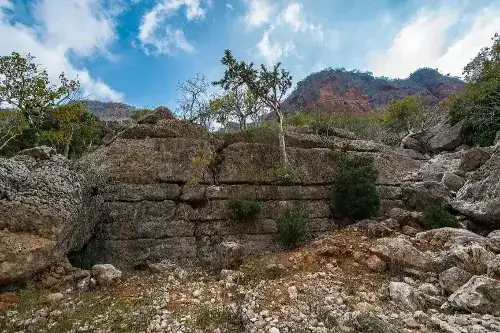
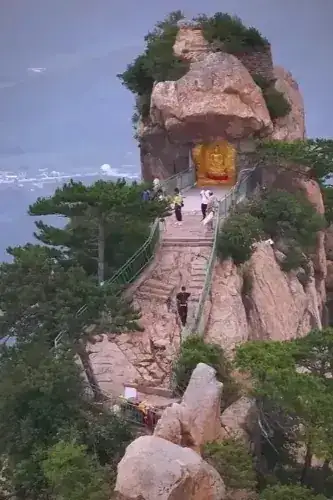
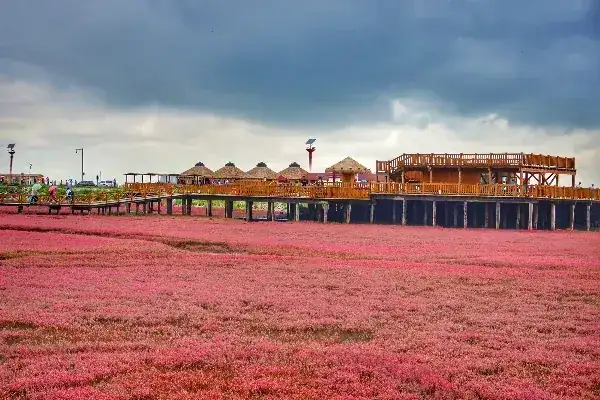
As of the end of 2025, Huludao has 54 travel agencies, 10 AAAA-level and 15 AAA-level tourist attractions, 1,319 registered tour guides, and 17 star-rated hotels. Notable sites include the Ningyuan Ancient City, Jiumenkou Water Great Wall, and Jieshi Qin-Han Dynasty Site Complex.
Local Specialties
Famous Figures
Honorary Titles
Travel information can change. Check current opening hours, reservations and entry requirements before you travel.
Traveller discussion
Start the conversation with a helpful tip or a question.