
Chaoyang City
Chaoyang CityChaoyang City, formerly known as Longcheng and Xingzhong, is a prefecture-level city in Liaoning Province, located in the northwestern part of the province with a total area of 19,699.14 square kilometers. As of October 2025, i
Chaoyang City
Chaoyang City, formerly known as Longcheng and Xingzhong, is a prefecture-level city in Liaoning Province, located in the northwestern part of the province with a total area of 19,699.14 square kilometers. As of October 2025, it administers 2 districts, 3 counties, and 2 county-level cities, with a total population of 3.178 million. Chaoyang is a historic hub for political, economic, and cultural exchange between Northeast China and the Central Plains. During the Sixteen Kingdoms period, the Murong Xianbei established Longcheng (the predecessor of Chaoyang) as the capital of the Three Yan states, earning it the name "Ancient Capital of the Three Yans." The culture formed during this period, represented by horse tack and buyao hairpins, is known as "Three Yan Culture." On June 30, 1984, Chaoyang was elevated to a province-administered city. It connects eastward to the Shenyang metropolitan area, borders the Bohai Sea to the south, links to the Beijing-Tianjin-Hebei economic circle to the west, and relies on the Inner Mongolian hinterland to the north. In 2025, Chaoyang's GDP reached 115.67 billion yuan (approximately $16.1 billion USD), growing 4.5% year-over-year. The primary industry's value-added was 24.66 billion yuan (approximately $3.4 billion USD, up 3.7%); the secondary industry's was 32.0 billion yuan (approximately $4.4 billion USD, up 2.2%); and the tertiary industry's was 59.01 billion yuan (approximately $8.2 billion USD, up 6.2%).
Historical Evolution
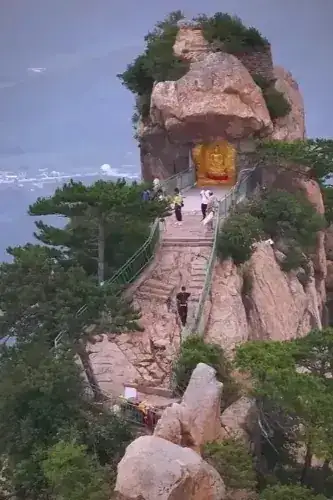
The name "Chaoyang" dates to the 43rd year of the Qianlong reign (1778), derived from the Chaoyang Cave on Phoenix Mountain, alluding to the Classic of Poetry's ode: "The phoenix calls at the morning sun."
During the Paleolithic period, the area was home to the Gezidong and Xibajianfang early human activities. During the Neolithic period, it was a core region of the Hongshan Culture, with the Niuheliang and Dongshanzui sites preserved. During the Xia and Shang dynasties, the area belonged to the Lower and Upper Xiajiadian Culture regions, respectively, and was part of ancient Yingzhou and the northern frontier of the Guzhu State.
During the Western Zhou, the Jizi people migrated northward to the Chaoyang area. During the Spring and Autumn and Warring States periods, the area was within the activity zones of the Shanrong, Donghu, and Yan State peoples. The Qin dynasty placed it under Liaoxi Commandery. During the Western Han, Liucheng, Husu, and Bailang counties were established. During the Eastern Han, the western part became Xianbei territory. During the Three Kingdoms and Western Jin, the area was split between the Wuhuan/Xianbei in the west and Changli Commandery in the east.
During the Eastern Jin and Sixteen Kingdoms period, the area successively belonged to Former Yan, Former Qin, Later Yan, and Northern Yan - the three Yan states built their capital at Longcheng (Chaoyang). During the Northern and Southern Dynasties, the Northern Wei established Helong Town, later renamed Yingzhou. The Sui dynasty established Liucheng Commandery, and the Tang dynasty set up the Yingzhou Governor-General's Office and Dongyi Protectorate.
During the Liao dynasty, the area belonged to the Zhongjing Circuit, with multiple prefectures established. In 1041, Bazhou was elevated to Xingzhong Prefecture (Chaoyang). The Jin dynasty divided the area between Beijing Route and Xingzhong Prefecture. The Yuan dynasty placed it under Daning Route, with Xingzhong Zhou and several counties. The Ming dynasty established the Yingzhou Guard under the Daning Regional Command. The Qing dynasty placed the area under the Josutu League, establishing Tazigou and Sanzuota subprefectures before merging them into Jianchang and Chaoyang counties under Chengde Prefecture in 1778. In 1904, Chaoyang County was elevated to Chaoyang Prefecture.
In 1931, the area fell under Rehe Province, later divided between Rehe and Jinzhou provinces. In 1945, it was liberated and returned to Rehe Province. In 1956, it was transferred to Liaoning Province. Chaoyang City was established in 1958, abolished and merged into Chaoyang County in 1964, re-established in 1979, and elevated to a province-administered city on June 30, 1984, with Shuangta and Longcheng districts created. In 1985, Beipiao became a county-level city; in 1989, Jianchang County was transferred to Jinxi City; and in 1991, Lingyuan became a county-level city.
Administrative Divisions
As of October 2025, Chaoyang City administers 2 districts, 3 counties, and 2 county-level cities: Shuangta District, Longcheng District, Chaoyang County, Jianping County, Kelaqin Left Wing Mongolian Autonomous County, Beipiao City, and Lingyuan City. The municipal government is located at No. 1 Renmin Road, Shuangta District.
Geography
Location and Boundaries
Chaoyang is located in western Liaoning Province between 118 degrees 50 minutes to 121 degrees 17 minutes east longitude and 40 degrees 25 minutes to 42 degrees 22 minutes north latitude. The east-west span is approximately 165 km, the north-south span about 216 km, and the boundary perimeter about 980 km. It borders Chifeng and Tongliao of Inner Mongolia to the north; Huludao and Qinhuangdao to the south; Fuxin and Jinzhou to the east; and Chengde and Qinhuangdao of Hebei to the west. Total area: approximately 19,699.14 square kilometers.
Topography
Chaoyang sits at the transitional boundary between the Inner Mongolian Plateau and the coastal plain, featuring low mountains and hills with elevations higher in the north, northwest, and southwest, sloping eastward like an eastward-opening dustpan. Four terrain units are identified: the central-western low mountain area, eastern low mountain-hill area, alluvial plains, and intermontane basins. The Songling and Nuluerhu mountain ranges traverse the territory northeast-to-southwest.
Climate
Chaoyang lies in the northern temperate continental monsoon climate zone. Cold, dry air from the Mongolian Plateau creates a semi-arid, semi-humid climate with distinct seasons, simultaneous rain and heat, and abundant sunshine. Annual average temperature: 5.4 to 8.7 degrees Celsius; annual sunshine: 2,850-2,950 hours; annual precipitation: 450-580 mm; frost-free period: 120-155 days. Spring and autumn are windy and drought-prone; winters feature prevailing northwesterly winds.
Hydrology
Chaoyang has 47 rivers totaling approximately 2,278 km, with five major rivers exceeding 1,000 square kilometers in drainage area: the Daling, Xiaoling, Qinglong, Liugu, and Laoha, plus 42 tributaries. River runoff is modest due to low precipitation, with channels often narrow and intermittent outside summer-autumn. Except for the northward-flowing Laoha, rivers flow west-to-east then south. Upper reaches feature steep gradients; middle and lower reaches are meandering.
Natural Resources
Water Resources
Groundwater is classified into four types: porous water in unconsolidated layers, karst-fracture water in carbonates, pore-fissure water in clastic rocks, and fissure water in bedrock. Mineralization is generally around 0.3 g/L (maximum 1 g/L); pH ranges from 7 to 8.0 (neutral to weakly alkaline). Surface water relies mainly on precipitation and runoff.
Plant Resources
The city belongs to the semi-arid temperate deciduous broad-leaved forest belt, transitioning from North China flora to arid grassland types. Approximately 1,500 vascular plant species include over 220 woody species. Over 600 wild plant species have high economic value, categorized into medicinal, fiber, oil, starch, brewing, tanning, aromatic oil, and other uses.
Animal Resources
Chaoyang sits at the intersection of the Palearctic Realm's North China and Mengxin regions. Approximately 214 wild vertebrate species across 4 classes, 25 orders, and 58 families are found here, with birds most numerous. Four species are Class I provincial protected, 22 Class II, and 57 Class III. Over 250 wild animal species are categorized into fur, meat, medicinal, ornamental, and aquatic types.
Mineral Resources
Chaoyang has 53 types of beneficial minerals across over 830 localities, with 46 having proven reserves. Advantageous provincial minerals include gold, molybdenum, manganese, phosphorus, limestone, bentonite, silica, perlite, and potassium-bearing rock. Wollastonite, purple sand, and nickel were first discovered here. Iron, coal, oil shale, dolomite, zeolite, fluorite, basalt, diabase, and granite hold important provincial positions. Copper, chromium, tungsten, silver, lead, zinc, platinum, palladium, asbestos, peat, marble, geothermal water, and mineral water show good prospecting potential.
Population
As of end-2024, total population was 3.204 million (783,000 urban). The permanent resident population was 2.756 million (down 32,000), with an urbanization rate of 52.17%. Birth rate: 5 per mille; death rate: 8.7 per mille; natural growth: -3.7 per mille.
As of end-2025, total population was 3.178 million (779,000 urban), with males at 1.620 million and females at 1.558 million. Birth rate: 4.3 per mille; death rate: 10.4 per mille; natural growth: -6.1 per mille.
Politics
Current Leadership
The municipal government is led by the Party Secretary and Mayor, who oversee administrative and political affairs.
Sister Cities
- Surgut City (Russia) - established April 26, 1992
- Obihiro City (Japan) - established November 18, 2000
Economy
Overview
In 2024, GDP was 115.32 billion yuan (approximately $16.0 billion USD), up 5.8%. Sectoral shares: primary 20.8%, secondary 30.6%, tertiary 48.6%. Per capita GDP was 41,600 yuan (approximately $5,778 USD), up 6.6%.
In 2025, GDP reached 115.67 billion yuan (approximately $16.1 billion USD), up 4.5%. Primary industry value-added: 24.66 billion yuan (approximately $3.4 billion USD, up 3.7%); secondary: 32.0 billion yuan (approximately $4.4 billion USD, up 2.2%); tertiary: 59.01 billion yuan (approximately $8.2 billion USD, up 6.2%). Sectoral shares: 21.3:27.7:51.0.
General public budget revenue was 9.03 billion yuan (approximately $1.25 billion USD, up 3.0%). Tax revenue was 5.71 billion yuan (down 0.9%). Expenditure was 30.13 billion yuan (approximately $4.18 billion USD, down 4.3%). Fixed asset investment fell 24.6%.
Primary Industry
In 2025, agriculture-forestry-animal husbandry-fishery value-added was 25.11 billion yuan (up 3.7%). Grain sown across 452,300 hectares (corn: 376,800 ha). Grain output: 3.151 million tons (corn: 2.764 million). Vegetables: 3.48 million tons; fruit: 493,000 tons. Meat: 797,000 tons (pork: 341,000). Pigs slaughtered: 4.009 million. High-standard farmland: 29,600 hectares built or improved. Agricultural machinery power: 2.679 million kW.
Secondary Industry
Above-scale industrial value-added grew 7.4%, with high-tech manufacturing up 15.2%. By sector: mining +9.9%, manufacturing +11.5%, utilities -3.6%. Equipment manufacturing grew 18.0%, metallurgy +9.5%, agricultural processing +18.9%, petrochemicals +30.1%, building materials -8.8%. Industrial revenue: 105.6 billion yuan (up 1.7%), profits: 2.18 billion yuan. Construction: 391 enterprises with 18.96 billion yuan in contracts.
Tertiary Industry
Total retail sales reached 34.53 billion yuan (approximately $4.8 billion USD, up 2.3%). Urban retail: 29.54 billion yuan; rural: 5.0 billion. Import-export volume: 7.41 billion yuan (approximately $1.03 billion USD, up 1.5%). Foreign investment: $8.41 million. Postal business: 1.34 billion yuan (up 12.1%). Telecom: 2.08 billion yuan (up 4.0%). Bank deposits: 344.97 billion yuan (approximately $47.9 billion USD). Outstanding loans: 143.49 billion yuan (approximately $19.9 billion USD). Insurance premiums: 5.83 billion yuan (approximately $810 million USD, up 5.1%). Tourism revenue: 24.0 billion yuan (approximately $3.33 billion USD, up 2.573 billion yuan).
Social Affairs
Science and Technology
In 2025, 135 invention patents were granted. Valid patents totaled 644 (up 15%). Technology contracts: 1.57 billion yuan (up 14.6%). Registered tech SMEs: 1,425; high-tech enterprises: 228; "eagle" and "gazelle" enterprises: 163.
Education
623 kindergartens (42,818 children), 287 primary schools (143,475 students), 134 junior high schools (83,339 students), 43 high schools including 13 vocational (74,249 students), and 3 higher education institutions. Special education: 6 schools (919 students). Major institutions: Civil Aviation University of China Chaoyang Flight College and Chaoyang Normal University.
Culture
8 public cultural centers, 8 libraries, 24 registered museums. Cable TV: 174,000 households. Radio coverage: 99.14%; TV coverage: 99.18%.
Healthcare
4,393 health institutions including 168 hospitals (31 public, 137 private) and 134 township health centers. Total beds: 23,705. Health professionals: 26,063 (11,139 physicians, 11,075 nurses). Clinical visits: 13.929 million; discharges: 491,500.
Sports
4 stadiums, 7,298 sports venues (7.326 million square meters; 2.62 sq m per capita). Provincial youth medals: 69 gold, 55 silver, 76 bronze. 30 municipal events hosted.
Social Security
17,099 new urban jobs created; 21,673 re-employed. Per capita disposable income: 27,454 yuan (approximately $3,813 USD, up 4.4%); urban: 34,530 yuan (approximately $4,796 USD); rural: 21,005 yuan (approximately $2,917 USD). Urban-rural income ratio: 1.64. Basic medical insurance enrollment: 2.632 million. Minimum living allowance beneficiaries: 78,566.
Environmental Protection
In 2025, sewage treatment rate was 100%, water supply coverage 99.8%, gas coverage 100%, and waste treatment 100%. Good air quality days: 92.3% (up 1.9 points). PM2.5: 27.7 micrograms per cubic meter. Surface water meeting Class III or better: 100%.
Transportation
Overview
Highway freight: 61.81 million tons (up 3.0%); freight turnover: 91.48 billion ton-km (down 2.6%). Highway passengers: 36.23 million (down 2.1%). Air cargo: 33.2 tons (up 103.8%); air passengers: 51,065 (up 7.7%). 200 bus routes with 673 vehicles totaling 6,052.5 km.
Highways
Expressway to Beijing in approximately 4 hours; to Jinzhou Bijianshan Port in 40 minutes. Major routes: Changchun-Shenzhen, Lingsui, and Dandong-Xilingol expressways, with density ranking second in Liaoning Province.
Railways
Chaoyang South Station (China Railway Shenyang Group) serves the Jinzhou-Chengde line for freight. Railways include Jinzhou-Chifeng, Beijing-Shenyang HSR, Chifeng-Kazuo HSR, and Chaoyang-Lingyuan HSR. Liaoning Chaoyang Station (opened December 29, 2018) is a major stop on the Beijing-Harbin HSR's Beijing-Shenyang section, with 3 platforms, 10 tracks, and a 12,000-square-meter building. Travel to Shenyang: approximately 1 hour; to Beijing and Dalian: approximately 2 hours.
Aviation
Chaoyang Airport is a 4C-level airport under the Liaoning Airport Management Group, with routes to Beijing Capital, Dalian Zhoushuizi, and Shanghai Pudong international airports.
History and Culture
Historical Names
Ancient cities from the Warring States to the Western Jin were located in the southern suburb's Liucheng Subdistrict (Liucheng Site still extant). Cities from the Former Yan to the Republic of China period were in the old urban area (Three Yan Longcheng Site preserved). In 341 CE, Murong Huang of the Former Yan built Longcheng north of Liucheng; the site has been used continuously to the present.
Distinctive Culture
The "Three Yan" refers to the Former Yan, Later Yan, and Northern Yan (317-420 CE), established by the Murong Xianbei. In 1965, archaeologists discovered the Feng Sufu tomb, yielding horse tack, gold-leaf buyao, and glassware. Since 1993, over 420 Three Yan tombs were excavated at the Lamadong cemetery in Beipiao. The Longcheng Palace South Gate Site was discovered in 2003-2004, confirming the Three Yan culture core area.
The Hongshan Culture (5,000-6,000 years old), named after its 1935 discovery at Hongshan in Chifeng, spans from the Yiwulu Mountains to the Yan Mountains. The Niuheliang Site at the Lingyuan-Jianping junction is its cultural center.
Chaoyang's Buddhist culture is the oldest in Northeast China, with Longxiang Temple (the region's first Buddhist temple), the North Pagoda, and monk Shi Tanwujie. Two Buddha relics (Dipankara and Shakyamuni) led scholars to call Chaoyang the "Buddhist Capital of the East."
Mesozoic Cretaceous fossils of 628 species across 11 phyla form a complete "Jehol Biota," earning Chaoyang the reputation of "world-class paleontological fossil treasure house." The Liaoning Chaoyang Bird Fossil National Geopark was established in 2004.
Chaoyang was the eastern hub of the Northeast Asian Grassland Silk Road ("Yingzhou Route"), with archaeology holding that "in the west there is Dunhuang, in the east there is Chaoyang."
Cultural Heritage Sites
The Three Yan Longcheng Site (Longcheng Palace South Gate and Longteng Garden) was named a Top Ten Archaeological Discovery in 2004 and inscribed as a National Key Cultural Relics Protection Unit in 2019. The Liucheng Site (Western Han) in Chaoyang County was designated a provincial-level protection unit in 2007. The Niuheliang Hongshan Culture Site at the Lingyuan-Jianping junction features the Goddess Temple, stone cairn tombs, and earthen platforms - the highest-level sacrificial center of the Hongshan Culture. The Dongshanzui Ritual Site in Kazuo County, with one of China's earliest circular altars, became a National Key Protection Unit in 2001. The Chaoyang Twin Pagodas (North and South, 300 meters apart) are Northeast China's oldest Buddhist pagodas; the North Pagoda was listed nationally in 1988, the South in 2019. The collapsed East Pagoda once formed a triangular layout giving the city its alternate name "Three Pagodas City."
Intangible Cultural Heritage
As of 2020, Chaoyang surveyed 17,000 intangible cultural heritage resources across 10 categories with over 600 projects: 65 municipal, 17 provincial, 6 national, and 2 on the UNESCO Representative List.
Scenic Spots
As of end-2025, Chaoyang had 80 national A-level and above tourist areas, including 11 at 4A level. Notable attractions: Bird Fossil National Geopark, Phoenix Mountain, Dahei Mountain, and Yulong Valley.
Local Specialties
Chaoyang is known for regional agricultural specialties including dates, millet, and other products characteristic of western Liaoning.
Notable Figures
Ancient Figures
Notable historical figures include Murong Huang, founder of the Former Yan, and Feng Ba, emperor of the Northern Yan, among other prominent figures from the Three Yan period and subsequent dynasties.
Modern Figures
Modern notable figures include scholars, military leaders, and cultural figures who contributed to the region's development from the late Qing through the contemporary period.
Honors and Titles
- 1990: Provincial-Level Historic and Cultural City
- 2006: "China Excellent Tourism City"
- 2019: "Advanced City in the Mid-Term of the Seventh Five-Year Legal Education Campaign"
- 2020: National Double Support Model City
- 2025: Selected for the National Double Support Model City (County) list
Travel information can change. Check current opening hours, reservations and entry requirements before you travel.
Traveller discussion
Start the conversation with a helpful tip or a question.