
Fuxin City
Fuxin CityFuxin City is a prefecture-level city in Liaoning Province, located in the southern part of Northeast China and northwestern Liaoning, in a transitional zone between the Inner Mongolia Plateau and the Liao River Plain. The territo
Fuxin City
Fuxin City is a prefecture-level city in Liaoning Province, located in the southern part of Northeast China and northwestern Liaoning, in a transitional zone between the Inner Mongolia Plateau and the Liao River Plain. The territory forms an elongated rectangle with terrain sloping from west to east, characterized by a northern temperate semi-arid continental monsoon climate, covering a total area of 10,355 square kilometers. As of December 2024, it administers 5 districts and 2 counties. Common languages include Mongolian, Korean, and Chinese. As of the end of 2024, the resident population was 1.541 million. During the Western and Eastern Zhou Spring and Autumn periods, the Shanrong and Donghu peoples were active in this area. In the 29th year of the Guangxu reign of the Qing Dynasty (1903), Fuxin County was established within the territory of the Tumut Left Banner, carved from Chaoyang County. In 1959, Zhangwu County and Fuxin Mongolian Autonomous County were placed under Fuxin administration. In March 1984, the Qinghemen District was established. Fuxin has a long history and culture, known as the "Hometown of Jade and Dragon, Cradle of Civilization" for yielding the world first jade and the first dragon of Huaxia; it is the cradle of the Khitan people and the birthplace of Wudang master Zhang Sanfeng. It is the nation first pilot city for economic transformation of resource-based cities, a national poverty alleviation reform pilot zone, and one of the first batch of national circular economy pilot cities, a China Excellent Tourist City, one of the first national basketball cities, and a provincial-level garden city. Notable attractions include Haizhou Temple, Ruiying Temple, the Fuxin Mass Grave Memorial, Haizhou Open-Pit Mine, and Haitang Mountain Scenic Area. In 2025, Fuxin regional GDP reached 65.18 billion yuan (approximately $9.05 billion USD), a year-on-year increase of 2.1% at constant prices.
Name Derivation
In the winter of the 29th year of the Guangxu reign of the Qing Dynasty (1903), Fuxin County was formally established, with the county seat at Ertuban (present-day Qinglong Mountain in Naiman Banner). Taking the meaning of "abundant resources and prosperous people, refreshed and renewed," the two characters "Fuxin" were adopted as the county name.
History
Pre-Qin Period
Fuxin has a long history, with a few dynasties placing it under direct central government administration, while most left it under minority regime jurisdiction as a frontier area. During the Western Zhou and Eastern Zhou Spring and Autumn periods, the Shanrong and Donghu peoples were active here. During the Warring States period, the Yan Great Wall ran through the territory; north of the wall remained under Donghu control, while the south lay between the Liaoxi and Liaodong commanderies of the State of Yan.
Qin-Han through Northern and Southern Dynasties
In 208 BCE, the Xiongnu defeated the Donghu, and present-day Fuxin belonged to the Xiongnu left domain. Under the Western Han, the area remained under Xiongnu control until Emperor Wu defeated them in 119 BCE, after which it came under Wuhuan control. During the Three Kingdoms, northern Fuxin belonged to the Xianbei, the south to Wei. Under the Western Jin (274 CE), northern Fuxin was under the Xianbei Murong Division, the south under Changli Commandery of Pingzhou; by 289 CE, all of Fuxin was under Murong control. During the Eastern Jin Sixteen Kingdoms, Fuxin was successively occupied by the Former Yan, Former Qin, Later Yan, and Northern Yan. During the Northern and Southern Dynasties, it was under Khitan jurisdiction.
Sui-Tang through Song-Yuan Period
Under the Sui, northern Fuxin was under Khitan control, the south under the Sui Yan Commandery. Under the Tang, the Songmo Protectorate was established in the Khitan grazing area (648 CE); northern Fuxin fell under it, the south under Yingzhou. In the early Liao Dynasty, Fuxin belonged to the Shangjing Circuit. Under the Jin, the south was under Guangning Prefecture, while the urban area and Zhangwu County were under Yizhou. Under the Yuan, the area was split among the Ningchang Circuit, Guangning Prefecture, and Liaoyang Circuit.
Ming-Qing Period
During the Ming Hongwu reign, Fuxin was divided between the Liaodong and Beiping Regional Military Commissions; during the Zhengtong and Jingtai reigns, it belonged to the Taining and Fuyu Guards. In 1637, the Qing established the Tumut Left Banner, subordinate to the Josutu League. The Qing court also established an imperial pasture in present-day Zhangwu County, renamed Yangxi Pasture in 1692. Zhangwu County was established in 1902 and Fuxin County in 1903, carved from Chaoyang County within the Tumut Left Banner, implementing a dual county-banner system with separate Mongol-Han administration.
Republic of China Period
In 1933, after Japanese invaders occupied Fuxin, the puppet authorities established Fuxin City on January 1, 1940, by carving out several towns from Fuxin County while abolishing the county. After the War of Resistance victory, the people army led by the Communist Party of China took over Fuxin on September 7, 1945. In 1946, the Kuomintang seized the area. In March 1948, all of Fuxin was liberated; on April 18, the Fuxin Municipal Government was established under Liaobei Province. In January 1949, Fuxin was placed under Liaoxi Province.
After the Founding of New China
On June 19, 1954, Liaodong and Liaoxi provinces merged into Liaoning Province, placing Fuxin under Liaoning. In 1959, Zhangwu County and Fuxin Mongolian Autonomous County were placed under Fuxin administration. In 1984, Qinghemen District was established.
Administrative Divisions
As of December 2024, Fuxin administers 5 districts (Haizhou, Xihe, Taiping, Xinqiu, Qinghemen) and 2 counties (Fuxin Mongolian Autonomous County, Zhangwu County), with 17 sub-districts, 60 towns, and 5 townships. The municipal government is at 45 Zhonghua Road, Xihe District.
Physical Geography
Location
Fuxin is in northwestern Liaoning, bordering Shenyang at 147.5 km straight-line distance. Southward via Jinzhou it reaches Beijing and Tianjin; northward via Tongliao to the Huolin River mining area; eastward to Shenyang and Liaodong coastal cities; westward to Chaoyang and Chifeng in Inner Mongolia. The territory forms a rectangle centered at approximately 42 degrees 10 minutes north latitude and 122 degrees east longitude, measuring 170 km east-west and 84 km north-south, totaling about 10,355 square kilometers.
Climate
Fuxin has a northern temperate semi-arid continental monsoon climate with above-average precipitation (unevenly distributed), higher temperatures, and abundant sunshine. The annual average temperature is 8.9 degrees Celsius, extreme maximum 35.9, extreme minimum -24.5. Average annual precipitation was 591.0 mm (21.3% above the historical average), with Fumeng County at 584.6 mm and Zhangwu County at 597.3 mm.
Topography
Bordered by the Horqin Sandy Land (north), Liao River Plain (east), Nuluerhu Mountains (west), and Yiwulu Mountains (south), Fuxin forms a transition zone between Inner Mongolian grasslands and North China rocky mountains. The terrain slopes from northwest to southeast, with the Xihe Basin and Liu River Plain in between. Hilly and mountainous terrain covers 58%, sandy land 19%, plains 23%. Principal mountains include Wulanmutu, Haitang, Luotuo, Daqing, Ta, and Yimatu mountains.
Hydrology
Fuxin is controlled by the Liao River and Daling River systems. The Liao system includes the Raoyang (114 km, 3,689 sq km basin), Liu (188 km, 1,739 sq km), Yangxim (77 km, 1,495 sq km), and Xiushui (17 km, 293 sq km) rivers. The Daling system includes the Xihe (86 km, 2,242 sq km) and Mangniu (41 km, 897 sq km) rivers.
Natural Disasters
Common natural disasters include drought, heavy rain, strong winds, hail, and frost.
Natural Resources
Water Resources
Groundwater resources total 436.56 million cubic meters, 16.3% below the multi-year average. The city has 48 reservoirs (1 large, 4 medium, 43 small); 33 assessed as Class II dams, 5 as Class III.
Land Resources
Total land area is 1,032,698.53 hectares, including arable land 517,241 hectares (50.09%), forest land 279,004 (27.02%), grassland 81,414 (7.88%), and urban/village/mining land 83,857 (8.12%).
Biological Resources
Fuxin sits at the intersection of North China and Mongolian floristic regions, with nearly 1,000 plant species across 110 families. Forest coverage is 26.34% with 15 million cubic meters of standing timber. The city has 349 protected terrestrial wildlife species (292 birds), including 13 national Class I protected bird species (white stork, golden eagle, red-crowned crane) and 54 Class II species. There are 15 nature reserves, including Haitang Mountain and Zhanggutai national-level reserves.
Mineral Resources
Proven reserves include coal (358.6 million tons), iron ore (5.43 million tons), gold (4,448.98 kg), zeolite (8.02 million tons), bentonite (14.92 million tons), oil shale (110.78 million tons), and copper (986 tons).
Politics
Fuxin governance follows the standard Chinese prefecture-level city system, with the Municipal People Congress and People Government as the primary governing bodies.
Population
Population Size
According to the 7th National Census (November 2020), Fuxin resident population was 1,647,280, down 9.46% from 2010. The sex ratio was 97.34 males per 100 females. As of end-2024, the registered population was 1.754 million; those aged 60+ accounted for 31.1%. Birth rate 4.2 per thousand, death rate 9.1, natural growth rate minus 4.9 per thousand.
Ethnic Groups
Fuxin is a multi-ethnic area with 36 minority groups totaling 245,300 people (14.89%), including 1 Mongolian autonomous county, 1 ethnic township, and 5 towns with ethnic treatment. Largest minorities: Mongolian, Manchu, Hui, Xibe, and Korean.
Language
Mongolian (Altaic family) is used in Mongolian-concentrated areas; in Fosi Town, where Mongolians are 80% of the population, daily communication is in Mongolian. Manchu, Xibe, Hui, and Korean communities have largely adopted Chinese, though most Korean residents maintain their native language.
Religious Beliefs
Fuxin has Buddhism, Tibetan Buddhism (Lamaism), Catholicism, Christianity, Daoism, and Islam. Lamaism was historically prevalent among Mongolian, Manchu, and Xibe peoples; Han Chinese practiced Buddhism and Daoism; Hui practiced Islam. Over the past century, some Han converted to Catholicism and Christianity.
Economy
Overview
In 2024, Fuxin regional GDP reached 65.03 billion yuan (approximately $9.03 billion USD), up 4.5%. By sector: primary 12.15 billion yuan (approximately $1.69 billion USD, +4.8%); secondary 18.81 billion yuan (approximately $2.61 billion USD, +5.3%); tertiary 34.07 billion yuan (approximately $4.73 billion USD, +3.9%). The three-sector ratio was 18.7:28.9:52.4. General public budget revenue was 5.0 billion yuan (approximately $694 million USD, +5.53%). Fixed asset investment fell 9.9%.
Primary Industry
In 2024, total crop sowing area was 471,500 hectares, with grain crops covering 374,200 hectares. Corn occupied 335,300 hectares, peanut 68,100 hectares. Total grain output was 2.705 million tons, oil crops 226,000 tons, vegetables 832,000 tons. Total meat output was 571,700 tons (+5.1%), including pork 212,400 tons, beef 112,200 tons, poultry 199,800 tons.
Secondary Industry
Above-scale industrial value-added grew 3.5% in 2024. Four pillar industries accounted for 68.7% of above-scale value-added: agricultural processing (12.1%), equipment manufacturing (13.2%), energy (19.5%), and chemicals (23.9%). Above-scale enterprises achieved revenue of 42.84 billion yuan (approximately $5.95 billion USD) and profit of 2.45 billion yuan (approximately $340 million USD). The construction industry had 258 qualified enterprises with output of 9.72 billion yuan (approximately $1.35 billion USD, +9.8%).
Tertiary Industry
In 2024, total retail sales reached 26.09 billion yuan (approximately $3.62 billion USD, +6.3%). Import-export totaled 1.51 billion yuan (approximately $210 million USD, -21.9%). Actual foreign investment utilized was $28.37 million USD. Financial deposits reached 208.83 billion yuan (approximately $29 billion USD, +5.8%) and loans 107.48 billion yuan (approximately $14.9 billion USD, +1.8%). Insurance premium income was 3.69 billion yuan (approximately $510 million USD, +4.3%).
Social Services
Science and Technology
In 2024, Fuxin converted 45 scientific and technological achievements.
Education
In 2024, higher education enrolled 16,800 students (49,247 enrolled, 16,208 graduates). Graduate programs enrolled 2,064 (7,147 enrolled, 1,975 graduates). Senior high schools enrolled 9,576 (28,347 enrolled). Junior high schools enrolled 11,863 (34,688 enrolled). Primary schools enrolled 9,453 (65,297 enrolled). Kindergartens had 25,465 children.
Culture
As of end-2024, Fuxin had 8 public libraries (617,000 volumes), 2 broadcasting stations, radio coverage 99.54%, TV coverage 99.62%.
Healthcare
Fuxin had 1,222 health institutions (56 hospitals, 64 township health centers), with 12,341 beds and 12,461 health professionals, including 4,780 licensed physicians.
Sports
In 2024, athletes won 420 medals at provincial and above competitions (149 gold, 125 silver, 146 bronze). The city held 11 major events and 7,000 fitness activities with 1.18 million participants.
Social Security
As of end-2024, 1.111 million people participated in basic pension insurance (543,000 receiving benefits), and 1.425 million in basic medical insurance. The city had 87 welfare institutions with 7,207 beds, including 84 elderly care facilities with 6,832 beds.
Transportation
Overview
Fuxin is an important station on the Beijing-Shenyang high-speed railway, a key member of Beijing 2-hour and Shenyang 1-hour economic circles.
Highways
On December 18, 2024, construction began on the Dandong-Fuxin Expressway (Xinfu section), a 62-km, 4-lane highway at 120 km/h design speed, with total investment of 5.25 billion yuan (approximately $729 million USD). Fuxin has 9,421 km of roads (367 km expressway). Annual freight volume was 57.37 million tons, passenger volume 11.19 million.
Railways
Fuxin South Station, rebuilt in 2005, serves routes to Shenyang, Dalian, Jinzhou, Beijing, Tianjin, and Shanghai. Fuxin Station, on the Beijing-Shenyang high-speed railway and Xintong branch line, opened December 29, 2018. A new Class I bus terminal was built on Yingbin Avenue in Haizhou District.
Public Transportation
As of January 2024, Fuxin had 4 dedicated bus lanes: Zhonghua Road, Renmin Avenue, Meicheng Road, and Dongxin Avenue.
Culture and History
Festivals and Customs
The Qagan Hada Neighborhood Festival, held annually on the 28th day of the sixth lunar month in Qagan Hada Village, Fosi Town, has a 216-year history. Villagers gather in traditional attire to share porridge and songs, celebrating neighborly harmony. In 2018, it was listed as a municipal intangible cultural heritage. Ruiying Temple ("Gegen Sum" in Mongolian), with over 300 years of history, hosts temple fairs featuring monks music, unique temple cuisine, Hurqin storytelling, and the Chama Dance.
Cultural Relics and Sites
As of 2018, Fuxin had 5 national-level, 32 provincial-level, and 5 municipal-level protected sites. The Chahai Site (ca. 8,000 years old) is one of the earliest and richest Neolithic settlements in the Liao River basin, yielding the earliest and largest dragon figure in Chinese archaeology ("First Dragon of China"). The Fuxin Mass Grave Site, established by Japanese invaders in 1940, contained remains of 70,000 abused miners, serving as evidence of Japan aggression and resource plundering.
Intangible Cultural Heritage
As of April 2023, Fuxin had 14 ethnic and folk heritage projects, including 4 provincial-level (Mongoljin clothing, weddings, Andai dance, Aobao worship) and 3 municipal-level projects.
Scenic Spots
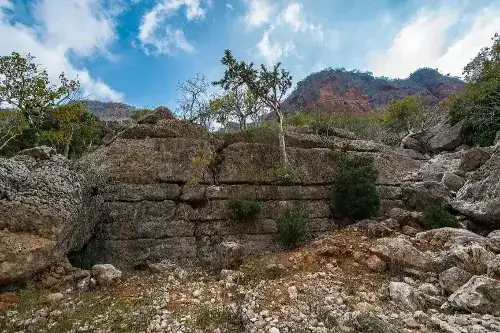
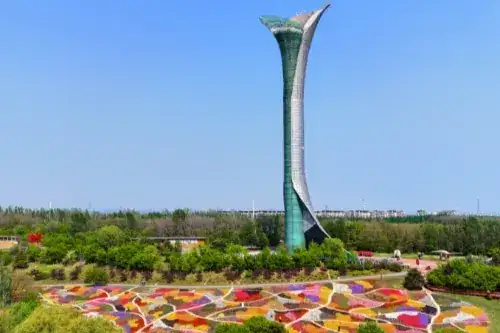
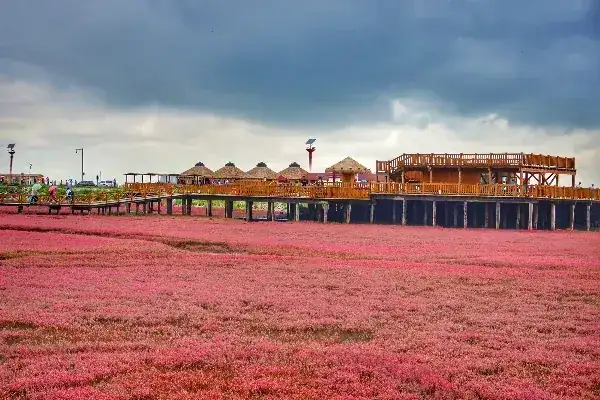
Notable attractions include Haizhou Temple, Ruiying Temple, the Fuxin Mass Grave Memorial, Haizhou Open-Pit Mine, and Haitang Mountain Scenic Area.
Local Specialties
Fuxin local specialties center on Mongolian cultural heritage and agricultural products, including premium peanuts and Mongolian ethnic cuisine.
Notable Figures
Fuxin is known as the birthplace of Zhang Sanfeng, the legendary Wudang martial arts master.
Important Honors
- 2018: Ranked 34th in China City Innovation Competitiveness
- October 2020: Designated a National Double Support Model City
- August 2022: Selected for the climate investment and financing pilot list
- April 2025: Awarded the National Double Support Model City title
Travel information can change. Check current opening hours, reservations and entry requirements before you travel.

Traveller discussion
Start the conversation with a helpful tip or a question.