
Yingkou City
Yingkou CityYingkou City, a prefecture-level city under Liaoning Province, is an important port city on the Liaoning Coastal Economic Belt. Located in the southern part of Northeast China, at the center of the Liaodong Peninsula, on the eas
Yingkou City
Yingkou City, a prefecture-level city under Liaoning Province, is an important port city on the Liaoning Coastal Economic Belt. Located in the southern part of Northeast China, at the center of the Liaodong Peninsula, on the eastern shore of the Bohai Sea, and at the mouth of the Daliao River, it covers a total area of 5,427 square kilometers. As of July 2022, Yingkou administers 4 municipal districts and 2 county-level cities. The Yingkou dialect is a branch of Jiao-Liao Mandarin. As of the end of 2024, the permanent population was 2.242 million. Yingkou is one of the birthplaces of human civilization—the Jinniushan ancient human site, dating back approximately 280,000 years, bears witness to the earliest civilization in the Liao River basin. It is the only prefecture-level city on the Chinese mainland where one can watch the sun set into the sea. Yingkou was also the first port in Northeast China to open to foreign trade in modern times, the birthplace and issuing site of the Dragon Stamp, the cradle of the Chinese Red Cross movement, and the origin of China's national financial industry. Yingkou is a National Excellent Tourist City and a National Forest City, as well as one of China's four major musical instrument production bases. In 2025, Yingkou's regional GDP reached 157.02 billion yuan (approximately $21.66 billion), up 4.0% from the previous year.
Name Origin
Yingkou's urban area sits at the mouth of the Daliao River. During the Kangxi reign of the Qing Dynasty, the imperial court permitted the Mongolian Barga people to graze here. The Barga people's shelters clustered together, resembling military camps from a distance, leading locals to call the area "Yingzi" (camp). Because the tidal channels dried at low tide and flooded at high tide, the place was named "Meigou Ying" (channel-less camp). "Yingkou" is an abbreviation of "Meigou Yingkou" (the port of Meigou Ying), as used in early Qing government documents. In the fifth year of the Tongzhi reign (1866), the Qing government established the Fengjin Shanhaiguan Circuit in Yingkou, administering foreign affairs and taxation from Shanhaiguan in the west to the Yalu River estuary in the east. In the sixth year of Tongzhi (1867), the Qing government added the Yingkou Coastal Defense Sub-Prefecture, the first official institution named with the characters "Yingkou."
History
Pre-Qin Period
The Yingkou area has a long history. As early as the Paleolithic Age, 260,000 years ago, ancestors of Yingkou lived and multiplied here. Over 5,000 years ago, during the legendary era of Yao and Shun, the area belonged to Qingzhou and Yingzhou. During the Xia, Shang, and Zhou dynasties, it was administered by Qingzhou, Yingzhou, and Youzhou. During the Warring States Period, the Yan state ruled present-day Liaoning Province, and Yingkou belonged to Liaodong Commandery.
Qin and Han to Northern and Southern Dynasties
After Qin unified China, establishing 36 commanderies, the Yingkou area remained under Liaodong Commandery. In 195 BC (the 12th year of Han Gaozu), the Han Dynasty established Pingguo County in present-day Xiongyue in southern Yingkou, Anshi County in present-day Dashiqiao, and Wen County in present-day Gaizhou—the earliest county-level administrations in the region. At the end of the Eastern Han, northern China fragmented into ethnic regimes. The Yingkou area successively came under the Gongsun regime, Former Yan, Former Qin, and Later Yan. In 385 AD, the Xianbei Later Yan regime moved the Pingzhou seat to Pingguo, overseeing Liaodong, Xuantu, Liaoxi, Changli, Lelang, and Daifang commanderies—the only time a local government in the Yingkou area administered the entire Northeast, eastern Hebei, and western Korea beyond the Taedong River.
Sui, Tang to Song and Yuan
In the early 10th century, the Khitan established the Liao Dynasty in northern China. Liao rulers relocated two capitals, eight prefectures, and thirty-two prefectures from the former Balhae Kingdom to the Liaoxi and Liaodong regions, bringing Chenzhou, Luzhou, Tiezhou, Guizhou, Yaozhou, and Ningzhou to Yingkou. In 1115, the Jurchen leader Wanyan Aguda proclaimed himself emperor and founded the Jin Dynasty. After the Liao fell in 1125, the Jin inherited its northeastern territories. In 1195, Chenzhou was renamed Gaizhou, administering Tangchi, Jian'an, Xiuyan, and Xiongyue counties. Under the Yuan Dynasty, the area belonged to the Liaoyang Route.
Ming and Qing Dynasties
In 1376, the Ming Dynasty abolished prefectures and established guards. The Gaizhou Guard administered a vast territory, and Gaizhou City served as the military, political, economic, and cultural center of the Yingkou region. In 1664, the Qing Dynasty established Gaiping County under Fengtian Prefecture. Yingkou had no independent administrative district; its port area was jointly administered by Haicheng and Gaiping counties. In 1909, the Qing government abolished the Yingkou Coastal Defense Sub-Prefecture and established the Yingkou Directly-Administered Department, giving Yingkou its first independent local administration.
Republic of China Period
In 1913, the Beiyang government reformed the administrative system, converting Yingkou Directly-Administered Department into Yingkou County. In 1938, the Japanese puppet regime renamed Yingkou County as Yingkou City with 8 districts. On October 20, 1945, Yingkou was first liberated, and a democratic government was established. On November 2, 1948, Yingkou was fully liberated. On May 1, 1949, the democratic government was renamed the Yingkou Municipal People's Government.
After the Founding of the PRC
In 1959, Gaiping County, Panshan County, and the Panjin Reclamation Bureau were placed under Yingkou's jurisdiction. Over the following decades, administrative boundaries shifted multiple times. In 1985, Panshan and Dawah counties were transferred to the newly established Panjin City. Yingkou then administered Gaixian, Yingkou County, and four districts: Zhanqian, Xishi, Laobian, and Bayuquan. In 1992, Gaixian was renamed Gaizhou City (county-level) and Yingkou County was renamed Dashiqiao City (county-level). In 2004, three towns from Gaizhou were transferred to Bayuquan District.
Physical Geography
Location
Yingkou is located at the center of the Liaodong Peninsula, on the left bank of the Liao River estuary, facing the Bohai Sea's Liaodong Bay to the west. It borders Huludao across the sea, Panjin and Anshan to the north, and Dalian to the south. Coordinates: 121 degrees 56 minutes to 123 degrees 2 minutes E, 39 degrees 55 minutes to 40 degrees 56 minutes N. The city spans 111.8 km north-south and 50.7 km east-west, with a total area of 5,427 sq km.
Climate
Yingkou has a continental monsoon climate with long, cold winters; warm, rainy summers; dry, windy springs; and cool, pleasant autumns. It falls within the warm temperate zone with a sub-humid climate. The annual average temperature is 7 to 9.5 degrees Celsius, with annual precipitation of 650 to 800 mm and annual sunshine of 2,600 to 2,880 hours.
Geology
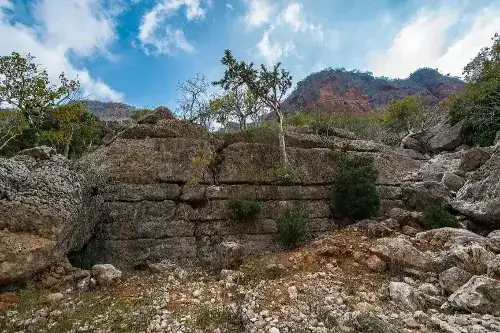
Yingkou lies on a NE-trending fault zone of the marginal-Pacific fracture system, with abundant hot spring resources, particularly in the Xiongyue area, where typical marine erosion remnants and rich thermal springs form unique tourist attractions. The area has experienced four sea-level changes, forming four distinct marine erosion terraces and creating distinctive hills such as Wang'ershan, Manshoushan, and Chahushan.
Topography
The terrain slopes from southeast to northwest: eastern mountains (100 to 1,000 m elevation), central hills (50 to 200 m), and western plains (2 to 10 m), accounting for 27%, 31.6%, and 41.4% of the total area respectively. The highest peak is Buyun Mountain at 1,130.7 m; the lowest point is the riverbed of Shifo Town in Dashiqiao at 1.2 m elevation.
Hydrology
Yingkou has over 150 rivers, including the large Daliao River and medium-sized Daqing and Biliu rivers. The water systems are divided between the Bohai Sea system (Daliao, Daqing, Sha, Xiongyue, and Fudu rivers) and the Yellow Sea system. The city has 1 large reservoir (Shimen), 3 medium reservoirs, and 33 small reservoirs.
Soil
Yingkou has 6 main soil types: brown earth, meadow soil, paddy soil, saline soil, aeolian sandy soil, and marsh soil, further classified into 12 subtypes, 37 soil genera, and 67 soil species. Brown earth is the zonal soil with the widest distribution. The soil distribution follows a regular southeast-to-northwest pattern: brown earth in the southeastern mountains and central hills, paddy soil in the northwestern plains, and aeolian sandy and saline soils in the western coastal plains.
Natural Resources
Water Resources
Yingkou has 205 rivers, with the Daliao, Daqing, and Biliu being the major ones. In 2022, total precipitation was 4.733 billion cubic meters (882.2 mm depth), 28.7% above the multi-year average. Surface water resources totaled 1.585 billion cubic meters, groundwater 428 million cubic meters, and total water resources 1.672 billion cubic meters.
Land Resources
Total land area: 541,568.08 hectares. Agricultural land comprises 75.8% (410,483.66 ha), including 119,460.93 ha of cultivated land. Construction land accounts for 18.2% (98,618.3 ha), and unused land 6% (32,466.12 ha). The western plains and central hills are major grain-producing areas, making Yingkou a quality grain production base for Liaoning Province.
Mineral Resources
As of 2015, 43 mineral types have been discovered, including metals (gold, silver, copper, iron, lead, zinc, etc.), non-metals (magnesite, pyrite, barite, granite, etc.), energy minerals (petroleum, geothermal), and mineral water. Proven reserves include 2.94 billion tons of magnesite, 500 million tons of metallurgical dolomite, and 25 billion cubic meters of granite.
Biological Resources
Forest coverage is 45.01%, with over 170 tree species including Korean pine, larch, Chinese pine, spruce, cypress, poplar, willow, elm, birch, and Manchurian ash. Over 700 medicinal plant species are found, including polygonatum, dictamnus, and clematis. Wildlife includes 240+ bird species, with black stork, white stork, and red-crowned crane under national first-class protection.
Marine Resources
Yingkou has 122 km of coastline, 1,542 sq km of jurisdictional waters, and 132 sq km of tidal flats. Over 400 marine species inhabit coastal waters, including prawns, krill, and jellyfish. The city has nearly ten beach tourism areas and multiple sites with marine wind energy potential.
Administrative Divisions
Evolution of Divisions
Yingkou's administrative divisions underwent numerous changes from 1938 onward. In 1938, the city established 8 districts. After liberation in 1948, the old divisions were abolished and new districts created. In 1958, the urban area was reorganized into Zhanqian, Xinhua, and Xishi districts plus a suburban area. In 1984, Bayuquan District was carved out of Gaixian, and the suburban area was renamed Laobian District. In 1992, Gaixian became Gaizhou City and Yingkou County became Dashiqiao City. In 2004, three towns from Gaizhou were transferred to Bayuquan District.
Current Divisions
As of July 2022, Yingkou administers 4 districts (Zhanqian, Xishi, Laobian, Bayuquan) and 2 county-level cities (Dashiqiao and Gaizhou), comprising 35 towns, 3 townships, 27 sub-districts, 644 villages, and 182 communities. The municipal government is seated at No. 1 East Xinlian Avenue, Xishi District.
Politics
Population
Population Size
According to the Seventh National Census (November 1, 2020), the permanent population was 2,328,582. As of end 2024, the permanent population was 2.242 million, of which 1.539 million (68.65%) were urban and 703,000 (31.35%) rural. Births: 9,279 (rate 4.14 per mille); deaths: 20,137 (rate 8.98 per mille); natural growth rate: -4.84 per mille.
Ethnic Groups
The Seventh National Census recorded 46 ethnic groups in Yingkou. Minority populations total 162,000 (6.96% of the total). The five largest minorities are Manchu (127,540), Hui (11,630), Korean (8,521), Mongolian (8,373), and Xibe (1,480).
Language
The Yingkou dialect is a branch of Jiao-Liao Mandarin, specifically the Gai-Huan sub-group of the Ying-Tong slice, situated in the transition zone between Northeastern Mandarin and Jiao-Liao Mandarin.
Religion
Major religions include Buddhism, Islam, Catholicism, and Protestantism. Yingkou has 36 Buddhist temples, with the oldest dating to the Tang Dynasty. Catholicism arrived in 1696, making Yingkou the earliest site of Catholic activity in Northeast China. Protestantism was introduced in 1852, also the earliest in the region.
Economy
Overview
In 2024, Yingkou's regional GDP reached 156.03 billion yuan (approximately $21.52 billion), up 5.1%. The primary, secondary, and tertiary sectors contributed 12.10 billion yuan (approximately $1.67 billion, +4.6%), 52.84 billion yuan (approximately $7.29 billion, +2.8%), and 91.09 billion yuan (approximately $12.56 billion, +6.5%) respectively, accounting for 7.8%, 33.9%, and 58.4% of GDP. Per capita GDP was 69,223 yuan (approximately $9,555), up 6.2%. Fixed asset investment grew 7.3%. General public budget revenue was 14.06 billion yuan (approximately $1.94 billion, +2.5%), and expenditure was 24.79 billion yuan (approximately $3.42 billion, -1.3%).
Primary Industry
In 2024, grain crops covered 93.1 thousand hectares. Rice: 41.1 thousand ha; corn: 47.7 thousand ha. Grain output was 750,000 tons (down 1.4%). Rice: 394,000 tons; corn: 343,000 tons. Fruit output (including melons) was 1.218 million tons, up 7.7%. Pork, beef, mutton, and poultry meat: 273,000 tons (+3.5%). Aquatic products: 564,000 tons, including 388,000 tons of mariculture and 131,000 tons of freshwater aquaculture.
Secondary Industry
In 2024, above-scale industrial value-added grew 0.8%, with high-tech manufacturing up 19.9%. By ownership: state-controlled enterprises +3.7%; joint-stock +2.8%; foreign/Hong Kong-Macau-Taiwan -4.8%; private +9.0%. By sector: mining +4.4%; manufacturing +0.2%; power, heat, gas, and water +8.3%. Major industries: steel and deep processing (31.7%), petrochemicals (20.7%, +11.4%), magnesite (14.1%, +2.5%), aluminum (11.2%), equipment manufacturing (10.7%, +17.8%). Pig iron: 14.558 million tons; crude steel: 15.139 million tons; steel products: 14.325 million tons. Above-scale industrial revenue was 212.74 billion yuan, down 8.3%.
Tertiary Industry
In 2024, total retail sales of consumer goods reached 49.27 billion yuan (approximately $6.80 billion), up 6.9%. Urban retail: 43.00 billion yuan (+6.7%); rural: 6.27 billion yuan (+8.0%). Total import and export value was 45.44 billion yuan (approximately $6.27 billion), down 4.8%; exports 23.94 billion yuan (+3.4%), imports 21.49 billion yuan (-12.6%). Foreign investment utilized: $4.19 million. As of end 2024, financial institution deposits totaled 396.07 billion yuan (approximately $54.63 billion), and loan balance was 203.06 billion yuan (approximately $28.01 billion). Insurance premium income was 6.86 billion yuan (approximately $946 million), up 4.7%.
Economic Functional Zones
Yingkou has 20 key industrial parks across 13 major industries. The Yingkou Economic and Technical Development Zone, approved as a national-level zone in October 1992, covers 268 sq km on the eastern shore of Liaodong Bay with 520,000 residents. In 2020, its GDP was 37 billion yuan. It serves as a central node of the Bohai Rim Economic Circle and the Liaoning Coastal Economic Belt. In 2019, it was selected as a port-type national logistics hub carrying city, and in 2020 became the only city in Northeast China approved for the national advanced manufacturing and modern services integration pilot.
Social Affairs
Science and Technology
In 2024, technology contract transaction value reached 1.70 billion yuan. There were 443 high-tech enterprises and 220 gazelle startups. The city had 143 innovation platforms, including 6 provincial key laboratories and 35 provincial technology innovation centers.
Education
As of end 2024, Yingkou had 684 schools (excluding higher education) with 246,000 students. Higher education institutions include Yingkou Institute of Technology, Yingkou Vocational and Technical College, and Liaoning Agricultural Vocational and Technical College.
Healthcare
As of end 2024, there were 2,662 health institutions, including 132 hospitals, 47 health centers, 9 CDCs, and 149 community health service centers. Licensed physicians numbered 7,404 and registered nurses 7,606. Total annual outpatient visits: 8.263 million.
Culture
As of end 2024, there were 8 cultural centers, 8 public libraries, and 5 museums. Urban cinemas: 20, with 241,000 screenings and 1.545 million viewers.
Sports
In 2018, Yingkou hosted the Bayuquan International Marathon (a national gold-label event with over 18,000 participants), the China Champions League opening ceremony, and the China Volleyball Super League. In 2024, 350 athletes competed in 21 provincial tournaments and 2 national events, winning 25 gold, 29 silver, and 40 bronze medals. New sports venues: 233, with 2.91 sq m per capita.
Social Security
As of end 2024, urban employee pension insurance covered 1.162 million people; basic medical insurance 1.921 million; work injury insurance 440,000; unemployment insurance 328,000. The city had 170 residential social service institutions with 14,000 beds, caring for 7,000 people. Welfare lottery sales totaled 410 million yuan.
Transportation
Overview
Yingkou possesses multiple transport modes—port, airport, high-speed rail, expressway, and pipeline—designated by the State Council as a national comprehensive transport hub and a port-type national logistics hub. In 2024, highway freight was 257.19 million tons (+11.3%), waterway freight 2.81 million tons (+47.1%), highway passengers 26.53 million (+8.1%), and port cargo throughput 220 million tons with 5.56 million TEU containers.
Highways
Three expressways traverse the city: Shenhai (G15), Naiying (G4513), and Zhuanggai (S19), along with four national highways and numerous provincial roads. The city has 46 passenger stations.
Railways
High-speed rail includes the Harbin-Dalian and Panjin-Yingkou lines; conventional rail includes the Changda, Shaba, and Yingkou-Dashiqiao lines. Dashiqiao Station handles 64 trains daily, connecting to cities across Northeast China and major cities nationwide. Yingkou East Station, at the junction of the two high-speed lines, serves 65 daily high-speed trains with direct connections to Beijing, Shanghai, Xi'an, and other major cities.
Aviation
Yingkou Lanqi Airport, a 4C-standard airport with a 2,600-meter runway, serves business, tourism, and cargo needs. Routes connect to Shanghai Pudong, Beijing, Shenzhen, Chengdu, Harbin, and other cities.
Water Transport
Yingkou Port, the closest sea outlet for the Northeast interior and China's ninth-largest coastal port, has operated since 1861. It comprises 5 port areas with 78 berths, including two 300,000-ton-class berths. It maintains shipping relations with over 140 ports in 50+ countries and operates 40+ domestic sea-rail intermodal container services. International passenger-cargo ferry service connects to Incheon, South Korea.
Public Transit
The city operates 112+ bus routes, with 57 serving the central urban area. A water bus connects the north and south banks of the Liao River, running every 40 minutes from 6:00 to 19:00 with a 1-yuan fare and 15-minute crossing time. The water bus operates seasonally, closing in winter when passengers can take bus route 501 to the Hebei office.
Culture
Cuisine
Yingkou cuisine is rooted in Shandong cuisine, incorporating official, temple, and regional influences. Lighter and slightly sweeter than typical Northeastern cuisine, it emphasizes presentation. Signature dishes include stir-fried crab with ginger and scallion, stewed tofu with sea catfish, and stewed cabbage with Spanish mackerel. The city's coastal location makes seafood a staple—raw marinated shrimp and crab, known as "Yingkou preserved goods," are local specialties. Grilled beef, served with sweet dipping sauce, is another beloved dish. Notable local products include Yingkou rice, soybean paste, Gaizhou apples, Xiongyue grapes, and Wang'ershan wine.
Customs
The Spring Dragon Festival (the second day of the second lunar month) features the tradition of hanging "dragon tails" before sunrise. Families eat dumplings, children get haircuts ("shaving the dragon's head"), and pork head is eaten in the evening. During the Lantern Festival, households in Dashiqiao and Gaizhou craft flour lamps—"gold lamps" from corn flour and "silver lamps" from buckwheat flour, along with sweet potato and radish lamps.
Regional Symbols
The city tree of Yingkou is the weeping willow, valued for its ornamental quality in landscaping and its resistance to toxic gases.
Historical Sites
The Jinniushan Hominid Cave Site in Dashiqiao is the earliest Paleolithic site discovered in Northeast China and a national-level protected cultural relic. Excavations revealed hominid fossils (55 pieces, including a complete skull) dating to 200,000 to 600,000 years ago, listed among the world's top ten scientific advances of 1984. The West Battery (Xipaotai), built 1882 to 1888 during the Qing Dynasty, is a key modern coastal defense installation and national-level protected site with 52 cannons and 900+ meters of walls. Lengyan Zen Temple (1922 to 1931) is one of Liaoning's best-preserved large Republican-era temple complexes, covering 10,000 sq m with 99 halls. Chongjiao Temple in Gaizhou, dating to 1383, is a provincial-level protected site. Wanghai Temple on Qinglong Mountain features granite construction and stone-carved couplets.
Scenic Spots
Overview
Yingkou is a National Excellent Tourist City and National Forest City with rich tourism resources—"mountains, sea, rivers, forests, springs, and temples" complementing each other. The eastern area features scenic peaks; the west has fine sandy beaches (one of only two such white-sand beaches in the Bohai Bay); the south offers hot spring resorts and beach bathing areas; the north features the Qing-era coastal battery and century-old Liao River Old Street.
Major Attractions
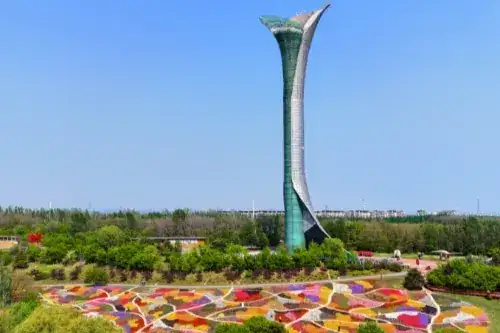
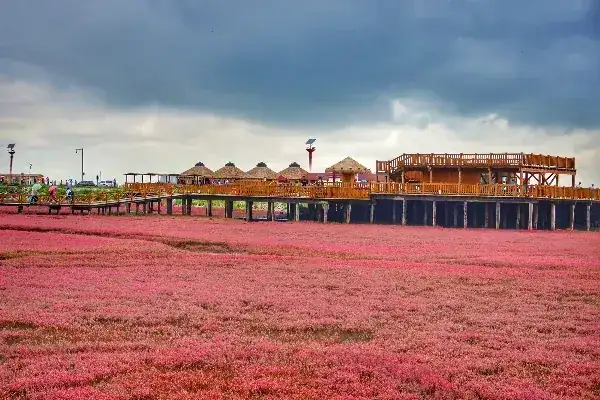
Notable attractions include Beihai National Marine Park (AAAA-level, 208-hectare marine special protection zone), the Liao River Old Street (1.3 km, known as "Northern Little Shanghai" for its 19th-century foreign consulates and commercial heritage), Moon Lake Park (91-hectare marine-themed park), the Red Carpet (alkali glasswort turning crimson along estuary tidal flats), Chishan Scenic Area (AAAA-level, with peaks, caves, springs, and Longtan Temple), Wang'ershan Tourist Area (AAAA-level, themed around maternal love, with the annual Mother's Festival since 1995), Shanhai Square (with the Bayuquan Princess sculpture and Bohai Pearl observation deck), and hot spring resorts including Jintaicheng and Hongxigu.
External Exchange
Famous People
Honorary Titles
Yingkou has received numerous honorary titles, including "China's Most Valuable Investment and Business City (Regional)" (July 2019), National Double Support Model City (October 2020), and "China's Happiest City" (December 2022). In April 2020, the State Council approved the establishment of a comprehensive cross-border e-commerce pilot zone in Yingkou.
Travel information can change. Check current opening hours, reservations and entry requirements before you travel.

Traveller discussion
Start the conversation with a helpful tip or a question.