
Jinzhou City
Jinzhou CityJinzhou City, a prefecture-level city under Liaoning Province, is located in the eastern part of the Eurasian continent, in China's Northeast region, southwestern Liaoning, on the northern shore of the Bohai Sea, and at the east
Jinzhou City
Jinzhou City, a prefecture-level city under Liaoning Province, is located in the eastern part of the Eurasian continent, in China's Northeast region, southwestern Liaoning, on the northern shore of the Bohai Sea, and at the eastern end of the Liaoxi Corridor. The terrain features undulating mountain ranges with higher elevations in the northwest and lower in the southeast, characterized by a warm temperate semi-humid climate. The total area is 10,301 square kilometers. As of October 2025, Jinzhou administers 3 districts, 2 counties, and 2 county-level cities. As of end 2025, the permanent population was 2.575 million. Jinzhou is designated by the State Council as the central city of western Liaoning, an important industrial city, and a transportation hub in Northeast China. It is also a key port city in the Liaoning Coastal Economic Belt, with over 2,000 years of history, first named during the Liao Dynasty. In 1949, Liaoxi Province was established with Jinzhou as its capital, making it a regional political, economic, and cultural center. Jinzhou has developed a comprehensive transportation network encompassing air, sea, rail, road, and pipeline transport, serving as a distribution center for the Liaoxi region, and housing Asia's largest grape cultivation and fresh storage base. Jinzhou Port is a national energy port and regional hub. In 2025, Jinzhou's regional GDP reached 136.53 billion yuan (approximately $18.83 billion, at 7.25 CNY/USD as of August 2026), up 4.6% at constant prices. The primary industry added 22.66 billion yuan ($3.12 billion), up 3.5%; the secondary industry 36.15 billion yuan ($4.98 billion), up 2.4%; and the tertiary industry 77.73 billion yuan ($10.72 billion), up 5.9%.
History
Jinzhou has a long history. Archaeological evidence confirms human habitation since ancient times, with close ties to Central Plains culture.
During the Xia, Shang, and Zhou dynasties, the area belonged to Ji and You prefectures. In the Spring and Autumn period, it belonged to the Yan state. During the Warring States period, it was part of Yan's Liaoxi Commandery. Under the Qin and Western Han, it was divided between Liaoxi and Liaodong commanderies. During the Eastern Han, most of the area belonged to the Liaodong Protectorate. In the Three Kingdoms period, it was under Youzhou's Changli Commandery. During the Jin Dynasty, it belonged to Pingzhou's Changli Commandery.
Under the Sui Dynasty, the western part belonged to Liucheng Commandery (present-day Chaoyang) and the eastern part to Yan Commandery. In the early Tang Dynasty, the area was under the Yingzhou military administration, later the Andong Protectorate, then the Pinglu Military Commissioner. During the Liao Dynasty (911–926 CE), Emperor Taizu Yelü Abaoji "established Jinzhou with Han captives," giving the city its name.
Under the Jin Dynasty, the area belonged to Beijing Circuit. During the Yuan Dynasty, it was divided between Daning Route and Guangning Prefecture Route. In the Ming Dynasty, Guangning Guard and military posts were established under the Liaodong Regional Military Commission. In 1662, Qing Emperor Kangxi merged three guards into Jin County; in 1665, Jinzhou Prefecture was set up.
After the Republic of China was founded, counties were administered under Fengtian Province, renamed Liaoning in 1929. After the Mukden Incident of September 1931, Jinzhou fell to Japanese occupation in January 1932. The puppet Manchukuo regime established a puppet Jinzhou Province in 1934. In 1937, Jinzhou City was formally established under the puppet regime. The Chinese Communist Party led the people in establishing the Ji-Re-Liao Anti-Japanese Base, with the Northeast Anti-Japanese United Army's First Route Army fighting bravely in Liaoning.
After the Anti-Japanese War, the Communist Party briefly established the Liaoxi Commissioner's Office and Jinzhou government. In October 1948, Jinzhou was liberated during the Liaoxi-Shenyang Campaign. In January 1949, Liaoxi Province was established with its capital in Jinzhou. In August 1954, Liaodong and Liaoxi provinces merged into Liaoning Province, and Jinzhou became a provincially administered city. In 1968, the city-administered-county system was adopted. In 1980, the Jinzhou Municipal People's Government was formally established.
Administrative Divisions
As of October 2025, Jinzhou administers 3 districts (Guta, Linghe, Taihe), 2 counties (Heishan, Yi County), and 2 county-level cities (Linghai, Beizhen). Two functional zones — Binhai New Area (Development Zone) and Songshan New Area (High-Tech Zone) — are administratively part of Taihe District. The city has 12 townships, 55 towns, 32 sub-districts, 251 communities, and 1,103 administrative villages. The municipal government is seated at No. 68 Shifu Road, Taihe District.
Geography
Location
Jinzhou is located in southwestern Liaoning, on the northern shore of the Bohai Sea, at the eastern end of the Liaoxi Corridor, serving as a transportation hub connecting North and Northeast China. Geographic coordinates range from 120°44′–122°36′E and 40°47′–42°08′N, measuring 188 km diagonally, 143 km east to west, and 114 km north to south. It borders Chaoyang and Fuxin to the north (separated by the Songling and Yiwulü Mountains), neighbors Shenyang, Panjin, and Anshan to the east (across the Raoyang River), faces Yingkou and Dalian across the Liaodong Bay to the south, and connects to Huludao to the west via Hongluo Mountain. Total area is 10,301 square kilometers with 124 km of coastline.
Terrain
The terrain slopes from northwest to southeast, featuring low mountain areas, hilly areas, and alluvial plains. The Yiwulü Mountains in the northeast and the Songling Mountains in the northwest form the skeletal framework. Rivers extend from the northwest to the southeast, creating an interlocking pattern of mountainous hills and river valleys.
Climate
Jinzhou has a warm temperate semi-humid continental monsoon climate with four distinct seasons. The annual average temperature ranges from 7.8 to 9.0°C, with an extreme high of 41.8°C and extreme low of -31.3°C. The frost-free period lasts 144–180 days. Annual precipitation averages 567 mm, with 60–70% concentrated in summer.
Hydrology
Jinzhou's major river systems (drainage area exceeding 3,000 sq km) include the Liugu, Xiaoling, Daling, and Raoyang rivers. Rivers originating within Jinzhou with drainage areas of approximately 500 sq km include the Shihe, Gouhe, Yantaihe, and Xingchenghe rivers. The coastline runs parallel to the Liaoxi Corridor along the northern Bohai Sea's Liaodong Bay, with relatively straight shores and few peninsulas, islands, or bays. Juhua Island off Xingcheng is the largest island, Huludao the largest peninsula, and Jinzhou Bay the largest gulf.
Natural Resources
Plant Resources
Jinzhou has 1,097 wild plant species across 115 families and 507 genera, most with economic value. The northwest low-mountain and hilly areas feature Chinese pine, Mongolian oak, and Liaodong oak alongside shrubs like vitex and wild jujube. Plains are mainly agricultural weeds, while coastal saline-alkali areas support salt-tolerant plants including tamarisk and seepweed.
Animal Resources
Jinzhou has approximately 226 insect species, 5 amphibian species, 14 reptile species, 183 bird species across 44 families, and 26 mammal species. Nationally protected wildlife includes red-crowned cranes, black storks, Oriental white storks, golden eagles, gray cranes, white-naped cranes, great swans, mandarin ducks, and goshawks. In 2026, an Arctic gull was recorded during wintering waterbird monitoring.
Mineral Resources
Jinzhou has discovered 48 mineral types, including 5 strategic resources: coal, iron, gold, fluorite, and crystalline graphite. Key advantage minerals include bentonite, fluorite, gold, and decorative granite. Coal is mainly in Heishan's Badaohao and Yi County's Jiudaoling; iron along the Yiwulü Mountains; fluorite in western Yi County; bentonite in Heishan's Shili and Yi County's Toutai; graphite near Beizhen's Dutun; and granite in Linghai, Yi County, and Beizhen.
Population
As of end 2025, Jinzhou's permanent population was 2.575 million, with registered population at 2.731 million. Urban registered population was 1.154 million (42.3%) and rural 1.577 million (57.7%). By gender: males 1.349 million (49.4%), females 1.382 million (50.6%). By age: 0–17 years 275,000 (10.1%), 18–34 years 425,000 (15.5%), 35–59 years 1.087 million (39.8%), and 60+ years 945,000 (34.6%). Major ethnic minorities include Manchu, Mongolian, Hui, Xibe, and Korean.
Politics
The Jinzhou Municipal People's Government serves as the city's administrative authority, operating under the leadership of the Liaoning Provincial Government.
Economy
Overview
In 2025, Jinzhou's GDP reached 136.53 billion yuan (approximately $18.83 billion), up 4.6% at constant prices. The three-sector ratio was 16.6:26.5:56.9. Fixed asset investment decreased 23.4%. General public budget revenue was 12.66 billion yuan ($1.75 billion), up 4.3%. General public budget expenditure was 26.20 billion yuan ($3.61 billion), down 15.1%, with social security spending at 6.70 billion yuan and education at 3.32 billion yuan.
Primary Industry
In 2025, grain crops were sown on 368,100 hectares, producing 2.626 million tons (up 2.5%). Corn output was 2.234 million tons and rice 344,000 tons. Vegetables and edible fungi yielded 3.371 million tons, fruit 986,000 tons, and meat 576,000 tons. Aquaculture output was 209,000 tons (up 4.1%). Agricultural machinery totaled 3.506 million kilowatts with 39,000 tractors.
Secondary Industry
Above-scale industrial value-added grew 10.7%, with manufacturing up 11.7% and mining up 18.3%. Key products included animal feed at 998,000 tons (up 21.7%), sponge titanium at 24,000 tons (up 6.2%), and electricity generation at 11.73 billion kWh (up 11.5%). Construction contract value reached 15.02 billion yuan ($2.07 billion), down 17.0%.
Tertiary Industry
In 2025, total retail sales of consumer goods reached 40.03 billion yuan ($5.52 billion), up 2.5%. Total import and export volume was 11.42 billion yuan ($1.58 billion), up 35.4%. Actual foreign investment used was $3.43 million. Postal service revenue was 1.25 billion yuan ($172 million), up 15.9%, with 148.28 million express deliveries. Financial institutions' deposits reached 422.57 billion yuan ($58.29 billion), with household deposits at 379.91 billion yuan ($52.40 billion). Loans reached 129.59 billion yuan ($17.88 billion). Insurance premium income was 6.88 billion yuan ($949 million), up 2.1%.
Social Affairs
Education
As of end 2025, Jinzhou had 712 schools with 328,000 students, including 9 regular higher education institutions (109,000 students), 10 vocational secondary schools, 27 regular high schools, 101 junior high schools, 133 primary schools, 424 kindergartens, and 8 special education schools.
Science and Technology
Jinzhou has 1 national high-tech development zone, 230 high-tech enterprises, and 3,000 registered technology-based SMEs. The city holds 1,762 valid invention patents and 1,300 domestic patent grants. It hosts 25 provincial key laboratories and 45 provincial industry innovation centers.
Healthcare
Jinzhou has 2,614 health institutions including 119 hospitals, 81 health centers, and 1,703 village clinics, with 26,411 health professionals and 22,294 hospital beds.
Culture
The city has 8 public cultural centers, 9 public libraries (2.179 million books), and 9 museums. It operates 1 municipal television and radio station with 3 radio channels (99.7% coverage) and 2 TV channels (99.8% coverage).
Sports
Jinzhou hosted the 10th Liaoning Provincial Games in 2006 with 18,000 participants from 14 cities. As of end 2025, the city has 8 stadiums, 892 urban fitness paths, and 1,594 rural fitness projects. Sports lottery sales reached 320 million yuan.
Social Security
In 2025, per capita disposable income was 36,040 yuan ($4,971), up 5.5%. Urban residents earned 44,147 yuan ($6,091) and rural residents 25,230 yuan ($3,481). The city provided subsistence allowances to 81,000 people across 57,000 households, disbursing 390 million yuan ($53.8 million). There were 197 residential eldercare institutions with 12,000 beds.
Environmental Protection
In 2025, Jinzhou's air quality excellent rate was 86.8%. PM2.5 annual average concentration rose 2.4%. Water quality at 9 national monitoring sections showed 88.9% excellent rate with no Grade V water. Nearshore water quality was 60.1% excellent. Daytime noise averaged 46 dB (down 9 dB) and nighttime 41 dB (down 5 dB).
Transportation
Overview
Jinzhou is located at the eastern end of the Liaoxi Corridor, serving as a transportation hub connecting North and Northeast China. The Qinhuangdao-Shenyang high-speed railway, Beijing-Harbin Railway, and multiple expressways converge here. Jinzhou is the only city in Northeast China with sea port, airport, railway, highway, and pipeline transport, forming a "one-hour city cluster" with neighboring cities.
Highway
In 2025, highway freight volume was 187.87 million tons (up 10.6%) with freight turnover of 25.79 billion ton-km (up 7.9%). Highway passenger volume was 18.27 million (down 13.0%).
Railway
Jinzhou is served by the Beijing-Harbin Railway and the Qinhuangdao-Shenyang passenger dedicated line, both major arteries of China's rail network.
Aviation
Jinzhou Bay Airport (IATA: JNZ, ICAO: ZYJZ), located in Linghai City, is a 4C-level domestic regional airport and China's first airport planned with unified aviation industrial park layout. Opened in December 2015, it features a 10,000 sqm terminal, 6 parking stands, and a 2,500m runway designed for 800,000 annual passengers. In 2025, it handled 285,000 passengers (up 2.6%) and 607.7 tons of cargo, operating 4 routes to 5 cities.
Water Transport
Jinzhou Port is China's northernmost international commercial port on the Bohai Sea coast and the country's first jointly-stock port. Its hinterland covers western Northeast China, eastern Inner Mongolia, Mongolia, and Russia's Far East. The port has 15 production berths including a 250,000-ton oil berth and a 100,000-ton bulk cargo berth, with shipping relations with over 80 countries and regions. In 2025, port cargo throughput was 100.99 million tons (up 0.9%) and container throughput 1.575 million TEU (down 10.3%).
Public Transportation
As of end 2025, Jinzhou had 1,026 public buses, 5,573 taxis, 807 road passenger vehicles, and 42,684 road freight vehicles. Private automobile ownership reached 552,000 out of 620,000 total civilian vehicles.
History and Culture
Overview
Jinzhou is a city with over 2,000 years of history. The famous idiom "an old horse knows the way" (laoma shitu) and the Battle of Songjin both occurred here. The decisive Liaoxi-Shenyang Campaign made Jinzhou a heroic city, and Chairman Mao Zedong's quote — "that place produces apples" — further elevated its national renown.
Jinzhou Campaign
The Jinzhou Campaign in October 1948 was a key assault by the Northeast Field Army of the People's Liberation Army against Nationalist forces during the first phase of the Liaoxi-Shenyang Campaign. It was one of the decisive battles of the Chinese Civil War, with the city's capture being a strategic turning point.
Apple Spirit
Chairman Mao said: "Jinzhou produces apples. During the Liaoxi Campaign in autumn, civilians had many apples, but not a single soldier took one. The soldiers consciously believed that not eating them was noble, while eating them would be base, because these were the people's apples." This story bound the city and the fruit together, with the "apple spirit" becoming synonymous with integrity and discipline.
Historical Architecture
The city walls were first built in 1391 (24th year of Ming Emperor Hongwu) by Commander Cao Feng and gradually reinforced with brick. Successive expansions in 1476 and 1504 established four city gates with a central drum tower axis. The surviving walls roughly follow the late Ming layout, covering about 2.6 square kilometers.
Literature and Arts
Jinzhou is a cradle of ancient Liaoxi culture with seven professional theatrical troupes: puppet theater (1949), Pingju opera (1952), Peking opera (early 1950s), acrobatics, drama, Linghai Arts Troupe, and Heishan local opera.
Local Customs
Jinzhou residents call the solar term Lichun (Start of Spring) "beating spring" (da chun). Folk sayings include "spring arrives at the head of the sixth nine-day period" and "don't rejoice at beating spring, there are still 40 cold days." On Lichun, people eat radishes ("gnawing spring"), spring pancakes with bean sprouts, and lightly whip children with colored-paper brooms to ward off bad luck. Historical records from the Yi County Gazetteer describe the "beating the spring ox" ceremony with paper whips, chanting prayers for favorable weather and national peace.
Scenic Spots
Overview
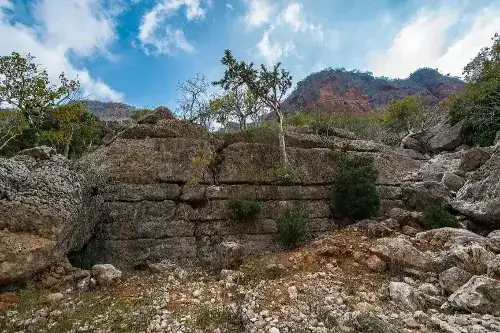
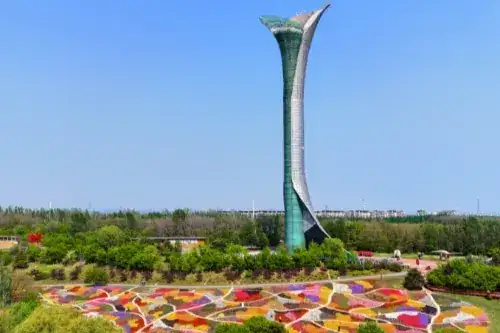
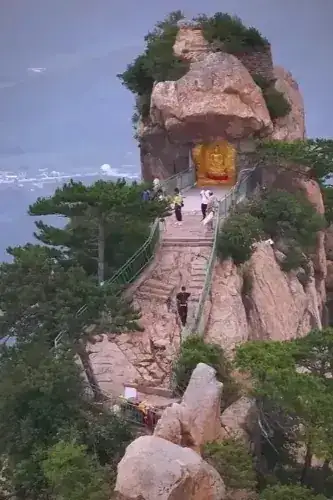
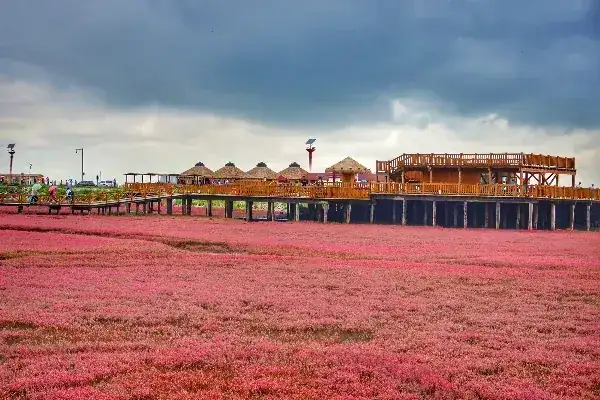
Jinzhou has abundant tourism resources with numerous historic sites. As of January 2023, it has 5 national-level protected cultural heritage sites, 1 national forest reserve, and 48 scenic areas. As of end 2025, Jinzhou has 33 A-level tourist attractions, including 14 at the 4A level.
Eight Views of Jinzhou
The traditional Eight Views of Jinzhou represent the city's most celebrated scenic landscapes, reflecting its rich natural beauty and cultural heritage accumulated over two millennia.
Specialty Products
Jinzhou's local specialties include Jinzhou barbecue, Jinhua roast chicken, Jinzhou mixed pickles, Daoguang 25 tribute liquor, Goubangzi smoked chicken, Jinzhou agate carving, Goubangzi soup dumplings, Beizhen pig trotters, and Beizhen pears.
Famous People
Jinzhou has produced numerous notable historical and contemporary figures across politics, military affairs, arts, and sciences, contributing to the city's rich cultural legacy.
Honorary Titles
Jinzhou has received various national honorary designations recognizing its urban development, environmental protection efforts, and cultural achievements.
Sister Cities
Jinzhou maintains sister-city relationships with several international cities, promoting cultural exchange, economic cooperation, and mutual understanding.
Travel information can change. Check current opening hours, reservations and entry requirements before you travel.
Traveller discussion
Start the conversation with a helpful tip or a question.