
Benxi City
Benxi CityBenxi City, a prefecture-level city under Liaoning Province designated by the State Council as a central city in eastern Liaoning, is located in the southeastern part of the province. It features a mid-temperate humid climate with
Benxi City
Benxi City, a prefecture-level city under Liaoning Province designated by the State Council as a central city in eastern Liaoning, is located in the southeastern part of the province. It features a mid-temperate humid climate with four distinct seasons and covers a total area of 8,413.96 square kilometers. As of April 2025, Benxi administers 4 districts and 2 autonomous counties, with the municipal government seated at No. 188-1 Fengye Road, High-tech Industrial Development Zone. The local dialect belongs to the central Liaoning dialect zone. As of end 2024, the permanent population was 1.229 million. The Benxi area belonged to Qingzhou and Yingzhou during the Xia and Shang dynasties. During the Qin dynasty, the urban area and Benxi County belonged to Xiangping County of Liaodong Commandery, while Huanren County fell under Liaodong Commandery's frontier. In 1906 (32nd year of Guangxu), Benxi County was established. On July 25, 1992, it was approved by the State Council as a "larger city." Benxi is renowned as the "Green Steel Capital," "Pharmaceutical Capital of China," and "City of Maple Leaves," featuring six signature attractions: wondrous caves, famous mountains, scenic waters, hot springs, maple foliage, and folk customs. It was an important base of the Northeast Anti-Japanese United Army and home to the UNESCO World Heritage site of Wunv Mountain City. The city has 51 national A-level scenic areas and is both a China Excellent Tourism City and a China Hot Spring City. As an important old industrial base with rich mineral resources, Benxi's 2025 regional GDP reached 100.6 billion yuan (approximately $13.9 billion), up 3.8% at constant prices, with primary, secondary, and tertiary industry values of 5.94 billion yuan (approximately $819 million), 37.38 billion yuan (approximately $5.16 billion), and 57.28 billion yuan (approximately $7.9 billion), respectively.
Name Evolution
In 1939, Benxihu City was carved out of Benxi County. After the victory of the War of Resistance Against Japan in 1945, a democratic coalition government was established in the Benxi urban area. In 1948, Benxi City was formally established, named after the Benxi Lake within its territory.
History
Pre-Qin Period
According to the Records of the Grand Historian: Biographies of the Xiongnu, during the Warring States period, the Yan state built the Great Wall from Zaoyang to Xiangping and established commanderies including Liaodong to resist northern tribes. At that time, the Benxi urban area and Benxi County were within Xiangping County of Yan's Liaodong Commandery, while Huanren County was in the frontier, under the jurisdiction of the Gaoyi tribe.
Qin, Han to Northern and Southern Dynasties
In 221 BCE, after unifying China, the Qin divided the nation into 36 commanderies; the Benxi area and Benxi County belonged to Xiangping County of Liaodong Commandery, and Huanren County to its frontier. During the Han dynasty, the area fell under Xiangping County of Youzhou's Liaodong Commandery. In 108 BCE, Emperor Wu conquered Gojoseon and established four new commanderies; Huanren belonged to Xuantu Commandery. In 37 BCE, Jumong, a prince of Buyeo, fled to Heshenggu City (present-day Wunv Mountain in Huanren) and founded the Goguryeo kingdom. In 3 CE, the capital moved to Guonei City (present-day Ji'an County, Jilin Province); Heshenggu served as the Goguryeo capital for 40 years. The Huanren area remained under Goguryeo rule until the Tang dynasty. During the Three Kingdoms, Western Jin, and Eastern Jin periods, the Benxi area successively belonged to Liaodong Commandery under Youzhou and Pingzhou. During the Northern and Southern Dynasties and Sui dynasty, it was under Goguryeo rule.
Sui, Tang to Song and Yuan
In 668 CE, the Tang conquered Goguryeo and established the Andong Protectorate. In 820, Dae Joyeong established the Balhae Kingdom, and Huanren belonged to Huan Prefecture of the Western Capital's Yalu Prefecture. In 909, the Khitans occupied Liaodong; in 926, they destroyed Balhae and established the Dongdan Kingdom; in 980, the Dongdan was abolished and replaced with the Tokyo Circuit. In 1125, the Jin dynasty conquered the Liao and reorganized into routes. In 1287, the Yuan dynasty established the Liaoyang Branch Secretariat.
Ming and Qing Periods
In 1371, the Ming dynasty established the Liaodong Guard Military Command. The Benxi area belonged to the Dongning Guard under the Liaodong Regional Military Commission, while Huanren belonged to the Jianzhou Guard under the Nurgan Regional Military Commission. During the Qing dynasty, the area initially belonged to Liaoyang Prefecture. In 1644, it came under Shengjing (later Fengtian Prefecture). In 1877, Huairen County was established. In October 1906, the Qing government formally approved the establishment of Benxi County.
Republic of China Period
In 1914, Benxi and Huanren counties were placed under the Dongbian Circuit of Fengtian Province. In 1928, Zhang Xueliang renamed Fengtian to Liaoning Province. In 1932, the Japanese puppet state of Manchukuo placed Benxi under Fengtian and Huanren under Andong Province. In 1939, Benxihu City was established. On August 15, 1945, Japan surrendered; CCP-led forces entered Benxi on September 18. In 1948, Benxi was fully liberated and the Municipal People's Government was established.
After the Founding of the PRC
In 1952, Benxi County was abolished and merged into Benxi City. In 1953, Benxi City was placed under direct central government administration. In 1954, it was transferred to Liaoning Province. In 1956, Benxi County was re-established under Benxi City. In 1959, Huanren County was placed under Benxi City. In 1966, Huanren was temporarily transferred to Dandong City; in 1968, it returned to Benxi. On July 25, 1992, the State Council approved Benxi as a "larger city."
Administrative Divisions
Division Evolution
In 1950, the urban area was divided into 5 districts. In 1955, Caicun and Gongyuan districts merged to form Pingshan District, while Hedong and Hexi merged to form Benxi District (later renamed Xihu District). In 1984, the urban area was reorganized into 4 districts: Pingshan, Xihu, Mingshan, and Nanfen. In 1989, the State Council approved the establishment of Benxi Manchu Autonomous County and Huanren Manchu Autonomous County.
Administrative Details
As of April 2025, Benxi administers Benxi Manchu Autonomous County, Huanren Manchu Autonomous County, Pingshan District, Mingshan District, Xihu District, and Nanfen District, comprising 18 towns, 5 townships (including 1 ethnic township), and 26 sub-districts, with 288 villages and 213 communities. The municipal government is seated at No. 188-1 Fengye Road, Xihu District.
Geographical Environment
Location
Benxi is located in southeastern Liaoning between 123 degrees 34 minutes to 125 degrees 46 minutes east longitude and 40 degrees 49 minutes to 41 degrees 35 minutes north latitude. It borders Tonghua City (Jilin Province) to the east, Liaoyang City to the west, Dandong City to the south, Fushun City to the north, and Shenyang City to the northwest. Total area: 8,413.96 square kilometers.
Geology
Benxi is situated in the mountainous area of eastern Liaoning, with mountains and hills comprising about 80% of the territory. The tectonic structure lies on the Sino-Korean Paraplatform's Jiao-Liao Uplift, with well-developed fault scarps, rift valleys, mesas, and cuestas.
Topography
The terrain features layered peaks and rolling hills: 80% mountains, 8.7% arable land, and 11.3% water and other uses, forming the classic "eight parts mountain, one part water, one part farmland" landscape. The average elevation is about 350 meters. The highest point is the main peak of Foding Mountain in Huanren at 1,367.78 meters, known as the "Roof of Liaoning." The lowest point, at approximately 85 meters, lies at the confluence of the Taizi and Xi rivers.
Hydrology
Benxi has 251 rivers with basin areas exceeding 10 square kilometers, including 30 exceeding 100 square kilometers, belonging to three major water systems: the Taizi, Hunjiang, and Caohe. The Taizi River is the longest at 363 kilometers (194.5 km within Benxi), eventually flowing into the Bohai Sea. The Hunjiang, the largest Chinese-side tributary of the Yalu River at 431 kilometers, flows through Huanren for 176.1 kilometers.
Climate
Benxi has a mid-temperate humid climate with four distinct seasons and abundant rainfall. Annual precipitation averages 816.6 mm, with about 50% concentrated in July and August. The mean temperature is 7.6 degrees Celsius, with extremes of 39.6 and minus 37.9 degrees Celsius. Frost-free period: approximately 160 days; freezing period: about 180 days.
Natural Disasters
Natural disasters in Benxi include droughts, floods, typhoons, hail, frost, snowstorms, earthquakes, landslides, debris flows, forest fires, and biological disasters.
Natural Resources
Water Resources
In 2024, surface water resources totaled 4.796 billion cubic meters, with large and medium reservoirs holding 3.381 billion cubic meters. Total water resources were 4.803 billion cubic meters, with usable water at 3.624 billion cubic meters. Three urban reservoirs (Xinglongshan, Dongfeng, and Gaocheng) have a combined capacity of 2.7754 million cubic meters.
Land Resources
Total land area is 841,300 hectares, including 84,000 hectares of arable land, 5,693 hectares of orchards, 653,000 hectares of forest, and 38,000 hectares of urban, industrial, and mining land.
Biological Resources
Benxi has 1,938 wild plant species, including 24 nationally protected species such as ginseng and Korean pine. There are 375 terrestrial vertebrate species, including 294 bird and 54 mammal species, with 85 nationally protected animals such as the saker falcon and Chinese merganser.
Mineral Resources
Benxi has 46 known mineral types, including iron, copper, lead, zinc, and gold (metallic); uranium and andalusite (rare and radioactive); coal, limestone, talc, marble, granite, and gypsum (non-metallic); and pyrite and bauxite (chemical-grade).
Population
Population Size
As of end 2024, the permanent population was 1.229 million, with a registered population of 1,367,296 (down 12,439). Urban residents numbered 960,684 (70.26%); rural residents 406,612 (29.74%). Births: 4,066 (rate 2.96 per mille); deaths: 11,500 (rate 8.37 per mille); natural growth rate: minus 5.41 per mille. In-migration: 4,096; out-migration: 8,954.
Ethnic Groups
Besides the Han majority, Benxi has 45 ethnic minorities, with Manchu, Hui, and Korean each exceeding 10,000. Total minority population exceeds 440,000.
Language
The Benxi dialect belongs to the central Liaoning dialect zone, one of Liaoning's three major dialect areas: less close to Standard Mandarin than the western Liaoning dialect but less divergent than the southern dialect.
Religion
Benxi has five major religions: Buddhism, Taoism, Islam, Catholicism, and Christianity, with 98 registered religious activity venues.
Politics
Economy
Overview
In 2024, Benxi's regional GDP reached 102.56 billion yuan (approximately $14.15 billion), up 5.5% at comparable prices. The primary, secondary, and tertiary industries posted added values of 5.78 billion yuan (approximately $797 million, up 4.0%), 43.05 billion yuan (approximately $5.94 billion, up 8.5%), and 53.73 billion yuan (approximately $7.41 billion, up 3.8%), respectively. The three-sector ratio was 5.6:42.0:52.4. Per capita GDP was 83,109 yuan (approximately $11,463), up 7.6%. Fixed asset investment grew 10.0%. General public budget revenue was 9.15 billion yuan (approximately $1.26 billion), up 14.2%; expenditure was 19.33 billion yuan (approximately $2.67 billion), up 12.3%.
Primary Industry
In 2024, grain planting area was 51,000 hectares, with corn covering 42,481 hectares and rice 5,457 hectares. Total grain output was 328,000 tons (down 4.1%). Livestock slaughter: 371,800 hogs (down 13.15%), 79,000 sheep (up 3.6%), 17,700 cattle (up 2.9%), and 12.62 million poultry (up 6%). Total meat output was 59,400 tons (down 5.9%). Aquatic product output was 7,060 tons (up 1.2%).
Secondary Industry
In 2024, designated industrial enterprise value-added grew 9.0%. Major products: pig iron 17.60 million tons (down 1.7%), crude steel 17.09 million tons (down 3.2%), rolled steel 18.54 million tons (down 3.4%), and Chinese patent medicines 2,757.5 tons (up 1.1%). Designated industrial enterprises achieved revenue of 195.59 billion yuan (approximately $27.0 billion, down 4.3%) and total profit of 250 million yuan (approximately $34.5 million, down 90.2%). Product sales rate was 99.4%. Construction enterprises signed contracts totaling 13.10 billion yuan (approximately $1.81 billion), with output value of 9.36 billion yuan (approximately $1.29 billion).
Tertiary Industry
In 2024, total retail sales of consumer goods reached 16.88 billion yuan (approximately $2.33 billion), up 5.6%. Exports totaled 13.76 billion yuan (approximately $1.90 billion, up 23.0%); imports 8.24 billion yuan (approximately $1.14 billion, down 8.2%). Actual foreign investment utilized was $9.49 million (down 7.2%). Financial institution deposits totaled 221.43 billion yuan (approximately $30.54 billion); loan balance was 136.9 billion yuan (approximately $18.89 billion). Insurance premium income was 3.98 billion yuan (approximately $549 million, up 10.4%), with claim payments of 1.66 billion yuan (approximately $229 million).
Social Affairs
Science and Technology
As of end 2024, Benxi had 3 research institutions, 146 national high-tech enterprises, 62 "eagle" startups, and 17 "gazelle" enterprises, with 277 invention patent grants (up 29.4%).
Education
Benxi had 359 schools (excluding higher education): 8 vocational, 16 regular high schools, 44 junior highs, 61 primary schools, 226 kindergartens, and 3 special education schools. Higher education institutions include Shenyang Pharmaceutical University Benxi Campus, Liaoning Institute of Science and Technology, and Liaoning Metallurgical Vocational College.
Culture
Benxi had 78 cultural institutions, including 7 public libraries, 7 cultural centers, and 8 public museums. In 2024, 225 cultural benefit activities were held.
Healthcare
As of end 2024, Benxi had 970 health institutions (up 70), including 41 hospitals (3 Grade III-A), 23 community health centers, and 289 village clinics, with 11,081 licensed beds and 4,032 licensed physicians.
Sports
In 2024, Benxi athletes won 3 gold, 1 silver, and 3 bronze medals nationally. Regular sports participants reached 611,000. Sports lottery sales totaled 210 million yuan (approximately $29 million).
Social Security
As of end 2024, basic pension insurance covered 1.0272 million persons; basic medical insurance covered 1.1444 million. Social insurance fund total expenditure was 17.59 billion yuan (approximately $2.43 billion). Urban minimum living standard recipients numbered 11,124 (down 15%).
Transportation
Overview
Benxi is 45 km from Shenyang and 29 km from Taoxian Airport, within 200 km of Dandong and Yingkou ports. Nearly 100 high-speed rail trips pass through daily. It is a key node in the Shenyang Economic Zone's one-hour circle, covering 22 million people.
Highways
In 2024, highway freight volume was 52.62 million tons (up 4.1%); passenger volume was 27.23 million trips (up 4.6%).
Railways
The Shen-Dan, Liao-Xi, and Ben-Huan railways converge here. In 2024, railway freight was 26 million tons (up 7.3%); passenger volume was 3.02 million trips (down 9.0%).
Public Transportation
Benxi operates 443 new energy buses on 45 routes with 100% new energy coverage, plus 90 customized bus routes and 6 tourism-integrated routes.
Culture and Humanities
Cuisine
Regional Symbol
The Benxi Spirit: "Ben is the root of all things; Xi is the source of four seas; be an honest person, do things bit by bit." "Ben" represents foundation and origin, the prerequisite for prosperity. "Xi" represents water, the source of life, symbolizing dynamism and resilience. This spirit has become the city's symbol and spiritual driving force for development.
Historical Sites
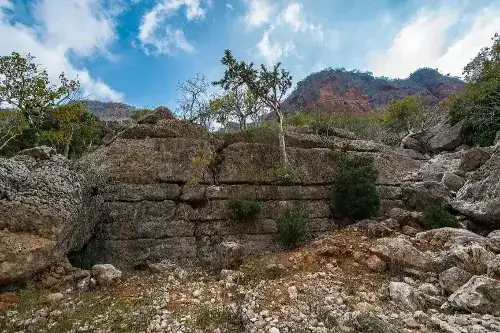
The Miaohoushan Paleolithic Site in Xiaoshi Town is the northernmost early Paleolithic site in China and the earliest human habitation in Northeast China, dating back 500,000 years: the "Hometown of the First Northeasterner." The Machengzi Neolithic Site in Nandian Town contains late Neolithic deposits dating back 4,500 to 5,000 years.
Intangible Cultural Heritage
External Exchange
Benxi established a pairing cooperation with Taizhou City in 2017, implementing the national strategy for revitalizing Northeast old industrial bases. Both cities have deepened cooperation based on their industrial strengths, with Taizhou's transformation experience being highly valuable for Benxi.
Scenic Spots
Overview
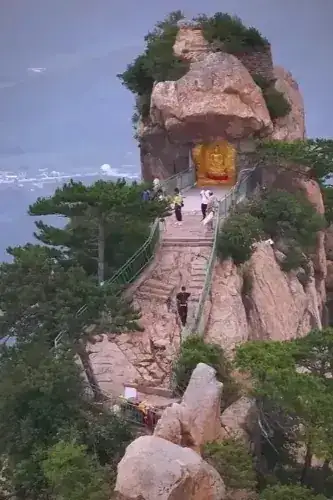
As of end 2024, Benxi had over 200 tourism resources, 15 star-rated hotels, and 51 A-level scenic areas, including 2 at 5A level (Benxi Water Cave, the world's longest navigable underground river, and Wunv Mountain, a World Heritage site), 13 at 4A level (including Guanmen Mountain and Tiecha Mountain), 21 at 3A level, and 15 at 2A level.
Important Scenic Spots
Honorary Titles
Travel information can change. Check current opening hours, reservations and entry requirements before you travel.
Traveller discussion
Start the conversation with a helpful tip or a question.