
Fushun City
Fushun CityFushun City, a prefecture-level city in Liaoning Province, is known as China's Coal Capital. Located in eastern Liaoning, it borders Jilin Province to the east, Shenyang to the west, Tieling to the north, and Benxi to the south.
Fushun City
Fushun City, a prefecture-level city in Liaoning Province, is known as China's Coal Capital. Located in eastern Liaoning, it borders Jilin Province to the east, Shenyang to the west, Tieling to the north, and Benxi to the south. The city lies in the foothills of the Changbai Mountains, with its urban area on the alluvial plain of the Hun River, surrounded by mountains on three sides. The terrain descends from southeast to northwest. Fushun is in the mid-temperate zone with a temperate monsoon climate and covers a total area of 11,271.03 square kilometers. As of April 2025, Fushun administers 4 districts and 3 counties. As of the end of 2024, the resident population was 1.71 million. Fushun has a long history as the birthplace of the Qing Dynasty. The name "Fushun" derives from the Ming Dynasty, meaning "to pacify the frontier and guide the people." Fushun is also the second hometown of Lei Feng and the birthplace of the Lei Feng Spirit. The city is an important energy and raw material industrial base designated by the State Council, a key industrial base in Liaoning, and the deputy center city of the Shenyang Economic Zone. New China's first ton of aluminum, magnesium, silicon, special steel, and first mechanical excavator were all produced here. Fushun is China's largest special steel production base and has been recognized as one of China's Happiest Cities, an Excellent Tourism City, and a National Forest City. In 2024, Fushun achieved a regional GDP of 101.09 billion yuan (~$14.04 billion), growing 4.9% year-on-year at constant prices.
Historical Evolution
During the Warring States period, Fushun belonged to Liaodong Commandery of the Yan State. The Qin Dynasty maintained this administrative system. In the early Han Dynasty, the western part of Fushun fell under Liaodong Commandery's Houcheng County, while the northern area belonged to Gaoxian County. In 108 BCE, the Xuantu Commandery was established, later relocating to Yongling in present-day Xinbin County. Over the following centuries, control shifted among various regimes including the Goguryeo, Tang Dynasty, Balhae Kingdom, Liao Dynasty, Jin Dynasty, Yuan Dynasty, and Ming Dynasty.
During the Qing Dynasty, Fushun was placed under Fengtian Prefecture in 1657. In 1664, Chengde County was established to govern the Shenyang-Fushun area. In 1908, Xingren County was renamed Fushun County. After the 1911 Revolution, Fushun was under Liaoning Province. Following the Mukden Incident of 1931, Japanese forces occupied Fushun the next day. Yang Jingyu led the Northeast Anti-Japanese United Army in fighting in the Liaodong region. On October 31, 1948, Fushun was liberated, and the Fushun Municipal Government and Fushun County Government were established.
In 1949, Fushun became a municipality directly under the Northeast Administrative Committee. It was elevated to a central government municipality in 1953, then reclassified as a provincial city under Liaoning in 1954. Xinbin and Qingyuan counties were transferred between Tieling, Shenyang, and Fushun multiple times before being permanently placed under Fushun in 1965. Fushun County was re-established in 1961.
Administrative Divisions
As of April 2025, Fushun administers 4 districts and 3 counties: Xinfu District, Wanghua District, Dongzhou District, Shuncheng District, Fushun County, Xinbin Manchu Autonomous County, and Qingyuan Manchu Autonomous County. The municipal government is headquartered at No. 21, East Linjiang Road, Shuncheng District.
Geography and Environment
Location and Boundaries
Fushun is located in the northeastern part of eastern Liaoning. It borders Dongfeng County, Tonghua City, and Meihekou City of Jilin Province to the east; Sujiatun District, Shenbei New Area, and Hunnan District of Shenyang to the west; Tieling County, Kaiyuan City, and Xifeng County of Tieling to the north; and Xihu District, Benxi Manchu Autonomous County, and Huanren Manchu Autonomous County of Benxi to the south. The city spans longitudes 123 degrees 39 minutes 42 seconds to 125 degrees 28 minutes 58 seconds East and latitudes 41 degrees 14 minutes 10 seconds to 42 degrees 28 minutes 32 seconds North, measuring 151 km east to west and 138 km north to south.
Topography and Geomorphology
Fushun sits on the northern margin of the North China Platform. The Hun River Fault, a northern extension of the Tanlu Fault, runs east-west across the city. North of the river lies the Tieling-Qingyuan Uplift, while the south features the Fushun-Xinbin Uplift with more extensively exposed bedrock. The landscape is characterized by mountainous terrain with the Hun River valley as its backbone, featuring low hills and narrow valley plains that descend from southeast to northwest.
Climate
Fushun experiences a typical monsoon climate. Winters are controlled by the Mongolian High with cold polar continental air masses and prevailing northerly winds. Summers are influenced by continental low pressure and Pacific subtropical high pressure, bringing warm, humid air with occasional typhoon-induced heavy rainfall. Spring features frequent southwest winds and increasing rainfall, sometimes experiencing late cold snaps. Autumn experiences early frost by late September, influenced by Siberian cold air.
Natural Resources
Water Resources
Fushun has 110 rivers exceeding 10 km in length, including 13 rivers with catchment areas over 200 square kilometers, such as the Hun River, Huifa River, Qing River, Chai River, Taizi River, and Fuer River. In 2016, total water resources reached 3.945 billion cubic meters, a 28.9% increase from the multi-year average of 3.06 billion cubic meters. Surface water resources totaled 3.908 billion cubic meters, and groundwater resources amounted to 806.6 million cubic meters.
Biological Resources
Fushun's flora belongs to the Changbai plant region with some North China plant communities. The city has 266 woody plant species across 43 families and 95 genera, and 712 wild herbaceous species across 90 families. Nearly 300 wild plant species have economic value, with 24 classified as rare, endangered, or threatened. Representative tree species include Korean pine, Khingan fir, Changbai larch, Manchurian walnut, purple linden, Manchurian ash, and birch. Wildlife includes 226 species: 33 mammals, 170 birds, 13 reptiles, and 10 amphibians.
Mineral Resources
Fushun has 34 types of mineral resources across metals, non-metals, and coal, with total reserves of approximately 5.497 billion tons and retained reserves of about 4.332 billion tons. Key minerals include coal, iron, copper, zinc, lead, gold, silver, nickel, platinum, and palladium. The Hongtoushan copper-zinc mine ranks among the province's largest by scale and reserves. The city also has significant oil shale and coalbed methane reserves.
Population
Population Size
According to the Seventh National Census (November 2020), Fushun's resident population was 1,861,372. As of end-2023, the registered population was 1.952 million (1.273 million in urban districts), with 1.346 million urban and 607,000 rural residents. The birth rate was 2.81 per thousand, and the death rate was 18.65 per thousand. By end-2024, the registered population was 1.925 million (1.254 million in urban districts), with a resident population of 1.71 million and an urbanization rate of 80.43%.
Ethnic Composition
In 2022, Fushun had 44 ethnic minorities with a total minority population of 490,000, representing 28.4% of the total population. The Manchu population was 464,500.
Politics
Current Leadership
Information regarding current leadership is not available in the source material.
External Relations
Information regarding external relations is not available in the source material.
Economy
Overview
In 2024, Fushun achieved a regional GDP of 101.09 billion yuan (~$14.04 billion), up 4.9% at constant prices. The primary, secondary, and tertiary industries contributed 5.95 billion yuan (~$826 million), 42.74 billion yuan (~$5.94 billion), and 52.40 billion yuan (~$7.28 billion), growing 4.3%, 6.8%, and 3.6% respectively, accounting for 5.9%, 42.3%, and 51.8% of GDP. Per capita GDP was 58,468 yuan (~$8,121), up 7.2%.
Fixed asset investment fell 19.5% year-on-year, with construction project investment down 9.6% and real estate development investment down 44.5%. General public budget revenue was 7.25 billion yuan (~$1.01 billion), up 8.3%, with tax revenue of 5.10 billion yuan (~$708 million), up 9.0%. General public budget expenditure was 20.31 billion yuan (~$2.82 billion), up 14.1%.
Primary Industry
In 2024, grain crop planting area was 121,800 hectares, with maize covering 106,100 hectares and rice 10,500 hectares. Total grain output was 880,000 tons, down 0.1%. Pork, beef, mutton, and poultry meat production totaled 110,000 tons, down 2.7%. Aquatic product output was 3,000 tons, up 11.0%.
Secondary Industry
Above-scale industrial value-added grew 6.0% year-on-year. State-owned enterprises grew 7.5%, while collective enterprises grew 12.2%. By sector: petrochemicals +10.4%, metallurgy +2.7%, coal +4.9%, electricity +12.5%, equipment manufacturing -2.2%, and building materials -1.5%. Above-scale industrial enterprises achieved operating revenue of 132.54 billion yuan (~$18.41 billion), down 2.5%, with total profits of 2.88 billion yuan (~$400 million). Major products: cement 697,000 tons (+103.3%), steel 4.728 million tons (+3.3%), and power generation 9.09 billion kWh (+13.5%). Construction industry output was 8.60 billion yuan (~$1.19 billion), down 0.3%.
Tertiary Industry
Total retail sales of consumer goods reached 20.50 billion yuan (~$2.85 billion), up 6.8%. Urban retail sales were 18.89 billion yuan, up 6.9%, and rural retail sales were 1.61 billion yuan, up 5.2%. Catering revenue grew 14.1% to 2.76 billion yuan. Notable retail categories: food and beverages +27.9%, tobacco and liquor +28.8%, home appliances +22.0%, and automobiles +19.1%.
Total import and export value was 4.15 billion yuan (~$576 million), down 22.2%, with exports of 3.88 billion yuan and imports of 270 million yuan. Actual foreign investment utilized was $4.41 million, down 23.7%. External investment attracted totaled 20.46 billion yuan (~$2.84 billion), up 13.6%.
By end-2024, financial institution deposits reached 320.82 billion yuan (~$44.56 billion), with household deposits at 278.12 billion yuan. Loan balances totaled 127.93 billion yuan (~$17.77 billion). The insurance sector had 44 institutions generating premium income of 4.57 billion yuan (~$635 million), up 5.4%, with claims paid of 2.11 billion yuan (~$293 million), up 22.5%.
Social Affairs
Science and Technology
In 2024, 511 technology contracts were registered with a transaction value of 900 million yuan. Patent grants totaled 1,678, including 278 invention patents.
Education
Fushun has 6 regular higher education institutions with 53,540 students and 2,248 faculty; 2 adult higher education institutions; 8 secondary vocational schools with 7,053 students; 100 regular secondary schools with 59,726 students; and 84 primary schools with 65,800 students.
Culture
The city has 8 cultural centers, 70 cultural stations, and 6 public libraries holding 1.338 million volumes. Radio coverage reaches 99.27% and television 99.26% of the population. Over 230 square cultural events were held.
Healthcare
Fushun has 1,415 medical and health institutions, including 54 hospitals, 47 township health centers, 123 community health service centers, and 540 village clinics. Total beds number 12,639, with 13,958 health technical personnel.
Sports
In 2024, Fushun athletes won 334 medals at provincial and above competitions, including 109 gold, 103 silver, and 122 bronze. The city has 3,851 outdoor sports venues and 399 indoor fitness facilities, hosting over 100 mass fitness events.
Social Security
By end-2024, 965,000 people participated in urban employee basic pension insurance, and 418,000 in urban-rural resident social pension insurance. Basic medical insurance covered 1.60 million people. Unemployment insurance had 246,000 participants, and work injury insurance 255,000. By December 2024, 28,000 urban residents and 31,000 rural residents received government minimum living allowances.
Transportation
Overview
As of end-2024, Fushun's total highway mileage was 6,678.1 km, including 326.4 km of expressways. Highway freight volume was 58.998 million tons, up 4.3%. The city has 657 public buses, 4,106 urban taxis, and 960 long-distance passenger vehicles.
Highways
The Shenji Expressway and National Highway 202 run through Fushun. The Fushun Central Long-Distance Bus Station operates routes throughout Liaoning Province.
Railways
Fushun Station, formerly known as Fushuncheng Station and Fushun North Station, is located on Fushuncheng Road in Shuncheng District. It has three platforms on the Shenji Railway line and is one of the larger stations on that route. Other stations include Qingyuan Station and Xinbin Station.
Rail Transit
The Shenfu Tram West Extension connects the Shenfu Demonstration Zone to Shenyang's existing Hunnan Modern Tram Line 5. The 5.23-km line with 4 stations opened on February 3, 2021, making it China's first tram system linking two cities and further integrating Shenyang and Fushun.
History and Culture
Origin of the Name
In 1384, during the Ming Dynasty, a city was built at the southern foot of Gao'er Mountain and named "Fushun," meaning "to pacify the frontier and guide the people," giving the city its name.
Arts
Yangge, a representative folk dance of northern China, takes two forms: stilt yangge and ground yangge. Fushun ground yangge, also known as "Dazi yangge," dates to the early Qing Dynasty and is deeply connected to Manchu folk dance traditions. Performers wear Manchu traditional clothing, with the lead character in a banner robe and accompanying performers wearing fur coats with hunting bells and tools, depicting ancient Manchu fishing and hunting life to the accompaniment of shamanic percussion.
Xinbin Manchu Autonomous County, birthplace of the Qing Dynasty, has developed distinctive Manchu folk paper-cutting over more than 200 years. The art features bold lines and primitive techniques, drawing on Manchu shamanic culture and folk customs as primary themes, including unique methods such as fire-burned cutting and three-dimensional composite cutting.
Traditional Crafts
Jet, or coalite, a unique Fushun mineral resource, forms from ancient hardwood trees such as birch, pine, and cypress over millions of years. Lighter than regular coal and found within coal seams, its special structure and texture make it excellent carving material. The craft of carving jet into decorative artworks has become a distinctive folk handicraft tradition in Fushun.
Scenic Spots
Overview
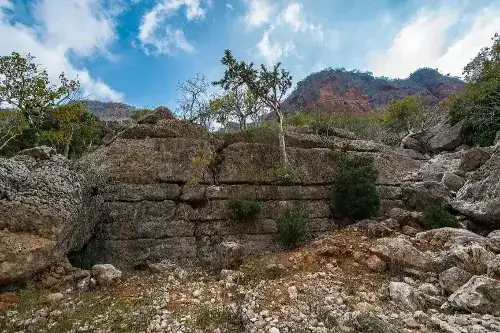
As of end-2024, Fushun has 7 national 4A-level scenic areas: Hetuala City, Sankuaishi National Forest Park, Honghe Canyon Rafting, Lei Feng Memorial Hall (national patriotism education base and key martyr memorial site), Hemu National Forest Park, Qingyuan Kuangzigou Ecological Scenic Area, and Liaoning Tiannu Mountain Forest Park. The city also has 18 national 3A-level scenic areas, including the War Criminals Management Office, Pingdingshan Massacre Memorial Hall, Sarhu Scenic Area, Marshal's Mausoleum, Gangshan National Forest Park, Yueya Island Ecological Park, and Gao'er Mountain Scenic Area.
Major Attractions
Key attractions include the Lei Feng Memorial Hall, Hetuala Ancient City (birthplace of the Qing Dynasty), the Sarhu Ancient Battlefield, and the Pingdingshan Massacre Memorial Hall.
Local Specialties
Notable local specialties include Fushun jet carvings, ginseng products from the Changbai Mountains, and traditional Manchu foods.
Famous Figures
Fushun is associated with notable historical figures from the Qing Dynasty era and modern times, most prominently Lei Feng, whose spirit of selfless service became a national model for civic virtue.
Honorary Titles
Fushun has been recognized as one of China's Happiest Cities, a China Excellent Tourism City, and a National Forest City.
Travel information can change. Check current opening hours, reservations and entry requirements before you travel.

Traveller discussion
Start the conversation with a helpful tip or a question.