
Lvliang City
Lvliang CityLvliang is a prefecture-level city in Shanxi Province, located in the central-western part of Shanxi, spanning 36°43′–38°43′N and 110°22′–112°19′E. It is named after the Lvliang Mountains that run through the entire territory. T
Lvliang City
Lvliang is a prefecture-level city in Shanxi Province, located in the central-western part of Shanxi, spanning 36°43′–38°43′N and 110°22′–112°19′E. It is named after the Lvliang Mountains that run through the entire territory. To the east, it borders Taiyuan and Jinzhong; to the west, it faces Shaanxi Province across the Yellow River; to the south and north, it borders Linfen and Xinzhou respectively. The total area is 21,000 square kilometers. As of the end of 2024, the permanent resident population was 3,315,800. The city administers 1 municipal district, 10 counties, and 2 county-level cities, with the municipal government in Lishi District. The local dialect is Jin Chinese. The terrain is part of the western Shanxi Loess Plateau, in the Jin-Shaan Grand Canyon, with elevations generally between 1,000 and 2,000 meters. The climate is temperate continental monsoon with four distinct seasons. The entire territory belongs to the Yellow River basin. The area's administrative establishment dates back to the Spring and Autumn period (770–476 BCE). In 2003, the State Council approved converting the Lvliang Prefecture to a city, and in July 2004, Lvliang City was formally established. The city has 5,901 immovable cultural heritage sites, including 39 national key protected units. In 2025, the GDP was 257.502 billion yuan, up 3.4%.
History
The administrative establishment in Lvliang dates back to the Spring and Autumn period, when the area had the settlements of Quyi, Pingling, Zhongyang, and Guayan. After the Partition of Jin by Han, Zhao, and Wei in 376 BCE, the area belonged to the State of Zhao. In 246 BCE, Taiyuan Commandery was established, and Lvliang became part of it. During the Western Han Dynasty (206 BCE–9 CE), the area was divided among Xihe, Taiyuan, and Pingyang commanderies. In 140 CE, the Xihe Commandery seat was moved to Lishi County, the earliest commandery-level establishment in the Lvliang area.
During the Three Kingdoms period (220–280 CE), the area belonged to the Wei State. In 221 CE, Xihe Commandery was established with its seat at Cishi County. During the Western Jin Dynasty (265–316), the counties belonged to Xihe and Taiyuan kingdoms. During the Eastern Jin and Sixteen Kingdoms period, the area changed hands frequently. The Northern Wei (386–534) established Lishi Garrison and Tujing Garrison. In 486, Tujing Garrison became Tujing Commandery, and Fenzhou was established. During the Northern Qi (550–577) and Northern Zhou (557–581), the area was contested. The Northern Zhou established Shizhou and Jiezhou, and added Dinghu, Kuhu, and Wutu counties.
During the Sui Dynasty (581–618), the area belonged to Lishi, Xihe, Taiyuan, Loufan, and Longquan commanderies. During the Tang Dynasty (618–907), it belonged to Shizhou, Fenzhou, Xizhou, Langzhou, and Bingzhou (later Taiyuan Prefecture). During the Song Dynasty (960–1279), the area belonged to Shizhou, Fenzhou, Langzhou, Xizhou, Jinning Military, and Taiyuan Prefecture. During the Ming Dynasty (1368–1644), Fenzhou was elevated to a prefecture in 1595. During the Qing Dynasty (1644–1912), the system was maintained. In 1912, the Republic of China abolished Fenzhou Prefecture. During the War of Resistance and Civil War, Lvliang's counties belonged to the Jin-Sui Border Region. In 1949, Xingxian and Fenyang Special Districts were established. In 1971, Lvliang Prefecture was formed. In 2004, Lvliang was converted from a prefecture to a city.
Administrative Divisions
As of the end of 2022, Lvliang administers 1 municipal district, 10 counties, and 2 county-level cities, with 15 sub-districts, 91 towns, and 45 townships. The municipal government is in Lishi District.
Geographical Environment
Location and Boundaries
Lvliang is in the central-western part of Shanxi Province, spanning 36°43′–38°43′N and 110°22′–112°19′E. The maximum east-west width is 140 kilometers, and the maximum north-south distance is 220 kilometers. The total area is 21,000 square kilometers, accounting for 13.5% of Shanxi Province's total land area.
Landforms
The city is in the Jin-Shaan Grand Canyon, at the middle section of the Lvliang Mountains. The terrain is higher in the center and lower on both sides, generally at 1,000–2,000 meters elevation. Mountains and semi-mountainous areas cover 91.8% of the territory. The highest peak is the main summit of Mount Guandi at 2,831 meters, the third-highest peak in Shanxi. The lowest point is at 556 meters along the Yellow River in Shilou County, with a relative elevation difference of 2,275 meters. The urban area sits at 920–940 meters.
The landforms fall into three types: mid-mountain areas (above 1,500m), hilly areas (900–1,500m), and plain areas (740–800m). The plains along the Fen River in Jiaocheng, Wenshui, Fenyang, and Xiaoyi have fertile soil and abundant water.
Climate
Lvliang has a warm temperate continental monsoon climate. Average annual precipitation is 472 mm, concentrated in July-September. Average annual temperature is about 9°C, with January averaging -10°C to -5°C and July averaging 19°C to 24°C. Extreme minimum: -33.0°C; extreme maximum: 41°C. Annual sunshine hours: 2,487–2,872. Frost-free period: 133–178 days.
Hydrology
The Yellow River, Fen River, Wenyu River, Qiushui River, Cangfen River, and Sanchuan River flow through Lvliang. The entire territory belongs to the Yellow River basin.
Soil
The city has a soil area of 18,634 square kilometers, with types including brown soil, cinnamon soil, chestnut-cinnamon soil, mountain meadow soil, fluvo-aquic soil, and yellow spongy soil.
Natural Resources
Water Resources
The multi-year average total water resources are 1.447 billion cubic meters, including 1.11 billion cubic meters of river runoff and 890 million cubic meters of groundwater, with an overlap of 551 million cubic meters.
Land Resources
Total land area: 21,211 square kilometers, including 169,000 hectares (8%) of eastern plains, 974,000 hectares (45.9%) of western loess plateau hilly areas, and 978,100 hectares (46.1%) of central mountainous areas.
Mineral Resources
Lvliang has 40 proven mineral types across 407 occurrences, including 40 large, 63 medium, and 30 small deposits. Key resources include coal (11,460 square km of coal-bearing area, 54.3% of total, with 42+ billion tonnes of reserves, including 11.4 billion tonnes of premium No. 4 coking coal), iron ore (1.3 billion tonnes, 34.6% of Shanxi's total), bauxite (649 million tonnes, 45.7% of Shanxi's total, ranking first in the province), dolomite, limestone, asbestos, silica, and potassium-bearing rock (472 million tonnes at Linxian's Zijin Mountain, a rare large deposit in China).
Biological Resources
Wildlife surveys record 213 species across 4 classes and 24 orders, including 160 bird species and 36 mammal species. Four species are under national Class I protection: brown eared pheasant, golden eagle, black stork, and leopard. Twenty species are under Class II protection. The brown eared pheasant, a Chinese national treasure, is concentrated in the Pangquangou area of Jiaocheng County, with over 2,000 individuals. Lvliang is the central distribution area of wild sea buckthorn in Shanxi, with 84,730 hectares of natural sea buckthorn, about one-fifth of the provincial total and one-tenth nationally. The city also has 412 notable ancient, large, rare, and precious trees across 175 sites, representing 26 families, 30 genera, and 40 species.
Population
Population Numbers
According to the 7th National Census (November 2020), Lvliang's permanent resident population was 3,398,431, a decrease of 328,626 (8.82%) from 2010. Males: 1,763,303 (51.89%); females: 1,635,128 (48.11%); sex ratio: 107.84. Urban population: 1,811,822 (53.31%). As of the end of 2025, the permanent resident population was 3,280,800, a decrease of 35,000, with urban population at 1,912,400 (58.29%). Birth rate: 5.81‰; death rate: 8.22‰; natural growth rate: -2.41‰.
Ethnic Composition
Lvliang is a scattered minority population area. As of the end of 2021, the permanent minority population was 2,312 across 25 ethnic groups, distributed across 159 townships in 13 county-level areas. About 600 temporary minority residents are concentrated in universities. Floating minority population: 237, mainly from Qinghai, Ningxia, and Xinjiang.
Economy
Overview
In 2025, GDP was 257.502 billion yuan (up 3.4%). Per capita GDP: 78,070 yuan. General public budget revenue: 27.826 billion yuan (down 16.2%). Fixed asset investment: 74.773 billion yuan (up 1%). Retail sales of consumer goods: 43.969 billion yuan (up 4.5%). Urban per capita disposable income: 37,783 yuan (up 3.3%); rural: 15,461 yuan (up 6.1%).
Primary Industry
The city promotes 8 characteristic industrial clusters (pigs, cattle, edible mushrooms, walnuts, red dates, coarse grains, potatoes, herbal tea) and 5 deep-processing clusters. Lvliang is a premium coarse grain production base, with over 20 quality varieties including millet, soybean, mung bean, and adzuki bean. In 2025, primary industry value added was 10.915 billion yuan (up 4.2%), accounting for 4.24% of GDP.
Secondary Industry
The city focuses on clean coal utilization, aluminum-magnesium new materials (targeting a 100-billion-yuan cluster), and the baijiu (Chinese liquor) industry, supporting the Fenjiu Group. In 2025, secondary industry value added was 140.381 billion yuan (up 2.4%), accounting for 54.52% of GDP.
Tertiary Industry
The city implements a "liquor+" integration strategy, hosting the China Xinghua Village International Liquor Expo, developing red tourism and green wellness brands, and promoting big data industrialization. In 2025, tertiary industry value added was 106.206 billion yuan (up 4.4%), accounting for 41.24% of GDP.
Economic Functional Zones
As of 2025, Lvliang has 9 provincial-level development zones.
Transportation
Highways
National Highways 307 and 209 traverse the city, along with 9 provincial highways, the G5 Beijing-Kunming Expressway, G20 Qingyin Expressway, G59 Hubu Expressway, G2516 Donglu Expressway, S50 Taijia Expressway, and S2002 Lvliang Ring Expressway, forming a comprehensive highway network. The Lvliang Bus Terminal in Lishi District's Maomaozhuang is the hub for passenger transport.
As of the end of 2025, total highway mileage was 18,483.8 kilometers, including 793.6 kilometers of expressways.
Railways
Multiple railways pass through Lvliang: Jiexi, Xiaoliu, Tai-Zhong-Yin, and the Shanxi Central-South Railway. The Tai-Zhong-Yin Railway's Lvliang section is 164.4 kilometers, with five passenger stations: Jiaocheng, Wenshui, Fenyang, Lvliang, and Liulin South. Trains reach major cities including Beijing, Shanghai, Chengdu, Chongqing, Xi'an, and Urumqi.
Aviation
Lvliang Dawu Airport officially opened on January 26, 2014, in Dawu Town, Fangshan County, 23 kilometers from the city center. It is a 4C-level regional airport capable of handling CRJ-200, Boeing 737-800, A319, and A320 aircraft. In 2025, the airport operated 18 routes with 575,000 passengers and 1,090.4 tonnes of cargo.
Politics
Current Leadership
Past Leaders
Social Undertakings
Education
As of the end of 2025, Lvliang has 29 secondary vocational schools, 41 general high schools, 172 junior high schools, 315 primary schools, and 615 kindergartens.
Culture and Sports
The novel "Lvliang Heroes," the song "People Say Shanxi Has Beautiful Scenery," and the film "Young People in Our Village" were all born in Lvliang. The city has produced high-quality plays including "Liu Hulan," "The Honest Official Yu Chenglong," and "The Apricot Blossom Wine Maker." "Liu Hulan" won the Ministry of Culture's Wenhua Drama Award. Fenyang and Xiaoyi were named National Advanced Cultural Cities. As of the end of 2025, the city has 14 cultural centers, 161 cultural stations, 14 public libraries, 14 radio/TV stations (broadcast coverage 97.15%, TV coverage 99.7%), 23 sports fields, and 3 gymnasiums.
Healthcare
As of the end of 2025, Lvliang has 3,890 medical and health institutions with 17,537 beds. There are 32 specialized public health institutions, 14 maternal and child health centers, and 23,065 health technical personnel.
Historical Culture
Historical Sites
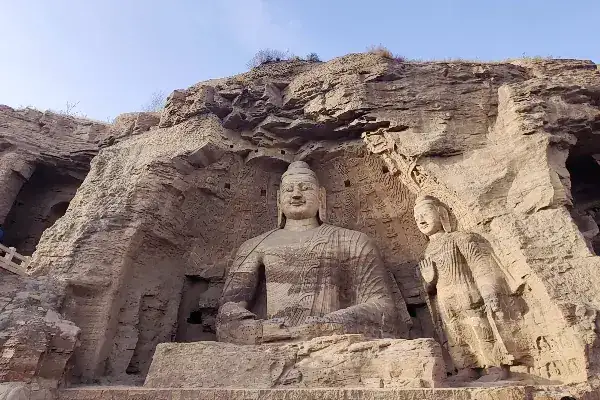
As of the end of 2022, Lvliang has 5,901 cultural heritage sites, including 39 national key protected units and 43 provincial key protected units.
Folk Arts
As of July 2022, Lvliang has over 100 intangible cultural heritage protection items: 16 national, 53 provincial, and 117 municipal, with 12 national, 73 provincial, and 250 municipal inheritors.
Scenic Spots
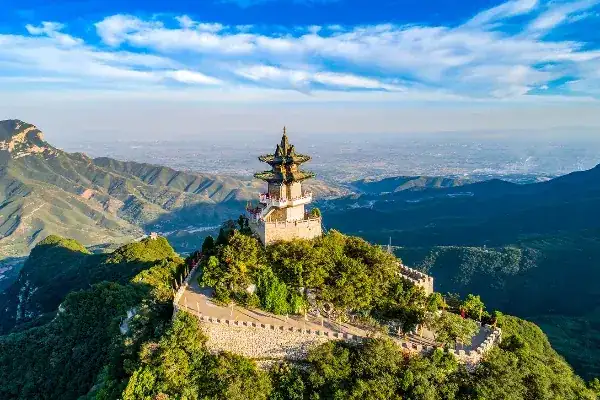
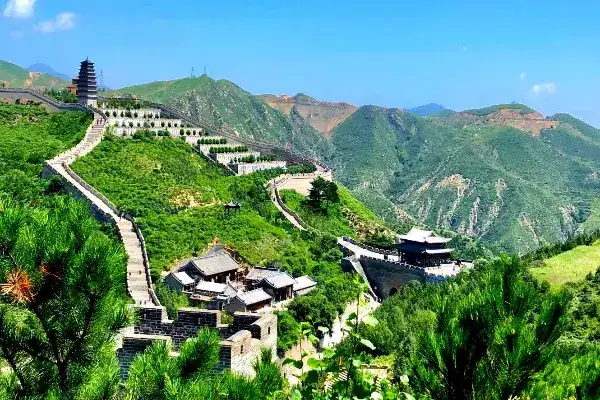
As of the end of 2021, Lvliang has 5 provincial-level and above natural scenic areas. Major attractions include: North Wudang Mountain in Fangshan County (a national scenic area, northern Taoist sacred site, approved as a national key scenic area in 1994), Qikou Ancient Town in Linxian (national scenic area), Pangquangou National Nature Reserve in Jiaocheng, "First Bend of the Yellow River" in Shilou, Xuanzhong Temple (birthplace of the Pure Land Buddhist sect), Xinghua Village in Fenyang (home of Fenjiu liquor), Xihua Town in Lishi ("second grassland of North China"), and Baima Fairy Cave ("first perilous cave of North China").
North Wudang Mountain, in Fangshan County, was originally called Dragon King Mountain. It was renamed Wudang Mountain after the Ming Dynasty restoration of the Xuantian Great Hall, and prefixed "North" to distinguish it from Wudang Mountain in Hubei. It is a famous northern Taoist sacred site.
The "First Bend of the Yellow River" at Xinguan Town, Shilou County, is where the Yellow River makes an extraordinarily sharp turn. Viewed from above, the bend resembles a gourd, with the narrowest point at 700 meters and the widest at 1,700 meters. In February 1936, Mao Zedong led the Red Army's Eastern Expedition through here and wrote the famous poem "Qinyuanchun—Snow."
Xinghua Village in Fenyang is a modern liquor city integrating liquor, poetry, calligraphy, painting, and scenery. It is the home of Fenjiu, one of China's most famous liquors, with a liquor history museum, ancient wells, and celebrity stele galleries.
Local Specialties
Lvliang has developed distinctive local brands including Fenzhou fragrant millet, "Mountain Flowers Blooming" coarse grains, Linxian kidney-type soybeans, Lanxian potatoes, Fenzhou walnuts, Liulin "Goumenqian" bowl cake, and Lvliang sea buckthorn. Sixteen products have been listed as national geographical indication agricultural products, including Xiaoyi walnuts, Jiaocheng jujubes, Liulin red dates, Zhongyang cypress-seed mutton, Linxian Kaiyang red dates, Fenyang brewing sorghum, and Xingxian mung beans.
Famous Figures
Honorary Titles
Travel information can change. Check current opening hours, reservations and entry requirements before you travel.

Traveller discussion
Start the conversation with a helpful tip or a question.