
Xinzhou City
Xinzhou CityXinzhou is a prefecture-level city in Shanxi Province, located in the central-northern part of the province, separated from Yunshuo by the Great Wall to the north, connected to Taiyuan via Shiling to the south, facing Shaanxi an
Xinzhou City
Xinzhou is a prefecture-level city in Shanxi Province, located in the central-northern part of the province, separated from Yunshuo by the Great Wall to the north, connected to Taiyuan via Shiling to the south, facing Shaanxi and Inner Mongolia across the Yellow River to the west, and linking to Beijing and Hebei via the Taihang Mountains to the east. Total area: approximately 25,000 square kilometers—the largest by territory in Shanxi. As of the end of 2025, the city administers 1 district, 12 counties, and 1 county-level city. As of the end of 2025, the permanent resident population was 2,565,000. Historically known as "Xiurong" and abbreviated as "Xin," the area has been inhabited since the Neolithic period. During the Yu-Shun era, it belonged to Bingzhou; during the Xia, Shang, and Zhou dynasties, to Jizhou. During the Qin Dynasty (221–206 BCE), it was under Taiyuan Commandery. During the Warring States period (475–221 BCE), it belonged to the State of Zhao. In 598 CE, the Sui Dynasty (581–618) formally named the area Xinzhou. In 2000, the State Council approved the establishment of the prefecture-level Xinzhou City. The city has 288 municipal-level and above cultural heritage protection units, with ancient buildings predominating. Two of China's only surviving four Tang Dynasty wooden structures are in Xinzhou, along with nearly 10,000 painted sculptures and over 20,000 square meters of temple murals. The city is known as the "Hometown of Wrestling," "China's Hometown of Bayin Music," "China's Capital of Coarse Grains," and a "National Famous Historical and Cultural City—Dai County." In 2025, GDP was 133.04 billion yuan, up 3.0%.
History
Human activity in Xinzhou dates back to the Neolithic period. During the Yu-Shun era, the area was part of Bingzhou. During the Xia, Shang, and Zhou dynasties, it belonged to Jizhou. During the Warring States period (475–221 BCE), after the Partition of Jin in 403 BCE, the area belonged to the State of Zhao.
After the Qin Dynasty unified China in 221 BCE, the area was mostly under Taiyuan Commandery. In 247 BCE, early county-level settlements were established. During the Han Dynasty (206 BCE–220 CE), Jiuyuan County was established. In 215 CE, the Xinxing Commandery was established. During the Three Kingdoms, the area belonged to the Wei State. During the Northern and Southern Dynasties, it changed hands among various regimes. In 579 CE, the Sizhou seat moved to present-day Dai County. In 581 CE, the Sui Dynasty abolished Xiurong Commandery and established Xinzhou—the first use of the name.
During the Tang Dynasty (618–907), the area was under the Hedong Circuit as Daizhou, Xinzhou, Langzhou, and Xianzhou. The Five Dynasties, Song, Jin, Yuan, and Ming dynasties saw various administrative changes. In 1724, the Qing Dynasty (1644–1912) elevated Xinzhou, Daizhou, and Baode to directly-administered prefectures. In 1912, the Republic of China abolished prefectures, and the area was named Xinxian. After the founding of the PRC, Xinxian Special District was established. In 1983, Xinzhou Prefecture was established. In 2000, the prefecture-level Xinzhou City was formally established.
Administrative Divisions
As of the end of 2025, Xinzhou administers 1 district (Xinfu), 12 counties (Dingxiang, Wutai, Daixian, Fanzhi, Ningwu, Jingle, Shenchi, Wuzhai, Kelan, Hequ, Baode, Pianguan), and 1 county-level city (Yuanping). The Municipal Government is at No. 21 Changzheng Street, Xinfu District.
Physical Geography
Location and Boundaries
Xinzhou is in central-northern Shanxi, between 110°53′3″–113°58′E and 38°65′–39°40′N. North-south length: ~170 km; east-west width: ~245 km; total area: ~25,000 km² (1/6 of Shanxi)—the largest city by area in Shanxi.
Climate
The area has a temperate continental monsoon climate with significant regional variation due to complex terrain. Four climate zones: severe cold and rainy (Wutai, Guancen, Luya mountains), cold and less rainy (Shenchi, Wuzhai, Kelan plateau), cool and less rainy (Ningwu, Jingle valleys and southern Wutai hills), and warm and less rainy (plains, valleys, and Yellow River coast). Annual sunshine: 2,670–2,940 hours (60–66%). Average annual temperature ranges from -4.2°C to 8.8°C, increasing southward and decreasing with elevation. The coldest point is Wutai Mountain's Zhongtai Peak at -4.2°C, the coldest in North China. January averages -8.5 to -18.9°C; July averages 9.6–25.1°C. Annual precipitation: 350–900 mm (average 463.5 mm), concentrated in summer.
Geological Structure
The area has strata from the Archean to Cenozoic (except Upper Ordovician, Silurian, Devonian, and Lower Carboniferous). The Archean Fuping Group is the oldest exposed formation, primarily in the Wutai Mountain core. The area sits on the northern part of the Shanxi Platform, with the Taihang composite anticline to the east, Ordos platform edge to the west, and Lvliang anticline north section in the center. Six tectonic development stages are identified from the Archean to Cenozoic.
Landforms
Mountains, hills, and basins characterize the terrain, with mountains covering 53.5%, hills 35.96%, and plains 10.54%. The highest point is Wutai Mountain's North Terrace at 3,058 meters (the "Roof of North China"); the lowest is at 600 meters in Dingxiang. Major mountain ranges: Hengshan to the north, Lvliang to the west (including Luya, Guancen, and Yunzhong peaks), Taihang and Wutai to the east, and Xizhou to the south.
Hydrology
Main rivers: the Yellow River (228 km through the city), Fen River (95.2 km, 2,975 km² basin), and Hutuo River (260 km, ~12,000 km² basin—the "mother river" of Xinzhou, originating in Fanzhi County and flowing through 6 counties). The three main river systems form three basins: Hutuo (east of Yunzhong Mountains), Fen-Hui (between Yunzhong and Guancen-Luya mountains), and direct Yellow River tributaries (west of Guancen-Luya). 3 hot springs (36–54°C) have been discovered. 8 medium reservoirs store 30.32 million cubic meters (as of end 2023). The Wanjiazhai Water Control Project (8.96 billion m³ total capacity) is a key national project and the starting point of the Yellow River-to-Shanxi water diversion.
Soil Types
10 major soil types including subalpine meadow soil, mountain meadow soil, mountain brown soil, cinnamon soil, chestnut-cinnamon soil, yellow spongy soil, skeletal soil, aeolian sandy soil, fluvo-aquic soil, and paddy soil, distributed by elevation from above 2,700m down to the valley floors.
Natural Disasters
Main hazards: drought, frost, hail, strong winds, landslides, debris flows, and ground subsidence from mining. The area is on the central-northern Shanxi seismic belt. Drought is the most common, known as "nine droughts in ten years." In 2021, severe flooding affected 5 cities and 13 counties including Xinzhou, with 100,000+ people impacted and direct economic losses exceeding 500 million yuan.
Natural Resources
Water Resources
Xinzhou is a water-poor area, with per capita runoff of 734 cubic meters (26.5% of national average). Water distribution is uneven: the Fen River basin has the most, followed by Hutuo, then the Yellow River. Groundwater is also unevenly distributed, with Xinfu, Dingxiang, Yuanping, Daixian, and Fanzhi having 63% of total groundwater resources. In 2023, total water resources were 2.06692 billion cubic meters. Total water use: 632.17 million cubic meters. 11 medium and 40 small reservoirs serve the city.
Land Resources
Total land area: 25,180 km², making Xinzhou a major agricultural city. Arable land: 9.48 million mu, including 2.08 million mu of irrigated land (21.6%) and 7.54 million mu of dryland (78.4%). Basic farmland: 7.683 million mu, including 2.96 million mu designated for grain production. By quality: 2.25 million mu high-yield, 3.8 million mu medium-yield, and 3.57 million mu low-yield.
Plant Resources
1,261 wild plant species (121 families, 519 genera), including 108 tree species, 184 shrub species, 400+ grass species, 300+ wild medicinal plants, and 24 crop categories. As of 2022, wild plant species reached 1,500.
Animal Resources
189 terrestrial vertebrate species: 146 birds, 37 mammals, 4 reptiles, 2 amphibians. National Class I protected: leopard, brown eared pheasant, black stork, musk deer, great bustard, golden eagle (6 species). Class II: 14 species including marten, blue sheep, red fox, leopard cat, stone marten, swan, lynx, and various raptors. 15 provincial protected species.
Mineral Resources
50 mineral types discovered, 32 listed in the provincial reserves table. Advantageous minerals: iron, bauxite, gold, coal, rutile, dolomite, kaolinite, and limestone. Iron, gold, rutile, and molybdenum rank first in Shanxi Province. 189 mining areas (44 large, 43 medium, 102 small). Coal: 27.7 billion tonnes proven (26.1 billion remaining). Iron: 1.98 billion tonnes proven (1.74 billion remaining). Bauxite: 1/3 of provincial total. Iron: over 1/2 of provincial total. Gold: 2/3 of provincial reserves.
Vegetation Conditions
Six vertical vegetation zones from subalpine meadow (above 2,700m) through mountain meadow, forest-shrub, shrub-grassland, xerophytic grassland, to intrazonal wet meadow, with characteristic species at each elevation.
Population
As of the end of 2025, the permanent resident population was 2,565,000, a decrease of 40,000. Urban population: 1,528,000 (59.6%, up 1.5 percentage points). Birth rate: 4.4‰; death rate: 9.3‰; natural growth rate: -4.9‰.
Politics
Economy
Overview
In 2025, GDP was 133.04 billion yuan (up 3.0%). Primary: 11.69 billion (up 3.1%); secondary: 49.66 billion (up 1.1%); tertiary: 71.69 billion (up 4.2%). Structure: 8.8:37.3:53.9. Fixed asset investment grew 4.7%. General public budget expenditure: 46.93 billion (down 1.0%). Per capita disposable income: 27,033 yuan (up 4.6%); urban: 40,985 yuan; rural: 14,596 yuan.
Primary Industry
Crop planting area: 480,300 hectares, including 431,900 hectares of grain. Meat output: 150,000 tonnes (up 5.4%), including pork 100,000, beef 16,000, mutton 26,000, and poultry 7,000 tonnes. Eggs: 89,000 tonnes; milk: 60,000 tonnes. Pig inventory: 850,000; slaughter: 1.262 million. 6,600 hectares of high-standard farmland completed.
Secondary Industry
Total industrial value added: 46.55 billion yuan (up 1.8%). Industrial enterprises above designated size grew 0.8%. Mining grew 1.6%, manufacturing declined 0.1%, utilities declined 1.2%. Coal declined 0.2%, non-coal grew 2.4%. Revenue: 120.86 billion (down 6.0%); profits: 9.87 billion (down 1.3%). Construction: output 7.91 billion (down 8.9%).
Tertiary Industry
Service industry value added: 71.69 billion yuan (up 4.2%). Transportation/warehousing/postal: 7.11 billion (up 7.8%); financial: 8.00 billion (up 1.4%); real estate: 5.87 billion (up 5.6%); for-profit services: 11.62 billion (up 4.8%). Retail sales: 29.23 billion (up 3.7%). Import/export: 3.14 billion (up 2.3%). Financial deposits: 406.01 billion (up 5.2%); loans: 211.75 billion (up 13.7%). Insurance premiums: 5.89 billion (up 6.1%). Express delivery: 54.66 million parcels (up 15.3%). 9 monitored scenic areas received 28.764 million visitors (up 20.92%).
Social Undertakings
Science and Technology
834 valid invention patents (up 23.6%). 42 provincial and 181 municipal enterprise technology centers. 157 specialized and sophisticated SMEs. 7 specialized earthquake stations. In 2025, the maximum earthquake was M3.9 on October 18 in Xinfu District.
Education
As of the end of 2025: 328 kindergartens, 231 primary schools, 137 junior high schools, 34 general high schools, 34 secondary vocational schools. Notable: Xinzhou Normal University (established 2000, one of 3 Shanxi provincial normal universities, the only university nationally awarded the "Advanced Unit for Two Basics Work" by the State Council) and Xinzhou Vocational and Technical College.
Culture
As of the end of 2025: 15 cultural centers, 164 cultural stations, 15 public libraries, 14 TV stations, 17 FM/TV relay stations. 1 newspaper (10.944 million copies) and 1 journal (24,000 copies) published.
Sports
13,597 sports venues (7,008 ball sports, 4,214 fitness, 2 winter sports, 14 large stadiums), covering 7.084 million m². Athletes won 11 gold, 12 silver, and 23 bronze medals. 1.057 million regular exercise participants. Sports lottery: 270 million yuan (up 11.9%).
Healthcare
3,981 medical institutions, 14,419 beds, 20,352 health technical personnel.
Social Security
Urban employee pension: 589,000 (up 16,000); resident pension: 1.641 million; employee medical: 452,000; resident medical: 2.10 million; unemployment: 297,000; work injury: 313,000; maternity: 241,000. 24,000 urban residents received minimum living allowance. 52 residential service institutions with 14,004 beds.
Environmental Protection
307 good air quality days (84.1%). 14 county-level cities achieved 287–344 good air quality days.
Safety Production
Natural disaster direct economic losses: 100 million yuan (down 69.4%). Crop affected area: 8,370 hectares (down 78.5%). 140 production safety accidents (down 19.5%) with 150 fatalities (down 19.4%). Coal mine fatality rate per million tonnes: 0.026.
Transportation
Xinzhou is a natural "dry port" and transportation hub within golden distances of Taiyuan, Datong, Beijing, Tianjin, Yulin, and Ordos. It is the only Shanxi city spanning across provinces, connecting the Taihang and Lvliang Mountains. The city has a "three vertical, two horizontal, one ring" highway network, 1 high-speed rail line, 3 trunk railways, 3 branch lines, and 6 coal transport lines. Railway operating mileage: 1,111 km (density 4.41 km/100 km², above provincial average). The Xiongan-Xinzhou High-Speed Railway (350 km/h design speed, Shanxi's first) began construction in October 2022.
As of the end of 2025: total highway mileage 17,865.2 km (920.9 km expressways). Wutai Mountain Airport (opened December 2015) operates 14 routes to 17 cities, with 519,000 passengers (up 24.0%). 61 km of inland waterways with 3 docks, including the Laoniuwan passenger terminal. In 2023, the Shanxi-Kelan inland port–Tangshan Port–Guangzhou Qinzhou Port container sea-rail intermodal service was launched.
Public Transit
All 2,702 administrative villages have bus service. 12 county-level logistics centers, 122 township stations, and 925 village service points form a three-tier logistics system. 1 Class II bus terminal and 17 township bus stations.
Historical Culture
Overview
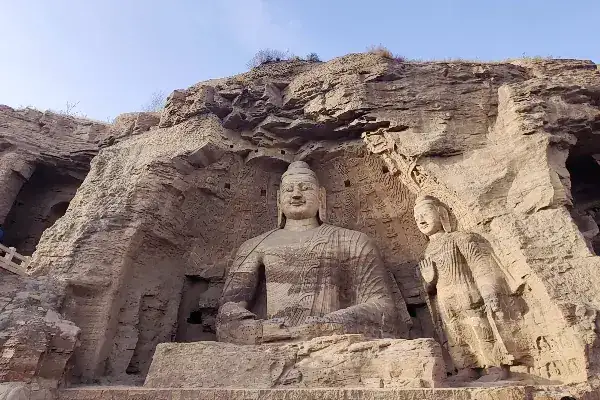
Xinzhou has profound cultural heritage as a Buddhist scenic area, ancient military defense zone, and Yellow River cultural area. It is known as the "Ocean of Folk Songs," "Hometown of Errentai," "Hometown of Wrestling," "Hometown of Bayin Music," and "Hometown of Northern Folk Songs." As of 2022, the city has 4,729 immovable cultural relics (1,950 ancient sites, 1,695 ancient buildings, 595 ancient tombs, 91 grottoes/inscriptions, 389 modern historical sites). Well-preserved Great Wall: 478.59 km (229.857 km early, 248.731 km Ming Dynasty). 36 national key protected units (42 points), 57 provincial, 114 municipal. Two of China's four surviving Tang Dynasty wooden buildings are in Xinzhou: Nanchan Temple (China's oldest wooden structure) and Foguang Temple ("China's First National Treasure, Asia's First Ancient Building"). The city nurtured historical figures including Ban Jieyu, Yang Ye, Yuan Haowen, Bai Pu, and Xu Jishe.
Name Origin
Multiple theories exist. One says Emperor Gaozu of Han, after breaking out of the Pingcheng siege, rejoiced upon reaching Xinkou, and "Xin" (rejoice) became the name. Another says the name derives from Sui Dynasty's 598 CE establishment of Xinzhou based on the Xinkou location. A third theory derives from the "Xin River" (Xinchuan Shui), a local stream.
Historical Sites
As of 2022: 4,729 immovable cultural relics. 36 national key protected units (42 points). Key sites: Foguang Temple (built Northern Wei, rebuilt 857 CE, with Tang Dynasty architecture, sculptures, murals, and inscriptions—the "Four Treasures" representing rare specimens of ancient Asian wooden architecture) and the Ashoka Pagoda in Daixian (built 601 CE, converted to brick in 1275, 40m high, the northernmost and best-preserved of China's 19 Ashoka pagodas).
Intangible Cultural Heritage
As of 2020: 15 national, 59 provincial, and 196 municipal items, with 22 national, 86 provincial, and 314 municipal inheritors—ranking among the top in Shanxi. Key items: Wutai Mountain Buddhist Music (dating to the temple's founding, with Han Chinese "Blue Temple" and Tibetan "Yellow Temple" traditions), Yanmen Residential Construction Techniques (traditional wooden structure building skills from the Yanmen Pass area), and Nao Yang Wrestling (dating to 1369 CE, where a wrestler who defeats 6 opponents receives a sheep prize).
Specialty Food
Xinzhou cuisine uses diverse cooking methods. "Eight Big Bowls" is a traditional banquet dish dating from the Tang Dynasty. The "Seven Plates and Eight Bowls" includes 7 cold dishes and 8 hot dishes. As "China's Capital of Coarse Grains," Xinzhou offers dozens of coarse grain dishes including oat rolls (kao kao), red flour fish, buckwheat noodles, bean flour dishes, fried cakes, and cornmeal porridge.
Folk Customs
Nao Yang Wrestling (Sheep-Lifting Contest): Originating in 1369 CE from traditional "wrestling" (jiao di). A wrestler who defeats 6 opponents receives a live sheep, which is lifted overhead and carried around the arena. Listed as national intangible cultural heritage in 2008.
Shanxi Dough Sculpture: Flour dough is shaped into various forms for different occasions—flower steamed bread for Spring Festival, "cold food offerings" for Qingming, human figures for the 15th of the 7th lunar month, wedding "xi buns," and funeral "small food" figures.
Hequ River Lantern Festival: Held on the 15th of the 7th lunar month for 3 days, combining Yu culture, ghost/spirit culture, and "going west" (zou xikou) culture. Listed as national intangible cultural heritage in 2008.
Folk Arts
Jinbei Bayin (Eight-Tone Music): A folk instrumental ensemble from Xinfu, Wutai, Dingxiang, and Yuanping. In 1953, eight musicians performed in Beijing and were named "Bayin" (Eight Sounds) by music experts. Listed as national intangible cultural heritage in 2008. The city was named "China's Hometown of Bayin Music" in 2006.
Hequ Folk Songs (Shanqu): Born from the "going west" lifestyle of Hequ residents who migrated seasonally to Inner Mongolia. Representative works include "Three Days' Journey in Two Days" and "Carrying Oat Wheat." Listed nationally in 2006.
Beilu Bangzi (clapper opera): One of Shanxi's four major Bangzi opera genres, originating from Puzhou Bangzi (clapper opera). Over 200 traditional plays. Known for its vigorous, robust singing style. Listed nationally in 2006.
City Symbols
City flower: Lilac (Syringa oblata), symbolizing diligence, humility, and nobility, representing the industrious spirit of the people. City tree: Chinese Scholar Tree (Sophora japonica), symbolizing good fortune, happiness, and beauty.
Dialect and Slang
Xinzhou dialect belongs to the Jinbei sub-group of Shanxi Jin Chinese, influenced by Jinzhong and Taiyuan dialects due to its southern location in northern Shanxi. Tone system: level tone splits into yin and yang, entering tone is undifferentiated. Initial consonants show transition features between Jinbei and Jinzhong. Final consonants show nasal loss features shared with both Jinbei and Jinzhong.
Scenic Spots
Overview
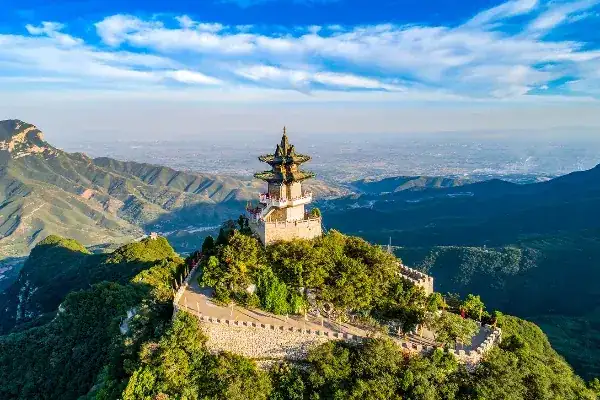
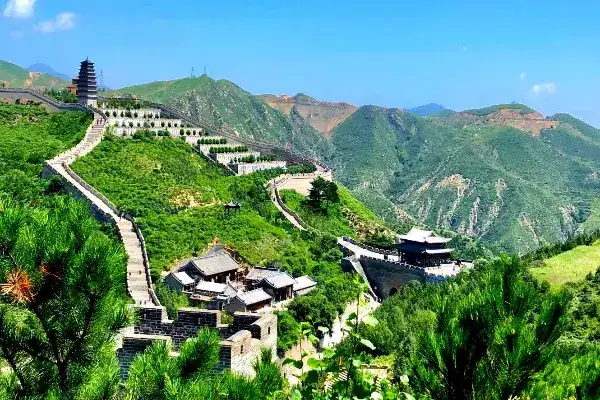
Xinzhou is the only Shanxi city with all three of Taihang, Yellow River, and Great Wall tourism resources. Natural attractions include: Wutai Mountain (Asia's earliest geological evolution specimen, 5A scenic area, UNESCO World Cultural Landscape), Guancen-Luya Mountain (on the UNESCO World Natural Heritage tentative list), 800,000 mu of primeval secondary forest in Ningwu and Jingle (North China's largest natural oxygen bar), and 4 national forest parks. Historical sites: the Yanmen, Ningwu, and Piantou passes form the "Three Outer Passes" of the inner Great Wall. 179 revolutionary sites. As of 2022: 39 A-level scenic areas (2 5A, 12 4A, 23 3A, 2 2A), 1 World Cultural Landscape, 1 national historical and cultural city.
Major Attractions
Wutai Mountain: China's foremost Buddhist mountain, a 5A scenic area, national key scenic area, national geopark, and UNESCO World Cultural Landscape Heritage. The only Buddhist site in China with both Blue Temple (Han Chinese) and Yellow Temple (Tibetan) traditions. 86 temples including Xiantong, Tayuan, Pusading, Nanshan, and Dailuoding.
Yanmen Pass: 20 km northwest of Daixian on Gouzhu Mountain, a 5A scenic area and World Cultural Heritage (Great Wall) component. Known as "China's First Pass"—the most contested and culturally rich pass on the Great Wall.
Xinzhou Ancient City: Built in the Eastern Han Dynasty, also known as "Xiurong Ancient City," a historic city on the China-Russia Tea Road. Four city gates. Now a national tourism area and Shanxi cultural wellness demonstration zone.
Ten-Thousand-Year Ice Cave: In Ningwu County, formed during the Quaternary glacial period 3 million years ago—the largest ice cave in mid-latitude mountainous regions of the world, with ice stalactites, pillars, and waterfalls. China's largest and best-preserved ice cave.
Guancen Mountain National Forest Park: In Ningwu County, covering 44,330 hectares with 90% forest coverage. Known as the "Home of Spruce" and "Birthplace of North China Larch." Home to brown eared pheasant, leopard, and sika deer.
External Exchange
Famous Figures
Honorary Titles
Travel information can change. Check current opening hours, reservations and entry requirements before you travel.

Traveller discussion
Start the conversation with a helpful tip or a question.