
Yuncheng City
Yuncheng CityYuncheng, historically known as "Hedong" (East of the Yellow River), named for its role as a "salt transport city," is a prefecture-level city in Shanxi Province. Located in the Jinnan Basin in southern Shanxi, on the east bank
Yuncheng City
Yuncheng, historically known as "Hedong" (East of the Yellow River), named for its role as a "salt transport city," is a prefecture-level city in Shanxi Province. Located in the Jinnan Basin in southern Shanxi, on the east bank of the Yellow River's middle northern mainstream, at the first step of the eastern Loess Plateau edge. It borders Linfen to the north along the southern foot of the Lvliang Mountains, Jincheng to the east across the Zhongtiao Mountains, and faces Shaanxi and Henan provinces across the Yellow River to the west and south. Total area: 14,182.88 square kilometers (9% of Shanxi). As of February 2025, the city administers 1 district, 10 counties, and 2 county-level cities. As of the end of 2025, the permanent resident population was 4,632,300. Yuncheng is one of the important birthplaces of Chinese civilization, with over 3,000 immovable cultural relics including 102 national key protected units—ranking first among prefecture-level cities nationwide. The city has 2,383 ancient buildings, over 2,000 m² of temple murals, and 270+ painted sculptures. In 2025, GDP was 224.80 billion yuan, up 6.0%.
History
Yuncheng is one of the primary birthplaces of the Chinese nation, with human activity dating back over 1.8 million years. According to legend, Yu the Great divided the world into Nine Provinces, with the area belonging to Jizhou. During the Xia Dynasty (c. 2070–1600 BCE), the capital was established at Anyi (present-day Xia County). Various vassal states existed in the area, including Xun, Xun, Ji, Dong, Xuan, Ji, and Pu.
In 403 BCE, after the Partition of Jin, the area belonged to the State of Wei, with its capital at Anyi. During the Warring States period (475–221 BCE), it was strategically contested. After the Qin Dynasty unified China in 221 BCE, the area belonged to Hedong Commandery. During the Han Dynasty (206 BCE–220 CE), Han Xin conquered the area. During the Sixteen Kingdoms period (317–439), it was fought over by various minority regimes. In 558 CE, the Northern Zhou (557–581) established Puzhou and Jiangzhou. During the Sui (581–618) and Tang (618–907) dynasties, the area was reorganized under the Hedong Circuit. In 948, the Later Han established Jiezhou. During the Song Dynasty (960–1279), it was divided between the Yongxing Military Circuit and Hedong Circuit. The Yuan, Ming, and Qing dynasties maintained the area under various administrative structures. In 1792, the Hedong Circuit moved to Yuncheng. After the 1911 Revolution, Yuncheng was liberated. In 2000, the State Council approved establishing the prefecture-level Yuncheng City.
Administrative Divisions
As of February 2025, Yuncheng administers 1 district (Yanhu), 10 counties (Wenxi, Xinjiang, Pinglu, Yuanqu, Jiangxian, Jishan, Ruicheng, Xiaxian, Wanrong, Linyi), and 2 county-level cities (Hejin and Yongji). The Municipal Government is at No. 248 Hedong Street, Yanhu District.
Physical Geography
Location and Boundaries
Yuncheng is in southern Shanxi's Jinnan Basin, on the east bank of the Yellow River, between 110°15′–112°04′E and 34°35′–35°49′N. East-west length: 201.87 km; north-south width: 127.47 km; total area: 14,182.88 km².
Geology
The area has 5 geological units: mid-mountain (Zhongtiao Mountains, 450–1,500m), low-mountain, loess hills, piedmont alluvial plains, and alluvial-lacustrine plains. The Zhongtiao Mountains feature Archean Sushui complex rocks, Proterozoic marble and quartzite, and Paleozoic Cambrian-Ordovician dolomite and limestone. Primary gold deposits occur around Xiyao and Changping.
Landforms
The terrain descends from northeast to southwest, with mountains, hills, and plains. Plains cover 58.2%, mountains and hills 41.8%. Four major mountain ranges: Zhongtiao, Jiwang, Gufeng, and Lvliang. The highest peak is Shunwangping. Five landform units include: northeast mountainous area, central hilly platform area, central-western Sushui River basin, Yellow River beach area, and northwest Fen River valley area.
Climate
Yuncheng has a warm temperate continental monsoon climate. Winter: cold and dry under Siberian air; summer: hot and rainy under Pacific moisture. Average annual temperature: 14.6°C. The warmest month (July) averages 27.2°C; the coldest (January) averages -2°C. Extreme maximum: 42.7°C; extreme minimum: -18.9°C. Annual precipitation: 564 mm, concentrated in summer (70%). Annual sunshine: 2,233.4 hours (51%). Average frost-free period: 207 days. In 2025: precipitation 706.6 mm, average temperature 15.0°C, sunshine 2,232.8 hours.
Hydrology
The city has Shanxi's largest freshwater lake (Wuxing Lake) plus natural lakes (Xiaochi, Tanglitan, etc.). The Yellow River flows 345 km through 8 counties, the largest external water resource. The Sushui River (200.55 km) is a primary Yellow River tributary flowing through 6 counties. 25 rivers have drainage areas exceeding 100 km².
Soil Types
4 soil types, 10 subtypes, 22 genera, and 82 species. Cinnamon soil dominates (74.5%), followed by meadow soil (24.5%), swamp soil (0.44%), and saline soil (0.5%).
Natural Disasters
Main meteorological hazards: torrential rain, snow, cold waves, road icing, strong winds, sandstorms, extreme heat, and drought. As of the end of 2020, 663 geological hazard points were identified: 72 landslides, 463 collapses, 47 debris flows, 23 ground subsidences, and 58 ground fissures, threatening 15,164 people and 469.157 million yuan in property.
Natural Resources
Water Resources
In 2023, total water use: 1.51 billion cubic meters (down 7.4%), including agricultural 1.16 billion, industrial 130 million, domestic 190 million, and ecological 30 million. 101 reservoirs (5 medium, 96 small). The Kuchi Reservoir (1957, expanded 2003-2005 to 37.17 million m³) is a key flood control project. The Yaoxian Canal (86 km, dating to 505 CE) protects the salt lake.
Land Resources
As of 2019: arable land 3,960.4 km², orchard land 2,841.7 km², forest land 4,001 km², grassland 944 km², wetland 106.7 km², urban/mining land 1,485 km², transportation land 299.2 km², water and water conservancy land 307 km².
Plant Resources
1,291 wild seed plant species, including 1 national Class I (southern yew) and 5 Class II (Katsura tree, wing-nut oil tree, Manchurian ash, Zelkova, wild soybean). 235 wild medicinal plant species. Natural forests are mainly in the Zhongtiao Mountains (warm temperate deciduous broadleaf forest, 60-70% pine and oak). Total forest stock: 7.417 million m³.
Animal Resources
317 terrestrial wildlife species: 13 amphibians, 20 reptiles, 249 birds, 35 mammals. National Class I: leopard, black stork, golden eagle, great bustard, relic gull, musk deer (13 species). Class II: whooper swan, mandarin duck, grey crane, macaque, various falcons, stone marten, Mongolian gazelle, giant salamander (35 species). 19 provincial protected species.
Mineral Resources
61 mineral types discovered, 34 developed. Salt lake magnesium ranks second nationally. Key reserves: coal 4.5 billion tonnes, iron 6.024 million tonnes, copper 2.4 million tonnes, bauxite 10.64 million tonnes. Industrial capacity: alumina 3.3 million tonnes, electrolytic aluminum 800,000 tonnes, magnesium 400,000 tonnes, coke 10 million tonnes.
Population
As of the end of 2025, the permanent resident population was 4,632,300, a decrease of 39,600. Urban population: 2,570,700 (55.49%, up 1.03 percentage points). Birth rate: 5.24‰; death rate: 9.35‰; natural growth rate: -4.11‰.
Politics
(As of June 2026)
Economy
Overview
In 2025, GDP was 224.80 billion yuan (up 6.0%). Primary: 36.97 billion (up 4.8%); secondary: 72.48 billion (up 6.4%); tertiary: 115.35 billion (up 6.1%). Structure: 16.4:32.3:51.3. General public budget revenue: 11.51 billion (up 1.3%). Fixed asset investment: 85.21 billion (up 6.1%). Per capita disposable income: 30,166 yuan (up 5.5%); urban: 42,793 yuan; rural: 18,705 yuan.
Primary Industry
Crop planting area: 664,900 hectares, including 539,100 hectares of grain. Grain output: 2.919 million tonnes (up 0.3%). Fruit: 8.105 million tonnes (up 4.6%). Meat: 278,000 tonnes (up 7.4%). Eggs: 378,000 tonnes. Pig inventory: 1.878 million; slaughter: 2.618 million.
Secondary Industry
Total industrial value added: 63.88 billion yuan (up 6.8%). Industrial enterprises above designated size grew 8.1%. Mining grew 14.6%, manufacturing 6.7%, utilities declined 1.0%. Revenue: 307.74 billion (down 8.0%); profits: 7.83 billion. Construction: 402 qualified enterprises, output 29.38 billion (up 7.3%).
Tertiary Industry
Service industry value added: 115.35 billion yuan (up 6.1%). Transportation/warehousing/postal: 12.77 billion (up 7.3%); wholesale/retail: 19.41 billion (up 10.2%); accommodation/catering: 3.75 billion (up 6.0%); financial: 11.10 billion (up 0.3%); real estate: 9.21 billion (up 1.6%). Retail sales: 82.45 billion (up 6.4%). Import/export: 16.35 billion (down 4.8%). Financial deposits: 478.12 billion (up 8.7%); loans: 293.49 billion (up 12.5%). Express delivery: 330 million parcels (up 26.4%). 9 monitored scenic areas received 9.212 million visitors (up 12.6%).
Social Undertakings
Science and Technology
In 2025, 1,737 patents authorized (372 invention). Technology contracts: 2.73 billion yuan. 326 high-tech enterprises (up 10.9%). 13 national basic weather stations, 14 artificial weather modification units.
Education
As of the end of 2025: 812 kindergartens, 553 primary schools, 154 junior high schools, 67 general high schools, 39 secondary vocational schools, 7 higher education institutions.
Culture
As of the end of 2023: 14 cultural centers, 28 museums, 13 public libraries (1.6804 million books). 283 municipal-level and above cultural heritage units (102 national, 110 provincial, 71 municipal). 13 TV stations, with broadcast and TV population coverage near 100%.
Sports
11,476 sports fields, 10 gymnasiums, 7.456 million m² of sports venue area. Sports lottery sales: 745 million yuan.
Healthcare
5,481 medical institutions, 32,359 beds, 42,947 health technical personnel.
Social Security
Urban employee pension: 959,000 (up 30,000); resident pension: 2.705 million; employee medical: 563,000; resident medical: 3.763 million; unemployment: 433,000; work injury: 729,000; maternity: 360,000. 3,184 urban and 53,395 rural residents received minimum living allowance.
Transportation
Yuncheng is a key node on the New Eurasian Continental Bridge and Silk Road Economic Belt, at the center of the Shanxi-Shaanxi-Henan Yellow River "Golden Triangle." High-speed rail reaches Xi'an in 1 hour, Taiyuan in 2 hours, Beijing in 5 hours. The Haoji Railway connects 7 provinces. Yuncheng Yanhu International Airport is Shanxi's second-largest airport.
As of 2025: total highway mileage 17,106.7 km (654.5 km expressways). The Linyi Yellow River Bridge set 4 world records for weathering steel usage (57,000 tonnes), continuous incremental launching length (3,816 m), single-segment launching length (1,912 m), and synchronized jack count (66 units).
Railways: Daxi High-Speed Railway, South Tongpu Railway (north-south), Haoji Railway, Houxi Railway (east-west). Haoji Railway (1,814.5 km, connecting 7 provinces) opened in 2019, with 5 stations in Yuncheng.
Yuncheng Yanhu International Airport (4D, upgrading to 4E, 3,200m runway, 2 terminals totaling 55,000 m², 20 parking positions) opened in 2005. As of 2025, 39 routes to 37 cities including Beijing, Shanghai, Hong Kong, and Bangkok. Annual passengers: 2.873 million (up 12.9%).
Public Transit
By the end of the 13th Five-Year Plan: 1,780 buses on 174 routes (up 80.5% vehicles, 66.0% routes). Urban center: 720 buses on 36 routes. 500-meter bus stop coverage: 100%. 7.6 km of bus lanes.
Historical Culture
Overview
Yuncheng is one of the key birthplaces of Chinese civilization where the Yellow Emperor, Chiyou, Yao, Shun, and Yu were active. The city's culture includes ancient human culture, agricultural origin culture, Yellow River ancestral culture, religious folk culture, Hedong folk culture, and red revolutionary culture. Key sites include the Yuncheng Salt Lake (one of the world's three great salt lakes), Shun Emperor's Mausoleum (origin of virtue-filial piety culture), Xiezhou Guandi Temple (the world's foremost Temple of the God of War), Wanguan Houtu Temple (ancestor of all Chinese shrines), Ruicheng Yongle Palace (treasure house of Eastern mural art), Pujiu Temple (setting of "Romance of the Western Chamber"), and Yongji Guanque Tower (one of China's four famous towers).
Name Origin
The city was historically called "Hedong" (East of the Yellow River). The Salt Lake area was variously called Yanyi, Kucheng, Lucun, Shenghuizhen, and Phoenix City. During the Song-Yuan period, a salt transport commissioner was stationed here, and the walled city was named "Yuncheng" (Transport City).
Historical Sites
As of April 2024, the city has 6,205 immovable cultural relics: 102 national, 110 provincial, 71 municipal, and 2,954 county-level. National key heritage units rank first among prefecture-level cities nationwide. Key sites include the Xiezhou Guandi Temple (the largest and oldest Guandi Temple, built 589 CE), the Xihoudu Site (one of China's oldest Paleolithic sites, with cut-marked antlers and burned bones revealing early human life), and the Jiangzhou Chengni Inkstone (one of China's "Four Great Inkstones," with production dating to the Qin-Han period).
Intangible Cultural Heritage
As of December 2021: 28 national, 153 provincial, 361 municipal, and 830 county-level items. 19 national, 180 provincial, 665 municipal, and 1,026 county-level inheritors. 1 national production demonstration base (Jishan traditional pastries), 31 municipal transmission centers, and 19 production demonstration bases.
Folk Customs
Yongji "Back Ice" (Liang Biao): A folk custom from Changwang Village, Yongji, dating to the Xianfeng era of the Qing Dynasty. During the Taiping Rebellion, a local military leader suggested carrying ice from the Yellow River to extinguish fires set by defenders. After retiring, he organized villagers to reenact the scene during Spring Festival—a tradition continuing today, symbolizing fearlessness.
Xiezhou Ancient Temple Fair: Held on the 8th day of the 4th lunar month since 948 CE, it was once a major medicinal and commodity distribution center. The "Guandi City Tour" ceremony dates to the Northern Song.
Guan Yu Cultural Tourism Festival: One of China's top ten figure-themed festivals, held annually since 1990, combining tourism, culture, folk customs, and commerce.
Folk Music
Jiangzhou Drum Music (Jiangzhou Dagu): Percussion music from Xinjiang County dating to the Neolithic period. Performance techniques include striking the drum center, edges, sides, and frame—over 10 methods. "Flower Drum" is the most renowned style.
Soft-Mallet Drum: A unique folk percussion from Gaohongzhuang in Wanrong County, using hemp rope drumsticks. 7 battle-themed melodies. Originating in the early Western Han Dynasty.
Folk Drama
Puju Opera (Puzhou Bangzi): One of the oldest Bangzi opera genres, originating in southern Shanxi's Puzhou (present-day Yongji). Known for its 30+ acrobatic special techniques including hat-wing, beard, feather, and whip skills.
Luogu Zaxi (gong-and-drum ritual drama): An ancient ritual drama from southern Shanxi, combining folk beliefs with sacrifice ceremonies. Its music and performance preserve early Jin-Yuan dynasty forms.
Folk Arts
Embroidery (100+ years history), paper-cutting (popular since Ming-Qing), and various carving traditions (silver, copper, jade, wood, stone, brick) are practiced. The city museum houses Tang Dynasty bronze mirrors, Song Dynasty star mirrors, Ming Dynasty bronze Buddha statues, and Qing Dynasty silver pieces.
City Symbols
City tree: Chinese Scholar Tree (Sophora japonica), symbolizing high office and scholarly achievement. City flowers: Chinese Rose and Chrysanthemum.
Language
Yuncheng dialect belongs to the Zhongyuan Mandarin, Hedong sub-group, Jiezhou minor group. Five dialect areas exist: central (urban), southwest (Jiezhou), east (Anyi), north (Sanluli), and northeast (Shangwang). Key features: no entering tone, labiodental initials (pf, f, v), aspirated initials for ancient voiced stops regardless of tone, and special vowel developments.
Local Specialties
Specialty Food
Yellow River carp, Ruicheng braised meat, and Wenxi boiled cake are notable local foods.
Scenic Spots
Overview
As of 2023: 18 national AAAA, 16 national AAA, 4 national AA, and 1 national A tourist attractions. 9 monitored scenic areas received 5.974 million visitors (up 110%), with ticket revenue of 71.515 million yuan (up 200%).
Important Attractions
Houtu Temple (AAAA, in Wanrong County): "Ancestor of Chinese Shrines" and "Crown of All Temples," a national key heritage site where 9 emperors made 24 sacrifices over history. Emperor Wu of Han visited 6 times and wrote the "Autumn Wind Ode."
Shun Emperor's Mausoleum (AAAA): Located on Mingtaigang, with the mausoleum dating to the Yu era and the temple built in the Tang Dynasty. Covers 1.185 km² with gardens, lakes, and recreational facilities.
Guanque Tower (AAAA): One of China's four famous towers, in Yongji at the Yellow River Golden Triangle junction. Made famous by Wang Zhihuan's Tang Dynasty poem "Climbing the Stork Tower" ("The sun beyond the mountains glows; the Yellow River seawards flows").
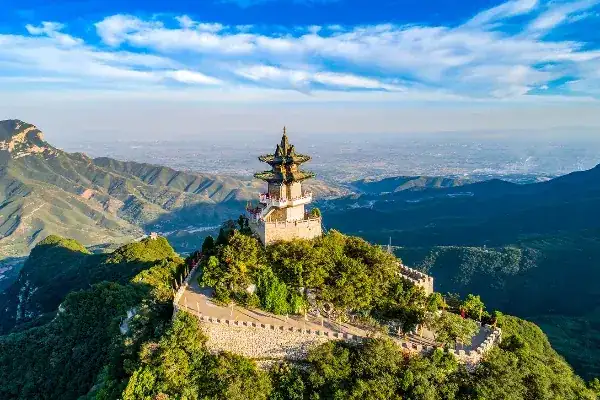
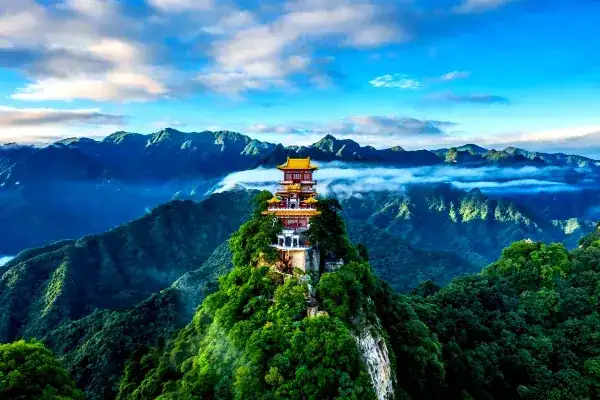
Wulao Peak (AAAA): In the Zhongtiao Mountains, a national forest park and scenic area (300 km²). Five main peaks with the highest, Yuzhu Peak, at 1,809.3m. A sacred site of Daoist Quanzhen sect and early Heluo culture.
Yuncheng Salt Lake (AAAA): ~132 km², over 4,000 years of development. Due to its salt content similar to the Dead Sea, people can float effortlessly—dubbed "China's Dead Sea."
Yuanqu Lishan Scenic Area (AAAA): 90% forest coverage, 1,400+ plant species, 330+ animal species (80%+ of Shanxi's wildlife), 8 km² of primeval forest. National Class I protected animals: leopard, black stork, golden eagle (9 species). 4 nature reserves (2 national, 2 provincial).
Famous Figures
Ancient
Nüwa (Mother Earth), Leizu (Yellow Emperor's wife, inventor of sericulture), Chiyou (Nine Li tribe leader), Fenghou (Yellow Emperor's prime minister), Houji (agricultural official, Zhou Dynasty ancestor), Shun (tribal alliance leader), Yu the Great (Xia Dynasty founder), Fu Yue (Shang Dynasty minister), Duke Wen of Jin (Spring and Autumn hegemon), Marquis Wen of Wei (Warring States founder), Yidun (famous Warring States merchant), Jie Zitui, Zhang Yi (diplomat), Xunzi (philosopher), Lian Po (general), Guan Yu (from Xiezhou, sworn brother of Liu Bei and Zhang Fei), Lady Wei (calligrapher, Wang Xizhi's teacher), Wei Jie (one of China's four great beauties), Pei Xiu (father of Chinese cartography), Wang Tong (Sui Dynasty educator), Guo Pu (feng shui master), Xue Rengui (Tang Dynasty general), Wang Bo (Tang poet, foremost of the "Four Eminences of Early Tang"), Wang Zhihuan (frontier poet), Wang Wei (Tang poet and painter), Zhang Xun (Tang general), Pei Xingjian (military strategist), Pei Du (chancellor), Yang Yuhuan (one of China's four great beauties), Lu Lun (Tang poet), Liu Zongyuan (poet/politician, one of the Eight Great Prose Masters), Sikong Tu (poet/critic), Lü Dongbin (one of the Eight Immortals), Sima Guang (Northern Song historian/politician), Zhao Ding (Southern Song patriot), Meng Gong (Southern Song general), Guan Hanqing (Yuan Dynasty drama pioneer, foremost of the "Four Great Yuan Drama Masters"), Ji Jike (founder of Xingyi Boxing), and Li Bing (builder of the Dujiangyan irrigation system).
Modern
Yang Shenxiu (one of the "Six Gentlemen of 1898"), Fu Zuoyi (anti-Japanese general), Dong Qiwu (PLA general), Chang Qiankun (early CCP pilot), Cheng Zihua (CPPCC vice chairman), Li Jianwu (writer/dramatist), Pei Lisheng (former governor of Shanxi), Yao Mianzhong (calligrapher), Wen Minsheng (former governor of Henan), Chai Zemin (first PRC ambassador to the USA), Yan Fengchun (Puju opera master, inventor of hat-wing technique), Hou Bo (photographer for Mao Zedong), Xi Zezong (astronomer, CAS academician), Zhang Zhijian (PLA general), Pei Huailiang (former president of National Defense University), Zheng Weiping (PLA general), Ning Jizhe (NDRC vice chairman), Zhang Shaoqin, Zhang Ping (writer, former vice governor of Shanxi), Ning Bin (CAS academician, control systems expert), Xiang Libin (CAS vice president), Meng Zhenping (State Power Investment Corporation GM), Shi Lirong (ZTE president), and Jing Haipeng (PLA astronaut, from Yuncheng).
Honorary Titles
2006: China's Top Ten Charming Cities. 2007: Top Ten Best Investment Cities in Central China. 2009: China Financial Ecological City. 2012: National Double Support Model City. 2018: Ranked 32nd in China City Innovation Competitiveness. 2020: National Double Support Model City. 2023: National Food Safety Demonstration City. 2025: National Double Support Model City.
External Exchange
International sister cities and domestic sister cities.
Travel information can change. Check current opening hours, reservations and entry requirements before you travel.
Traveller discussion
Start the conversation with a helpful tip or a question.