Shanghai, January 7 (China News Service) -- Title: A Food Street Brings Chinese and Korean Cultures Together
Every evening around 6 p.m., the lights on Hongquan Road in Minhang District, Shanghai, gradually illuminate the street. The sizzling pork belly on the grill at the barbecue restaurants, along with the sounds of conversations in Chinese and Korean, create a unique background soundscape for this street.
This is Shanghai's "Seoul Night Market," also known as "Korea Street." This street, less than a kilometer long, has become a trendy spot for Koreans to experience their hometown atmosphere and Shanghai lifestyle.
When Choi Jong-hee, a South Korean, first visited a night market in Seoul, he was moved by the scene of cultural fusion: a Chinese tea shop was next to a Korean barbecue restaurant, and there were bilingual signs in Chinese and Korean everywhere... This atmosphere of cultural fusion made him decide to stay.
“I never imagined I would settle down here for so long,” Choi Jong-hee said in fluent Chinese. From his involvement in restaurants like “Snow Night Mi” and “Jongro Chamber of Commerce,” his career has been inextricably linked to this street. Now, he not only has a thorough understanding of how Korean restaurants operate in China, but his life is also anchored here. Having become a “Shanghai son-in-law,” he jokingly says that he has spent more time in Shanghai than in his hometown.
"This tastes just like the Seoul I remember." This simple statement from a customer is what Choi Jong-hee cherishes most about running his restaurant. His personal experience also reflects the transformation of "Korea Street," from a hub providing hometown flavors for Koreans in Shanghai to a window for Chinese people to experience Korean life, and a unique neighborhood where Chinese and Korean customers are evenly matched and cultures blend.
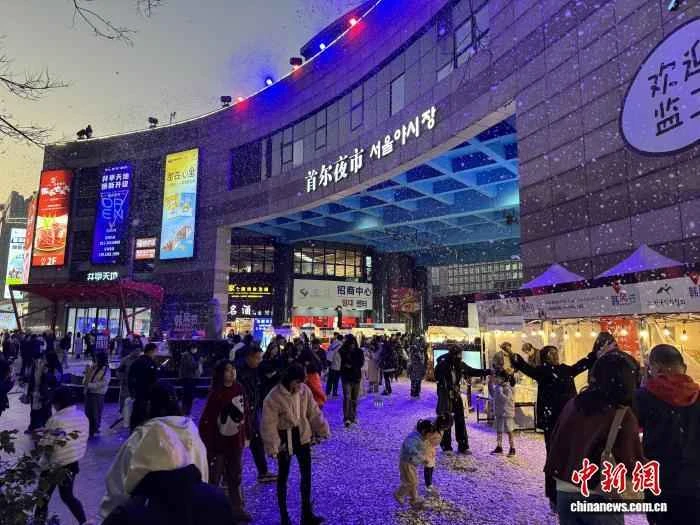
In early 2026, the Shanghai Seoul Night Market will transform its entire atrium into a "winter living room." ( Photo provided by Minhang District )
In an interview with China News Service, Feng Lili, Assistant General Manager of the Jingting Tiandi Project, the management company behind "Korea Street," stated that "Korea Street" has gradually developed into a representative district showcasing the integration of diverse cultures in Shanghai and an important window for friendly exchanges between the people. Through regularly holding events such as Korean cultural festivals, traditional food experiences, and art exhibitions, it continuously promotes mutual understanding and cultural resonance between the people of China and South Korea.
Today, the stories on "Korea Street" continue to grow. New-style Korean cosmetics shops run by young entrepreneurs and creative spaces blending aesthetics from both countries are constantly emerging, attracting tourists from both China and South Korea to explore. This street has transcended its initial definition as a "food destination," becoming a continuously evolving "cultural organism."
Feng Lili explained that in the future, the district will adopt a more open and inclusive approach, further enriching the Sino-Korean themed business formats around cultural displays and distinctive consumption, introducing more fine dining, trendy retail and cultural experiences, and planning a series of in-depth cultural activities to provide citizens and tourists with a more vibrant exchange scene.
Author Gao Zhimiao