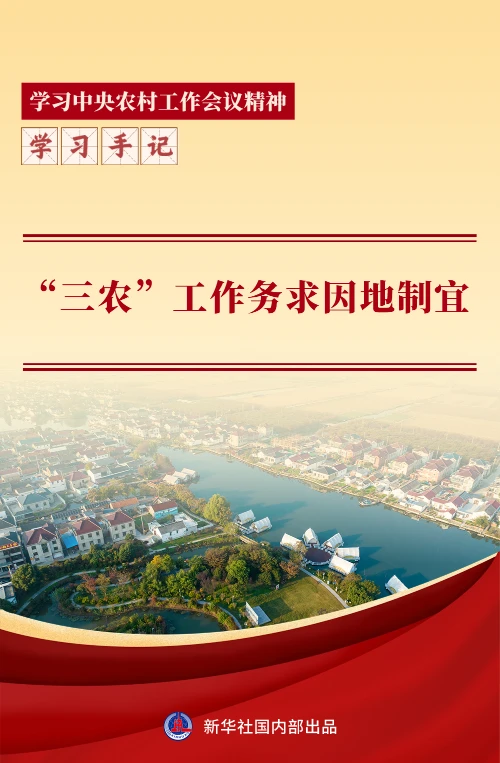
Building beautiful homes and living a better life is the common aspiration of hundreds of millions of farmers. Not long ago, the Central Rural Work Conference was held, and General Secretary Xi Jinping gave important instructions: "We should learn from and apply the experience of the 'Ten Thousand Villages Project' to promote the construction of livable, workable, and beautiful villages in accordance with local conditions, and improve the level of rural governance and the construction of civilized rural customs."
The principle of "adapting to local conditions" is a methodology for rural work that the General Secretary has repeatedly emphasized.
In June 2003, under the guidance and promotion of Xi Jinping, then Secretary of the Zhejiang Provincial Party Committee, the "Ten Thousand Villages Project," focusing on improving the rural living environment, was launched. For over 20 years, how has this project been able to consistently create thousands of beautiful villages and benefit hundreds of millions of farmers?
We can find the answer in an article in "Zhejiang New Discourse" entitled "Building a New Countryside Should Embodies the Principle of Adapting to Local Conditions": "Building a new socialist countryside must adhere to adapting to local conditions, providing classified guidance, using pilot projects to drive overall development, setting examples, making democratic decisions, and operating in a standardized manner. Implementing the 'Thousands of Villages Demonstration, Ten Thousands of Villages Renovation' project is precisely the inevitable choice of adapting to local conditions."
Building livable, business-friendly, and beautiful villages requires basing our efforts on our own realities. General Secretary Xi Jinping has repeatedly stated that rural environmental improvement is necessary in both developed and underdeveloped regions, although standards can vary.
Adapting to local conditions means focusing on practical results and implementing precise policies, avoiding "vanity projects" and "image projects," and preventing them from being divorced from reality or exceeding the stage of development. Only in this way can we meet the wishes of farmers, bring them tangible benefits, and gain their support.
Take the seemingly small matter of rural toilet renovation as an example; General Secretary Xi Jinping has repeatedly emphasized the need to adapt to local conditions.
In 2014, in Yongmaowei Village, Shiye Town, Zhenjiang, Jiangsu Province, upon learning that the village's dry toilets had been converted to flush toilets, the General Secretary was very pleased: "We must do a good job in the construction of toilet drainage networks and rural sewage treatment according to local conditions." During the 2019 National People's Congress, while participating in the deliberations of the Inner Mongolia delegation, the General Secretary inquired with concern about the details of the villagers' indoor toilet renovations from a grassroots NPC deputy: "Is it a flush toilet or a dry toilet? Is it a centralized septic tank or one septic tank per household?"
At the 2025 Central Economic Work Conference, the General Secretary reiterated that "rural toilet renovation should also be tailored to local conditions," and further analyzed: "With such a large difference between the north and the south, how can toilet renovation follow the same model? Is it necessary to build standard toilets in remote areas with few households? We cannot turn a project that wins the hearts of the people into a project that breeds resentment."
Behind the repeated emphasis lies a consistent pragmatic spirit and demonstrates the determination to "truly do this good thing well and do practical things practically."
Adapting to local conditions requires leveraging existing strengths and consciously following established principles. Rural areas in my country vary greatly, and achieving agricultural modernization necessitates a scientific understanding of both these differences and underlying patterns. In recent years, General Secretary Xi Jinping has elucidated the principles that rural development should follow on various occasions.
Rural areas and cities are different living spaces. Promoting integrated urban-rural development does not mean building rural areas to be the same as cities, but rather focusing on improving rural conditions and making them more livable. As General Secretary Xi Jinping pointed out, "Integrated urban-rural development, it is entirely possible to preserve the original features of villages, carefully avoid cutting down trees, filling in lakes, and demolishing houses, and improve residents' living conditions as much as possible while maintaining the original village form."
As the economy and society develop, some villages will gather more people, while some natural villages will gradually shrink, which is in line with the laws of village evolution and development. The General Secretary emphasized, "Which villages to retain, which villages to renovate, which villages to shrink, and which villages to expand must be scientifically demonstrated. We must not act impulsively, disregard the wishes of farmers, forcibly merge villages, or force farmers to move into high-rise buildings."
my country boasts a splendid and long-standing agricultural civilization, and the roots of its rural culture must not be severed. The General Secretary emphasized: "The construction of new rural areas must follow a path that suits the realities of rural areas, adhere to the inherent laws of rural development, fully reflect rural characteristics, pay attention to local flavor, preserve the rural landscape, retain the green mountains and clear waters, and preserve the sense of nostalgia for the countryside."
Every village has its own unique characteristics and customs. We should pay attention to regional features, respect cultural differences, and embrace diversity. "We cannot simply copy urban planning, nor can we apply a one-size-fits-all approach. We must scientifically grasp the differences in rural areas, tailor our measures to each village's specific circumstances, and create distinctive modern versions of the 'Dwelling in the Fuchun Mountains' painting."
Adapting to local conditions is essentially about being pragmatic.
Looking to the future, the "15th Five-Year Plan" recommendations further deploy and promote the construction of livable, business-friendly, and beautiful villages. As long as all localities closely integrate with their realities, focus on the needs of farmers, adapt to local conditions, grasp the laws of development, and continuously explore new paths and apply new methods, a new picture of modern rural areas will surely unfold across the land of China.
Planning: Zhang Xiaosong
Editor-in-Chief: Zhu Jichai
Main writer: Yan Fujing
Visuals: Hao Xiaojing, Huang Jiongrui
Produced by Xinhua News Agency Domestic Department