Xinhua News Agency, Guangzhou, January 8th : Passenger traffic surpasses 100 million in both areas! The "three connections" between Guangdong, Hong Kong, and Macao continue to improve.
The cumulative number of passengers entering and leaving the country via the Zhuhai Port of the Hong Kong-Zhuhai-Macao Bridge recently exceeded 100 million, and the cumulative number of passengers on the Hong Kong section of the Guangzhou-Shenzhen-Hong Kong Express Rail Link also recently exceeded 100 million. The fact that passenger flow has exceeded 100 million in both areas demonstrates the continuous improvement of the "three connections" between Guangdong, Hong Kong and Macao.
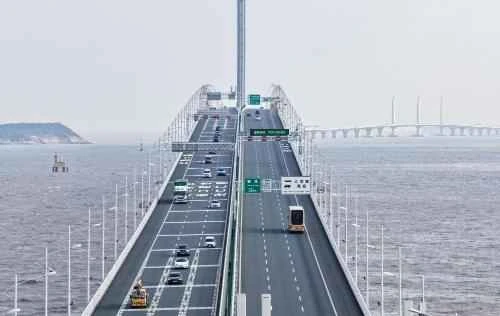
This photo, taken on January 6, shows vehicles traveling on and off the Hong Kong-Zhuhai-Macau Bridge (drone photo). From its opening in October 2018 to January 6, 2026, the number of passengers traveling between Guangdong, Hong Kong, and Macau via the Zhuhai Port of the Hong Kong-Zhuhai-Macau Bridge is expected to exceed 100 million. (Xinhua/Deng Hua)
The increasingly sophisticated transportation infrastructure, the smoother integration of rules and mechanisms, and the closer exchanges and interactions are continuously strengthening the foundation for the integrated development of the Guangdong-Hong Kong-Macao Greater Bay Area.
Today, the Greater Bay Area has six cross-river and cross-sea channels that have been completed and opened to traffic: the Humen Bridge (opened in 1997), the Huangpu Bridge (opened in 2008), the Hong Kong-Zhuhai-Macau Bridge (opened in 2018), the Nansha Bridge (opened in 2019), the Shenzhen-Zhongshan Bridge (opened in 2024), and the Huangmaohai Cross-Sea Channel.
The "hard connectivity" of infrastructure within the city cluster has facilitated the smooth development of the Greater Bay Area, especially with the rapid growth in passenger traffic from the Hong Kong section of the Guangzhou-Shenzhen-Hong Kong Express Rail Link and the Hong Kong-Zhuhai-Macau Bridge, two major infrastructure projects that have been opened successively.
Today, taking the Guangzhou-Shenzhen-Hong Kong Express Rail Link, the fastest journey from Guangzhou South Station to Hong Kong West Kowloon Station takes less than 50 minutes, and from Shenzhen Futian Station to Hong Kong West Kowloon Station takes only about 15 minutes. MTR Corporation Managing Director (Hong Kong Passenger Services), Yang Meizhen, believes that the continuously record-breaking passenger volume on the Hong Kong section of the Guangzhou-Shenzhen-Hong Kong Express Rail Link reflects the vigorous development trend brought about by the deepening integration between the Mainland and Hong Kong.
The Hong Kong-Zhuhai-Macau Bridge has shortened the travel time between Hong Kong and Zhuhai/Macau from 3 hours to about 45 minutes. "It took more than 5 years to break the first 50 million passenger trips, but only 1 year and 8 months to break the second 50 million passenger trips," said Chen Faqiu, head of the Hong Kong-Zhuhai-Macau Bridge Border Inspection Station.
Since the opening of the Hong Kong section of the Guangzhou-Shenzhen-Hong Kong Express Rail Link and the Hong Kong-Zhuhai-Macau Bridge more than seven years ago, for more and more travelers in the Greater Bay Area, taking the Guangzhou-Shenzhen-Hong Kong Express Rail Link to cross the border for meetings and taking the Hong Kong-Zhuhai-Macau Bridge to cross the border for shopping are becoming daily routines instead of novel experiences.
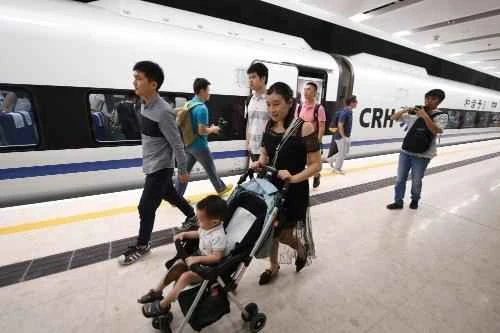
On September 23, 2018, passengers on the G5711 high-speed train arrived at Hong Kong West Kowloon Station. (Photo by Mao Siqian, Xinhua News Agency)
The record-breaking 100 million visitors in both cities vividly demonstrates that the vision of a "one-hour living circle" in the Greater Bay Area is becoming a reality. "These two cross-border projects directly promote the unimpeded flow of talent, capital, and innovation in the Greater Bay Area, accelerating the complementary advantages of urban functions and socio-economic resources, as well as the integration of industrial chains," said Yan Gang, a member of the Legislative Council of the Hong Kong Special Administrative Region.
Increasingly完善的交通基础设施 (increasingly完善的交通基础设施) is the hardware, while continuously convenient supporting customs clearance policies are the software. In the past two years, with the successive implementation of policies such as "Macau vehicles going north", "Hong Kong vehicles going north", and "Guangdong vehicles going south", the Hong Kong-Zhuhai-Macau Bridge has witnessed the accelerated integration of the Greater Bay Area. Customs clearance policies such as "cooperative inspection, one-time release" and "facial recognition clearance" are also being continuously optimized at major ports.
In July 2023, the "Hong Kong vehicles going north" policy was officially implemented. On December 23, 2025, the "Guangdong vehicles going south" policy for entering Hong Kong's urban areas was officially implemented. "I can drive from Zhuhai to Hong Kong with just one step on the gas, this experience is so exhilarating!" said Mr. Cao, a Zhuhai resident who took his family on a road trip to Hong Kong during the year-end shopping season.
People traveling between the two places generally believe that in the past, they had to consider issues such as vehicle traffic restrictions and ferry schedules when traveling between the two places, but now the procedures have been greatly simplified, making travel more convenient.
Hong Kong's Secretary for Transport and Logistics, Chan Mei-po, said that Hong Kong is making every effort to advance the Northern Link and the Hong Kong-Shenzhen Western Railway (Hung Shui Kiu to Qianhai) projects. The two cross-border railway projects will fully connect the MTR networks of Hong Kong and Shenzhen.
No need to search for documents; simply face the camera, press your fingerprint, and the customs clearance can be completed in about 10 seconds—this convenient scenario has become a daily routine at the Gongbei Port's "face-scanning" smart channel for over a year. In November 2024, the first batch of smart fast channels in the country were launched for trial operation at the Gongbei Port between Zhuhai and Macao, and the Shenzhen Bay Port between Shenzhen and Hong Kong.
"I work in Macau. In the past, I had to take out my documents and queue up every morning and evening to cross the border. Now, with 'face recognition + fingerprint scanning,' it's all done in one step, which is very convenient," said Ms. Li, a resident of Zhuhai who works in Macau.
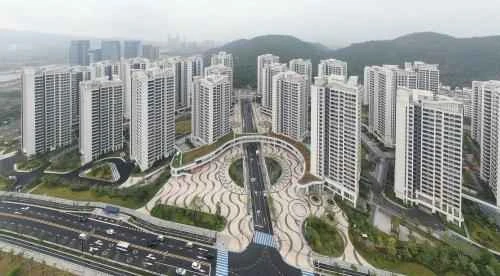
This photo, taken on November 24, 2024, shows the Macao New Neighborhood community in Hengqin (drone photo). (Xinhua/Deng Hua)
With the gradual improvement of infrastructure and the increasing convenience of supporting policies, residents of the Greater Bay Area are encouraged to engage in closer exchanges and integration.
"I feel very relaxed and comfortable in Hengqin." Su Baijing, a Macao resident, works at a university in Macao. She was attracted by the comfortable living environment and increasingly convenient customs clearance policies in Hengqin. After moving to a new neighborhood in Hengqin, she drives her Hengqin-plated car to and from the border every day. During off-peak hours, she hardly has to wait and can pass through customs quickly in just a few minutes.
Since moving in at the end of 2024, Su Baijing and her family have witnessed the changes in Macau's new neighborhood and its surroundings. Whether it's the living environment, or the supporting facilities and community activities such as health stations and family community service centers, she feels very cared for. "In the past year, there have been more neighbors and more children in the community, and many Macau people have come to open shops nearby. It's very prosperous."
Su Bojing's parents frequently travel between their hometown of Yangjiang, Guangdong and Hengqin, while she lives in Hengqin and works in Macau. The Su family are participants and witnesses to the integration and development of the Greater Bay Area.
“We’ve already explored Hengqin, and our daily travel is now expanding to cities like Zhuhai and Zhongshan,” said Su Baijing. As spatial distances decrease, the flow of people and capital accelerates, and people’s psychological distance will become closer and closer. “This is an inevitable trend.”
"The smooth flow of people naturally leads to convenient logistics and efficient circulation of capital. The interaction between consumption and the economy from north to south is constantly consolidating the foundation for the integrated development of the Greater Bay Area," said Shi Ronghuai, a member of the Standing Committee of the National Committee of the Chinese People's Political Consultative Conference and president of the Hong Kong Beijing Association.
Xinhua reporters Wang Haoming, Wang Xinyi, and Qi Fei