The Yangtze River Delta region, encompassing Shanghai, Zhejiang, Jiangsu, and Anhui, spans 358,000 square kilometers. These three provinces and one municipality are geographically adjacent and share a common cultural heritage. With its connections to the sea and interconnected markets, it has become one of the most dynamic, open, and innovative regions in my country's economic development.
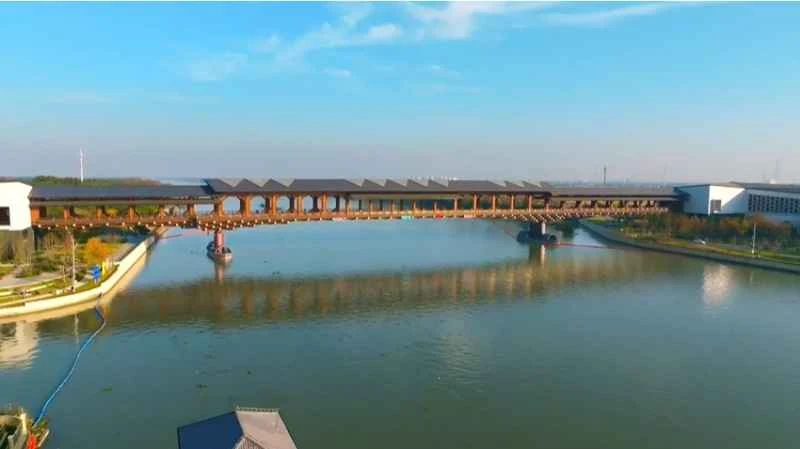
Located at the junction of Shanghai, Jiangsu, and Zhejiang, the Taipu River connects Taihu Lake to the west and the Huangpu River to the east. Its shimmering waters link Shanghai's Qingpu District, Suzhou's Wujiang District, and Jiaxing's Jiashan County, Zhejiang, earning it the title of "Origin of the Yangtze River Delta." Atop the river, a building resembling a traditional courtyard house spans both banks—this is Fangting Shuiyuan, the first cross-provincial housing construction project in China.
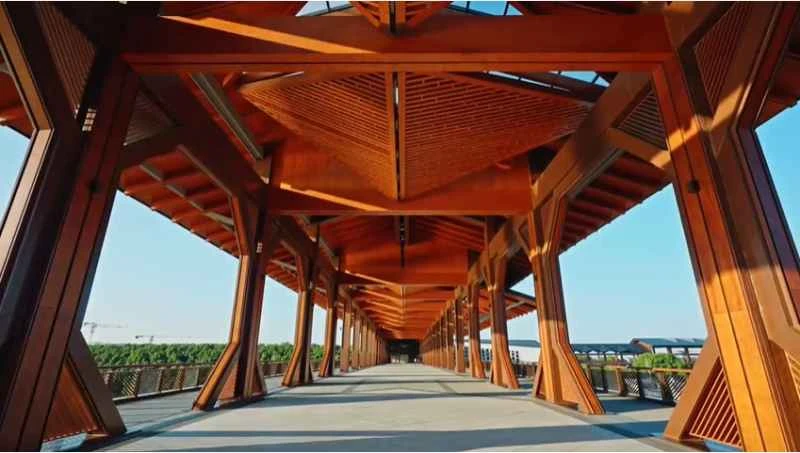
The name "Fangting" (方厅) is derived from the concept of a round heaven and a square earth, while "Shuiyuan" (水院) highlights the water towns of Jiangnan. From an aerial view, the complex is square in the traditional courtyard house style, with white walls and gray tiles. The four themed pavilions—Shanghai, Jiangsu, Zhejiang, and Anhui—are located at the four corners, connected by pedestrian bridges spanning rivers and regions, symbolizing the beautiful picture of the Yangtze River Delta's three provinces and one municipality converging and developing in an integrated manner. The four regional pavilions capture the essence of their respective cultures: the Shanghai pavilion features elements of Shikumen architecture, the Jiangsu pavilion incorporates elements of Suzhou gardens, the Anhui pavilion features landscape designs such as Huangshan pines, and the Zhejiang pavilion showcases the landscape of Zhejiang.

Construction of Fangting Water Park began in May 2023 and was completed at the end of May 2025. It serves as a shared meeting place for international forums and exhibitions, functioning as a "shared living room" for the Yangtze River Delta region, and also as a waterfront park for visitors from all three areas. Strolling along the connecting corridors, visitors can seamlessly cross the Yangtze River Delta in just 15 minutes. Surrounded by lush greenery, boats occasionally glide beneath the corridors, blending the vibrancy of the Yangtze River Delta with the poetic charm of Jiangnan, stretching endlessly into the distance.
Fangting Water Conservancy Institute is a core project of the Yangtze River Delta Ecological Green Integrated Development Demonstration Zone, which was established in 2019 and encompasses Qingpu District of Shanghai, Wujiang District of Suzhou, and Jiashan County of Jiaxing. In November 2022, the Executive Committee of the Demonstration Zone, together with the governments of the two districts and one county, announced an implementation plan for cross-provincial collaborative promotion of common prosperity. Looking to the future, the Yangtze River Delta, formed by the convergence of Shanghai, Jiangsu, Zhejiang, and Anhui, will join hands to tackle challenges and share benefits on a larger scale, paving the way for cross-provincial promotion of common prosperity nationwide.
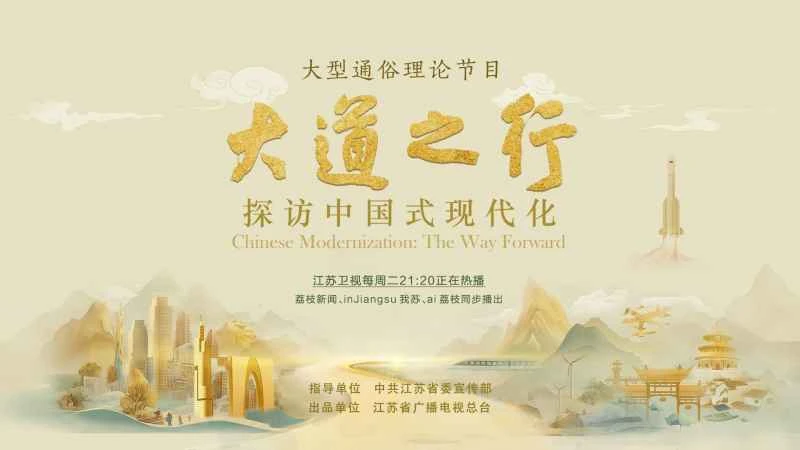
To deeply study and implement Xi Jinping's Thought on Socialism with Chinese Characteristics for a New Era, and to showcase the distinctive features and profound connotations of Chinese-style modernization, the five-episode popular theoretical program "The Path of the Great Way: Exploring Chinese-Style Modernization," produced by Jiangsu Broadcasting Corporation under the guidance of the Jiangsu Provincial Party Committee's Publicity Department, premiered on Jiangsu Satellite TV on December 30th at 9:20 PM. Guided by Xi Jinping's Thought on Socialism with Chinese Characteristics for a New Era, the program closely follows the strategic deployment of the Fourth Plenary Session of the 20th CPC Central Committee regarding the "15th Five-Year Plan," focusing on the core theme of "Chinese-style modernization." Based on the five aspects of Chinese characteristics in Chinese-style modernization, the program systematically interprets the concept from multiple dimensions, including international and domestic perspectives, history and reality, and theory and practice, comprehensively outlining the magnificent picture of Chinese-style modernization.