According to the China Manned Space Engineering Office, on January 8, 2026, Beijing time, the China Manned Space Engineering Office released the 2025 "Report on the Progress of Scientific Research and Application of China's Space Station" to the public.
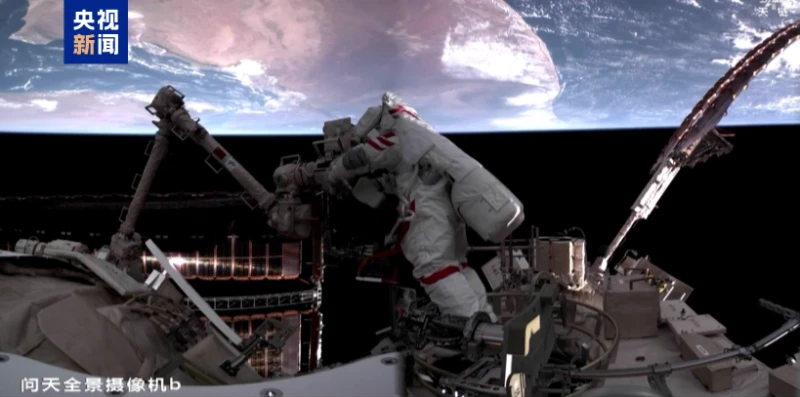
△ Footage of the Shenzhou-21 crew's first spacewalk
The report aims to comprehensively promote the vigorous development of space science, space technology, and space applications. Focusing on areas such as space life sciences and human research, microgravity physics, and new space technologies and applications, it selects 33 representative scientific research and application achievements from scientific and application projects that have completed on-orbit experiments, obtained downlink scientific experimental samples, analytical results, and made outstanding research progress. It also showcases related popular science and cultural activities, responding to the concerns and expectations of all sectors of society regarding the construction and development of China's space station. The report reflects my country's capabilities and innovative spirit in the field of space science and technology, and plays a positive role in promoting more in-depth space science experimental research, achieving high-level scientific breakthroughs, large-scale application and promotion, and multi-dimensional benefit enhancement.
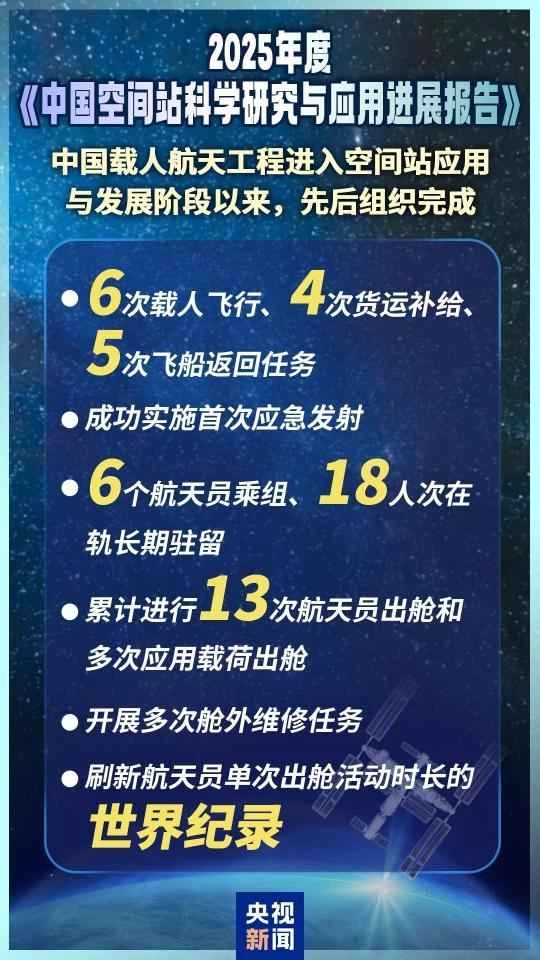
Since entering the space station application and development phase, China's manned space program has successfully completed six manned flights, four cargo resupply missions, and five spacecraft return missions, including its first emergency launch. Six astronaut crews, comprising 18 personnel, have maintained long-term stays in orbit, conducting a total of 13 extravehicular activities (EVAs) and multiple payload EVAs, carrying out numerous extravehicular maintenance missions, setting a new world record for the longest single EVA, and completing the selection of the fourth batch of reserve astronauts, including payload experts from Hong Kong and Macau, as well as the selection and development of a low-cost cargo transportation system. Currently, China's space station is operating stably in orbit and demonstrating its effectiveness.
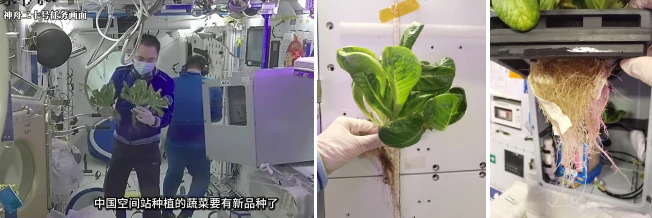
△ Harvesting and collecting samples of lettuce in orbit
It is understood that the space science, applied experiments, and technological test projects carried out on the Chinese space station are progressing smoothly and yielding fruitful results, demonstrating a certain degree of cutting-edge nature and innovation. Currently, my country has planned four major research areas and 32 research themes: space life and human research, microgravity physics, space astronomy and earth science, and new space technologies and applications. As of December 2025, 265 scientific and applied projects have been deployed and implemented in orbit in the three major areas of space life and human research, microgravity physics, and new space technologies and applications.
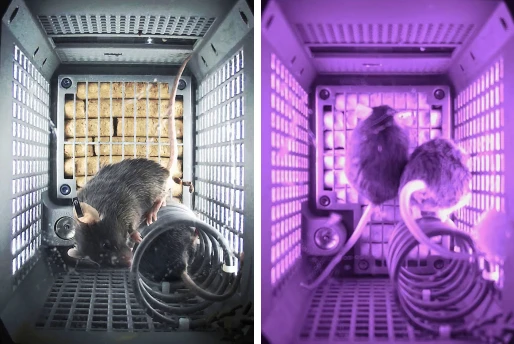
△ Mouse in-orbit experiment
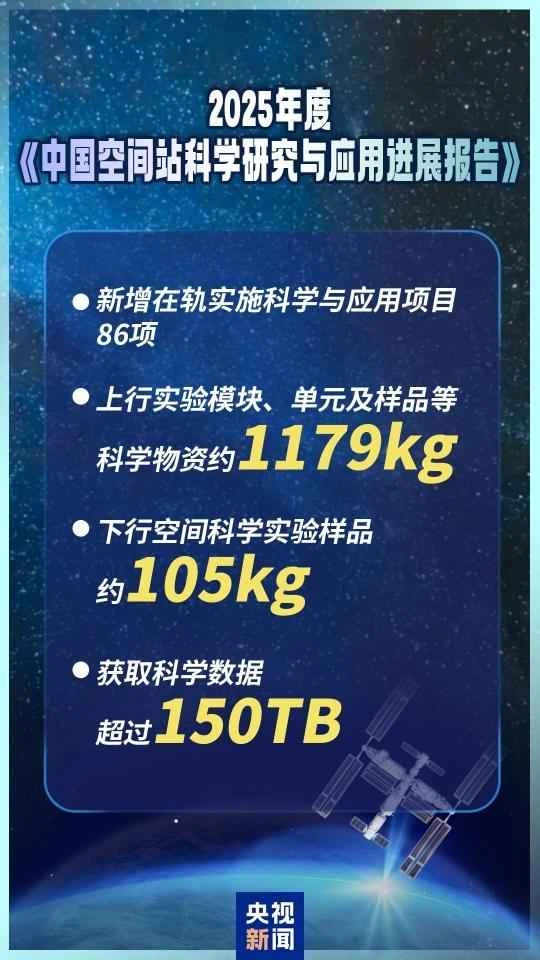
In 2025, 86 new scientific and applied projects were launched in orbit, carrying up to approximately 1179 kg of scientific materials, including experimental modules, units, and samples, and down to approximately 105 kg of space science experimental samples, acquiring over 150 TB of scientific data. Over the past year, several significant advances have been achieved, including the successful completion of the first mouse space science experiment on the Chinese space station; the first international study on the biological environment of the space station under submagnetic and microgravity conditions; the discovery of a novel magnesium ion binding mode for bacteriophage adenosine triphosphate hydrolase; the first internationally proposed non-invasive intracranial pressure monitoring technology based on transorbital ultrasound measurement of the subarachnoid space area of the optic nerve; a series of influential scientific discoveries on the solidification mechanism of high-temperature refractory alloys; the elucidation of the formation mechanism and influencing factors of different phases in multiphase iron-based magnetostrictive alloys; and the first internationally conducted in-orbit testing of a space station pipeline inspection robot, yielding groundbreaking results.
To maximize the benefits of on-orbit scientific research, scientific teams in various fields have conducted in-depth research focusing on major national needs and cutting-edge technologies, producing a series of original, cutting-edge, and innovative results. Preliminary statistics show that in 2025, over 230 high-level SCI papers were published, and more than 70 patents were obtained. Through in-depth experimental research and application exploration, some results have been transferred, transformed, and widely applied, significantly promoting the rapid development of space science and its applications in my country.
Space exploration is a never-ending journey. As a national space laboratory, the Chinese Space Station will continue to carry out a series of space science research projects, actively promote science popularization and international cooperation, gather high-level scientific research forces from home and abroad, and comprehensively support the integrated development of my country's space science, space technology and space applications, making important contributions to accelerating the construction of a science and technology power and a space power.
(Illustrations by CCTV reporters Wang Gang and Tian Ruonan, and Ai Jiumei)


