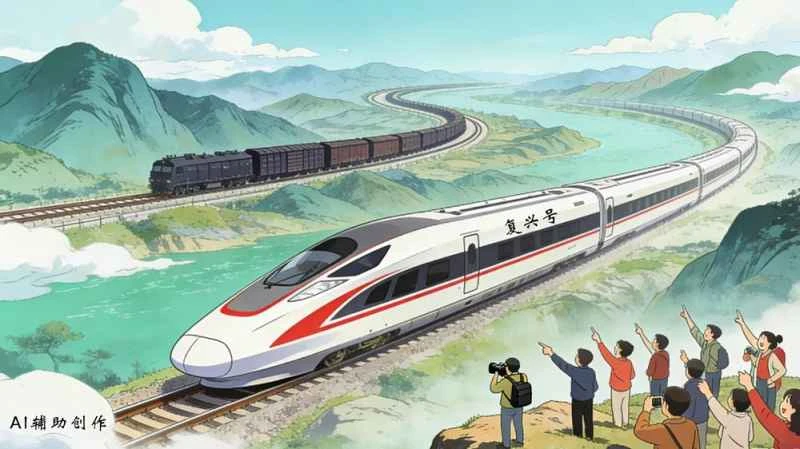
In 2025, China's national railway system transported 4.255 billion passengers, a year-on-year increase of 4.2%, with a peak daily passenger volume of 23.132 million, setting a new historical record. This impressive performance paints a picture of a prosperous, mobile China, highlighting the railway's core strength as a vital artery of the national economy.
The simultaneous improvement in both quantity and quality of railway development is essentially a resonance between people's livelihood needs and national strategies. The steady increase in passenger volume reflects the continuous release of public travel demand and, more importantly, a high level of recognition of the quality of railway services. Peak-day transport volumes test not only the precision and efficiency of capacity scheduling but also the maturity and resilience of the railway system in handling large-scale passenger flows. From simply "being able to travel" to "traveling well," from the slow pace of old-fashioned trains to the lightning speed of high-speed rail, the iterative upgrades of railway passenger transport have continuously shortened the distance between places, making "spontaneous travel" a daily occurrence for ordinary people, promoting inter-regional population flow and cultural exchange, and injecting fresh vitality into economic and social development.
The continuous growth in freight volume and the strong performance of the China-Europe Railway Express and the New International Land-Sea Trade Corridor demonstrate the core value of railways in serving national strategies. The 4.066 billion tons of freight transported carry the demand for industrial raw materials and consumer goods, serving as a crucial guarantee for the stable operation of the real economy. The impressive figures of 34,000 annual China-Europe Railway Express trains and a 47.5% year-on-year increase in the New International Land-Sea Trade Corridor vividly illustrate the role of railways as a link in the "dual circulation" development pattern. From "steel camel caravans" traversing Eurasia to the New International Land-Sea Trade Corridor connecting east and west, railways, with their advantages of large capacity, low cost, environmental friendliness, and high efficiency, are breaking down geographical barriers, building convenient bridges for international trade, and providing solid support for the deep integration of China's economy with the world economy.
The nation's sustained investment and long-term planning in railway construction serve as a powerful stimulant for economic growth and a proactive strategy for the future. The over 50,000-kilometer high-speed rail network, like a dense network of blood vessels, tightly connects major urban clusters, fostering the formation of "one-hour living circles" and "two-hour economic belts," and promoting the optimal allocation of resources and coordinated regional development. This development logic of "network building empowering development" deeply integrates railway construction with urban development and industrial upgrading, providing strong support for current economic growth and accumulating ample momentum for future high-quality development.
The rapid development of railways embodies the innovative spirit and sense of responsibility of China's infrastructure construction. Achieving milestones such as daily freight loading exceeding 200,000 wagons and leading the world in high-speed rail operating mileage is inseparable from continuous technological innovation. From train manufacturing to track laying, from dispatching systems to service facilities, China's railways have continuously broken through barriers through independent research and development and technological iteration, forming a railway construction and operation system with Chinese characteristics. At the same time, railway development has always adhered to the concept of green and low-carbon development. Compared with highways and aviation, railway transportation has a natural advantage in energy conservation and emission reduction. The shift of a large amount of passenger and freight transport to railways has not only reduced logistics costs but also made a significant contribution to achieving the "dual carbon" goals (carbon reduction and emission reduction).
Standing at a new starting point for development, the achievement of exceeding 165,000 kilometers of operating railway mileage nationwide is not only a milestone but also a new beginning. Faced with ever-increasing passenger and freight demand and continuously evolving development expectations, railway construction still requires sustained efforts. On the one hand, it is necessary to continue improving the railway network layout and addressing transportation shortcomings in the central and western regions and remote areas; on the other hand, it is crucial to deepen technological innovation and service upgrades, promote the construction of smart railways, improve transportation efficiency and service quality, and meet the diverse and high-quality travel needs of the public. Simultaneously, it is essential to further strengthen the railway's pivotal role in international trade, expand its reach, and provide stronger transportation support for globalization.
The flowing railway carries the flow of China. With the continuous improvement of the railway network and the sustained advancement of technology, this "steel artery" will undoubtedly become more efficient and smoother, providing stronger impetus for high-quality economic and social development and writing a more splendid new chapter in building a strong transportation nation.
Lü Jinyi


