Changsha, January 12 (Reporter Liu Shuangshuang) -- Stepping into the National Supercomputing Center in Changsha, the constant hum of giant server racks and flashing indicator lights form a backdrop. The rapidly scrolling data streams on the screens empower various industries with this "super brain"—the "industry-finance + big data model" ecosystem built here for a bank has compressed a comprehensive industrial chain analysis that originally required three weeks of manual work into an automatic generation within 48 hours.
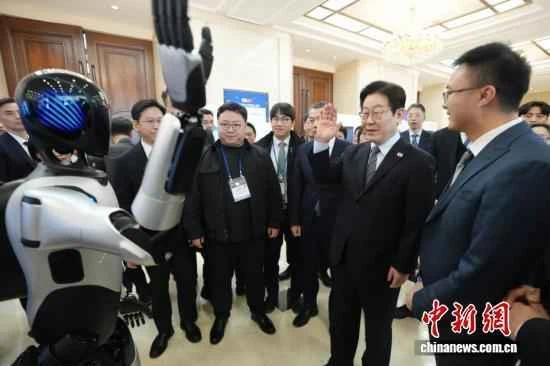
At the Zoomlion Smart Industrial Park, located more than 20 kilometers away in the same city, over 3,000 AI industrial robots are operating on different production lines. Several agile humanoid robots are repeatedly practicing grasping and assembly actions at a simulated workstation. Technicians explained that these robots are already capable of undertaking some pre-assembly and quality inspection tasks.
These are two stops on January 8th during a visit by Hunan's top officials to Changsha and Zhuzhou to investigate the artificial intelligence industry. Two days later, Hunan held a meeting to promote the "Artificial Intelligence+" initiative in five key areas, clearly stating that implementing the "Artificial Intelligence+" action plan is a major track for Hunan to seize opportunities.
From the "computing power base" of the supercomputing center to the embodied experiments on the production line, Hunan's path of exploring "artificial intelligence +" is outlined: bringing cutting-edge technologies down from the cloud and into workshops and fields to solve specific industrial problems.
Supercomputing power is the foundation for Hunan's leapfrog development. Official data shows that during the 14th Five-Year Plan period, Hunan's total computing power reached 13,000P, supercomputing power reached 228P, and intelligent computing power reached 4,800P, which are 21 times, 36 times, and 32 times that at the end of the 13th Five-Year Plan period, respectively. Among them, the National Supercomputing Center in Changsha ranks among the top in the country in terms of supercomputing power, and the province has built a total of 205,000 5G base stations.
Li Kenli, Vice President of Hunan University and Director of the National Supercomputing Center in Changsha, introduced that the National Supercomputing Center in Changsha has built a first-class "super-intelligent fusion" computing power platform in China, which can provide integrated computing power services of "supercomputing power + intelligent computing power" and is leading the construction of the National New Generation Artificial Intelligence Public Computing Power Open Innovation Platform.
According to the "Implementation Plan of Hunan Province for Implementing the State Council's 'Artificial Intelligence+' Action" released in October 2025, by 2027, the scale of Hunan's artificial intelligence industry will exceed 120 billion yuan, and the intelligent computing power will reach 5.25 EFlops; by 2030, the scale of Hunan's artificial intelligence industry will exceed 200 billion yuan, and the intelligent computing power will reach 12 EFlops.
Breakthroughs often begin with specific "pain points." In Zhuzhou, a list of "AI + Manufacturing" needs, compiling 51 specific challenges from over 30 companies, was recently released to the public, using a "challenge-based" mechanism to drive breakthroughs in industry challenges. This "company-proposed" model precisely defines the direction of technological research and development.
Combining Hunan's industrial foundation and scientific research advantages, Wang Yaonan, an academician of the Chinese Academy of Engineering and director of the National Engineering Research Center for Robot Vision Perception and Control Technology, believes that Hunan should focus on the "bottleneck" problems in intelligent manufacturing, make forward-looking plans for cutting-edge directions such as embodied intelligence and collaborative control of swarm robots, and strive to achieve original breakthroughs "from 0 to 1".
In Wang Yaonan's view, embodied intelligence has become an important direction for future technological development, which will drive major changes in production patterns, promote the upgrading of traditional industries and the emergence of new business models.
These advantages are translating into changes on the production line. Zoomlion's subsidiary, Zhongke Yung Valley, has built a cloud-based "industrial super brain" through its independently developed AI-native national-level industrial internet "dual-cross" platform. This platform enables collaboration between large, medium, and small models and deep integration of data and knowledge, establishing a comprehensive advantage across technology research and development, platform support, and scenario implementation. Zhongke Yung Valley began developing humanoid robots in 2024 and has built a training ground covering hundreds of workstations.
Zeng Guang, general manager of Zhongke Yunguo Technology Co., Ltd., introduced that dozens of robots have already "joined" the factory, performing tasks such as sorting and testing. In the future, these humanoid robots are also expected to be widely used in flexible manufacturing, commercial services, and home-based elderly care. "What we are exploring is to form a collaborative manufacturing model between industry and humanoid robots in the future." This is highly consistent with Hunan's direction of promoting the deep integration of AI and industry—from solving a production problem to reshaping the entire production process.
Changes are also occurring in other areas. The combination of portable devices and cloud-based AI has reduced routine blood tests at the grassroots level to ten minutes; artificial intelligence is analyzing ancient bamboo and silk manuscripts from the Mawangdui Han tombs to build a "digital Hunan gene bank"... The impact of technology is spreading from the workshop to the very edge of social services.
Xiao Xiangjiang, president of the Hunan Provincial Artificial Intelligence Association and chairman of Chaoneng Robotics, is full of confidence in the future of the "AI+" industry. Relying on core businesses such as smart healthcare and intelligent operation and maintenance, the company's revenue exceeded 100 million yuan in 2025 and is expected to double in 2026.
A review of Hunan's planning and practices in "Artificial Intelligence+" reveals its core logic: it's not about building technological castles in the air, but rather about strengthening and intelligently upgrading its industrial foundation. As the global technological wave surges, Hunan chooses to ride the wave of intelligence, collaborating with various parties to create synergy, comprehensively empowering high-quality development, and building its differentiated competitiveness for the future. (End)