
Xiqing District
西青区
Origin of the name: Named after Xiqing Road (the highway from Tianjin West Railway Station to Yangliuqing Town, the district government) within its boundaries. Basic introduction to Yangliuqing Ancient Town: Xiqing District is one of the four suburban districts of Tianjin, covering a total area of 565.36 square kilometers. It administers seven t…
Origin of place name:
It is named after Xiqing Road (the highway from Tianjin West Railway Station to Yangliuqing Town, the district government) within the territory.
Basic introduction:
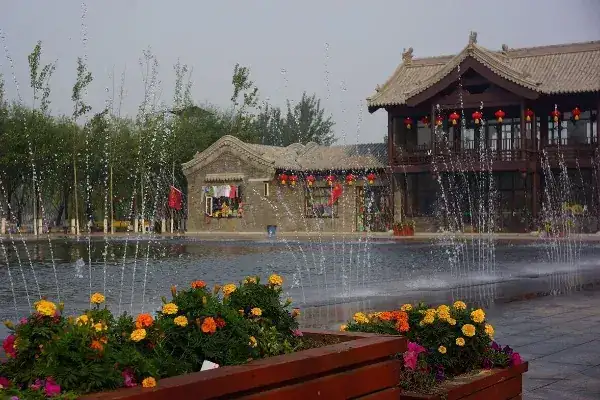
Xiqing District is one of the four suburban districts of Tianjin, covering a total area of 565.36 square kilometers. It administers seven towns, five subdistricts, 133 villages, and 128 communities, with a registered population of 438,600 and a resident population of 863,400. It is a National Civilized District, a National Sanitary District, a National Health Promotion District, a National Advanced District for Scientific and Technological Progress, a National Model City for Supporting the Army and Giving Preferential Treatment to Families of Servicemen, a National Demonstration District for Ecological Civilization Construction, a National Demonstration District for the Construction of a Rule-of-Law Government, and a National Pilot Zone for Green Agricultural Development. The district government is located in Yangliuqing, an ancient town with a history of over a thousand years, the birthplace of Yangliuqing woodblock New Year paintings, one of the four major types of woodblock New Year paintings in China.
Xiqing District is adjacent to the central urban area of Tianjin, boasting a well-developed transportation network. The Tianjin South Railway Station of the Beijing-Shanghai High-Speed Railway is located within the district, and it is connected by over 30 railways, expressways, national highways, and subway lines. Xiqing District has a long history, being the hometown of renowned patriotic martial artists Huo Yuanjia and Han Muxia. Within the district are the Fengshan Yaowang Ancient Temple, originally built in the Tang Dynasty, and the Grand Canal, constructed in the Ming Dynasty.
View detailed information about Xiqing District >>
Honors Ranking:
In September 2026, it was awarded the title of "Demonstration County for the Construction of a Safe China (2021-2025)".
In January 2026, it was recognized as a county (city, district) that achieved universal and inclusive preschool education in 2025.
In April 2025, it was named a national model city (county) for supporting the military and giving preferential treatment to families of servicemen.
In November 2024, it was listed as a key county for leisure agriculture in China.
In September 2024, the list of pilot areas for the fourth batch of convenient living circles in cities across the country was announced, and Xiqing District was included on the list.
In March 2023, the Ministry of Human Resources and Social Security announced the list of national demonstration cities for public employment and entrepreneurship services, and Xiqing District was selected.
In March 2023, Xiqing District was recognized as an advanced county in the national village cleaning campaign for 2022.
In January 2023, Xiqing District was recognized as one of the first batch of national demonstration counties (cities) for the conservation and intensive use of natural resources.
In October 2022, Xiqing District was included in the list of national demonstration counties for rural revitalization in 2022.
View more honors and rankings of Xiqing District >>
Historical background:
The land within Xiqing District was formed during the mid-to-late Tang Dynasty.
During the Northern Song Dynasty, it was the border between the Song and Liao Dynasties. During the Ming Dynasty, it was under the jurisdiction of Jinghai County and Wuqing County of Hejian Prefecture. During the Qing Dynasty, it was under the jurisdiction of Tianjin Prefecture.
In 1912, it was reorganized into Tianjin County, under the jurisdiction of Zhili Province.
In 1952, Tianjin County was placed under the jurisdiction of Tianjin Municipality.
In May 1953, Tianjin County was abolished, and the former Fifth District of Tianjin County was established in the Jinxi Suburbs of Tianjin City, with its seat in Liqizhuang.
It was renamed the Western Suburbs in June 1955.
In October 1958, the western suburbs were merged into the Nankai District.
The western suburbs were restored in 1962, with its headquarters located in Liqizhuang.
In 1971, the district seat was moved to Yangliuqing.
It was renamed west in March 1992.
View detailed historical evolution of Xiqing District >>
Travel information can change. Check current opening hours, reservations and entry requirements before you travel.
Traveller discussion
Start the conversation with a helpful tip or a question.