
Shexian County, Huangshan City
黄山市歙县
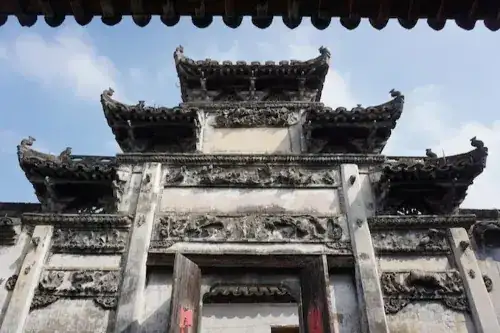
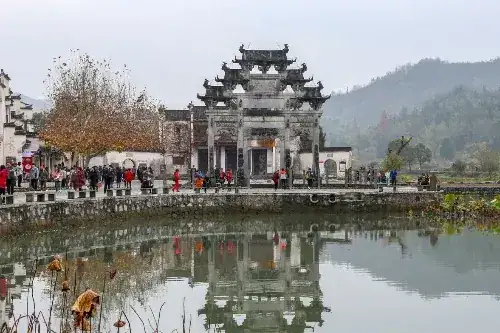
Origin of the place name: "Shepu is located to the south, hence the name." Pu means port, the place where many rivers converge to form the Xin'an River. Baojia Garden Tangyue Stone Archway Group Tangyue Stone Archway Group Huizhou Ancient City Basic Introduction: Shexian County is located east of Hangzhou and south of Qiandao Lake, covering an are…
Origin of place name:
"There is Shepu in the south, hence the name." Pu means the mouth of a river, where many rivers converge to form the Xin'an River.
Basic introduction:
Shexian County is located east of Hangzhou and south of Qiandao Lake. It covers an area of 2,122 square kilometers and has a population of 468,900. It administers 28 townships, 182 administrative villages, and 10 communities. More than 85% of the county is mountainous or reservoir area, with an average of 0.3 mu of land and 5 mu of mountain land per person.
It has six main characteristics:
First, it boasts a long history. Established as a county in 221 BC during the Qin Dynasty, and later as Huizhou Prefecture during the Song Dynasty, the prefecture and county coexisted for 1400 years, making it the political, economic, and cultural center of ancient Huizhou. In 1986, it was designated a National Historical and Cultural City by the State Council, ranking alongside Pingyao in Shanxi, Lijiang in Yunnan, and Langzhong in Sichuan as one of my country's four best-preserved ancient cities. In 2019, it was included in the list of "Millennium Ancient Counties" of Chinese place name cultural heritage.
Secondly, it boasts a rich cultural heritage. Shexian County is a major birthplace of Huizhou culture, historically valuing education and passing down the tradition of poetry and etiquette. There's a saying that "even in a village of ten households, reading and recitation are never neglected." Since the Tang Dynasty, it has produced 820 Jinshi (successful candidates in the highest imperial examinations), including economist Wang Maoyin, and Jianjiang and Huang Binhong, founders of the Xin'an School of painting.
+View detailed information about Shexian County>>
Honors Ranking:
In April 2026, it was designated as a county (city, district) to support the construction of characteristic protection zones for traditional villages in 2026.
In January 2026, it was selected as one of the top 100 cultural counties in China in 2025.
In May 2025, it was ranked 3rd on the list of China's Most Beautiful Small Towns. Its features include: the ancient city of Huizhou, the mother of Huizhou culture, and the Chinese painting paradigm composed of mountains, rivers and white walls and black tiles.
In August 2025, it ranked 29th among the top 30 counties in Anhui Province in terms of comprehensive strength.
In June 2025, it ranked 74th among the top 100 counties in China in terms of comprehensive tourism strength.
In May 2025, the list of the 2025 Hurun China Top 100 Tea Counties was released, with Shexian County ranking 29th.
In January 2025, it was selected as one of the top 100 cultural counties in China in 2024.
In December 2024, Shexian County ranked 53rd on the list of China's Top 100 Tourism Counties and Cities.
In November 2024, the list of key tea-producing counties (formerly the top 100) for 2024 was released, and Shexian County was on the list.
+View more Shexian County honors and related rankings>>
Historical background:
In the 26th year of Qin Shi Huang's reign (221 BC), Shexian County was established and placed under the jurisdiction of Zhang Commandery.
In the fifth year of Emperor Gaozu of Han (202 BC), it belonged to the State of Chu; in the second year of Emperor Wu of Han (121 BC), it belonged to Danyang Commandery; in the thirteenth year of Jian'an of the late Han Dynasty (208 AD), it belonged to Xindu Commandery; in the first year of Taikang of Jin Dynasty (280 AD), Xindu Commandery was renamed Xin'an Commandery, and Shexian County belonged to it; in the second year of Chengsheng of Liang Dynasty of Southern Dynasties (553 AD), the three counties of Shexian, Yixian and Haining of Xin'an Commandery were separated to establish Xinning Commandery; in the third year of Tianjia of Chen Dynasty (562 AD), Xinning Commandery was abolished and it was still under the jurisdiction of Xin'an Commandery.
In the ninth year of the Kaihuang era of Emperor Wen of Sui (589), Xin'an Commandery was merged into Dongyang Commandery, and Shexian County was merged into Haining County, both under the jurisdiction of Wuzhou; in the eleventh year (591), Shezhou was re-established.
+View detailed historical evolution of Shexian County>>
Travel information can change. Check current opening hours, reservations and entry requirements before you travel.
Traveller discussion
Start the conversation with a helpful tip or a question.