
Wuzhou City
梧州市
Origin of the place name: Wuzhou has always used the name Cangwu. The ancestors of Wuzhou were anciently called the "Cangwu" tribe. During the Spring and Autumn and Warring States periods, the primitive clan tribes living in Wuzhou were called "Cangwu," meaning "blue-colored people." The *Yi Zhou Shu Zhu* states, "Cangwu is a barbarian tribe, thei…
Origin of place name:
Wuzhou has always used the name Cangwu, and the ancient inhabitants of Wuzhou were called the "Cangwu" tribe. During the Spring and Autumn and Warring States periods, the primitive clan tribes that lived in Wuzhou were called "Cangwu," which means "blue-colored people." The "Yi Zhou Shu Zhu" says: "Cangwu is a barbarian tribe, whose color is green." The "Cangwu" tribe was a branch of the "Baiyue." After the establishment of Cangwu Prefecture, the name of the Cangwu tribe gradually disappeared.
Basic introduction:
Wuzhou is located in eastern Guangxi, in the middle reaches of the Pearl River. A city with over 2,000 years of history, Wuzhou was once part of the Baiyue region, known in ancient times as Guangxin and Cangwu, a name said to have originated from the abundance of the prickly ash tree (Aralia elata) in ancient times. In 621 AD (the 4th year of the Tang Dynasty's Wude era), the county seat was changed from a prefecture to a state seat, and Cangwu was renamed Wuzhou, marking the beginning of Wuzhou's name. Wuzhou was officially established as a provincial-level city in 1927. Currently, Wuzhou administers Wanxiu District, Dieshan District, Suburbs, Cangwu County, Teng County, and Mengshan County, and also manages Cenxi City. It covers an area of 12,585 square kilometers and has a population of 2.73 million, with Han Chinese comprising over 99% of the total population. The urban area of Wuzhou covers 307 square kilometers and has a population of 320,000. Ethnic groups: Han Chinese make up over 99%, with 18 other ethnic groups including Zhuang, Yao, Hui, Manchu, Dong, and Miao.
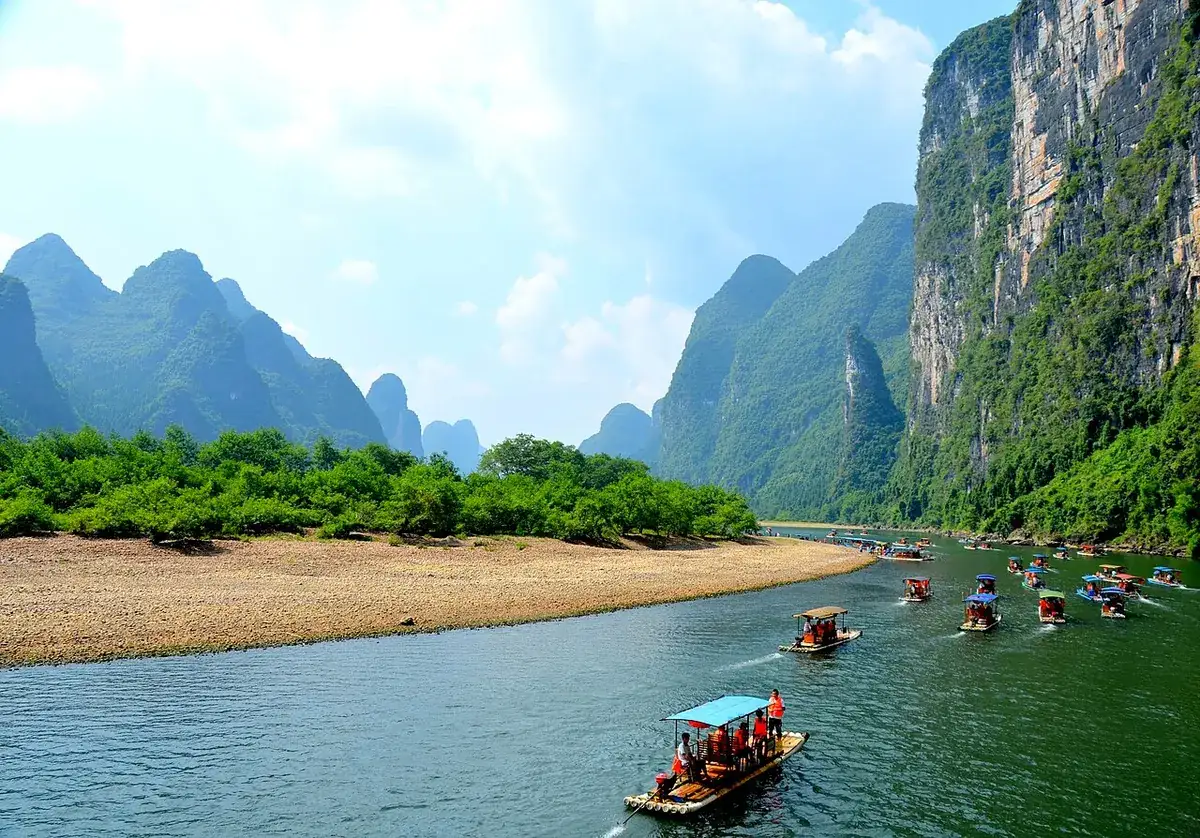
Wuzhou City is located at the confluence of the Xunjiang River and the Guijiang River (whose upper reaches are called the Lijiang River), backed by an elevation of [missing information - likely a specific elevation].
View detailed information about Wuzhou City >>
Honors Ranking:
In January 2026, it ranked 132nd in the overall ranking of overseas online influence of Chinese mainland cities in 2025.
In May 2025, the 2025 China City Charm Ranking was released, with Wuzhou City ranking 217th (a fifth-tier city).
In April 2025, it was named a national model city (county) for supporting the military and giving preferential treatment to families of servicemen.
In September 2024, the list of the fourth batch of pilot cities for convenient living circles within 15 minutes was announced, and Wuzhou City was included.
In May 2024, the 2024 China City Commercial Attractiveness Ranking was released, with Wuzhou City ranking 214th.
In February 2024, Wuzhou City was named a Safe City of Guangxi Zhuang Autonomous Region for 2023.
In January 2024, it was named one of the eleventh batch of national demonstration zones for ethnic unity and progress by the State Ethnic Affairs Commission.
In November 2023, it was selected as a national pilot project for the standardization of rural property rights transfer and trading.
In June 2023, six departments, including the National Health Commission, announced the list of pilot cities for integrated urban medical groups, and Wuzhou was among them.
View more Wuzhou City honors and related rankings >>
Historical background:
During the Qin Dynasty, it was Guilin Commandery (according to Du You's "Tongdian" of the Tang Dynasty, it belonged to Nanhai Commandery).
In the fifth year of Empress Gaozu of Han (183 BC), Zhao Tuo proclaimed himself Emperor Wu of Nanyue and built the Cangwu Royal City, marking the beginning of Wuzhou's establishment as a city. In the sixth year of Yuanding (111 BC), after Emperor Wu of Han destroyed the Nanyue Kingdom, he established Cangwu Commandery, with its capital at Cangwu Royal City in Guangxin County. In the fifth year of Yuanfeng (106 BC), Emperor Wu moved the Jiaozhi Inspectorate to Guangxin County in Cangwu Commandery, governing nine commanderies including Cangwu in Lingnan. Wuzhou became a "key place in Lingnan" and the capital of Lingnan. In the eighth year of Jian'an (203 BC), Jiaozhi was renamed Jiaozhou, and a governor of Jiaozhou was appointed, with his capital at Guangxin.
Since its establishment, Wuzhou has served as a prefecture for over 700 years, spanning the Han, Three Kingdoms, Wei, Jin, and Northern and Southern Dynasties.
View detailed historical evolution of Wuzhou City >>
Travel information can change. Check current opening hours, reservations and entry requirements before you travel.


Traveller discussion
Start the conversation with a helpful tip or a question.