
Tongren City
铜仁市
Origin of the place name: Tongren was originally named Tongren (Copper Man). Legend has it that during the Yuan Dynasty, a fisherman dived into the river at Tongyan and found three bronze figures, which he pulled out, hence the name of the prefecture. During the Yuan Dynasty, the "Tongren Daxiaojiang Barbarian Military and Civilian Chiefdom" was e…
Origin of place name:
Tongren was originally named Tongren (Copper Man). Legend has it that during the Yuan Dynasty, a fisherman dived into the river at Tongyan (Copper Rock) and found three bronze figures, which he pulled out, hence the name of the prefecture. During the Yuan Dynasty, the "Tongren Daxiaojiang Barbarian Military and Civilian Chiefdom" was established, under the jurisdiction of the Sinan Pacification Commission. In the fifth year of the Hongwu reign of the Ming Dynasty (1372), "the Tongren Daxiaojiang Barbarian Military and Civilian Chiefdom was renamed Tongren Chiefdom, and Tongren was officially named from then on." According to the *Tongren City Gazetteer*, "The ancients believed that 'humanity is benevolence, and gradually transforming people,' and 'benevolence' is one of the core tenets of Confucianism, so the name was changed to 'Tongren.'"
Basic introduction:
Tongren City, bordering Hunan Province to the east and Chongqing Municipality to the north, is known as the "Gateway to Eastern Guizhou." It covers an area of 18,000 square kilometers and administers 2 districts, 8 counties, 8 provincial-level economic development zones, 2 provincial-level high-tech industrial development zones, and 1 provincial-level demonstration zone for the big health and pharmaceutical industry. With a total population of 4.4904 million, it is home to 29 ethnic groups, including Han, Miao, Dong, Tujia, and Gelao, with ethnic minorities comprising 71.75% of the total population. Tongren is a National Sanitary City, a National Forest City, a National Model City for Ethnic Unity and Progress, a Model City for the Construction of a Safe China, one of the first National Smart City Pilot Cities, a National Transportation Power Pilot City, a National Cross-border E-commerce Comprehensive Pilot Zone, and one of the first National Pilot Cities for Modernization of Urban Social Governance.
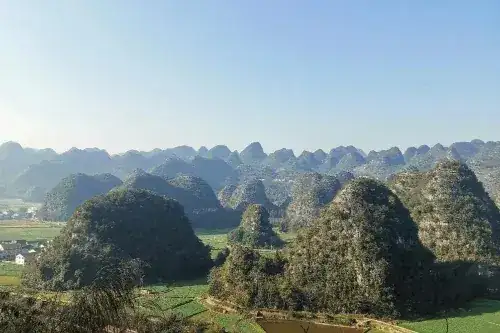
This is the green ecological park of "Brahma's Pure Land, Peach Blossom Spring Tongren". "Of all the counties and cities in central Guizhou, Tongren is uniquely beautiful." Nature's generous gifts have endowed Tongren's landscape with unique charm; every county boasts beautiful rivers flowing through its cities, every township has verdant mountains and clear waters, and every village has idyllic fields and mountains.
View detailed information about Tongren City >>
Honors Ranking:
In May 2025, it was awarded the title of "Demonstration City for the Construction of a Safe China (2021-2025)".
In January 2026, it ranked 176th in the overall ranking of overseas online influence of Chinese mainland cities in 2025.
In May 2025, the 2025 China City Charm Ranking was released, and Tongren City ranked 198th (a fourth-tier city).
In May 2024, the 2024 China City Commercial Attractiveness Ranking was released, with Tongren City ranking 224th.
In January 2024, it was named one of the eleventh batch of national demonstration zones for ethnic unity and progress by the State Ethnic Affairs Commission.
In April 2023, the 2023 China City Commercial Attractiveness Ranking was released, with Tongren City ranking 187th.
In 2022, Tongren City's GDP totaled 147.719 billion yuan, ranking 7th among all cities and prefectures in Guizhou Province.
In November 2022, the State Council approved the establishment of a cross-border e-commerce comprehensive pilot zone in Tongren City.
In September 2022, the National Forestry and Grassland Administration approved Tongren City as a National Forest City for 2022.
View more honors and rankings of Tongren City >>
Historical background:
During the Shang and Zhou dynasties, the territory of Tongren City was within the sphere of influence of the Ba and Pu peoples.
During the Spring and Autumn and Warring States periods, it belonged to the Qianzhong region of Chu.
During the Qin Dynasty, it belonged to Qianzhong Commandery.
During the Han Dynasty, it belonged to Wuling Commandery of Jingzhou.
During the Sui Dynasty, it was divided among the three prefectures of Yelang, Nanyang, and Fuling.
During the Tang Dynasty, it was either divided into or belonged to seven prefectures: Qian, Si, Jin, Xu, Jiang, Fei, and Yi.
During the Song Dynasty, it belonged to Yuanzhou and Sizhou.
During the Yuan Dynasty, it was ruled by the Tian clan, the chieftains of Sizhou.
In the 22nd year of the Yuan Dynasty's Zhizheng era (1362), the Sizhou Pacification Commission was abolished, and two separate Pacification Commissions, Sizhou and Sinan, were established.
The "Bronze Man, Big and Small River Barbarian Military and Civilian Chiefdom" was established, under the jurisdiction of the Sinan Pacification Commissioner's Office.
In the early Ming Dynasty, the bronze statues were replaced with bronze statues, and the name Tongren (铜仁) originated from this.
In the eleventh year of the Yongle reign (1413), the Xuanwei Division was abolished and a government office was established.
Set up in Tongren and Sinan
View detailed historical evolution of Tongren City >>
Travel information can change. Check current opening hours, reservations and entry requirements before you travel.
Traveller discussion
Start the conversation with a helpful tip or a question.