
Tongliang District
铜梁区
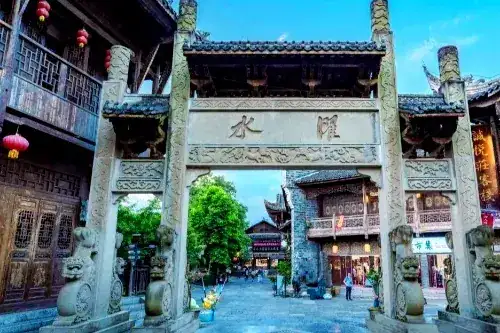
Origin of the name: Southeast of the county seat lies Tongliang Mountain, shaped like a jade screen. When the sun shines obliquely, the stone ridges appear bronze-colored, hence the name Tongliang (Bronze Ridge). Tongliang Anju Ancient Town: Tongliang is located in northwest Chongqing. It is named after Xiaotongliang Mountain within its borders, w…
Origin of place name:
Southeast of the county seat lies Tongliang Mountain, shaped like a jade screen. Whenever the sunlight shines obliquely, the stone beams turn bronze, hence the name Tongliang (Bronze Beam).
Basic introduction:
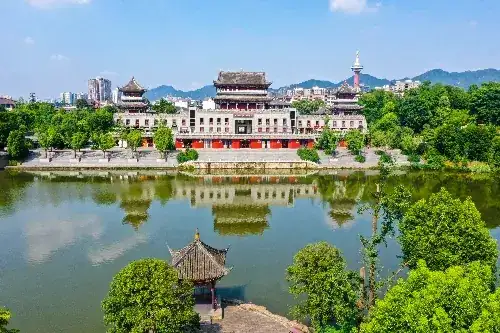
Tongliang District, located in northwestern Chongqing, derives its name from Xiaotongliang Mountain, a mountain ridge described as "stretching across the land and resembling copper in color." It was established as a county in 703 AD (the third year of the Chang'an era of the Tang Dynasty) and became a district in 2014. The district covers an area of 1,340 square kilometers, comprising 5 subdistricts and 23 towns, with a registered population of 837,100 and a resident population of 679,600, resulting in an urbanization rate of 64.94%. In 2024, the district's GDP grew by 2.2%, fixed asset investment by 10.3%, general public budget revenue by 7.7%, and per capita disposable income by 4.1%. Industrial electricity, gas, and water consumption increased by 22.7%, 16.2%, and 9%, respectively.
It boasts a prominent locational advantage. Situated at a key node on the central axis of the Chengdu-Chongqing Economic Circle, it is 40 kilometers from the central urban area of Chongqing, 200 kilometers from the central urban area of Chengdu, 25 kilometers from the starting station of the Chongqing-Xinjiang-Europe International Railway, 60 kilometers from Chongqing Jiangbei International Airport, and Chongqing Second International Airport.
View detailed information about Tongliang District >>
Honors Ranking:
In January 2024, the China Meteorological Administration awarded Tongliang District the title of "China's Most Livable City (County) in 2023".
In November 2023, the Ministry of Agriculture and Rural Affairs designated Tongliang District as a key county for leisure agriculture in China.
In February 2023, the National Rural Revitalization Administration released the first batch of typical cases of "one county, one product" characteristic culture and art nationwide, and Gaolou Fire Dragon (artistic performance) of Tongliang District was selected.
In January 2023, Tongliang District was recognized as one of the first batch of national demonstration counties (cities) for the conservation and intensive use of natural resources.
In January 2022, the National Patriotic Health Campaign Committee reconfirmed Tongliang District as a National Sanitary City (District) for 2021.
In October 2021, Tongliang District was named a "Hometown of Chinese Folk Culture and Art" for 2021-2023 by the Ministry of Culture and Tourism (Tongliang Dragon Dance).
In September 2021, Tongliang District was designated as one of the third batch of demonstration zones for the construction of a social credit system.
According to the results of the Seventh National Population Census in May 2021, Tongliang District had a population of 685,700, ranking 22nd among all counties and districts in Chongqing and 639th among all counties and districts in China.
View more honors and rankings of Tongliang District >>
Historical background:
During the Spring and Autumn and Warring States periods, Tongliang was part of the Ba Kingdom.
During the Qin Dynasty, the state of Ba was conquered and Dianjiang County was established, with Tongliang becoming part of Dianjiang.
During the Northern and Southern Dynasties period, in the first year of Yongchu of the Song Dynasty (420 AD), Dongdangqu Prefecture was established, Dianjiang was renamed Dangqu, and Tongliang was within the territory of Dangqu County.
In the third year of Emperor Gong of Western Wei (556), the prefecture was renamed Dianjiang, Hezhou was established, and the county was renamed Shijing.
During the Sui and Tang dynasties, although the prefectures and states changed from time to time, Tongliang was always under the jurisdiction of Shijing County of Hezhou.
In the fourth year of the Chang'an reign of Emperor Wu of Zhou (704 AD) during the Tang Dynasty, Tongliang was established by carving out a piece of land from Shijing, under the jurisdiction of Hezhou. The county seat was initially located at Liesu Dam on Nulun Mountain (present-day Tangba Town, Tongnan County); in the third year of the Kaiyuan reign (715 AD), it was moved to Wujinkeng (present-day Hechuan).
View detailed historical evolution of Tongliang District >>
Travel information can change. Check current opening hours, reservations and entry requirements before you travel.
Traveller discussion
Start the conversation with a helpful tip or a question.