
Prince Gong's Mansion Museum
Prince Gong's Mansion Museum is located at No. 17 Qianhai West Street, Xicheng District, Beijing, on the southern bank of Shichahai Lake. It is a national 5A-level tourist attraction, a national first-class museum, and a key national cultur
Prince Gong's Mansion Museum is located at No. 17 Qianhai West Street, Xicheng District, Beijing, on the southern bank of Shichahai Lake. It is a national 5A-level tourist attraction, a national first-class museum, and a key national cultural relic protection unit. As the largest mansion of the Qing Dynasty, it covers an area of approximately 61,120 square meters, including 32,260 square meters for the residence and 28,860 square meters for the garden. With its regular layout, exquisite craftsmanship, and interlocking pavilions and buildings, it is the best-preserved existing mansion, integrating the magnificent style of the royal family and the elegant charm of folk architecture. The overall complex is divided into three routes (East, Middle, and West) and consists of more than 30 various architectural clusters.
History and Culture
Prince Kung's Mansion was first built during the Qianlong reign of the Qing Dynasty. From 1780 (the 45th year of Qianlong) to 1799 (the 4th year of Jiaqing), it served as the private residence of He Shen, a Grand Secretary. In 1799, He Shen was dismissed and his property confiscated, and the mansion was granted to Yonglin, Prince Qingxi, the younger brother of Emperor Jiaqing. In 1850 (the 30th year of Daoguang), Yixin, Prince Kung, became the third owner of the mansion, which was then renamed Prince Kung's Mansion. From 1937 (the 26th year of the Republic of China) to the early years of New China (1952), it was used by Fu Jen Catholic University, which demolished and renovated some halls of the mansion. In 1962, Premier Zhou Enlai inspected the site and proposed protecting Prince Kung's Mansion for future public opening. In 1982, it was listed as a key national cultural relic protection unit in the second batch. The garden opened to the public in 1988, and the entire mansion was fully opened after the completion of renovation works in 2008. Having witnessed the historical process of the Qing Dynasty from prosperity to decline, there is a saying that "Prince Kung's Mansion bears half of the history of the Qing Dynasty."
Major Attractions
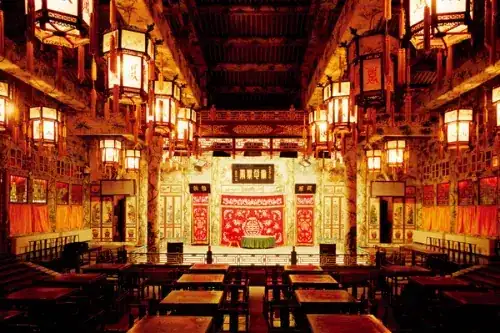
Grand Theater Building
Built during the Tongzhi reign (1862-1874), it was a venue for Prince Kung and his relatives and friends to watch operas. This is the only existing fully enclosed grand theater building in China. In Qing court archives, it was recorded as the "Grand Opera House." Covering a construction area of 685 square meters, it adopts a three-span connected fully enclosed structure. It is said that the entire wooden structure was built without a single iron nail.
Yin'an Hall
Commonly known as the "Silver Phoenix Hall," it was the main hall and central building of the mansion, used for holding major ceremonial activities. Destroyed by fire in 1921, the current courtyard is a reconstruction. Its roof is covered with green glazed tiles, with glazed ridges and mythical beast ornaments. Together with the east and west auxiliary halls, it forms a spacious central courtyard with an imposing manner.
Jiale Hall
It is the last main hall on the Middle Route of the mansion, with five bays, a gable roof, and a veranda in front. It was the name of the room during He Shen's time, and mainly served as a sacrificial site during Prince Kung's period, housing memorial tablets of ancestors and gods.
Duofu Xuan (Hall of Abundant Blessings)
As the main house of the front courtyard on the East Route, it served as the through living room of the mansion for receiving guests. In front of the hall stands a wisteria tree with a history of over 200 years. Composed of the main house, side rooms, a platform, and east-west wing rooms, it has a rigorous layout.
Leyao Tang (Hall of Joyful Dao)
It is the main house of the back courtyard on the East Route and was the residence of Yixin, Prince Kung.
Baoguang Shi (Room of Preserved Light)
A quadrangle courtyard building on the West Route, it was once the reception hall of Prince Kung. The floor is paved with golden bricks, and the colored paintings on the ceiling are original. It now houses the exhibition on the historical evolution of Prince Kung's Mansion.
Xijin Zhai (Study of Tin and Jin)
The hall features an imperial "Zhou-style" double-decked building modeled after the Leshou Palace in the Forbidden City's Ningshou Palace. Its pillars are made of golden nanmu, and its unique structure fully reflects the owner's social status. It was also one of the reasons He Shen was accused of exceeding imperial regulations.
Houzhao Building (Rear Screen Building)
A two-story building stretching 156 meters east-west, it has 88 windows on the back wall and 108 rooms inside, commonly known as "99 and a Half Rooms," implying the Taoist concept of "fullness without excess." The first floor has a through gate leading to the garden, and the middle section of the first floor is a Buddhist hall, which is said to have been He Shen's treasure storage building.
Jian Dao (Arrow Path)
Located between the back eave wall of the Houzhao Building and the garden, it is a wide blue brick road nearly 200 meters long. Besides daily passage, it was used by the prince and his sons to practice horse riding and archery in ancient times, hence the name "Arrow Path."
Western-style Gate
The main entrance to the garden is an arch-shaped white marble stone gate with Western architectural style. As the only Western-style building in the garden, it reflects the owner's desire to save the Qing Dynasty by learning Western culture and technology. It is one of the three masterpieces of Prince Kung's Mansion, along with the Grand Theater Building and the Houzhao Building.
Dule Peak (Solitary Joy Peak)
A Taihu stone in the garden, shaped like the Guanyin Bodhisattva holding a child. It was purchased by He Shen from the Jiangnan region in his time.
Fu Chi (Bat Pond)
A pond in the garden shaped like a bat, symbolizing the accumulation of wealth and other auspicious meanings.
Fu Character Stele
Written by Emperor Kangxi himself, the character "Fu" (blessing) implicitly contains five Chinese characters: "Zi" (son), "Tian" (field), "Cai" (talent), "Shou" (longevity), and "Fu" (blessing). The imperial jade seal of Emperor Kangxi is carved above the stele to "guard the blessing." Hidden in the rockery on the north side of the garden, photography is prohibited.
Dihua Xuan (Hall of Brotherly Virtue)
Named after the plaque "Dihua Xuan" inscribed by Emperor Xianfeng. In their childhood, Yizhu (Emperor Xianfeng) and Yixin (Prince Kung) created their own spear and sword techniques. Emperor Daoguang named the spear technique "Dihua Xieli" (Brotherly Virtue and Cooperation) and the sword technique "Bao'e Xuanwei" (Precious Sword Declares Prestige), hoping the brothers would work together to support the Qing Dynasty. Hence the name "Dihua."
Fangtang Shuixie (Square Pond and Water Pavilion)
The main scenic spot on the West Route of the garden, consisting of a rectangular pond covering about 1,800 square meters and a pavilion in the center of the water. Springs are chiseled in the mountains, and water flows into the pond through stone-carved dragon heads at three different locations.
Yuguan (Elm Pass)
A small city wall with battlements north of the Dragon King Temple, featuring a city gate with the characters "Yuguan" above it. Yuguan is another name for Shanhaiguan Pass, symbolizing the Great Wall. It reflects the owner's nostalgia for his hometown.
Dragon King Temple
Located at the southwest corner outside Yuguan, this temple is situated at the "water" position of the garden according to the Bagua (Eight Trigrams). A dragon temple is built here to guard the area.
Recommended Tour Routes
Half-day Tour Route: Main Gate → Yin'an Hall → Jiale Hall → Baoguang Shi → Xijin Zhai → Baoxia → Houzhao Building → Western-style Gate → Dule Peak → Fu Chi → Anshan Hall → Liubei Pavilion → Yishu Pu → Chuihua Gate → Bamboo Courtyard → Peony Garden → Yishen Suo → Fu Ting → Pingbu Qingyun Road → Yaoyue Platform → Dicui Rock → Fu Character Stele → Shihua Fang → Lingdaojing → Fangtang Shuixie → Miaoxiang Pavilion → Yuguan → Dragon King Temple → Jian Dao → Leyao Tang → Duofu Xuan → Exhibition Hall of Fine Traditional Chinese Crafts.
Travel Tips
- You can learn about the historical and cultural background of Prince Kung's Mansion in advance to enhance your visiting experience.
- Try to avoid visiting on holidays and peak tourist seasons; mornings are ideal with fewer visitors.
- If time permits, choose the half-day tour route to enjoy the scenic spots more comprehensively.
- You may rent an electronic guide or hire a professional tour guide during your visit to gain deeper insights into the stories behind the attractions.
- Please protect cultural relics and the scenic environment; do not touch or climb on the cultural relics.
Notes
- Comply with the opening hours of the scenic area and enter/exit on time.
- Photography is prohibited at the Fu Character Stele. Do not use flash when taking photos in other areas to avoid damaging cultural relics.
- Smoking and eating are not allowed in the scenic area to keep the environment clean.
- Take good care of your personal belongings, especially in crowded places.
- Follow the arrangements of the scenic staff and do not enter unopened areas without permission.
Transportation
- Subway: Take Line 6 and get off at Beihai North Station, exit from Exit B (Northeast).
- Bus: Take Bus No. 3, 4, 13, 42, 107, 111, 118, 612 or Tourist Line 3 and get off at Beihai North Gate Station.
Opening Hours
Open from 8:30 to 17:00; ticket checking stops after 16:10. Closed every Monday (except on legal holidays).
Tickets
Ticket price: 40 yuan per person.
You can search the official WeChat official account "恭王府博物馆" to get the latest updates or book tickets online.
Online Booking
Click here to jump to the Trip.com ticketing platform for ticket purchase.
Travel information can change. Check current opening hours, reservations and entry requirements before you travel.
Traveller discussion
Start the conversation with a helpful tip or a question.