
Place names and administrative divisions of Guangxi
广西地名与行政区划
The origin of the name Guangxi: In the early Northern Song Dynasty, Guangnan Road was established, later divided into East and West Roads, abbreviated as Guangdong Road and Guangxi Road. Hence the name. Because the seat of government of Guangxi was in Guilin (named Guizhou in the Song Dynasty, Guilin Prefecture in the Ming and Qing Dynasties) from…
Origin of the name Guangxi: In the early Northern Song Dynasty, Guangnan Circuit was established, which was later divided into East and West Circuits, abbreviated as Guangdong Circuit and Guangxi Circuit. Hence the name. Because the seat of government of Guangxi was in Guilin from the Song Dynasty to the Qing Dynasty (named Guizhou in the Song Dynasty, and Guilin Prefecture in the Ming and Qing Dynasties), it is abbreviated as "Gui".
Guangxi Zhuang Autonomous Region, abbreviated as Gui, is located in the southern border region of China, between 104°28′ and 112°04′ east longitude and 20°54′ and 26°24′ north latitude, with the Tropic of Cancer running through its central part. It has a total land area of 237,600 square kilometers, accounting for approximately 2.5% of China's total land area, ranking ninth among all provinces, autonomous regions, and municipalities. It boasts a 1,595-kilometer-long coastline and is rich in coastal port resources, marine biological resources, and coastal tourism resources. It is home to 12 ethnic groups: Zhuang, Han, Yao, Miao, Dong, Mulam, Maonan, Hui, Jing, Yi, Shui, and Gelao. Guangxi is China's only coastal minority autonomous region and the only coastal region in western China. It serves as a crucial gateway and frontier for China's opening up to the outside world, its connection with ASEAN, and its access to the world, and is the most convenient sea outlet for Southwest China.
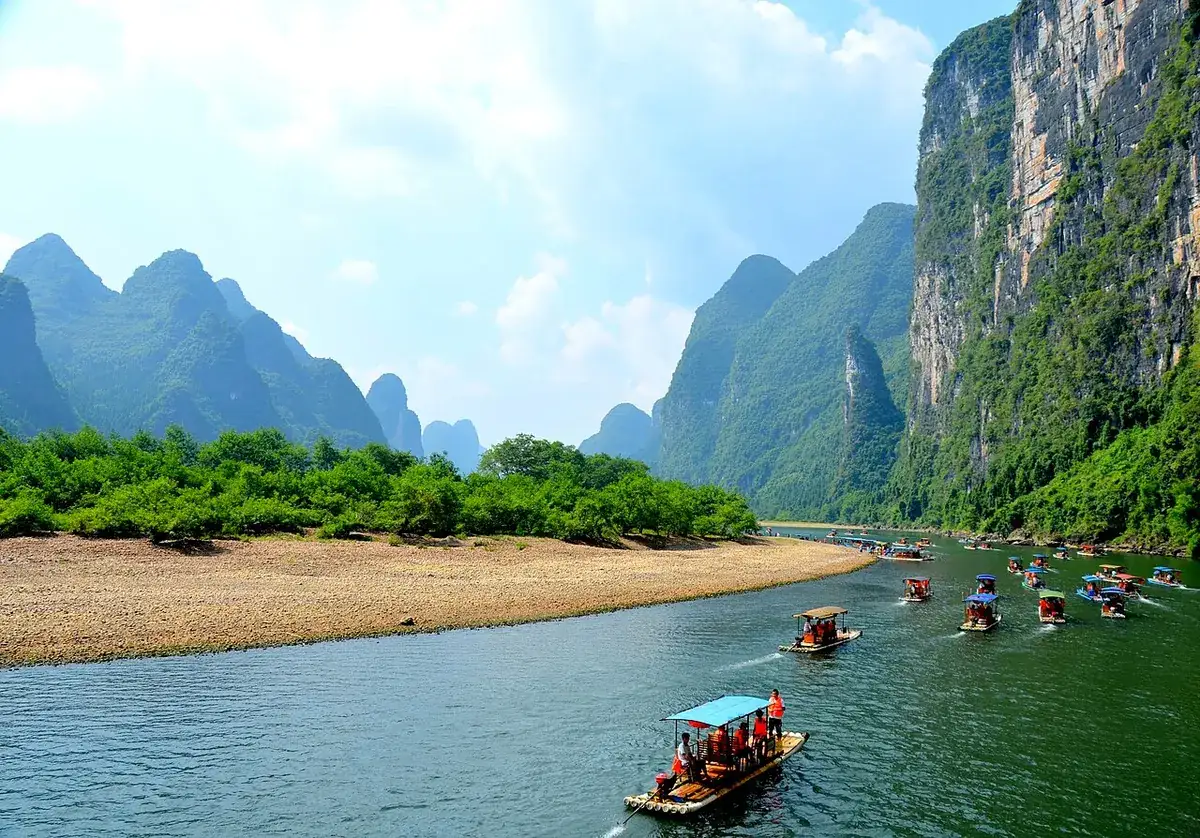
The karst peaks of Guangxi are a typical example of perfectly developed tropical karst landforms. Rising abruptly from the plains, they possess an imposing grandeur and unique shapes. The most typical and beautiful limestone peaks are found in the Guilin and Yangshuo area, once praised by the Ming Dynasty traveler Xu Xiake as a "world of jade bamboo shoots and lotus blossoms." In addition, limestone peaks can also be found throughout northeastern, central, southeastern, and western Guangxi.
Guangxi boasts numerous caves with beautiful scenery, earning it the reputation of "every mountain has a cave, and every cave is unique." It is estimated that there are approximately 100,000 karst caves in Guangxi. Within these magnificent caves, stalactites, stalagmites, flowstones, columns, cave flowers, stone lotuses, and stone forests abound, creating breathtaking scenery. Among the more famous are dry caves such as Reed Flute Cave and Seven Star Cave in Guilin, Dule Cave in Liuzhou, Yiling Cave in Wuming, Selu Cave in Beiliu, and Longquan Cave in Yulin; water caves such as Guanyan Cave in Guilin, Fengyu Cave in Lipu, Longgong Cave in Guanyang, Bishui Cave in Zhongshan, and Jinlun Cave in Mashan; and archaeological sites such as Zengpi Cave in Guilin (a representative Neolithic cave site in China) and Longyin Cave (containing over 200 cliff carvings from the Tang to Qing dynasties), and Bailian Cave in Liuzhou (an important site of prehistoric human culture in China).
Travel information can change. Check current opening hours, reservations and entry requirements before you travel.
Traveller discussion
Start the conversation with a helpful tip or a question.