
How to Order Food at Chinese Restaurants Without Speaking Chinese
Quick Answer (30 seconds)Three ways to order in Chinese restaurants: scan-to-order (scan the QR code on the table with WeChat or Alipay — most common), paper menu (snap a photo and translate with a translation app), or point at what you wan
Quick Answer (30 seconds)
Three ways to order in Chinese restaurants: scan-to-order (scan the QR code on the table with WeChat or Alipay — most common), paper menu (snap a photo and translate with a translation app), or point at what you want (see what the next table is eating, point at it). To call the server, shout "fúwùyuán!" (server) — don't say "waiter." Spice levels come in three: mild, medium, extra spicy. Can't handle spice? Order "not spicy" (bú là) or "mild" (wēi là). Rice is per bowl (¥2-5/bowl). Many restaurants charge a tea fee (¥2-10/person). Leftovers? Ask for a dǎbāo (doggie bag) — free or ¥1-2 for the container.
---
Full Guide
My first three months in China, walking into a restaurant was like Russian roulette — I'd point at a random line on the menu and eat whatever came. Once I got a plate of nothing but chicken feet. I stubbornly ate two. After I learned scan-to-order and a few key phrases, my quality of life shot up. Here's the step-by-step.
Scan-to-Order: The Mainstream Now
Over 90% of Chinese restaurants (from chains to hole-in-the-wall spots) use QR code ordering. There's a QR code sticker on the table. The process:
1. Open WeChat or Alipay, tap the "+" in the top right → "Scan" (扫一扫 - sǎo yī sǎo)
2. Scan the QR code on the table (make sure it's the one stuck on the table, not someone else's payment code)
3. A mini-program ordering page pops up — it may ask for phone number authorization, just tap "Skip" (跳过 - tiào guò) or "Guest order" (游客点餐 - yóu kè diǎn cān)
4. Browse the menu — if there are photos, pick by picture
5. Add to cart, tap "Order" (下单 - xià dān) or "Submit" (提交 - tí jiāo)
6. Pay directly on your phone (WeChat/Alipay) — no need to call the server for the bill
Pros: Zero human interaction needed, you handle everything yourself, photos mean you won't accidentally order something weird.
The catch: The mini-program is all Chinese. What if you can't read it? Use WeChat's built-in translation — long-press the text and select "Translate" (翻译 - fān yì). Or screenshot and use a translation app.
Paper Menus: Photo Translate
Some restaurants (especially traditional Chinese restaurants, old joints near tourist sites) still use paper menus — no photos, all Chinese. In that case:
- Use a translation app (Google Translate, 百度翻译/Bǎidù Fānyì, etc.) to photo-translate the entire page
- Google Translate camera translation works well, but needs a VPN
- 百度翻译 (Bǎidù Fānyì) app's photo feature also works, no VPN needed
- Translation results can be hilarious ("鱼香肉丝" → "fish-flavored shredded pork" — but there's no fish in it), but at least you'll know roughly what it is
Point and Show
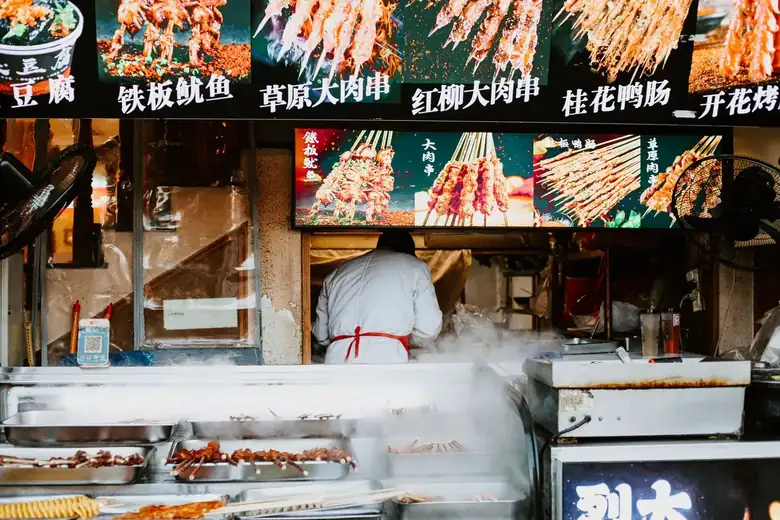
- Many restaurants have a food display case at the entrance (plastic models or real photos). Point at what you want, give the server a thumbs-up.
- See something good on the next table? Just point: "I'll have that" (来一份那个 - lái yí fèn nà ge)
- This works especially well at hotpot and BBQ places
Calling the Server
- In Chinese restaurants, you call out loudly: "fúwùyuán!" (server) — completely normal, not rude at all
- Don't say "waiter" or "excuse me" — the staff won't understand
- Raising your hand works too, but calling out is faster
- Useful phrases when you need service:
- "点菜" (diǎn cài) — I want to order
- "买单" (mǎi dān) — The bill, please
- "打包" (dǎ bāo) — To go / doggie bag
- "加一个米饭" (jiā yí ge mǐ fàn) — Add a bowl of rice
Spice Levels
Chinese food (especially Sichuan, Hunan, and Jiangxi cuisine) comes in spice tiers:
- Not spicy (bú là) — Completely no spice. Note: many "not spicy" versions still have the numbing sensation of Sichuan peppercorn
- Mild (wēi là) — Lightly spicy, manageable for most people
- Medium (zhōng là) — Noticeably spicy, you'll sweat
- Extra spicy (tè là) — Very spicy, this is the daily level for Hunan and Sichuan locals
My advice: First time and unsure? Go with "mild" (wēi là). If you can handle it, level up next time. Ordering "not spicy" at a Sichuan restaurant for their signature dish — the chef may not know how to make it that way. Pick a different dish instead.
Rice, Tea Fees, and Hidden Charges
- Rice is per bowl — ¥2-5/bowl, not all-you-can-eat. Want more? Order another bowl. Some restaurants have "unlimited rice" (自助米饭 ¥3-5) — eat as much as you want.
- Tea fee — Many restaurants automatically bring a pot of tea (or a small dish of peanuts/cold dishes). This is NOT free! Tea fee is ¥2-10/person. Don't want it? Tell the server "不要茶" (bú yào chá).
- Tissue fee — The plastic-wrapped wet wipes/tissue packets on the table are also charged (¥1-2). Don't use them? Tell the server when paying: "纸巾没用,退掉" (tissues unused, take them off).
- Tableware fee — Some cities (especially Guangdong) charge a tableware fee ¥1-2/person. This is normal.
Safe Bet Dishes (Can't Go Wrong)
- 番茄炒蛋 (fān qié chǎo dàn) — Tomato and egg stir-fry, sweet and sour, not spicy, the safest choice
- 宫保鸡丁 (gōng bǎo jī dīng) — Kung Pao chicken with peanuts, mild spicy and sweet, a classic
- 糖醋里脊 (táng cù lǐ jǐ) — Sweet and sour pork tenderloin, not spicy, tangy
- 蛋炒饭 (dàn chǎo fàn) — Egg fried rice, can't go wrong anytime
- 饺子 (jiǎo zi) — Dumplings (boiled or steamed), reliable choice
- 炒青菜 (chǎo qīng cài) — Stir-fried greens with garlic, light and refreshing
Doggie Bag (dǎbāo)
- Can't finish? Say "dǎbāo" (打包 - dǎ bāo), the server will pack it in a container
- Usually free, some charge ¥1-2 for the container
- Let hot food cool before packing — save it for a late-night snack back at the hotel
---
Troubleshooting
Problem 1: Scan-to-Order Asks for WeChat Authorization
What happens: You scanned the code, the mini-program pops up a "Get Phone Number" authorization page, and you don't want to bind your number.
Fix: Most mini-programs can be skipped — look for small text buttons like "Skip" (跳过), "Guest Order" (游客点餐), or "Close" (关闭). If you can't skip it: ask the server to order from the paper menu for you. Some mini-programs only accept WeChat-bound Chinese phone numbers (can't use without one) — in that case, the server can manually input your order. Translation app + hand gestures + typing numbers on the calculator app also gets the job done.
Problem 2: The Dish Looks Nothing Like What You Expected
What happens: You ordered something that looked good, and it arrives as something unrecognizable.
Fix: Don't panic — try a bite, it might be delicious. If you really can't eat it (all offal, too spicy, allergy): tell the server "这个我不吃" (zhè ge wǒ bù chī — I don't eat this). Ask if you can swap (usually can't refund, but you can order something else). Lesson: when scanning to order, look at the photos. With paper menus, photo-translate. If unsure, don't gamble. Before ordering, ask the server "这个辣不辣?" (zhè ge là bú là — Is this spicy?) and let them help you judge.
Problem 3: Bill Is Way More Than Expected
What happens: You thought you spent ¥80, the bill says ¥120 — tea fee, tissue fee, container fee all added up.
Fix: Hidden charges are common in Chinese restaurants — ask first before sitting down. Tea fee and tissue fee can be refused — tell the server when paying "茶没喝" (didn't drink the tea) or "纸巾没用" (didn't use the tissues), and they'll usually remove the charge. Tableware fee is legally charged in some cities (Guangdong, etc.) and can't be refused. Next time, check the entrance for a "茶位费¥X/人" sign, or ask "有茶位费吗?" (yǒu chá wèi fèi ma — Is there a tea fee?) before sitting down.
---
Last verified: August 2026 · Sources: 大众点评/美团 (Dàzhòng Diǎnpíng/Měituán) ordering process, China Consumer Association dining guidelines · Prices and charges vary by region and restaurant.
Travel information can change. Check current opening hours, reservations and entry requirements before you travel.




Traveller discussion
Start the conversation with a helpful tip or a question.