
Nanchang City, Jiangxi Province
江西省南昌市
Origin of the name: Nanchang's name is related to Emperor Li Jing of the Southern Tang Dynasty. During the Han Dynasty, Liu Bang established Yuzhang Prefecture in Nanchang. During the Tang Dynasty, it was called Hongzhou. The Tang Dynasty poet Wang Bo's "Preface to the Pavilion of Prince Teng" refers to Hongzhou. During the Five Dynasties and Ten …
Origin of place name:
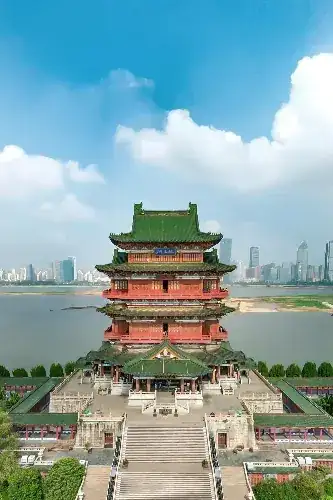
The name Nanchang is related to Emperor Li Jing of the Southern Tang Dynasty. During the Han Dynasty, Liu Bang established Yuzhang Prefecture in Nanchang. During the Tang Dynasty, it was called Hongzhou. The Tang Dynasty poet Wang Bo wrote about Hongzhou in his "Preface to the Pavilion of Prince Teng". During the Five Dynasties and Ten Kingdoms period, the Southern Tang was defeated by the Later Zhou and ceded Huainan. Its capital, Nanjing, was separated from the north only by the Yangtze River. To avoid the northern military advance, Emperor Li Jing of the Southern Tang made Hongzhou his southern capital, calling it "a prosperous place in Jiangnan", hence the name Nanchang.
Basic introduction:
Nanchang, the capital of Jiangxi Province, is the province's political, economic, and cultural center. Located in northern Jiangxi, on the south bank of the Yangtze River and the lower reaches of the Gan River, it borders Poyang Lake. The southeast is flat, while the northwest is hilly. Rivers crisscross the city, and lakes are scattered throughout. Nanchang is also a heroic city with a glorious revolutionary tradition. The August 1st Nanchang Uprising is world-renowned, and the People's Liberation Army was born here. Therefore, Nanchang is also known as the "Heroic City."
Since the reform and opening up, Nanchang's tourism industry has developed rapidly. Many cultural relics and historical sites have been restored, and the number of natural scenic spots has increased from 26 to 78. Nanchang is surrounded by famous World Cultural Heritage sites such as Lushan Scenic Area, Poyang Lake Migratory Bird Reserve, Longhushan National Scenic Area, Jinggangshan National Scenic Area, and Sanqingshan National Scenic Area. This has formed a tourism and sightseeing system centered on Nanchang, focusing on the scenic belt along the Beijing-Kowloon Railway, and radiating throughout Jiangxi Province.
View detailed information about Nanchang City >>
Honors Ranking:
In July 2026, it was designated as a tourism hub city in the "15th Five-Year Plan for Building a Tourism Power".
In March 2026, it ranked 27th among China's top 100 cities.
In January 2026, it ranked 38th in the overall ranking of overseas online communication influence of Chinese mainland cities in 2025.
In May 2025, it was selected as one of the pilot cities for new forms, models and scenarios of consumption nationwide.
In November 2025, it ranked 32nd on the 2025 list of Chinese cities with international influence.
In September 2025, it ranked 40th among the top 100 smart cities in China (SMILE Index).
In September 2025, it ranked 29th on the list of the top 100 cities in the digital economy in 2025.
In May 2025, it was designated as one of the first batch of pilot cities for innovation and upgrading of the national retail industry.
In May 2025, the 2025 China City Charm Ranking was released, with Nanchang ranking 35th (a second-tier city).
View more honors and rankings of Nanchang City >>
Historical background:
In the sixth year of Emperor Gaozu of Han (201 BC), Yuzhang Commandery was established by separating Jiujiang Commandery, and Nanchang County was set up as an attached county under Yangzhou. The name Nanchang originated from this.
In the first year of the Xin Dynasty (9), Yuzhang Commandery was renamed Jiujiang Commandery.
In the first year of Jianwu in the Eastern Han Dynasty (25), it was renamed Yuzhang Commandery.
It belonged to Jiangzhou and served as its capital.
During the Northern and Southern Dynasties, the Liang Dynasty called it the Kingdom of Yuzhang; the Chen Dynasty restored it to Yuzhang Prefecture.
In the ninth year of the Kaihuang era of the Sui Dynasty (589), the prefecture was abolished and Hongzhou was established. In the third year of the Daye era (607), it was restored as Yuzhang Prefecture.
In the fifth year of the Tang Dynasty's Wude era (622), it was restored as Hongzhou. In the early Zhenguan era, it belonged to Jiangnan Circuit. In the twenty-first year of the Kaiyuan era (733), it belonged to Jiangnan West Circuit and was the administrative center of the circuit. In the first year of the Tianbao era (742), Hongzhou was renamed Yuzhang Prefecture. In the first year of the Zhide era (743), it was renamed Yuzhang Prefecture.
View detailed historical evolution of Nanchang City >>
Travel information can change. Check current opening hours, reservations and entry requirements before you travel.
Traveller discussion
Start the conversation with a helpful tip or a question.