
Ma'anshan City, Anhui Province
安徽省马鞍山市
Origin of the name: The city of Ma'anshan has an unusual origin. Legend has it that during the Chu-Han Contention, Xiang Yu, the King of Chu, was trapped at Gaixia, surrounded by enemies, and retreated to the Wujiang River in He County. He asked a fisherman to ferry his beloved horse, Wuzhui, to the other side. Feeling ashamed to face the people o…
Origin of place name:
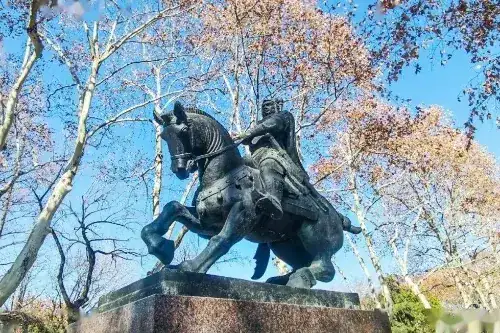
The name Ma'anshan has an unusual origin. Legend has it that during the Chu-Han Contention, Xiang Yu, the King of Chu, was trapped at Gaixia, surrounded by enemies. He retreated to the Wujiang River in He County and asked a fisherman to ferry his beloved horse, Wuzhui, to the other side. Feeling ashamed to face the people of Jiangdong, he committed suicide. Wuzhui, missing its master, rolled over and killed itself. Its saddle fell to the ground and transformed into a mountain, hence the name Ma'anshan (Saddle Mountain).
Basic introduction:
Ma'anshan currently administers 3 counties and 3 districts, and has 3 national-level and 6 provincial-level development zones, covering an area of 4,044 square kilometers with a resident population of 2.186 million. In 2023, its GDP reached 259.06 billion yuan, a growth of 5.7%; and its urban and rural residents' income has ranked first in the province for many consecutive years. In particular, on August 19, 2020, General Secretary Xi Jinping visited Ma'anshan and gave it a new development positioning as Anhui's "Hangzhou-Jiaxing-Huzhou" and the "heart of the Yangtze River Delta," which is of extremely significant milestone importance in Ma'anshan's development history.
Ma'anshan is a city of civilization where the past and present shine brightly. Our city is both ancient and young. It is ancient because of its long history; the Yangtze River culture has a long and rich tradition. 300,000 years ago, the Hexian Ape-Man lived and thrived here, and is widely recognized as a representative of Homo erectus in southern China. The Lingjiatan site in Hanshan County, dating back approximately 5800-5300 years, is hailed as the "Dawn of Chinese Civilization" and has been selected as one of the "Centennial Sites" in China.
View detailed information about Ma'anshan City >>
Honors Ranking:
In January 2026, it ranked 270th in the overall ranking of overseas online influence of Chinese mainland cities in 2025.
In September 2025, it ranked 82nd among the top 100 smart cities in China (SMILE Index).
In May 2025, the 2025 China City Charm Ranking was released, with Ma'anshan City ranking 118th (a third-tier city).
In May 2025, the list of the top 100 cities with the greatest talent attraction in 2024 was released, with Ma'anshan City ranking 55th.
In April 2025, it was named a national model city (county) for supporting the military and giving preferential treatment to families of servicemen.
In February 2025, the list of the top 100 Chinese cities in terms of social development, economic development and people's livelihood in 2024 was released, and Ma'anshan City ranked 48th.
In February 2025, the 2024 China Urban Social Development Comprehensive Ranking Top 100 list was released, with Ma'anshan City ranking 88th.
In May 2024, the 2024 China City Commercial Attractiveness Ranking was released, with Ma'anshan City ranking 112th.
In January 2024, Ma'anshan City was designated as a national demonstration city for building a strong intellectual property city.
View more honors and rankings of Ma'anshan City >>
Historical background:
During the Western Zhou Dynasty, the Ma'anshan area belonged to the State of Wu. During the Spring and Autumn and Warring States periods, it was successively assigned to the State of Yue and the State of Chu. From the Qin Dynasty to the Western Jin Dynasty, it belonged to Danyang County (the seat of which is now Danyang Town, Bowang District).
In the fourth year of Xianhe in the Eastern Jin Dynasty (329 AD), refugees from Dangtu County (now within Huaiyuan County, Anhui Province) on the banks of the Huai River migrated south and established Dangtu County in the area of present-day Nanling. Thus, the name Dangtu County first appeared in Jiangnan, but it was not an actual county.
In the first year of Yonghe (345 AD), people from Yuzhou in Jiangbei (present-day southeastern Henan and eastern Hubei) were relocated to Niuzhu (present-day Caishi).
In the first year of the Tianjian era of the Southern Liang Dynasty (502 AD), the Southern Danyang Prefecture was established by dividing Danyang County, with its capital at Caishi.
In the ninth year of the Kaihuang era of the Sui Dynasty (589 AD), they were relocated to Anhui.
View detailed historical evolution of Ma'anshan City >>
Travel information can change. Check current opening hours, reservations and entry requirements before you travel.
Traveller discussion
Start the conversation with a helpful tip or a question.