
Lanzhou
兰州市
Origin of the name: Lanzhou was formerly known as Jincheng. According to the *Yuanhe Junxian Zhi* (Records of Prefectures and Counties of the Yuanhe Era), Lanzhou was named after Gaolan Mountain. Due to the ancient custom of abbreviation, "Gao" was dropped from "Gao" and "Lan" was retained, resulting in the name Lanzhou. According to the *Gaolan C…
Origin of place name:
Lanzhou, formerly known as Jincheng, derives its name from Gaolan Mountain, according to the "Yuanhe Junxian Zhi" (Records of Prefectures and Counties of the Yuanhe Era). Due to a common practice of abbreviation in ancient times, the character "Gao" was dropped from "Gao," leaving "Lan," thus creating the name Lanzhou. Furthermore, the "Gaolan County Gazetteer" states: "Gaolan is Lanzhou; the name Gaolan comes from the southern mountain Gaolan." In the third year of the Kaihuang era of the Sui Dynasty, prefectures were abolished and replaced by states, with Jincheng Prefecture becoming Lanzhou. The name "Lanzhou" originated from this time and has a history of over 1400 years.
Basic introduction:
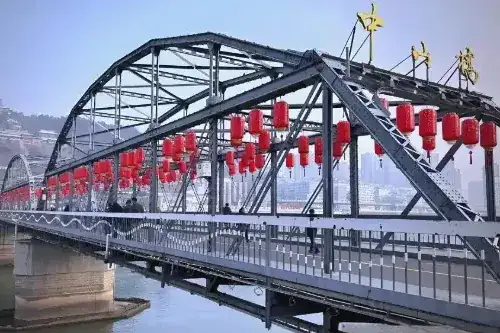
Lanzhou is the only city in the Yellow River basin through which the Yellow River flows. The city is nestled between mountains and water, creating a unique urban landscape characterized by tranquility and movement. To highlight this scenic beauty, the city is currently accelerating the comprehensive development project of greening the mountains to the north and south and developing the Yellow River scenic tourism route. This project integrates the construction of roads and bridges along the 40-kilometer stretch of the Yellow River within the city, the repair and reinforcement of riverbanks, the dredging of navigation channels, the development of tourist attractions, the improvement of urban architectural styles, and the enhancement of greening, beautification, and lighting, bringing together Silk Road culture, Yellow River culture, and ethnic minority cultures.
The Yellow River not only nurtures the people of Lanzhou, but also brings abundant local specialties. Fruits such as white melons, soft pears, winter pears, and peaches have long been famous, while local specialties such as lilies, black melon seeds, roses, bracken, and water pipes are renowned at home and abroad, making Lanzhou a famous fruit city at home and abroad.
View detailed information about Lanzhou City >>
Honors Ranking:
In May 2025, it was awarded the title of "Demonstration City for the Construction of a Safe China (2021-2025)".
In July 2026, it was designated as a tourism hub city in the "15th Five-Year Plan for Building a Tourism Power".
In March 2026, it ranked 52nd among China's top 100 cities.
In January 2026, it ranked 33rd in the overall ranking of overseas online communication influence of Chinese mainland cities in 2025.
In May 2025, it was selected as one of the pilot cities for new forms, models and scenarios of consumption nationwide.
In November 2025, it ranked 34th on the 2025 list of Chinese cities with international influence.
In September 2025, it ranked 67th among the top 100 smart cities in China (SMILE Index).
In September 2025, it ranked 56th on the list of the top 100 cities in the digital economy in 2025.
In May 2025, the 2025 China City Charm Ranking was released, with Lanzhou ranking 51st (a third-tier city).
View more honors and rankings of Lanzhou City >>
Historical background:
During the Shang and Zhou dynasties, the land belonged to the Western Qiang.
In the 33rd year of Qin Shi Huang's reign (214 BC), Yuzhong County was established and belonged to Longxi Commandery.
During the mid-Western Han Dynasty, it was part of Jincheng Commandery, under the jurisdiction of Liangzhou Inspectorate.
In the third year of the Kaihuang era of Emperor Wen of Sui (583), Jincheng County was renamed Lanzhou and a General Administration Office was established.
In the third year of the Daye era of Emperor Yang of Sui, Zicheng County was renamed Jincheng County, and Lanzhou was renamed Jincheng Prefecture, which governed Jincheng and Didao counties, with its capital in Jincheng.
Lanzhou was re-established in the second year of the Wude era of Emperor Gaozu of Tang (619 AD).
In the eighth year of the Wude era (625), the Governor-General's Office was established.
In the first year of the Xianqing reign of Emperor Gaozong of Tang (656), it was changed to a prefecture.
In the first year of the Tianbao era of Emperor Xuanzong of Tang (742), it was renamed Jincheng County.
In the second year of the Qianyuan era of Emperor Suzong of Tang (759), it was changed to Jin.
View detailed historical evolution of Lanzhou City >>
Travel information can change. Check current opening hours, reservations and entry requirements before you travel.


Traveller discussion
Start the conversation with a helpful tip or a question.