
Gannan Prefecture
甘南州
Origin of the name: Gannan derives its name from its location in southwestern Gansu Province. The Gannan Tibetan Autonomous Prefecture was established in 1952, became the Gannan Tibetan Autonomous Region in 1953, and was renamed Gannan Tibetan Autonomous Prefecture in 1955. Basic introduction to the Dangzhou Grassland: Gannan Tibetan Autonomous Pr…
Origin of place name:
Gannan gets its name from its location in southwestern Gansu. The Gannan Tibetan Autonomous Prefecture Committee was established in 1952, the Gannan Tibetan Autonomous Region was established in 1953, and it was renamed Gannan Tibetan Autonomous Prefecture in 1955.
Basic introduction:
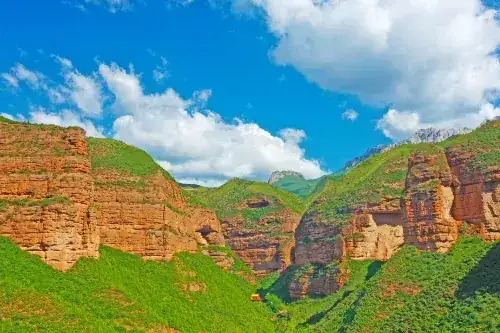
Gannan Tibetan Autonomous Prefecture, one of China's ten Tibetan autonomous prefectures, is located in southwestern Gansu Province. Situated on the northeastern edge of the Qinghai-Tibet Plateau and the western transition zone of the Loess Plateau, it is a confluence of Tibetan and Han cultures and a water conservation and replenishment area for the Yellow River and Yangtze River. It was described by Mr. Fei Xiaotong as "the window to the Qinghai-Tibet Plateau" and "a springboard for Tibetan modernization," and has been designated by the state as a major ecological functional area and a pilot demonstration zone for ecological civilization. The prefecture boasts vast grasslands, an altitude of 2,960 meters, an average temperature of 1.7℃, a short frost-free period, and long hours of sunshine, exhibiting a typical continental climate. The highest elevation is 4,920 meters, and the lowest is 1,172 meters.
Gannan Prefecture borders Aba Prefecture of Sichuan Province to the south, Huangnan and Guoluo Prefectures of Qinghai Province to the southwest, and Longnan, Dingxi, and Linxia Prefectures to the east and north. Its geographical coordinates are between 100°46′ and 104°44′ east longitude and 33°06′ and 36°10′ north latitude. It administers [various administrative divisions].
View detailed information about Gannan Prefecture >>
Honors Ranking:
In January 2026, it ranked 213th in the overall ranking of overseas online influence of Chinese mainland cities in 2025.
In May 2025, the 2025 China City Charm Ranking was released, and Gannan Prefecture ranked 285th (a fifth-tier city).
In May 2024, the 2024 China City Commercial Attractiveness Ranking was released, with Gannan Prefecture ranking 324th.
In January 2024, it was named one of the eleventh batch of national demonstration zones for ethnic unity and progress by the State Ethnic Affairs Commission.
In September 2023, Gannan Prefecture was named a Gansu Province Food Safety Demonstration City for 2023.
In April 2023, the 2023 China City Commercial Attractiveness Ranking was released, with Gannan Prefecture ranking 320th.
In 2022, Gannan Prefecture's GDP totaled 24.512 billion yuan, ranking 14th among all cities and prefectures in Gansu Province in terms of GDP.
In August 2022, Gannan Prefecture was included in the third batch of national agricultural green development pilot zones.
In 2021, Gannan Prefecture's GDP reached 23.004 billion yuan, ranking 14th among all cities and prefectures in Gansu Province in terms of GDP.
View more honors and rankings of Gannan Prefecture >>
Historical background:
Humans began developing this ancient wilderness in the Sanhe-Yijiang River basin during the Neolithic Age. Since the Chinese nation developed writing, the character "Qiang" has been inscribed on oracle bone fragments.
The Qiang people are a diverse group of tribes. As history progressed, the Qiang tribes in Gannan gradually established their own tribal alliances or attached themselves to the Central Plains dynasties, and exchanges between ethnic groups became more frequent.
During the Qin Dynasty, some areas were already under the jurisdiction of Lintao.
During the Western Han Dynasty, the eastern part belonged to Longxi Commandery, and the northern part belonged to Jincheng Commandery, with Baishi and Qiangdao counties established there.
During the Sui Dynasty, Lintao Commandery, Paohan Commandery, and Dangchang Commandery respectively governed parts of the northwest and southeast of present-day Gannan.
In the early Tang Dynasty, prefectures were abolished and replaced by states. The area within Gannan was once the entirety of Taozhou, Fangzhou, and Diezhou.
View detailed historical evolution of Gannan Prefecture >>
Travel information can change. Check current opening hours, reservations and entry requirements before you travel.

Traveller discussion
Start the conversation with a helpful tip or a question.