
Guizhou
GuizhouOverviewGuizhou, abbreviated as "Qian (黔)" or "Gui (贵)," is located in the mountainous interior of southwestern China. It borders Hunan to the east, Guangxi to the south, Yunnan to the west, and Sichuan and Chongqing to the north. It
Guizhou
Overview
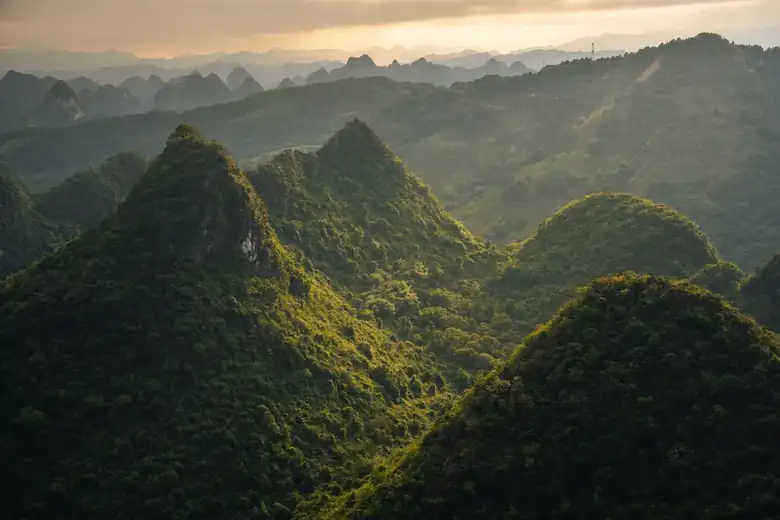
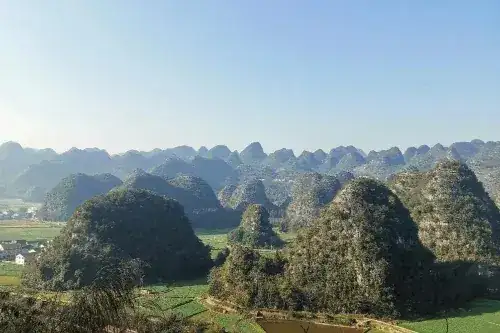
Guizhou, abbreviated as "Qian (黔)" or "Gui (贵)," is located in the mountainous interior of southwestern China. It borders Hunan to the east, Guangxi to the south, Yunnan to the west, and Sichuan and Chongqing to the north. It is China's only provincial-level region without significant plains, with an average elevation of approximately 1,100 meters (3,610 feet). Mountains and hills account for 92.5% of its land area, while karst landscapes cover 109,000 square kilometers, representing 61.9% of the province. This dramatic terrain has given rise to the well-known saying that Guizhou has "not a single stretch of flat land extending three li." Four major mountain ranges define the province's landscape: the Wumeng Mountains in the west, the Dalou Mountains in the north, the Miaoling Mountains across the central region, and the Wuling Mountains in the northeast. These ranges form the backbone of Guizhou's topography, while rivers belonging to both the Yangtze and Pearl River systems—including the Wujiang, Yuanjiang, Chishui River, Nanpan River, and Beipan River—flow northward, eastward, and southward, making Guizhou a vital ecological barrier protecting the upper reaches of China's two largest river basins.
Covering a total area of 176,200 square kilometers, Guizhou had a permanent population of approximately 38.56 million at the end of 2023. Ethnic minority groups account for about 36.4% of the population, making it one of China's provinces with the highest proportion of ethnic minorities. Guizhou is home to 18 indigenous ethnic groups, including the Han, Miao, Bouyei, Dong, Tujia, and Yi peoples, whose long histories have created one of the country's richest and most diverse cultural landscapes.
Administratively, Guizhou is a provincial-level division with its capital in Guiyang. The province comprises six prefecture-level cities—Guiyang, Zunyi, Liupanshui, Anshun, Bijie, and Tongren—and three autonomous prefectures: Qianxinan Bouyei and Miao Autonomous Prefecture, Qiandongnan Miao and Dong Autonomous Prefecture, and Qiannan Bouyei and Miao Autonomous Prefecture. Together, these jurisdictions encompass 88 county-level administrative divisions.
Guizhou's economy follows a development pattern often described as "one core driving multiple growth poles." Guiyang, the provincial capital, serves as the political, economic, and cultural center, with big data industries and modern services forming the foundation of its role as the province's primary engine of high-quality development. Zunyi functions as the province's secondary economic hub, building upon its world-famous baijiu industry and revolutionary heritage. Anchored by Kweichow Moutai, it has developed China's leading cluster for premium sauce-aroma baijiu production, with an economic output second only to Guiyang. Liupanshui, widely known as the "Coal Capital South of the Yangtze," is an important energy and raw materials base for southwestern China. Meanwhile, Qiandongnan is celebrated for its ethnic cultural tourism and preserves some of the country's most authentic traditions of the Miao and Dong peoples. Together, these cities and regions create a diversified and complementary provincial economy.
The abbreviation "Qian" originates from the ancient Qianzhong Commandery, while "Gui" is a shortened form of the province's modern name. Thanks to its extensive karst formations and countless limestone caves, Guizhou is also known as the "Land of Caves" and the "Kingdom of Karst Caves." In the context of Chinese ethnic culture, it is often praised as the "Garden of Ethnic Cultures" and the "Land of Song and Dance," with the music and dance traditions of the Miao and Dong communities in southeastern Guizhou being particularly renowned. In recent years, the rapid growth of the big data industry has earned Guizhou yet another title—"China's Big Data Valley"—symbolizing how this ancient mountainous province embraces modern technology in a unique way.
Historical Background
Although Guizhou has never occupied the political center stage of Chinese dynasties like the Central Plains, its history follows a distinctive trajectory—from a remote frontier to an integral part of the Chinese heartland. Human activity in the region dates back to the Paleolithic Age. The Guanyindong Site in western Guizhou is recognized alongside Zhoukoudian near Beijing and Xihoudu in Shanxi as one of China's three major early Paleolithic archaeological regions. During the Spring and Autumn and Warring States periods, most of present-day Guizhou formed part of the lands collectively known as the Southern Barbarians (Nanyi), where the ancient Kingdom of Yelang emerged as the dominant regional power. The Records of the Grand Historian (Shiji) notes that "Among the many rulers of the Southwestern tribes, Yelang was the greatest." Archaeological discoveries at the Kele Site in Hezhang County, including numerous tombs dating from the Warring States to the Han Dynasty and their distinctive "head-covering burial" customs, vividly demonstrate the prosperity of the ancient Yelang civilization. Following the Qin unification of China, the region was incorporated into Qianzhong Commandery, although imperial authority remained relatively limited.
In 111 BCE, during the sixth year of Emperor Wu's Yuanding reign, the Han Dynasty conquered the kingdom of Nanyue and launched a campaign to pacify the southwestern tribes. Zangke Commandery was subsequently established in Guizhou, formally incorporating the region into the imperial administrative system. Over the following millennium, however, Guizhou remained largely governed through the jimi, or "loose rein," system, whereby hereditary local chieftains ruled indigenous communities on behalf of successive dynasties. During the Tang Dynasty, Qianzhong Circuit was established, and several areas came under direct imperial administration. By the Song Dynasty, much of Guizhou belonged to Kuizhou Circuit, and organized settlement and development gradually expanded. The Yuan Dynasty institutionalized the Tusi (Native Chieftain) System, giving rise to powerful hereditary domains such as Shuixi under the An clan of the Yi people, Bozhou under the Yang clan, and Sizhou under the Tian clan. Among these, the Shuixi An clan maintained its hereditary rule for nearly a thousand years, making it one of the longest-lasting native chieftain regimes in Chinese history.
The eleventh year of the Yongle reign (1413) marked the decisive turning point in Guizhou's history. Following violent conflicts between the native chieftains of Sizhou and Sinan, the Ming court suppressed the unrest, abolished hereditary chieftain rule in the region, and formally established the Guizhou Provincial Administration Commission, making Guizhou China's thirteenth province. This event represented far more than an administrative adjustment—it was the Ming Dynasty's first large-scale implementation of the gaitu guiliu policy, replacing hereditary indigenous rule with direct imperial administration and fundamentally transforming governance across China's southwestern frontier. Thereafter, the Ming government established numerous military garrisons and agricultural colonies throughout Guizhou while relocating large-scale migrants from Jiangnan and Huguang. These migrations profoundly reshaped the province's demographic and cultural landscape. The fortified Tunbao villages, still scattered around Anshun today, preserve the clothing, dialects, architecture, and customs of Han settlers who arrived over six centuries ago, earning them the reputation as "living fossils" of the Ming Dynasty. During the Zhengde reign, the renowned philosopher Wang Yangming was exiled to Longchang (present-day Xiuwen County), where, amid hardship, he achieved the spiritual awakening and began lecturing his disciples, known as the "Enlightenment at Longchang." It was here that his influential philosophy of the Unity of Knowledge and Action first took shape, making Guizhou the birthplace of Yangmingism.
Between 1726 and 1731, during the Yongzheng reign of the Qing Dynasty, the Governor-General of Yunnan and Guizhou, Ortai (Ertai), oversaw another sweeping implementation of the gaitu guiliu policy. Combining military campaigns with political negotiation, the Qing government dismantled the remaining native chieftain domains across Guizhou and brought their territories and populations under direct imperial administration. Although this transformation was marked by conflict and bloodshed, it ultimately dismantled the long-standing system of hereditary rule and laid the institutional foundations for broader economic development and cultural dissemination. By the late Qing Dynasty, Guizhou had begun participating in China's early industrial modernization. The planned construction of the Qingxi Ironworks in 1887, though ultimately unsuccessful, represented one of the country's earliest industrial ventures. In 1902, Guiyang Zhengben Academy was reorganized into Guizhou University Hall, marking the emergence of modern education within the province.
From the ancient Kingdom of Yelang to the establishment of Guizhou Province, from hereditary chieftain territories to directly administered counties, and from a remote frontier to the birthplace of Yangming philosophy, Guizhou's history has consistently revolved around its gradual integration into the broader Chinese civilization. The many layers of this history remain deeply etched into the province's mountainous, multiethnic landscape. The Kele archaeological site preserves the distant memory of the Kingdom of Yelang; Hailongtun Fortress near Zunyi bears witness to more than seven centuries of the Yang clan's rule over Bozhou; the Tunbao villages preserve the cultural memory of Ming-era migrants from eastern China; and the countless guild halls, post roads, and ancient bridges scattered throughout the province tell the story of how generations of merchants, migrants, and travelers gradually wove this mountainous land into the grand historical tapestry of China.
Cultural Heritage
Guizhou's cultural landscape is woven from the rich traditions of its many ethnic groups, layered with centuries of Han Chinese influence, creating a fascinating tapestry of linguistic diversity, vibrant festivals, and varied spiritual beliefs. In this mountainous land of deep valleys and rugged terrain, the old saying "Different mountains nurture different dialects; ten miles apart, customs already change" perfectly captures the remarkable cultural diversity found throughout the province.
Language is perhaps the first key to understanding Guizhou. The Chinese dialects spoken here belong primarily to the Southwestern Mandarin family, specifically the Sichuan–Guizhou and Central Guizhou subgroups. Like Standard Mandarin, they are part of the broader Northern Chinese dialect group, having evolved through centuries of interaction between migrants from Jianghuai during the Ming Dynasty's military settlement campaigns and the indigenous peoples of Guizhou. In areas where ethnic minorities form the majority, the linguistic landscape becomes even richer. Qiandongnan Miao and Dong Autonomous Prefecture is the heartland of the Eastern Miao dialect, while Taijiang County, where the Miao population accounts for approximately 98% of residents, is widely known as "China's Premier Miao County." The Bouyei people of southern and southwestern Guizhou speak the Bouyei language, a member of the Tai branch of the Kam-Tai (Zhuang-Dong) language family within the Sino-Tibetan phylum and closely related to Zhuang. The Dong language, also part of the Kam-Tai (Zhuang-Dong) family, is concentrated in counties such as Liping, Rongjiang, and Congjiang, which form the core area of its southern dialect. Within their traditional communities, these languages continue to serve as vibrant means of everyday communication, while the widespread use of Standard Chinese provides a common bridge for intercultural exchange.
Guizhou's traditional customs are deeply rooted in the rhythms of agricultural life and folk beliefs. Among the Miao people, the most important celebrations are the Miao New Year and the Guzang Festival. Celebrated in the tenth lunar month, the Miao New Year in Leishan marks the beginning of a new annual cycle with lively Lusheng reed-pipe dances, bullfighting competitions, and magnificent parades showcasing elaborate silver ornaments and traditional costumes. Held only once every thirteen years, the Guzang Festival is a solemn ancestral ceremony organized around extended clans. Ritual cattle sacrifices are performed to honor ancestors and pray for the prosperity of future generations. Among the Bouyei people, the festivals of "Third Day of the Third Lunar Month" and "Sixth Day of the Sixth Lunar Month" are particularly significant, dedicated respectively to the worship of mountain deities and field deities, reflecting a profound spiritual relationship between humanity and nature. The Dong people celebrate their own New Year during the Spring Festival period, followed later in the autumn by the New Rice Festival, while the cultural centerpiece of these celebrations is the internationally acclaimed Grand Song of the Dong—a remarkable tradition of conductor-free, unaccompanied polyphonic choral singing. In 2009, it was inscribed on the UNESCO Representative List of the Intangible Cultural Heritage of Humanity. For the Shui people, the Duan Festival serves as their New Year celebration, marking both the end and beginning of the traditional Shui calendar, with horse racing as its most iconic event.
Guizhou is equally distinguished by its rich traditions of performing arts and craftsmanship. Dong Opera, which emerged during the Jiaqing and Daoguang reigns of the Qing Dynasty, evolved from Dong folk songs and narrative ballads while incorporating elements of Han Chinese opera. Performed entirely in the Dong language, its repertoire is largely drawn from traditional Dong folklore. Guizhou Lantern Opera (Huadeng Opera) is widely performed throughout Han communities across the province. Regional variations such as Sinan Tujia Lantern Opera and Dushan Lantern Opera feature lively performances by a comic male and a female lead, combining singing, dancing, and scenes inspired by everyday rural life. Anshun Ground Opera (Dixi), often hailed as the "Living Fossil of Chinese Theater," features performers wearing carved wooden masks and carrying traditional battle flags while reenacting heroic military tales through stylized martial movements. The art vividly reflects the martial heritage preserved by the descendants of Ming Dynasty military settlers in the Tunbao communities. In the realm of traditional craftsmanship, the Miao people's mastery of silversmithing, embroidery, and batik dyeing is often regarded as a cultural "trilogy of excellence." Kongbai Village in Leishan is famous for its generations of silversmiths, whose elaborate ceremonial ornaments can weigh more than ten kilograms and are intricately engraved with Miao mythology and historical narratives. In nearby Danzhai, Miao batik artisans create elegant patterns by applying molten wax with copper knives before dyeing the cloth in indigo. After the wax is removed through boiling, naturally formed crackled patterns emerge, giving each textile its own understated beauty.
By the end of 2023, Guizhou had two cultural traditions recognized by UNESCO's Intangible Cultural Heritage program: the Grand Song of the Dong and Shiqian Shuochun, included as part of the expanded inscription for the Twenty-Four Solar Terms. At the national level, the province boasts well over one hundred officially recognized items of intangible cultural heritage. These encompass folk literature, including the Ancient Songs of the Miao and the Mojing scriptures of the Bouyei; traditional music such as the Grand Song of the Dong and Miao Flying Songs; traditional dances including the Miao Lusheng Dance and the Yi Bell Dance; traditional theater forms such as Dong Opera, Anshun Ground Opera, and Lantern Opera; traditional visual arts including Miao embroidery and Shui horsehair embroidery; and traditional craftsmanship represented by the brewing techniques of Moutai baijiu, Miao silver forging, and Miao batik. Together, these living traditions form one of China's richest and most comprehensive cultural ecosystems.
Architecture and Urban Landscape
Guizhou's architecture tells an epic story of life in the mountains—a testament to centuries of adaptation between human communities and the province's dramatic karst landscape. From the stilted wooden houses of ethnic minority villages and the stone fortresses of the Tunbao settlements to the iconic drum towers and Wind-and-Rain Bridges of Dong communities, Guizhou's built environment reflects an enduring philosophy of working with nature, making ingenious use of local materials and the surrounding terrain.
Three traditional residential forms stand out as the province's most representative architectural styles. The first is the diaojiaolou, or stilt house, built by the Miao, Dong, Bouyei, and several other ethnic groups. Constructed along steep hillsides, these wooden buildings are supported by sturdy timber columns, with one side anchored to the ground and the other elevated above the slope. This ingenious design not only accommodates the mountainous terrain but also provides protection from moisture and insects. In the Miao villages beneath Leigong Mountain in southeastern Guizhou, hundreds of stilt houses cascade gracefully from the valley floor toward the mountainsides. Their gray-tiled roofs shimmer like fish scales, while curling smoke rises from chimneys at dawn and dusk, blending harmoniously with terraced fields and surrounding forests. The most spectacular example is Xijiang Qianhu Miao Village, where more than 1,200 stilt houses spread across two opposing hillsides with the Baishui River flowing through the center. Owing to its immense scale and remarkable preservation, it is often described as a living museum of Miao culture.
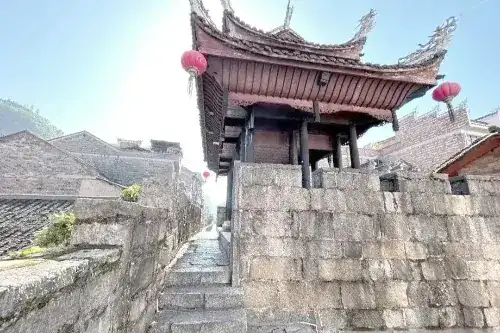
The second characteristic architectural tradition belongs to the Tunbao settlements around Anshun. These fortified villages were built almost entirely from locally quarried stone. Stone walls, stone roofs, and stone-paved lanes create an atmosphere of solidity and defense, reflecting the strategic role these communities once played. Despite the change in building materials, the courtyard layouts faithfully preserve the traditional residential design of the Jianghuai region from which their ancestors originated. Villages such as Tianlong Tunbao and Yunshan Tun remain exceptionally well preserved today, offering visitors the rare sensation of stepping into a Ming Dynasty village frozen in time over six centuries ago.
The third iconic architectural tradition is represented by the Dong drum towers and Wind-and-Rain Bridges. The drum tower serves as both the architectural and spiritual heart of every Dong village. Rising more than twenty meters high, these elegant multi-tiered wooden towers are constructed entirely without nails, relying instead on sophisticated mortise-and-tenon joinery. Their soaring silhouettes resemble towering cedar trees. Historic examples such as the Zengchong Drum Tower and the drum tower complex of Zhaoxing Dong Village date back to the Ming and Qing dynasties. Equally remarkable are the Wind-and-Rain Bridges, which combine the functions of bridge, covered corridor, and pavilion. Beyond serving as transportation infrastructure, they act as communal gathering spaces where villagers gather and socialize. Diping Wind-and-Rain Bridge, celebrated for its extraordinary timber craftsmanship, is protected as a National Key Cultural Heritage Site. In 2006, the Traditional Dong Timber Frame Construction Techniques were inscribed on China's first National Intangible Cultural Heritage List.
Guizhou's architectural heritage reflects the province's gradual embrace of modernization. Jiaxiu Pavilion, originally constructed during the Ming Dynasty, has long been Guiyang's most recognizable landmark. Built atop the Aoji Rock in the Nanming River, this elegant three-story wooden pavilion symbolizes scholarly achievement and has been designated a National Key Cultural Heritage Site. During the early twentieth century, Western architectural influences left their mark on Guiyang through buildings such as the Former Residence of Wang Boqun and Dajue Jingshe, both combining Chinese and Western design elements. During the War of Resistance Against Japanese Aggression, Guizhou became an important rear-area refuge for institutions relocated from eastern China. Zhejiang University, for example, spent seven years in Meitan and Zunyi, leaving behind a collection of Republican-era campus buildings. During the Third Front Construction campaign after the founding of the People's Republic, numerous factories and industrial complexes were established deep within Guizhou's mountains, creating a distinctive industrial architectural heritage. More recently, contemporary landmarks such as the Huaguoyuan Twin Towers and the Guizhou Financial City complex have dramatically reshaped Guiyang's skyline, with the tallest towers reaching 335 meters. Public buildings including the Guiyang Olympic Sports Center and the New Guizhou Provincial Museum further demonstrate how modern architecture attempt to integrate motifs inspired by the province's diverse ethnic cultures.
Guizhou's urban fabric exhibits a remarkable ability to adapt to mountainous terrain. The provincial capital, Guiyang, is situated within an intermontane basin, and its neighborhoods have expanded organically along valleys, with the Nanming River winding through the city to create the distinctive landscape of "a city within the mountains, and mountains within the city." Streets in the historic districts often follow the contours of the land, rising and falling with the hills, while many road names include characters meaning slope, embankment, or cliff, reflecting the city's topography. The historic center of Zunyi stretches along the Xiangjiang River, where the preserved neighborhoods surrounding the Zunyi Conference Site feature rows of blue-brick buildings topped with layered pitched roofs, creating a cityscape dominated by shades of red and gray. Beyond the urban centers, numerous ethnic minority villages remain largely untouched by modern development. Terraced rice fields, wooden houses, stone-paved pathways, ancient trees, and traditional village gates continue to coexist in harmony with the surrounding mountains, forming complete cultural landscapes where architecture and nature remain inseparably intertwined.
Culinary Culture
Guizhou cuisine is defined by the harmonious pairing of sourness and spiciness, a flavor profile that distinguishes it within China's rich culinary landscape. A popular local saying goes, "Go three days without something sour, and you'll barely be able to walk," reflecting the central role that sour flavors play in everyday life. Unlike the numbing heat of Sichuan cuisine or the fragrant spiciness of Hunan cooking, Guizhou's cuisine embraces a more direct and rustic balance—spicy with a bright sour edge, and sour with lingering warmth. This distinctive culinary philosophy is deeply rooted in the province's mountainous geography. Historically, salt was scarce in Guizhou, leading local communities to rely on fermentation and souring techniques to season and preserve food. The region's humid climate encouraged the generous use of chili peppers to dispel dampness and cold, while the extraordinary diversity of local ingredients inspired an endless variety of flavor combinations.
The concept of "sour" in Guizhou cuisine is itself a sophisticated culinary system. Souring agents are classified according to both their ingredients and preparation methods. Common varieties include rice sour, produced by fermenting rice-washing water; red sour, made from tomatoes and wild cherry tomatoes; white sour, fermented from clear rice broth; and pickled chili sour, created by fermenting chili peppers together with ginger and garlic. Preparation methods generally fall into two categories: naturally fermented sours and fresh sour broths prepared directly during cooking. Among them, Kaili Red Sour Soup represents the pinnacle of Guizhou's sour culinary tradition. It is made by fermenting locally grown maolajiao (small wild tomatoes) and red chili peppers after washing, crushing, salting, sealing, and allowing the mixture to mature naturally. The resulting broth is brilliantly red, deeply aromatic, and pleasantly tangy, and has been recognized as a National Geographical Indication Product. The province's signature dish, Sour Soup Fish, is perhaps the finest expression of this philosophy. Fresh rice-field fish are simmered in red sour soup and served with dipping sauces flavored with litsea oil (Mujiangzi oil) and chili. The tender fish, combined with the bright, spicy broth, creates a harmonious balance of sourness, heat, and freshness that has long been a traditional dish served to honored guests by the Miao and Dong peoples.
Among Guiyang's countless street foods, Changwang Noodles are perhaps the city's most iconic specialty. The name refers to its three principal ingredients: chang, or pork intestines; wang, meaning fresh pig's blood curd; and handmade egg noodles. The bowl is further enriched with crispy fried pork cubes, peanuts, chopped scallions, and fragrant chili oil, creating a remarkable combination of crisp, tender, silky, aromatic, and spicy textures in every bite. Dating back to street vendors of the late Qing Dynasty and early Republican era, Changwang Noodles remain one of Guiyang's favorite breakfast choices today. Another beloved staple throughout the province is beef rice noodles, with Huaxi Beef Rice Noodles being especially renowned. Slow-braised yellow beef is served in a clear, flavorful broth alongside pickled cabbage and fresh cilantro, complementing the smooth rice noodles. In northern Guizhou, Zunyi Lamb Rice Noodles are a winter favorite, featuring locally raised mountain goats cooked with skin intact and seasoned with chili peppers and Sichuan peppercorns. The result is rich and aromatic without the strong gaminess often associated with lamb.
One of Guizhou's most creative street foods is Siwawa, literally meaning "Silk Baby." Similar in concept to a fresh spring roll, it consists of an ultra-thin rice-flour wrapper into which diners assemble their own selection of more than a dozen finely shredded vegetables. Typical fillings include shredded radish, fish mint (Houttuynia cordata), kelp, bean sprouts, fried soybeans, and other fresh ingredients. Once wrapped, the roll is generously drizzled with a tangy, spicy dipping sauce before being eaten. With all the vegetables served cold, the contrast between the chewy wrapper, the natural sweetness of the vegetables, and the vibrant sour-spicy dressing makes Siwawa one of Guiyang's most interactive and refreshing culinary experiences.
Bean Hot Pot (Doumi Hot Pot) offers a distinctly Guizhou interpretation of hot pot culture. Unlike the fiery broth of Chongqing hot pot or the delicate simplicity of Beijing's lamb hot pot, its foundation is a rich, creamy soup made from slowly simmered white beans. Smoked pork or seasoned minced pork is added for extra depth before vegetables and meats are cooked in the broth. The meal traditionally concludes with a bowl of rice mixed with the remaining bean soup, providing a comforting and satisfying finish that evokes the warmth of home cooking for many Guizhou families. Equally representative of the province's nightlife are the ubiquitous stalls selling grilled tofu cubes. Made from simple soybeans, the tofu develops a crisp, golden exterior while remaining tender inside. Dipped in dry chili powder, it has become one of Guizhou's quintessential evening snacks.
Behind Guizhou's cuisine lies a vivid reflection of the province's regional character. The widespread love of sour flavors represents the practical wisdom developed by mountain communities in times of material scarcity—resourceful and resilient. Their wholehearted embrace of chili peppers reveals a straightforward and passionate spirit. The extensive use of wild herbs and native seasonings, such as fish mint, litsea, and Agastache (Chinese patchouli), reflects an intimate relationship with the surrounding mountains and forests. Perhaps most distinctive of all is Guizhou's remarkable dipping sauce culture, where nearly every dish is accompanied by its own carefully crafted sauce. This endless pursuit of nuanced flavors reveals a refined culinary sensibility hidden beneath the cuisine's seemingly rustic appearance. These are, in every sense, the flavors of the mountains—and the people who call them home.
Modern Development
Guizhou's modern history is a story of a landlocked mountainous province steadily overcoming its geographical constraints and forging stronger connections with the outside world. It has undergone several profound transformations—from becoming a strategic center of China's Third Front Construction defense industries, to serving as a major energy supplier through the West-to-East Electricity Transmission Project, and more recently emerging as one of China's leading hubs for the big data industry.
For much of its modern history, Guizhou's development was constrained by poor transportation infrastructure. During the War of Resistance Against Japanese Aggression, the province became an important rear area, receiving numerous relocated factories, educational institutions, and refugees from eastern China. Prestigious universities, including Zhejiang University and Daxia University, temporarily relocated to Guizhou, bringing a brief flourishing of education and intellectual life. The completion of the Guizhou–Guangxi Railway to Dushan in 1943 connected the province to China's national railway network for the first time. Yet by 1949, industrial output accounted for only 14% of Guizhou's combined industrial and agricultural production, leaving it overwhelmingly agricultural, with the vast majority of its population still living in remote mountain villages.
The Third Front Construction campaign between 1964 and 1980 fundamentally reshaped Guizhou's industrial landscape. As one of the principal provinces designated for China's inland defense industrialization, Guizhou became home to three major military-industrial complexes: the 011 Aviation Base, the 061 Aerospace Base, and the 083 Electronics Base. Engineers, technicians, and industrial equipment were relocated from China's coastal regions into the province's mountainous interior. The 011 Aviation Base, established in Anshun, developed a complete fighter aircraft research and manufacturing system hidden among valleys and mountains, where China's first JJ-7 trainer aircraft was produced. Meanwhile, the 061 Base near Zunyi became a major center for the development of surface-to-air missile systems. These self-contained "military industrial cities" included their own schools, hospitals, and commercial facilities, functioning almost as isolated industrial enclaves separate from the surrounding rural communities. While the Third Front program successfully laid the technological and human-resource foundations for Guizhou's modern equipment manufacturing industry, it also left lasting structural challenges, including an overreliance on heavy industry, geographically dispersed production facilities, and relatively weak integration with the broader local economy.
Following China's Reform and Opening-up, Guizhou faced a new set of challenges and choices. Around the turn of the twenty-first century, the province identified its role within the national West-to-East Electricity Transmission Project, converting its abundant coal resources into electricity that could be supplied to rapidly industrializing coastal provinces such as Guangdong. During this period, coal mining and power generation became major pillars of Guizhou's economy, while Liupanshui emerged as one of southwestern China's leading energy production centers. Nevertheless, dependence on natural resources exposed the province to fluctuations in commodity markets, leaving Guizhou caught in the long-standing paradox often described as "rich in resources, yet poor in prosperity."
The province's true turning point came with its embrace of the big data strategy around 2013. Demonstrating remarkable strategic foresight, the Guizhou provincial government identified big data as the province's opportunity to leapfrog traditional stages of industrial development and achieve rapid modernization. This decision was supported by several unique advantages: a cool climate with an average annual temperature of approximately 15°C, significantly reducing data center cooling costs; abundant and relatively inexpensive electricity; and stable geological conditions suitable for large-scale infrastructure. The southern data centers of China's three major telecommunications operators were all established in the Gui'an New Area, followed by investments from technology giants including Apple, Tencent, and Huawei, all of which constructed major data centers in the region. Since 2015, Guiyang has hosted the annual China International Big Data Industry Expo, transforming Guizhou from one of China's less-developed provinces into the country's first National Big Data Comprehensive Pilot Zone. The nickname "China's Big Data Valley" has since become one of Guizhou's defining international identities.
Today, Guizhou's industrial structure has become increasingly specialized and diversified. Guiyang and the Gui'an New Area focus on big data, electronic information technology, advanced equipment manufacturing, and modern service industries. Zunyi remains overwhelmingly centered on premium sauce-aroma baijiu production, with Kweichow Moutai Group alone possessing a market capitalization exceeding the province's entire annual GDP, while also expanding into equipment manufacturing and electronic information industries. Bijie and Tongren are developing new energy, advanced materials, and environmentally sustainable industries. Liupanshui continues to strengthen its position as a key energy and raw materials base, while Guizhou's three autonomous prefectures emphasize cultural tourism, healthcare, pharmaceuticals, and specialty agriculture. The province's GDP has grown from approximately 800 billion yuan in 2013 to more than 2 trillion yuan by 2023, with its economic growth rate ranking among China's fastest for many consecutive years. Today, efficient mountain agriculture, a rapidly expanding digital economy driven by big data, and a vibrant modern service sector centered on cultural tourism are together reshaping the economic future of this once-isolated mountainous province.
Transportation
"Mountain peaks reached the heavens, where even birds could scarcely pass." Five hundred years ago, the philosopher Wang Yangming penned these words after his exile to Guizhou, capturing the profound transportation challenges that had long defined this mountainous land. Today, however, Guizhou has transformed itself into one of southwestern China's most important overland transportation hubs, building an integrated network centered on its capital, Guiyang, and connecting neighboring provincial capitals as well as major cities throughout the province. Guizhou has completed an extraordinary journey from an isolated mountain region to a vital crossroads of Southwest China.
Railways were the first area in which Guizhou achieved a major breakthrough. In December 2014, the Guiyang–Guangzhou High-Speed Railway officially opened, marking both Guizhou's first high-speed railway and the first direct high-speed corridor linking Southwest China with the Guangdong–Hong Kong–Macao Greater Bay Area. This milestone connected Guizhou to China's national high-speed rail network, reducing travel time between Guiyang and Guangzhou from nearly 20 hours to around four hours. Over the following years, additional high-speed rail lines—including the Shanghai–Kunming High-Speed Railway (Guiyang–Changsha section in 2015 and Guiyang–Kunming section in 2016), the Chongqing–Guiyang Railway (2018), the Chengdu–Guiyang High-Speed Railway (2019), and the Guiyang–Nanning High-Speed Railway (2023)—were completed in succession, firmly establishing Guiyang as one of southwestern China's principal high-speed rail hubs.
Today, Guizhou's high-speed rail network forms a distinctive "rice-character" (米-shaped) pattern radiating outward from Guiyang toward neighboring provincial capitals. Eight of the province's nine prefecture-level cities and prefectures are already served by high-speed rail or high-speed EMU services. The only remaining exception, Xingyi in Qianxinan Prefecture, is expected to join the network upon the completion of the Panzhou–Xingyi High-Speed Railway in 2025, achieving the goal of high-speed rail access to every prefecture-level jurisdiction in Guizhou. Alongside this modern network, four conventional railway trunk lines—the Sichuan–Guizhou, Guiyang–Kunming, Hunan–Guizhou, and Guizhou–Guangxi railways—were built as early as the 20th century and continue to serve as the backbone of the province's traditional rail transportation system.
Guizhou's expressway network is equally remarkable. In 2015, it became the first province in western China and the ninth nationwide to provide expressway access to every county. By the end of 2023, the province's expressway network had exceeded 8,700 kilometers, its density ranking among the highest in the country. Spectacular engineering achievements such as the Beipanjiang Bridge, soaring 565 meters above the river below and recognized as the world's highest bridge, together with over a hundred landmark structures including the Yachi River Bridge and Qingshui River Bridge, have earned Guizhou the nickname "The World's Bridge Museum." These are far more than transportation infrastructure—they are monumental feats of engineering that have transformed seemingly impassable mountain gorges into vital transportation corridors. Driving across Guizhou often feels like traveling through a scenic gallery, where bridges suspended above the clouds and tunnels carved through mountains appear one after another in an endless procession.
Air transportation has likewise developed into a comprehensive "one hub with multiple regional airports" system. Guiyang Longdongbao International Airport serves as the province's primary aviation hub and one of southwestern China's key international gateways, offering flights to major destinations across China as well as routes to Southeast Asia, Japan, and South Korea. Every prefecture-level city or autonomous prefecture—including Zunyi (served by both Xinzhou and Maotai airports), Bijie, Tongren, Xingyi, Liupanshui, Anshun, and Qiandongnan (Liping Airport)—operates its own regional airport. Libo Airport specifically supports tourism to the nearby South China Karst World Natural Heritage Site.
Within Guizhou's transportation network, Guiyang's role as the central hub is unmistakable. Guiyang North Railway Station is one of the largest high-speed rail stations in Southwest China, bringing together major routes including the Shanghai–Kunming, Guiyang–Guangzhou, Chengdu–Guiyang, and Chongqing–Guiyang high-speed railways. At the same time, Guiyang Longdongbao International Airport offers seamless transfers between air travel, high-speed rail, metro services, and long-distance coaches, making Guiyang one of the few cities in China with a truly integrated air–rail transportation hub. For travelers, it is now entirely feasible to use Guiyang as a base and reach neighboring provincial capitals within two to four hours by high-speed train.
Traveling through Guizhou is itself an unforgettable experience. Trains constantly alternate between soaring across dramatic bridges and disappearing into long mountain tunnels. Outside the window, breathtaking canyons suddenly give way to complete darkness before opening once again onto expansive karst landscapes. Concepts that once existed only in geography textbooks become vividly real. Those who choose to drive will find that nearly every expressway winds through mist-covered mountains, with scenery changing far more dramatically than on the plains. Meanwhile, travelers seeking a deeper experience may prefer the remote Miao and Dong villages that lie beyond the reach of high-speed rail, accessible only after leaving the expressway and following winding mountain roads. These isolated communities have preserved authentic mountain landscapes that remain largely untouched by the homogenizing effects of modern transportation. In Guizhou, the journey itself becomes a way of reading the province.
Travel Tips
Guizhou is a rewarding destination throughout the year, with each season offering its own distinctive experiences. Spring (March–May) is widely regarded as the most comfortable time to visit, bringing mild temperatures and moderate rainfall. Around the Qingming Festival, the vast rhododendron blooms at Baili Rhododendron Scenic Area burst into spectacular color, while renowned karst attractions such as Zhijin Cave and Dragon Palace Cave remain enjoyable regardless of weather conditions. Summer (June–August) coincides with the rainy season, yet it is also Guizhou's premier season for escaping the heat. The provincial capital, Guiyang, enjoys an average summer temperature of only 23°C (73°F), earning it the title "China's Summer Capital." While much of the Yangtze River Basin and southern China swelter under intense heat, Guizhou offers refreshingly cool weather. Summer is also when Huangguoshu Waterfall reaches its most spectacular flow, with mist from the cascading water drifting hundreds of meters into the surrounding landscape.
Autumn (September–November) brings more stable weather and clear skies, making it the ideal season to visit Miao and Dong villages. The forests of the Leigong Mountains blaze with autumn colors, terraced rice fields turn brilliant gold, and many Miao communities celebrate the Miao New Year, providing visitors with an immersive cultural experience. Winter (December–February) is the province's low tourist season, yet it possesses its own quiet charm. After snowfall, Xijiang Qianhu Miao Village becomes a picturesque landscape of snow-covered wooden houses and rising chimney smoke. Winter is also an excellent time to enjoy Guizhou's hot springs and warm up with a comforting meal of traditional sour soup hot pot.
For first-time visitors, five experiences provide an ideal introduction to Guizhou. The first is Huangguoshu Waterfall, the largest waterfall complex in Asia. Its main waterfall stands 77.8 meters high and 101 meters wide, making it Guizhou's most iconic natural landmark. Set aside at least half a day to explore the scenic trails, including the famous Water Curtain Cave, where visitors can walk behind the curtain of cascading water for a truly unforgettable perspective.
The second essential experience is spending a night in Xijiang Qianhu Miao Village. Choose a guesthouse perched halfway up the mountainside and watch thousands of lights gradually illuminate the valley at dusk. Wake the following morning to the crowing of roosters and drifting mountain mist before enjoying a traditional long-table banquet and listening to authentic Miao Flying Songs. Although the village has become increasingly commercialized, it remains the most accessible and comprehensive gateway to experiencing Miao community life.
Third, visit the historic town of Zhenyuan Ancient Town. Built along both banks of the Wuyang River, this nationally designated historic city has preserved much of its Song Dynasty urban layout. The remarkable Qinglong Cave Ancient Architectural Complex, dramatically built against the cliffs overlooking the river, harmoniously combines the philosophies of Confucianism, Buddhism, and Taoism within a single architectural ensemble. Spending a night in a riverside inn and taking an evening boat cruise offers a peaceful atmosphere that many travelers find quieter than Lijiang and more authentically preserved than Fenghuang.
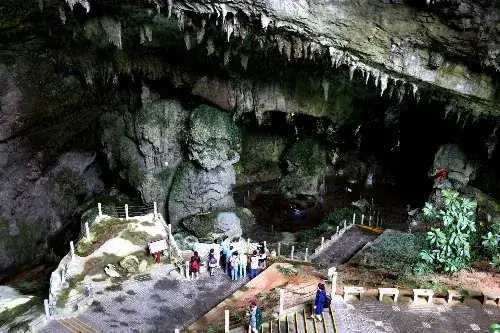
The fourth recommendation is exploring the magnificent underground world of Zhijin Cave, often regarded as the finest cave system in Guizhou. Celebrated for its immense scale, extraordinary formations, and remarkable diversity, the cave contains an astonishing array of stalagmites, stone columns, and stone curtains. It was ranked by Chinese National Geography as the finest among China's Six Most Beautiful Tourist Caves. A full visit typically takes around three hours, and since the cave maintains a constant temperature of approximately 16°C (61°F) throughout the year, bringing a light jacket is advisable.
Finally, no visit to Guizhou is complete without hearing the Grand Song of the Dong in Zhaoxing Dong Village, often known as "The No. 1 Dong Village." The village's five magnificent drum towers each represent one of its five major clans. As night falls, villagers gather beneath the towers to perform their extraordinary polyphonic songs, creating a natural musical experience of breathtaking beauty that few formal concert halls can replicate.
Several practical tips can help make your journey more enjoyable. Attractions in Guizhou are widely dispersed, so allow generous travel time between destinations. Guiyang works best as a transportation hub, with one or two nearby destinations explored in depth rather than attempting an exhausting whirlwind itinerary. Guizhou cuisine is characterized by sour and spicy flavors, and fish mint (Houttuynia cordata) is a beloved local herb that many first-time visitors find unfamiliar. If you prefer not to eat it, simply ask the restaurant to leave it out in advance. Mountain weather changes quickly, making a rain jacket or umbrella and sturdy, non-slip footwear essential. Even during midsummer, carrying a light jacket is recommended for cooler mornings and evenings. While mobile payment is accepted almost everywhere throughout the province, keeping a small amount of cash remains advisable when visiting remote ethnic minority villages.
Visitors should also be mindful of local customs and etiquette. Miao, Dong, and other ethnic minority communities observe traditional social practices that deserve respect. When offered a ceremonial toast, it is considered polite to receive the cup with both hands. If you do not drink alcohol, taking a symbolic sip is generally accepted. Avoid touching ceremonial objects such as bronze drums displayed in villagers' homes, as some are regarded as sacred ritual items. Likewise, always ask for permission before photographing local residents in traditional ethnic dress. Guizhou's mountain roads are often steep and winding, so those driving should exercise extra caution and avoid traveling after dark whenever possible. During the rainy season, particularly in June and July, travelers should monitor weather forecasts and heed official warnings regarding landslides or other geological hazards in karst regions. Above all, approach Guizhou with humility, curiosity, and an appreciation for its mountain culture, and the province will reward you with landscapes and experiences far beyond expectation.
Travel information can change. Check current opening hours, reservations and entry requirements before you travel.
Traveller discussion
Start the conversation with a helpful tip or a question.