
Guilin City, Guangxi
广西桂林市
Origin of the name: Guilin's name originated in the 33rd year of Qin Shi Huang's reign (214 BC), named for the abundance of osmanthus trees at the source of the river, where no other trees grew. Another explanation is that it was named Guilin because of Guishan Mountain to the northeast of the city, where osmanthus trees grew in abundance, forming…
Origin of place name:
The name Guilin originated in the 33rd year of Qin Shi Huang's reign (214 BC), named after the abundance of osmanthus trees at the source of the river in the area, where no other trees grew. Another explanation is that there is a Gui Mountain to the northeast of the capital, with osmanthus trees growing on its summit, forming a forest, hence the name Guilin. The gist is the same: there are many osmanthus trees, forming a forest.
Basic introduction:
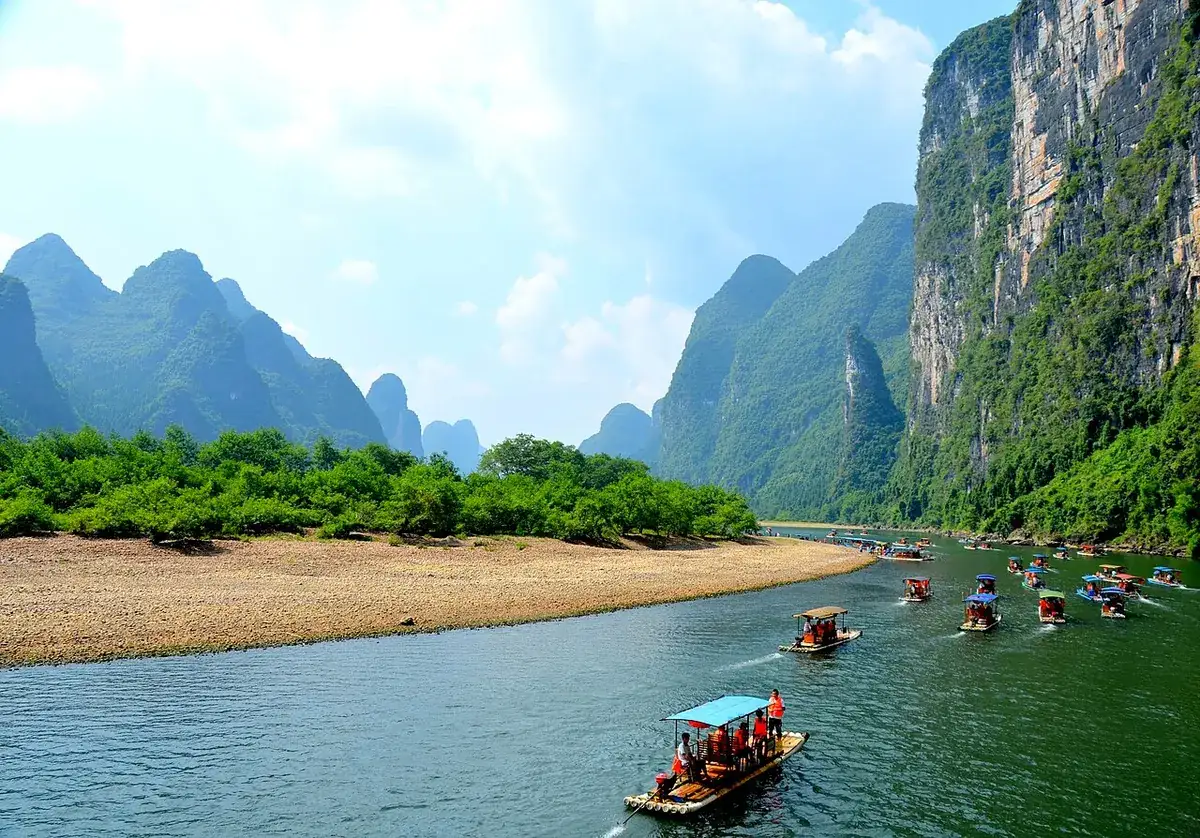
Guilin, located in the northeastern part of Guangxi Zhuang Autonomous Region, is a famous scenic tourist city and historical and cultural city in China, renowned for its breathtaking landscape. Centered on Guilin City, it encompasses 12 surrounding counties, boasting vast and verdant primeval forests, majestic and precipitous peaks and valleys, rushing streams and waterfalls, and the world-renowned terraced fields. It is home to more than ten ethnic minorities, including Zhuang, Yao, Miao, Dong, Mulam, and Maonan.
Guilin is characterized by karst landforms. According to geological research, approximately 300 million years ago, Guilin was a vast ocean. Due to crustal movement, limestone deposited on the seabed rose to become land. After weathering and erosion, it eventually formed the magnificent peaks, deep and beautiful caves, and mysterious underground rivers.
These unique landforms, combined with the ever-changing scenery of the Li River and its surrounding beautiful and charming pastoral landscape, form the distinctive and world-renowned "Guilin landscape" characterized by "green mountains, clear waters, unique caves, and beautiful rocks."
View detailed information about Guilin City >>
Guilin City contact number: 0773-12345
Honors Ranking:
In July 2026, it was designated as a key tourism city in the "15th Five-Year Plan for Building a Tourism Power".
In May 2025, it was selected as a key city for inbound tourism in the "15th Five-Year Plan for Building a Tourism Power".
In July 2026, it was listed among the top 50 cities in China with the best business environment, ranking 25th.
In March 2026, it ranked 97th among China's top 100 cities.
In January 2026, it ranked 24th in the overall ranking of overseas online influence of Chinese mainland cities in 2025.
In October 2025, Guilin City's Lijiang River landscape outdoor sports destination was included in the first batch of high-quality outdoor sports destination construction areas.
In May 2025, it was designated as one of the first batch of pilot cities for innovation and upgrading of the national retail industry.
In May 2025, the 2025 China City Charm Ranking was released, with Guilin City ranking 79th (a third-tier city).
In April 2025, it was named a national model city (county) for supporting the military and giving preferential treatment to families of servicemen.
View more Guilin City honors and related rankings >>
Historical background:
In 221 BC, the 26th year of Qin Shi Huang's reign, Lingling County was established, with its seat in the southwest of present-day Quanzhou County. It governed the present-day counties of Quanzhou, Xing'an, Ziyuan, Guanyang, and Lingchuan, marking the beginning of the second-level administrative divisions within the present-day city area. It belonged to Changsha Commandery; the rest belonged to Guilin Commandery.
In the sixth year of the Yuanding era of the Western Han Dynasty (111 BC), Shian County was established, with its seat in present-day Guilin City. It governed the present-day Guilin urban area and the counties of Yangshuo, Longsheng, and Lingchuan. It belonged to Lingling Commandery along with Lingling County, while the rest belonged to Cangwu Commandery.
In the first year of Ganlu (265) of the Three Kingdoms period, Shian Commandery was established by separating Lingling Commandery, with its seat in Shian County.
A prefecture was a second-level local administrative division. The area of present-day Guilin City was divided among the prefectures of Shian, Lingling, and Cangwu.
During the Jin Dynasty, the territory was divided among Shian, Lingling, Cangwu, and Gui.
View detailed historical evolution of Guilin City >>
Travel information can change. Check current opening hours, reservations and entry requirements before you travel.


Traveller discussion
Start the conversation with a helpful tip or a question.