
[Quanzhou Tourism] The most comprehensive guide to Quanzhou attractions, including transportation, accommodation, and food!
Quanzhou, also known as Licheng, Wenling, Citong City, and the City of Light, is a prefecture-level city in Fujian Province, located in southeastern Fujian. It is one of the three major central cities of Fujian, comprising 4 urban districts, 5 counties, and 3 county-level cities. As the starting point of the ancient Maritime Silk Road, Quanzhou is…
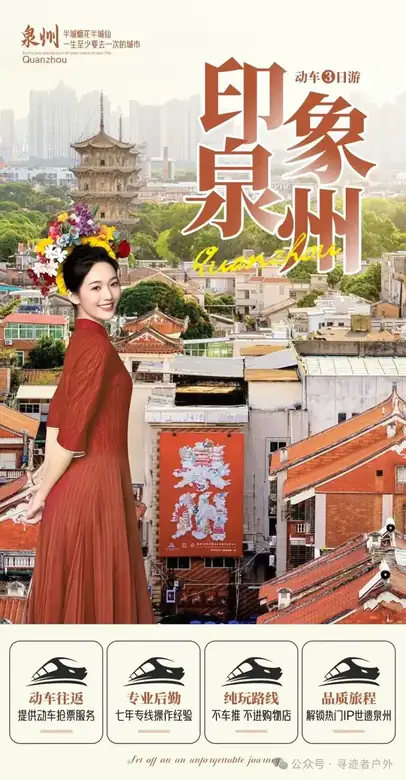
Quanzhou, also known as Licheng, Wenling, Citong City, and the City of Light, is a prefecture-level city in Fujian Province, located in southeastern Fujian. It is one of the three major central cities of Fujian, comprising 4 urban districts, 5 counties, and 3 county-level cities. As the starting point of the ancient Maritime Silk Road, Quanzhou is among the first batch of National Historical and Cultural Cities, the first East Asian Capital of Culture, and a World Heritage City. Quanzhou is one of the starting points of the Maritime Silk Road and also a world religious museum. With a long history and splendid culture, Quanzhou is an important historical and cultural city in Fujian Province. It is known as Citong City, the World Religious Museum, the starting point of the Maritime Silk Road, the capital of Nanyin music, and a Buddhist city, among other things. Quanzhou's diverse and inclusive religious culture is an important testament to the cultural exchange along the Maritime Silk Road. Quanzhou is a city where different faiths, ethnic groups, and cultures coexist peacefully. Quanzhou is a world religious museum with over 6,000 temples, including those of Buddhism, Islam, Catholicism, Christianity, and other religions.
Further Reading: [Fujian Tourist Attractions] 10 Most Worth Visiting Places in Fujian, Each More Beautiful Than the Last
Quanzhou Transportation
How to get to Quanzhou
Please see the map:
Airport: Jinjiang AirportIt is about 15 kilometers from Quanzhou, and the car ride takes about 20-30 minutes. There are also buses that can get there, but they take longer.
Taipei Taoyuan International Airport (TPE) or Taipei Songshan Airport (TSA) → Quanzhou Jinjiang International Airport (JJN)(✅Flight booking: Trip)
Flight Information: There are currently no direct flights; a connecting flight is required.
Hong Kong International Airport (HKG) → Quanzhou Jinjiang International Airport (JJN)(✅Flight booking: Trip)
Flights: Multiple direct flights daily.
High-speed rail: Quanzhou StationIt is the closest to the ancient city, about 10 kilometers away.
Hong Kong West Kowloon Station → Quanzhou Station(✅High-speed rail booking: Trip)
Service frequency: Approximately one direct train per day.
Travel in Quanzhou City
🏙Ancient City: There are small white cars available near the ancient city that you can hail and they will stop for you 👍🏻. They will take you directly to the station for 2 yuan per person. You can also book in advance through the 【Xiaobai Rent】 mini-program.
🚌Public Transportation: Quanzhou does not have a subway; public transportation relies on buses. You can use a public transport card to ride the bus. You can obtain your city bus code in advance through the WeChat mini-program - Ride Code; or you can obtain your Quancheng Tong card through Alipay. Some buses in Quanzhou run between cities, so a small number of these buses will charge 2 yuan; generally, they only charge 1 yuan.
🏍Shared electric bikes & bicycles: In Quanzhou, the shared bike service is 【Xiaocheng Mobility】. It's very convenient for short-distance travel within the city, and you don't have to worry about traffic jams. Bicycles are free for the first hour. Xiaocheng's bicycles are all geared, making them easy to ride uphill.
Quanzhou Accommodation Arrangements
In terms of location, I highly recommend the old town of Quanzhou, as many of Quanzhou's attractions are located there. However, there's a catch: most accommodations within the old town are guesthouses, with fewer hotels. For hotels, you'll have more options outside the old town. I stayed at two guesthouses last time; I'll review those later. Let's finish discussing the itinerary first!
Further Reading: [Quanzhou Accommodation] A "Treasure Trove" of Accommodation Options in Quanzhou Old Town
✅Quanzhou Accommodation Booking: Trip
I stayed at two different places this time, only 20 meters apart, right next to each other. The location was fantastic, just a few minutes' walk from West Street and Kaiyuan Temple. However, each had its own advantages and disadvantages:
Sanchao Li Homestay
Address: No. 56-24, Gurong Lane, Xinfeng Community, Lizhong Street, Licheng District, Quanzhou City
✅ Discounted room booking: Trip
The advantages are that it's an old house, which has a certain charm, and the exterior is also very beautiful. Some young women even took pretty photos there. BUT, the bathroom in my room didn't have a separate shower and toilet area, and the showerhead wasn't working properly. Also, my room was on the second floor, which was okay, but the rooms on the first floor were terrible—they felt very cramped and damp.
Quanzhou Yuanji Chaoye Hotel
✅ Discounted room booking: Trip
The room was fine, the hotel's decor and facilities were great, and the rooftop offered a beautiful view of Kaiyuan Temple. The only downside was the lack of an elevator on the third floor, making it a bit tiring to drag a suitcase. Also, there's an elementary school across the street, and I was woken up early by the kids.
In short, it's just a guesthouse, so take it easy and make do.
Furthermore, during peak seasons like Chinese New Year and National Day, as anyone with travel experience knows, hotel prices in places like Quanzhou can vary drastically between peak and off-peak seasons, sometimes even doubling. Whether or not to recommend it then depends on the price increases of other hotels at that time and how you compare them.
Quanzhou Itinerary
Quanzhou Ancient City Tour Route
First stop: Bell Tower, West Street, Kaiyuan Temple. These three points form a line.
Second stop: Dongyang Ancestral Hall, Huaxiang Catholic Church, the old compound of the Arts and Crafts Factory, Quanzhou Ancient Buildings Protection and Exhibition Hall
Third stop: Goldfish Lane + Confucius Temple
Fourth stop: Guan Yue Temple + Qingjing Ancient Temple
Fifth stop: Tianhou Temple
Sixth stop: Chengtian Temple
Last stop: The Christian church on Zhongshan Middle Road
Quanzhou 3-day 2-night independent trip
Day 1: Guan Yue Temple → Kaiyuan Temple → West Street (Ancient City Cultural Tour)
Day 2: Luojia Temple → Yongning Ancient City → Quanzhou Eye Ferris Wheel (Mountain and Sea Romantic Route)
Day 3: Xunpu Village (Fishing Village Experience)
Hidden Easter Egg in Quanzhou in May 2026
Quanzhou in May 2026 will be even more fun than in previous years—because this year, Quanzhou has really pulled out all the stops for the May Day holiday:
"Quanzhou Really Good Chairs" Free Folding Chairs:During the May Day holiday, Quanzhou will give away over 10,000 portable folding chairs to tourists free of charge. Artistic photo opportunities have been set up at selected locations across the city's 13 counties (cities and districts), creating new relaxing and tranquil tourism scenarios, each with its own unique feature. In Quanzhou, you can sit down anytime and enjoy the scenery and savor the moment.
Fujian Super League - Quanzhou Home Stadium:On May 2nd, the Fujian Super League kicked off at its home stadium in Quanzhou. Before the match, a "360-degree" intangible cultural heritage show will be held, featuring more than 20 intangible cultural heritage items, as well as a "Zitong Illusionary Screen" fan performance.
"Cuohai Has a Show" Intangible Cultural Heritage Week (May 1-5):Xunpu Fisherman's Wharf has launched a series of intangible cultural heritage projects that integrate string puppetry, hand puppetry, Liyuan Opera, stilt walking, and drum and umbrella performances, creating a youthful experience of "lying down to watch the show and enjoying the breeze at the market".
Other concurrent activities:Each county and district has its own unique activities, such as the Luojiang Bridge South Ancient Street Long Table Banquet, the Hui'an Women's Folk Performance, the Anxi Tieguanyin Tea Picking Season, the Dehua "Village Bowl" Carnival, and the Shishi Hongtawan Slow Wave Life Festival... You won't be bored no matter which one you choose.
Must-see attractions in Quanzhou
Quanzhou West Street
West Street in Quanzhou is the best-preserved ancient street in Quanzhou city. Its blend of diverse architecture and everyday life makes it a must-visit for tourists. It's more than just a street; it's a historical and cultural district. Located in the western corner of Quanzhou's ancient city, it begins at the Bell Tower and ends at Kaiyuan Temple.
The ancient alleys crisscross the street, and it takes about 3 kilometers to walk from one end to the other. In addition to Kaiyuan Temple, East and West Pagodas, City Center Pagoda, residences of famous people, clock towers, and modern Western-style buildings, there are also a large number of unique ancient houses, and groups of antique wooden buildings, which are scattered in an orderly manner and have a long-standing ancient flavor.
As an old street, besides the red brick buildings, the snacks on West Street are not to be missed. The most famous ones include Wu's handmade glutinous rice cake, Ya Fu Runbing skin, garlic sticks, Manjian cake, meat dumplings, sea worm jelly, beef soup, rice noodle soup, and seaweed jelly... all of which are indispensable delicacies in the Minnan food culture.
Further Reading: [Quanzhou West Street] Quanzhou West Street Travel Guide, Fujian - For this traditional delicacy, I stayed directly in the deep alleys of the ancient city.
Kaiyuan Temple
Kaiyuan Temple was originally the Huang family's mulberry garden, named for the lotus blossoms that bloomed on the mulberry trees. The garden was donated to build a temple, which was then called Lotus Zen Temple. When the temple was built, auspicious purple clouds appeared, hence the Purple Cloud Screen. The Hall of Heavenly Kings has a plaque with the character "Purple Cloud," and the Huang family adopted "Purple Cloud" as their ancestral home and hall name. It is now officially named by imperial decree of Kublai Khan during the Yuan Dynasty, and the Hall of Heavenly Kings has a plaque that reads: "Imperial Decree: Kaiyuan Wanshou Zen Temple." Kaiyuan Temple also contains two pagodas, one to the east and one to the west.
The West Pagoda, also known as the Renshou Pagoda, was built during the Southern Song Dynasty through private fundraising. It was modeled after a brick, wood, and stone pagoda. During the Ming Dynasty, a magnitude 8 earthquake struck Quanzhou, destroying the entire city; aside from the East and West Pagodas, it was considered a miracle. The area below the steps, resembling an elephant's eye, features a phoenix image, hence it is also called the Phoenix Pagoda. The Sumeru pedestal has eight arhats carrying the pagoda on their backs, each with a different posture, subduing dragons and using a jewel to collect the dragons into a bowl, which also contains the dragon's tail. The Tiger-Subduing Arhat is easily recognizable.
The East Pagoda, also known as the Zhenguo Pagoda, was officially built during the Southern Song Dynasty and boasts high-quality carvings. It features an Asura statue with three heads and six arms. In its left hand are a jade rabbit pounding medicine inside a moon, a cassia tree, a Mahoragas holding a bow. The prototype is a python, but its eyes are triangular without pupils, and a python is carved beside it. The base of the pagoda is decorated with various Buddhist stories, such as the arrival of the white horse carrying the scriptures.
Further Reading: [Kaiyuan Temple] Four Must-See Attractions at Kaiyuan Temple in Quanzhou (Recommended to Save)
Xunpu Village
Xunpu Village was originally named Qianpu Village. Later, when the villagers of Yangdai Village in Jinjiang jointly presented a satin curtain on the birthday of the goddess Mazu, they unintentionally wrote "Pu" instead of "Qianpu". The villagers also believed that the area was rich in red sturgeon and oysters, so naming it Xunpu would be more appropriate. Therefore, the name "Pu" has been used to this day.
The women of Xunpu, Hui'an, and Meizhou are collectively known as the three major fishing women of Fujian. The clothing of the Xunpu women and Hui'an women is considered two unique gems of Quanzhou folk customs. Hui'an women are described as having "feudal heads, democratic bellies, thrifty clothes, and wasteful trousers," while Xunpu women are described as having "democratic heads and feudal bellies."
Wearing flowers is in the nature of the "Xunpu Aunties." From the time they braided their hair as children, they loved to adorn their temples with brightly colored chrysanthemums, magnolias, and camellias. When they reached the age of fifteen, their relatives would "comb their hair into a bun." From then on, their beautiful hair would be coiled at the back of their heads into a round bun, adorned with gold and silver jewelry, and a chopstick made of ivory would be inserted horizontally in the middle.
Jinjiang Wudian City
Wudian City is located in the old town of Qingyang, Jinjiang City, Quanzhou. It is a traditional historical and cultural district with a number of well-preserved ancient residences and buildings. Surrounded by high-rise buildings and a burgeoning modern city, Wudian City exudes a unique charm of traditional culture, urban leisure, Minnan style, and tourist attractions, making it a shining pearl of the city.
During the Kaiyuan era of the Tang Dynasty, five seventh-generation descendants of the Cai family opened five restaurants along the official road at the foot of Qingyang Mountain to serve travelers. Their wine flags fluttered in the wind, and the aroma of their food filled the air, quickly gaining them a reputation that earned them the title "Qingyang Cai, Five-Store Market." From then on, "Five-Store Market" became an alternative name for Qingyang and the birthplace of Jinjiang city. By the Ming and Qing dynasties, Five-Store Market had become a bustling district, with shops lining the streets, traffic flowing freely, and beautiful red-brick mansions scattered throughout.
Luoyang Bridge
Luoyang Bridge, located at the mouth of the Luoyang River in Quanzhou, is the oldest existing beam-style long stone bridge in China. Construction of Luoyang Bridge began in the Northern Song Dynasty, spanning the Luoyang River, which was described as "five li wide and unfathomably deep." Before the bridge was built, only a ferry crossing was available. Construction of Luoyang Bridge began in 1053, initiated by Cai Xiang, the then prefect of Quanzhou and a renowned calligrapher of the Song Dynasty, and was completed in 1059. After its completion, Luoyang Bridge was decorated with many exquisite stone lions, pagodas, and pavilions, and stone generals stood guard at both ends.
Luoyang Bridge, originally named "Wan'an Bridge," was built during the early Tang Dynasty when a large number of people from the Central Plains migrated south to this area, including many from Henan. These Henan people, who settled in Quanzhou, came here with a deep longing for their homeland and named the place "Luoyang," thus Wan'an Bridge became known as "Luoyang Bridge."
Further Reading: [Luoyang Bridge] Step onto Luoyang Bridge in Quanzhou and fulfill a thousand-year-old promise.
Anping Bridge
Anping Bridge in Jinjiang was first built in 1138 and completed in 1152, a collaborative effort by monks, merchants, government officials, and local residents. The bridge runs east-west, is approximately 2255 meters long, and has a width of 2.9-4 meters. It is paved with stone slabs and protected by granite railings on both sides. There are 360 stone piers in various shapes, including rectangular, single-pointed boat-shaped, and double-pointed boat-shaped. Large stone slabs, ranging from 5 to 11 meters in length, are laid horizontally between the piers to form the bridge deck.
Several auxiliary buildings were constructed on and around Anping Bridge. At the eastern end of the bridge were Ruiguang Pagoda, a pavilion at the bridgehead, and a pavilion in the middle of the bridge, while at the western end was Haichao Temple. In the middle section of the bridge, four small square stone pagodas were also built in the water, all serving to protect merchants and travelers.
Luojia Temple
Luojia Temple is located on the Minnan Golden Coast of Shishi City. With its vast sea area and captivating scenery, it is nestled against Baogai Mountain to the northwest and faces the Taiwan Strait to the southeast. Covering an area of over twenty acres, it is a picturesque setting. Luojia Temple is the only Buddhist temple in Quanzhou that stands on a floating island, earning it the reputation of "a temple floating on the sea." The three characters "Luojia Temple" were personally inscribed by Zhao Puchu, the former president of the Buddhist Association of China.
Luojia Temple houses the Hall of Heavenly Kings, the Hall of Perfect Enlightenment, the Amitabha Recitation Hall, the Sutra Repository, the Bell and Drum Tower, and the Hall of Five Contemplations, among other structures. The entire temple complex is magnificent, with intricately carved beams and painted rafters, its golden splendor creating a breathtaking panorama against the backdrop of the sea and sky. Inside the temple are twelve lifelike stone sculptures of the Chinese zodiac, each with a unique expression, compelling visitors to stop and admire them. Standing within the temple grounds, one can directly gaze upon the endless sea; every angle offers a view of the horizon where the sea meets the sky. The pavilions and towers, the vast expanse of water, and the distant silhouettes of sails create a fantastical and breathtaking landscape.
Further Reading: [Luojia Temple] A Complete One-Day Tour Guide to Luojia Temple in Quanzhou, Fujian | A Buddhist Kingdom by the Sea and a Stunning Coastline
Quanzhou Puppet Theatre - Puppet Show
Quanzhou string puppet show is the first of the 12 puppet shows listed in the first batch of national intangible cultural heritage. It has a history of more than 2,000 years and preserves a large number of folk beliefs and customs of weddings, funerals and other celebrations in the ancient Minnan language region.
The origins of Quanzhou string puppet show can be traced back to the late Tang Dynasty. By the Ming and Qing Dynasties, numerous troupes had sprung up. Over more than a thousand years of inheritance, it has accumulated more than 700 traditional plays and more than 300 traditional tunes and singing styles, forming a complete set of exquisite string manipulation skills and a comprehensive performance system, which is highly infectious and has local characteristics.
The story of the performance is based on the intertwined life customs of Quanzhou string puppetry and the Minnan-speaking people over thousands of years, encompassing birth, aging, illness, and death. The traditional stage used in Quanzhou puppet shows is called a "Bagua Peng," constructed with two long wooden benches, several planks, eight bamboo poles, and a few cloth curtains. The side facing the audience is surrounded by several painted or embroidered screens with traditional decorative patterns.
During the performance, actors manipulate the puppets behind a screen while singing and accompanied by music. Based on the shape of the puppets and the manipulation techniques, they are divided into glove puppets, string puppets, rod puppets, etc.
Huian Stone Carving
Huian stone carving, with its exquisite craftsmanship and rich connotations, has formed five major systems: monument processing, environmental garden sculpture, architectural components, craft carving, and practical utensils. Stepping into Huian is like stepping into a world of stone carving. The stone carvings here are diverse and lifelike.
The stone used in Huian stone carving is mainly granite. This type of stone is chemically stable, corrosion-resistant, and will not rot, decay, or change over thousands of years. The craftsmanship of Huian stone carving is also unparalleled. Traditional stone carving techniques, commonly known as "daqiao," include four processes: pinching, hollowing, carving, and sculpting. Each process requires artisans to carefully consider and meticulously execute. From the initial rough draft to the final finishing, every step embodies the wisdom and dedication of the artisans.
In Huian, you can not only appreciate the exquisite craftsmanship of stone carving art, but also feel the profound cultural heritage of the place.
Hui'an·Hui Women's Folk Culture Park
The Hui'an Women's Folk Custom Park is built against the mountain and faces the sea. It has facilities such as a Chinese restaurant, a folk museum, a teahouse, and a sightseeing boardwalk. After purchasing a park ticket, the Hui'an women at the teahouse reception will serve a pot of fragrant tea for tourists to enjoy free of charge.
Sipping fragrant tea on the viewing platform and gazing at the azure coastline, you'll see a group of Hui'an women in brightly colored costumes gracefully walking along the boardwalk at sunset—a truly romantic scene. The main reason to come here is to photograph the Hui'an women and experience their lives and daily routines in depth.
Fujian Salt Production Base
Shanyao Saltworks is the second largest state-owned saltworks in Fujian Province and the largest production and export base for high-end green edible salt (carrier salt). It has eight working areas: Daigang, Caitang, Zhongcuo, Donghai, Wusi, Nanhai, Xihai, and Xiajiang. The salt field protection area covers 92,000 hectares, and 21,000 hectares of abandoned salt fields are under control. The seawall is 17.5 kilometers long.
From July to September each year is the peak production season at the Shanyao Saltworks. The frontline salt workers work outdoors, under the scorching sun, their feet sinking into salt ponds exceeding 40 degrees Celsius, busily moving back and forth. Scraping, turning, sifting, and collecting the salt—every step requires them to sweat profusely. Salt production involves half seawater and half sweat, and their tanned faces are a standard feature of these salt workers.
The salt fields on the mountainside are like mirrors, the salt as white as snow, displaying different colors throughout the year. Under the blue sky and white clouds, the salt ponds are like square fields, crisscrossing and shimmering, with small snow-capped hills shining brightly, as if entering a mirror of the sky. The seawater, salt fields, charcoal embankments, stone paths, salt rakes, and wheelbarrows outline the unique landscape of the salt fields, a picturesque and breathtaking sight.
Quanzhou cuisine
Quanzhou is also the soul of Minnan snacks, with dishes such as rice noodle soup, ginger duck, seaweed jelly, four-fruit soup, sea worm jelly, oyster omelet, roasted pork rice dumpling, Anhai vegetable cake, and "fist-shaped" rice dumplings, etc.
When asked why they love rice noodle soup so much, Quanzhou locals say it's probably because... it's light. Light yet not bland, it blossoms with countless delights when topped with various sauces.
The ducks didn't make it out of Nanjing alive, nor did they leave Quanzhou in style. Because they all wisely transformed into ginger ducks. Ginger duck originated in Quanzhou and comes in two styles: dry and wet. Ginger duck uses the local Muscovy duck (a breed from "foreign lands" that "dominates" the Fujian, Jiangxi, and Guangdong regions), stir-fried with plenty of ginger and sesame oil, making it exceptionally fragrant.
Four-fruit soup is a very local dessert, with a variety of toppings including mung bean soup, red bean soup, grass jelly, taro balls, and various fruits. You choose four toppings to make four-fruit soup.
Quanzhou-style braised pork rice dumplings have won the hearts of countless diners with their unique taste and rich fillings. They are made with pork belly, lotus seeds, shiitake mushrooms, dried shrimp, eggs and other ingredients as the main fillings, along with sweet chili sauce, peanut sauce and minced garlic.
Of course, there are no bamboo shoots in the sea worm jelly. Upon closer inspection, what's mixed in with the crystal-clear "jelly" is none other than an insect.
A true warrior doesn't care whether it's a worm or a bamboo shoot; he sticks a toothpick in, picks it up, and tosses it into his mouth, using his teeth to crush the chewy jelly. Catalyzed by the garlic sauce, the jelly's life force is fully activated, and then he swallows it down his throat – that's true satisfaction. Ten minutes after eating, a lingering sweetness remains in the mouth, as if the oral cavity has received a deep ice-cold spa treatment.
Many people mistakenly believe that sea worm jelly is made from sandworms. In fact, sea worms and sandworms look similar, but they are slightly different. Sea worms are darker in color, while sandworms are reddish-brown. Sea worms grow in mudflats, while sandworms grow in sandy areas by the sea. One is like an earthworm that governs the muddy ground, while the other likes to burrow into the salty, damp sand.
If one day, someone from Quanzhou says they're going to treat you to a fist-sized meal, would you be scared?
The "fist-shaped meat" mentioned by Quanzhou locals doesn't refer to the meat used for hitting people! In Quanzhou, it's a meat product shaped like a fist. It has a savory, meaty flavor that lingers in your mouth, is very chewy, and when paired with a secret sauce, it's incredibly salty and delicious. It's a famous snack in Quanzhou, especially in coastal areas.
Travel information can change. Check current opening hours, reservations and entry requirements before you travel.


Traveller discussion
Start the conversation with a helpful tip or a question.