
[Tianjin Attractions] 10 Recommended Attractions in Tianjin! Each One is Worth Visiting!
Tianjin is a city that exudes a blend of Chinese and Western styles, and every corner is imbued with historical atmosphere. In recent years, Tianjin has gradually become a popular tourist destination. Friends planning a trip to Tianjin can bookmark this list of 10 recommended attractions! Further reading: [Tianjin Tourism] Tianjin Two-Day Itinerar…
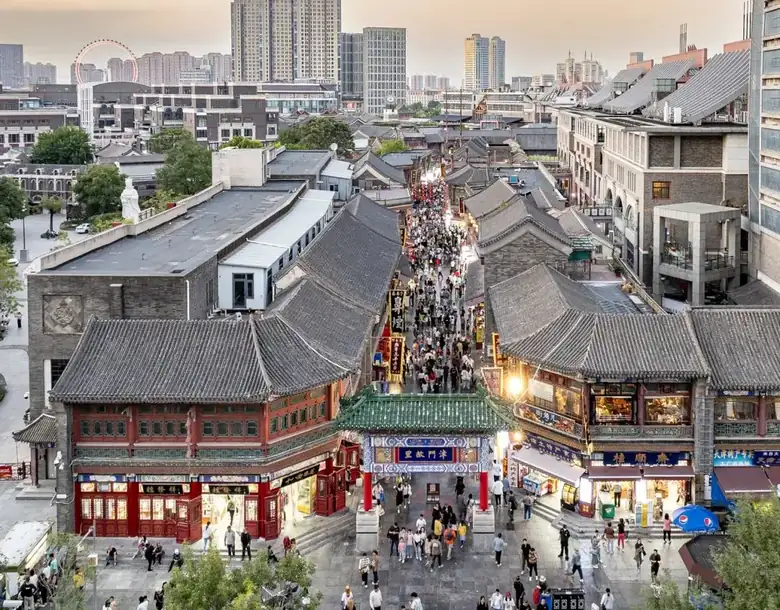
Tianjin is a city that exudes a blend of Chinese and Western styles, and every corner is imbued with historical charm. In recent years, Tianjin has gradually become a popular tourist destination. Those planning a trip to Tianjin can save this list of 10 recommended attractions!
Further Reading: [Tianjin Tourism] Two-Day Tianjin Itinerary, including transportation, accommodation, food, and attractions.
Recommended attractions in Tianjin
Ancient Culture Street
Located in Nankai District, Tianjin, this place is steeped in history and culture. Centered around the magnificent Tianhou Palace, it stretches from Shuige Street in the south to Tongbei Road in the north. It is home to Tianjin's most famous time-honored shops and handicrafts.
A dazzling array of handicrafts, including Yangliuqing New Year paintings, Zhang's clay figurines, and Wei's kites, are on display here. These traditional handicrafts carry the weight of China's long history and culture. Passed down through generations, each piece embodies the wisdom and dedication of the artisans. Strolling along the Ancient Culture Street feels like traveling back in time to ancient Tianjin.
Further Reading: [Tianjin Ancient Culture Street] A Grand Scene of Tianjin Where Ancient Charm and Modern Style Intertwine
Porcelain House
Located on Chifeng Road in Heping District, Tianjin, it was originally a century-old French-style villa. It was first a bank, and later became the residence of Huang Rongliang, a diplomat in modern China.
In 2000, Zhang Lianzhi, an antique collector from Tianjin, spent a lot of money to buy this French-style building and transformed it into a porcelain building, creating an extremely luxurious "porcelain building wonder". It is known as a priceless "Chinese ancient porcelain museum" and has gradually become a landmark building in Tianjin.
The Porcelain House lives up to its name. This small villa is covered with porcelain shards and pieces from head to toe, including celadon from the Jin Dynasty, sancai (three-color glazed pottery) from the Tang Dynasty, Jun ware from the Song Dynasty, Longquan ware, and blue and white porcelain from the Yuan and Ming Dynasties. It covers all historical periods of Chinese porcelain, and all categories of official kilns and folk kilns can be found on the walls of the Porcelain House.
Further Reading: [Tianjin Porcelain House] Encountering the Beauty of Ancient Porcelain and Understanding the Heart of Craftsmen
Five Avenues
Located in Heping District, Tianjin, the area is named after five main roads within the district, but actually comprises more than twenty streets. There are over 2,000 garden-style European-style buildings along the streets, including more than 300 former residences of famous figures. Many prominent figures from the late Qing Dynasty and early Republic of China, such as Zhang Xueliang, Gu Weijun, and Aisin-Gioro Zaizhen, have left their names here.
The architecture here is predominantly European, but each style is unique and distinctive. The neighborhood is elegant and romantic, attracting many film and television crews to shoot scenes here.
Panshan
First recorded in the Han Dynasty and flourishing in the Qing Dynasty, it is a tourist destination that combines natural landscapes with famous historical sites and integrates Buddhist culture with imperial culture. As early as the Tang Dynasty, it was known in the Buddhist world as "Eastern Wutai Mountain", and during the Kangxi period of the Qing Dynasty, it was famous at home and abroad as "the first mountain east of Beijing".
Panshan Mountain is renowned for its unique scenery, characterized by "five peaks and eight rocks" and "the beauty of three sections." It connects to Jiuhua Peak in the east and borders Wujian Peak in the west. The five peaks cluster together, with craggy rocks forming the natural "beauty of three sections." The upper section is famous for its pines, which twist and turn, obscuring the sky; the middle section is famous for its rocks, which are strange and magical; and the lower section is famous for its water, which splashes like jade and sprays like pearls.
Yangliuqing Ancient Town
Connecting Beijing to the north and Gukou to the south, Yangliuqing was a vital hub for the Grand Canal transport and the birthplace of the Eight Great Families of Tianjin in the late Qing Dynasty. Merchants from all directions and goods from various regions converged here, bringing with them diverse regional cultures. This fusion fostered the flourishing culture of Yangliuqing Ancient Town, giving rise to unique folk arts such as New Year paintings, brick carvings, stone carvings, paper cutting, kites, and folk flower festivals, making it a center for folk arts in northern China.
Among them, the most famous is Yangliuqing New Year Painting, which is the first of the four major woodblock New Year painting styles in China. It is known as "Southern Peach Blossom and Northern Willow" along with the famous Suzhou Taohuawu New Year Painting in the south. These two places, along with Yangjiabu in Weifang, Shandong and Mianzhu in Sichuan, are known as the four major production areas of New Year paintings in my country.
National Maritime Museum
Located in the Binhai New Area of Tianjin, it is known as the "Forbidden City on the Sea" and is a museum by the sea. It is also China's first national-level maritime museum, with an extremely rich collection, making it well worth a visit.
The museum houses a vast collection of marine biological specimens, marine geological specimens, and marine archaeological artifacts, showcasing the biodiversity and cultural heritage of marine life from various seas around the world. It also features multiple exhibition halls, including a marine life hall, a marine science and technology hall, and a marine culture hall, displaying knowledge about marine biology, science, and culture.
Tianjin Eye
Located on the banks of the Haihe River in Hongqiao District, the Tianjin Eye is a Ferris wheel that spans the river and combines a bridge with a wheel, serving both sightseeing and transportation functions. It is the only Ferris wheel in the world built on a bridge and is one of Tianjin's landmarks.
Further Reading: [Tianjin Eye Travel Guide] Experience the dazzling Ferris wheel under the night sky of the Haihe River
The Ferris wheel rotates at a steady speed, completing one rotation in approximately 30 minutes. When the cabin reaches its highest point, passengers can enjoy panoramic views of the surrounding area for tens of kilometers, taking in the entire Haihe River landscape. Operating hours vary depending on the season; please check the current schedule before you plan to visit.
Prince Qing's Mansion
It is a two-story brick and wood structure (with a basement) with an enclosed courtyard, and the exterior is in the Western classical style. The building walls are built with Chinese blue bricks, the eaves are terrazzo, and the wide corridors and towering columns surrounding the building are decorated with traditional Chinese glazed columns in blue, green and yellow.
The central courtyard, with its square layout, forms the heart of the building, around which other houses unfold in sequence. This design blends the elegance of a Western garden villa with the spirit of a traditional Chinese courtyard house, making it a quintessential example of Sino-Western architectural fusion.
Water Park
Located in the southwest of the city, it was formerly known as "Qinglongtan". Established in 1951, it has been a park for more than 70 years and is the largest comprehensive park in the city. It has now become a scenic spot with beautiful scenery and sparkling water in Tianjin.
The park boasts lush green lawns, picturesque scenery, expansive waters, and numerous islands. This excellent ecological environment has also attracted a large number of rare birds to settle in the park's lake.
Italian Style District
Located on the banks of the Haihe River in Hebei District, Tianjin, the area is bounded by Wujing Road, Bo'ai Road, Shengli Road, and Jianguo Road. It boasts over one hundred well-preserved European-style buildings with a history of over a century, making it a tourist attraction with an Italian flair within Hebei District.
Tianjin Tourist Attractions Map
Travel information can change. Check current opening hours, reservations and entry requirements before you travel.


Traveller discussion
Start the conversation with a helpful tip or a question.