
Are you ready for a journey to explore the Mausoleum of Emperor Shun in Jiuyi Mountain?
【Exploring the Mausoleum of Emperor Shun】A mausoleum that holds a thousand years of history, where ancient charm and modern style can be appreciated together. We invite you to explore the ancient imperial tomb and experience a thousand years of cultural heritage. "Emperor Shun toured the south and arrived here, where he died in the wilderness of C…
【Exploring the Mausoleum of Emperor Shun】A mausoleum that holds a thousand years of history, where ancient charm and modern style can be appreciated together. We invite you to explore the ancient imperial tombs and experience the profound cultural heritage of a thousand years. "Emperor Shun toured the south and came here, where he died in the wilderness of Cangwu and was buried in Jiuyi Mountain."
Further Reading: [Hunan Attractions] Recommended 22 Most Beautiful Scenic Spots in Hunan
Stepping into Jiuyi Mountain in Ningyuan, Hunan, is like traveling through a time tunnel back to ancient times, where Emperor Shun, one of the Five Emperors, is buried.
Every inch of this land exudes the fragrance of history, and every stone records ancient stories.
The Mausoleum of Emperor Shun, as one of the oldest imperial mausoleums in Chinese history, carries a profound historical and cultural heritage. It is not only the final resting place of Emperor Shun, the legendary ancestor of the Chinese nation, but also a sacred place for future generations to commemorate their ancestors and pass on their culture.
More than fifty historical books, including the Book of Documents, the Classic of Mountains and Seas, and the Records of the Grand Historian, contain records of Emperor Shun's death in the wilderness of Cangwu and his eternal rest in the Jiuyi Mountains, which adds to the mystery and solemnity of this mausoleum.
The mausoleum of Emperor Shun at Mount Jiuyi is divided into five main entrances, each leading into the next. These entrances guide each visitor through a long corridor of history, allowing them to experience the nobility and wisdom of the ancients.
Next, please follow in my footsteps and embark on this journey of discovery to explore the beauty of ancient sites. Use your eyes to see, and your heart to feel and listen to the historical stories that have been sealed by time.
Shun Emperor Mausoleum Scenic Spots
Sacrificial Hall
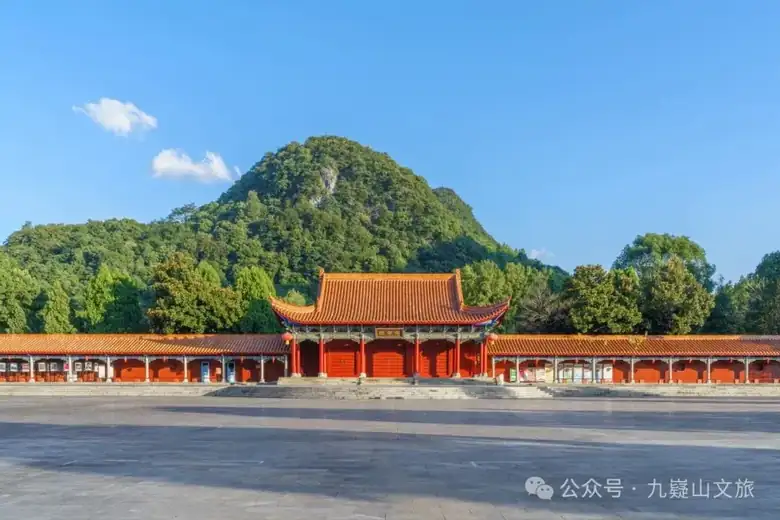
Upon entering the Mausoleum of Emperor Shun, the first thing that catches the eye is the ancient and elegant architectural complex. Most of these buildings adopt the style of the Ming and Qing dynasties, with red walls, yellow tiles, and upturned eaves, showcasing a unique charm.
The plaque above the main hall bears the inscription "Mausoleum of Emperor Shun," a rubbing taken from the tombstone in the mausoleum's inner chamber, and possesses extremely high historical and cultural value. The three doors of the main hall are generally not opened; only the middle door is opened during sacrificial ceremonies to welcome the procession.
The main sacrificial hall is located on the central axis of Emperor Shun's Mausoleum and is the only way to enter the mausoleum temple. A plaza is situated in front of the hall, facilitating large-scale sacrificial ceremonies. The plaza is surrounded by a spirit path and stone sculptures, enhancing the solemnity of the sacrificial atmosphere.
Meridian Gate
The Meridian Gate (Wu Men) was the main gate of the imperial palace in ancient times. It is a three-gate city gate in the palace style, possessing extremely high architectural value. The central path was the Imperial Road, while the two side paths were the Imperial Passages. In ancient times, the Imperial Road was the exclusive passage for the emperor, while the Imperial Passages were for civil and military officials and imperial relatives.
A leisure tea bar is located on the second floor of the Meridian Gate. With its unique cultural charm and elegant environment, it has become a beautiful sight within the Mausoleum of Emperor Shun.
Here, people can experience the charm of the guqin culture and the profoundness of tea culture up close, further deepening their understanding of traditional Chinese culture.
Worship Hall
The worship hall was where offerings were prepared during grand sacrificial ceremonies in ancient times. It was also a place where those performing the rituals would tidy their clothes and prepare themselves for the ceremony. In ancient times, when people came to the Mausoleum of Emperor Shun to pay homage to him, they would begin their grand ceremony of three kneelings and nine prostrations from the worship hall, reflecting the solemnity and rigor of ancient sacrificial activities.
The mausoleum is surrounded by ancient trees, lush and green. Especially noteworthy is the over 600-year-old cypress tree to the right of the main hall entrance, where two trees have grown together and are known locally as the "Couple Trees." Hanging a love lock here allows one's love to be eternally witnessed.
main hall
As the main building for the sacrificial rites at the Mausoleum of Emperor Shun, the main hall is a key attraction for visitors. The main hall features a double-eaved hip roof and an all-wood structure, with massive stone and timber pillars, bracket sets, and flying eaves. It is surrounded by a white marble carved railing, making it a magnificent sight.
The main hall houses a bronze statue of Emperor Shun. The statue sits upright, exuding an aura of majesty and benevolence.
Emperor Shun was renowned for his filial piety, and his virtues have been widely praised by later generations, becoming an important part of the traditional virtues of the Chinese nation.
This is the main site for sacrificial rites, where ordinary sacrificial activities and incense-offering ceremonies are held. Every year, a grand sacrificial ceremony is held at the Mausoleum of Emperor Shun to commemorate Emperor Shun's great achievements and noble character.
Burning incense is not merely a religious ritual, but also a form of cultural inheritance and spiritual sustenance. It expresses reverence for ancestors and a desire for a better life.
Bedchamber
Behind the main hall is the sleeping quarters, which are usually located deep within the mausoleum. A couplet hangs on the pillars of the sleeping quarters: "Filial piety moves heaven and earth, virtue spreads throughout humanity." It was written by Mr. Chen Dalou, a renowned cultural figure and honorary president of the Taiwan Shun Descendants Clan Association. These eight characters summarize the influence of Emperor Shun's moral culture on human society.
Inside the hall is the tombstone of Emperor Shun, which is nearly two thousand years old and is the oldest stele in the Shun Mausoleum. The tombstone is inscribed with "Tomb of Emperor Shun of the Youyu Clan." According to the "Table of Ancient and Modern People" in the Book of Han, "Emperor Shun of the Youyu Clan" is the most standard title for Emperor Shun.
The Ancient Stele Gallery is where the inscriptions for the sacrificial rites to Emperor Shun are stored. These steles were placed here to commemorate the date of the ceremony at the mausoleum. The steles in the gallery are all original steles passed down from ancient times, precious historical relics of Emperor Shun's mausoleum.
These inscriptions are divided into imperial edicts and sacrificial texts, which are sacrificial texts left by the emperor when he sent imperial envoys or other ministers to perform sacrifices to Emperor Shun.
In addition to these five main entrances, the Mausoleum of Emperor Shun also contains a bell tower, a drum tower, the Chongde Archway on the left and right, the side rooms on the left and right, and the stele rooms on the left and right, which together constitute the complete layout of the Mausoleum of Emperor Shun.
Shun Emperor's Mausoleum Tickets and Opening Hours
Shun Emperor Mausoleum Ticket Price
Adult tickets are 30 yuan, and some parts of the park are open to the public free of charge.
Children between 1.1 and 1.4 meters tall (excluding 1.1 meters, including 1.4 meters) and students can enjoy discounted tickets upon presentation of their student ID.
Children under 1.1 meters (inclusive), seniors aged 60 and above (inclusive), and military personnel can enjoy free admission upon presentation of relevant identification.
Shun Emperor's Mausoleum Opening Hours
08:00 - 18:00
Transportation Guide to Emperor Shun's Mausoleum
Buses: Routes 16 and 33 both reach the Mausoleum of Emperor Shun, with major stops including Chengxi Renjia Residential Area, the train station, and the central station.
Travel Tips
Guided tours are available at the scenic area, but some visitors have reported that there are some commercialized activities, such as name cards and face analysis in the family hall. Please choose according to your needs.
Smart navigation: The scenic area is equipped with smart navigation maps with QR codes, making it convenient for tourists to learn about scenic area information.
Time allocation: It takes about 40 minutes to visit the entire Shun Emperor Mausoleum Scenic Area, so it is recommended to plan your time accordingly.
The Mausoleum of Emperor Shun, this ancient and mysterious tomb, seems to conceal countless unsolved mysteries. Brave explorers, are you willing to embark on this unknown journey to uncover more secrets and stories behind the Mausoleum of Emperor Shun?
Travel information can change. Check current opening hours, reservations and entry requirements before you travel.



Traveller discussion
Start the conversation with a helpful tip or a question.