
[Tiantai Mountain] Zhejiang Tiantai Mountain Travel Guide | Tickets, Tour Routes
Mount Tiantai in Zhejiang Province is renowned for its eight peaks, its uniform shape on all sides, its summit facing the three celestial bodies, situated at the intersection of the Cowherd and Weaver Girl constellations, and corresponding to the constellation Tiantai. It is famous as the ancestral home of the Tiantai School of Buddhism, the South…
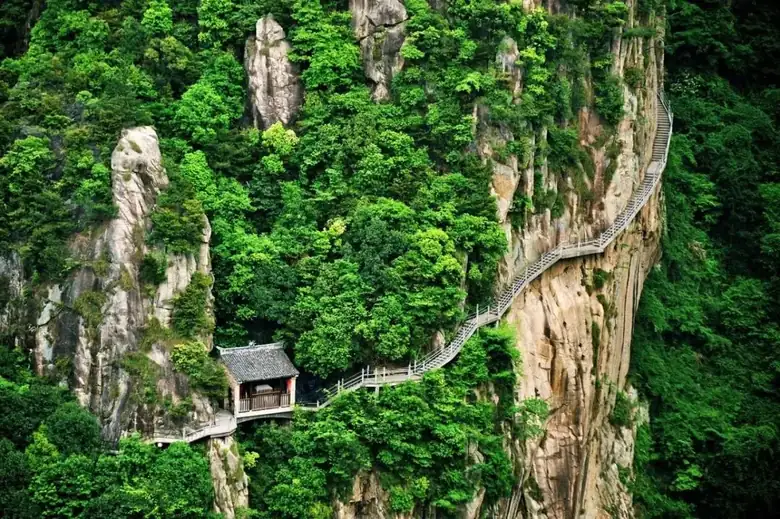
Mount Tiantai in Zhejiang Province is renowned for its eight peaks, its uniform shape on all sides, its summit facing the three celestial bodies, situated between the constellations of the Cowherd and the Weaver Girl, and corresponding to the constellation of the Terrace. It is famous as the ancestral home of the Tiantai School of Buddhism, the Southern School of Taoism, and the birthplace of the legendary monk Ji Gong. Known for its "Buddhist and Taoist origins, and its beautiful and spiritually rich landscape," it is one of the "Ten Famous Mountains of China." Mount Tiantai boasts stunning natural scenery and a profound cultural heritage. It features five peaks encircling the mountain, two winding streams, and lush pine trees stretching for dozens of miles; it also possesses naturally formed stone bridges and a three-tiered waterfall, rare sights in the world.
The Tiantai Mountain Scenic Area is divided into 13 scenic areas based on its geographical location and characteristics. These 13 main scenic areas are: Guoqing Scenic Area, Chicheng Scenic Area, Folong Scenic Area, Shiliang-Tonghu Scenic Area, Huading Scenic Area, Baizhang-Qiongtan Scenic Area, Tongkengxi-Wannian Temple Scenic Area, Taoyuan Scenic Area, Qingxi Scenic Area, Kaiyan-Zining Scenic Area, Hanshan Lake Scenic Area, Minghanyan Scenic Area, and Jiuzhe Mountain Scenic Area. Each scenic spot is naturally beautiful, unique, and has its own distinct charm, making them all breathtakingly beautiful. Among them, the Shiliang Waterfall and Huading Clouds are particularly noteworthy.
Tiantaishan Scenic Area Qualification
National 4A-level scenic spot
Features of Tiantai Mountain Scenic Area
Photography, hiking, summer retreat, sightseeing, vacation, temples, historical sites, mountains
Tiantai Mountain Scenic Area
1. To visit the Danxia landform, please go to the Chicheng Scenic Area;
2. The Stone Bridge Waterfall and Huading Returning Clouds within the scenic area are not to be missed;
3. For tourism and vacation, Hanshan Lake Scenic Area is a good place to visit;
4. For agritourism and leisure travel, Jiuzhe Mountain Scenic Area is a good choice;
5. To watch the sunrise and sea of clouds, you can go to Huading Scenic Area (Huading, Guiyun, and Tianzhu Peaks).
Guoqing Scenic Area
Guoqing Scenic Area, located on the southern slope of Tiantai Mountain, 3 kilometers north of the county seat, is surrounded by five peaks and two streams. It is the birthplace of the Tiantai School, the first sect of Chinese Buddhism, and the ancestral temple of the Tiantai School in Korea, Japan, and around the world. Guoqing Temple was first built in the 18th year of the Kaihuang era of the Sui Dynasty (598), initially named Tiantai Temple, and later renamed Guoqing Temple, meaning "If the temple is completed, the country will be at peace." It was listed as one of the ten temples in Jiangnan during the Southern Song Dynasty. The existing buildings were rebuilt by imperial decree in the 12th year of the Yongzheng era of the Qing Dynasty (1734). The temple covers a total area of 73,000 square meters, divided into five longitudinal axes, forming an ancient architectural complex of more than 20,000 square meters, more than 800 rooms, complete halls, and a magnificent and orderly structure. It is now listed as a national key cultural relics protection unit. Guoqing Temple has a very good reputation and is free of charge. Vegetarian meals are 2 yuan and all you can eat, making it a refreshing exception among 5A-level scenic spots.
Chicheng Scenic Area
Chicheng Scenic Area is mainly composed of Chicheng Mountain, also known as Shaoshan. Located 3 kilometers north of the city, it stands 306.5 meters high and is an isolated mountain formed from the erosion of sedimentary rocks. It is named for its reddish-brown color and the way its rock formations resemble a city wall. It is the only Danxia landform in Tiantai Mountain. At sunrise and sunset, clouds and mist swirl around the mountainside, creating a dazzling spectacle. Cao Wenhui, a Yuan dynasty scholar, described it as: "The red glow of Chicheng rises high, a myriad of red lights reflecting in the azure sky. A beauty does not roll up her brocade, an immortal pours down cinnabar." Hence the name "Chicheng Qixia" (Red Glow at Chicheng), considered the best place to pray for peace. "Chicheng Qixia" is a wondrous sight praised by famous figures throughout history. Chicheng Mountain has been a place of rest and cultivation for eminent monks and Taoist priests since ancient times. On the mountain are the famous Ziyun Cave nunnery in southeastern Zhejiang, the Yujing Cave (the sixth largest Taoist grotto-heaven), and the Liangfei Pagoda, a landmark of Tiantai Mountain built in 538 AD.
Shiliang-Tonghu Scenic Area
Shiliang-Tonghu Scenic Area, located 23 kilometers from the county seat, is nestled in verdant valleys and mountains, covering an area of 2.1 square kilometers. It boasts a collection of natural wonders and is considered the essence of the "Tang Poetry Road" in eastern Zhejiang. Famous poets such as Li Bai and Meng Haoran praised its beauty in their poems. Following the stream upstream, one is surrounded by lush green mountains, ancient trees, strangely shaped rocks, and towering peaks—a truly exceptional place where every step reveals a new vista. Visitors feel as if they have entered a fairyland. The valley stretches over 1800 meters and features famous formations such as "Rhinoceros Gazing at the Moon," "Old Monk in Meditation," "Millennial Sleeping Lion," "Ten-Thousand-Year-Old Tortoise and Elephant," a primeval forest of *Michelia champaca* trees, and "Yingzhen Bathing Pool." The Shiliang Waterfall within the scenic area is hailed as the most spectacular sight in the world. The Shiliang itself is about 7 meters long and less than a foot wide, resembling the spine of a soaring dragon, stretching across the cliffs between two mountains—a masterpiece of nature and a rare sight indeed. The waterfall cascades through three sections, passing under beams, before plunging down a 40-meter-high cliff like collapsing white frost and snow, its thunderous roar resounding like thunder.
Huading Scenic Area
Huading Scenic Area, covering an area of 7.5 square kilometers, is located 25 kilometers north of the county seat and is a national forest park. The main peak, at 1098 meters above sea level, is surrounded by mountains that arch towards it, layer upon layer, resembling a hundred-petaled lotus flower. Huading Peak is situated at the top of this "flower," hence its name. Huading Peak is the main peak of Tiantai Mountain in Zhejiang Province. At the foot of the peak is Huading Temple, originally named Shanxing Temple, founded in 936 AD by the National Preceptor Master Deshao. The existing buildings were rebuilt in 1998. Behind the temple is Guiyun Cave, said to be the site of a tea garden planted by Ge Xuan during the Wu Kingdom period, over 1700 years ago. A Guiyun Pavilion now stands there. To the northeast of the temple is Taibai Study Hall, and to the southwest are ancient sites such as Youjun Ink Pond. In the dense forests on both sides of the temple, there were originally 72 thatched huts, the largest of which was Yaoshi Nunnery in the east.
Tiantai Mountain Waterfall
Tiantaishan Grand Waterfall Scenic Area is located on the western slope of Tongbai Mountain within Tiantai County. The main waterfall has a total drop of 325 meters and a maximum width of 90 meters, making it a rare high-drop, tiered waterfall group, arguably the highest waterfall in China. The scenic area covers a total area of 11.31 square kilometers and includes the Grand Waterfall area, Jiulong Lake area, Tongbai Palace area, and Qiongtan Xiangu area. These areas are connected by sightseeing elevators, suspension bridges, glass suspension bridges, and the Jinting Lake greenway, forming a large-scale mountain scenic area that integrates canyon landscapes, waterfall landscapes, suspended walkways, modern experiences, and Taoist culture.
Qiongtan Fairy Valley Scenic Area
Qiongtan Fairy Valley Scenic Area is renowned for its "majesty, wonder, beauty, and tranquility." Within the area, towering mountains, deep ravines, and cascading waterfalls create a complete grand canyon landscape, complete with peaks, rocks, pools, and waterfalls. The Tang Dynasty poet Li Bai highly praised Qiongtan Fairy Valley, writing, "I refuse to dwell in the dragon towers and phoenix palaces, I soar straight to the Heavenly Terrace!" He also wrote, "A woman in green invited me to visit Qiongtan, where the fragrant flowers of the Qimu tree bloom with nine petals." Legend has it that this is where the Yellow Emperor, the ancestor of the Chinese nation, received the elixir of immortality from the immortal Jiu Yuanzi. At the southern end, a natural stone chair is said to be where high-ranking Taoist priests such as Ge Xuan, Lü Dongbin, and Bai Yuchan refined elixirs, hence the name "Immortal's Seat." On the platform are inscriptions such as "Penglai Wonderland" and "The Ultimate View" by Liu Mi, Tian Hezi, and Kang Youwei from the Tang and Song Dynasties. At the highest point, the Yellow Emperor's Altar, the Altar of Heaven, and the Altar of Earth stand atop the peak, a harmonious unity between humanity and nature.
Longchuanxia Scenic Area
Longchuanxia Scenic Area is located in Baihe Town, about 18 kilometers north of Tiantai County. The scenery within Longchuanxia Scenic Area is characterized by its steep peaks, deep canyons, craggy rocks, dreamlike mist, and clear streams. Most spectacular are the diverse and unique waterfalls, with cascading waterfalls as smooth as silk, offering breathtaking views that captivate visitors. The scenic area is divided into ten sections: Taiyue Spring and Autumn, Xiuxi Waterfall Viewing, Wuxie Flowing Spring, Taibai Wind, Dragon and Phoenix Playing, Dragon Piercing the Wall, Stone Gate Knocking on the Pass, Heavenly Pool Bathing in Greenery, Birdsong in the Valley, and Three Gorges Adventure.
Tiantai Mountain sightseeing route
Route 1: Sui Pagoda → Guoqing Temple → Gaoming Temple → Zhizhe Pagoda Courtyard → Luoxi Fishing Boat → Diaochuan Rock → Huafeng → Huading Temple → Huading Mountain → Taibai Study Hall → Shiliang Waterfall → Tonghu Dripping Waterfall → Fangguang Temple → Wannian Temple → Taoyuan Spring Dawn → Qiongtan Night Moon → Tongbai Power Station → Chicheng Mountain.
Route 2: Tiantai Mountain Scenic Area has 13 scenic spots. Visiting one scenic spot each day is the most suitable option, making it ideal for a vacation.
Visiting time at Tiantai Mountain
Tiantai Mountain is a famous summer resort, and the best time to visit is from April to October. Among them, visiting Tiantai Mountain in July and August allows you to enjoy its beautiful scenery while escaping the scorching sun.
Ticketing information
Guoqing Scenic Area: 10 yuan, discounted ticket 5 yuan
Shiliang Scenic Area: 60 yuan, discounted ticket 30 yuan
Guoqing + Shiliang: 70 yuan, discounted ticket 35 yuan
Huading: 50 yuan
Qiongtai: 65 yuan
Chicheng Mountain: 15 yuan
Recommended accommodations in Tiantai Mountain
1. B&Bs at the foot of Tiantai Mountain: (Top choice for high cost-performance)
Prices typically range from 100 to 500 yuan, making it suitable for tourists with limited budgets who prefer a more down-to-earth atmosphere.
2. Budget hotels: (A hassle-free and convenient option)
Prices are generally around 150-300 yuan, suitable for those who don't have high requirements for accommodation and value convenient transportation.
3. Resort Hotel: (Immersive Experience)
The price range is quite large, ranging from several hundred yuan to over a thousand yuan.
4. Farmhouse Inn: (Excellent value for money)
Some farmhouses offer all-inclusive services, costing around 100 yuan per day, which is suitable for tourists who want to immerse themselves in the local culture.
Precautions
1. The temperature difference between day and night is large on Tiantai Mountain, especially if you are going to Huading or Beishan. Be sure to dress warmly and bring a jacket, as the temperature on the mountain is generally about 5 to 6 degrees Celsius lower than at the foot of the mountain.
2. If you are going to the waterside, such as Shiliang Waterfall, Tongbai Reservoir, Baizhangkeng, or Qiongtan Valley, be sure to bring insect repellent, as the mosquitoes in those places are quite fierce in the summer. Of course, you should also prepare for the cold weather.
3. If you're going to lower-lying areas like Chicheng Mountain, Longshan Mountain, or Hanshan Lake, be sure to bring some food and drinks, as those places are extremely expensive.
4. It's best to travel by car, as it's convenient. However, if you're going to mountains like Huading Mountain, remember to take the new roads, not the old ones. Even experienced drivers are hesitant to drive on the old roads going up the mountain because they are steep, winding, and have cliffs on the sides, making them quite dangerous.
5. Finally, remember to bring plenty of food, and if you have GPS or other navigation devices, don't forget them either, in case you get lost, you can slowly find your way back.
Travel information can change. Check current opening hours, reservations and entry requirements before you travel.

Traveller discussion
Start the conversation with a helpful tip or a question.