
[Sichuan Attractions] Recommended 20 Most Beautiful Scenic Spots in Sichuan
Sichuan is a major tourist province in China. With its beautiful mountains and rivers, and its rich cultural heritage, it has long been a dreamlike paradise of beauty, abundance, peace, and ever-changing scenery, earning it the nickname "Land of Abundance." The title "Oriental Eden" further enhances its romantic appeal. Sichuan is a paradise for t…
Sichuan is a major tourist province in China. With its beautiful mountains and rivers, and its rich cultural heritage, it has long been a dreamland of beauty, abundance, peace, and ever-changing scenery, earning it the nickname "Land of Abundance." The title "Oriental Eden" further enhances its romantic appeal. Sichuan is a paradise for tourists and a must-visit destination for hikers and mountaineers. Below is a list of twenty must-see tourist attractions in Sichuan: Chengdu Chunxi Road, Wuhou Temple, Du Fu Thatched Cottage, Kuanzhai Alley, Wuming Buddhist Academy, Daocheng Yading, Jiuzhaigou, Mount Emei, Danba, Mount Gongga, Leshan Giant Buddha, Deng Xiaoping's Former Residence in Guang'an, Beichuan Qiang City Tourist Area, Mount Qingcheng, Langzhong Ancient City, Hailuogou, Jianmen Shu Road, Mount Siguniang, Sanxingdui, and Luoji Mountain.
The 20 Most Beautiful Scenic Spots in Sichuan
Chengdu Chunxi Road
Chunxi Road, located in the heart of Chengdu, is known as the "Number One Street in Southwest China." At night, Chunxi Road is illuminated by neon lights, and numerous famous Chengdu snacks and bustling shopping malls line both sides of the road, making it a vibrant and modern fashion center of Chengdu.
Wuhou Temple
The Wuhou Temple, comprised of the shrine where Liu Bei, Zhuge Liang, and other ministers of the Shu Han state are jointly worshipped, along with Liu Bei's Hui Mausoleum, is the only temple in China where a ruler and his ministers are worshipped together. Besides the main hall enshrining statues of Zhuge Liang and Liu Bei, the temple also houses a "Three Perfections Stele" erected in the Tang Dynasty. The inscription is a high praise for Zhuge Liang's life, and because the writing, carving, and drafting of the inscription were all done by renowned calligraphers of the time, it is hailed as the "Three Perfections."
Du Fu Thatched Cottage
Du Fu Thatched Cottage is located on the banks of Huanhua Creek in the western suburbs of Chengdu, Sichuan Province. Du Fu, courtesy name Zimei, was born in Gongxian County, Henan Province in the first year of the Xiantian era of Emperor Xuanzong of Tang. He died of illness on a boat on the Xiang River in the fifth year of the Dali era of Emperor Daizong. Because he once served as an official in the Ministry of Works, he was also known as "Du Gongbu" in later generations.
Kuanzhai Alley
Kuanzhai Alley is a collection of two parallel alleys in the northwest of downtown Chengdu. The wider one is called "Kuan Alley," and the narrower one is called "Zhai Alley." Kuan Alley, which is less than 300 meters long, is now the only old street in Chengdu that has preserved its original Qing Dynasty appearance. Dozens of courtyard houses in the style of the late Qing and early Ming Dynasties and garden villas with Western influences are unique to this era and have witnessed more than a hundred years of development in Chengdu.
Larung Gar Buddhist Academy
Larung Gar Buddhist Academy in Seda, Sichuan Province, is the world's largest Tibetan Buddhist academy. The academy is located in a mountain valley called Larung Valley, more than 20 kilometers from Seda County. The valley is about 7 kilometers long, with continuous mountain ridges, a quiet and secluded valley, and lush green grass on the ridges. The sky is blue, with white clouds gathering and wind horses flying. The red wooden houses are all next to each other, which is breathtaking. The temples and altars are golden and the Buddha halls are grand and magnificent.
Daocheng Yading
Daocheng Yading, also known as Yading Nature Reserve or Yading Scenic Area, is located in the southern part of Daocheng County, Ganzi Prefecture. It mainly consists of three sacred mountains, namely Xiannairi, Yangmaiyong, and Xianuoduoji, as well as the surrounding rivers, lakes, and alpine meadows. It is one of the best-preserved natural ecosystems in China.
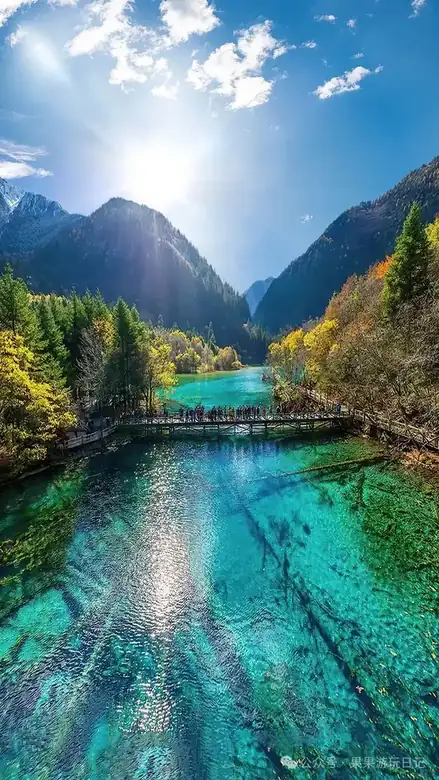
Jiuzhaigou
Jiuzhaigou is located in Jiuzhaigou County, Aba Tibetan and Qiang Autonomous Prefecture, Sichuan Province. Situated in the transition zone between the Qinghai-Tibet Plateau, the Western Sichuan Plateau, and the Sichuan Basin, it is a mountain valley stretching over 50 kilometers in depth, with a forest coverage rate exceeding 80%. It is named after the nine Tibetan villages nestled within this cluster of high-altitude lakes, including Shuzheng Village, Heyezhai Village, and Zechawa Village. The saying "After seeing Jiuzhaigou, no other water scenery is worth seeing" truly captures the essence of Jiuzhaigou's beauty.
Mount Emei
Mount Emei, one of China's four sacred Buddhist mountains, is located in south-central Sichuan Province, on the southwestern edge of the Sichuan Basin. Rising higher than the Five Sacred Mountains, it is renowned for its breathtaking beauty. Among China's famous tourist mountains, Mount Emei is arguably the highest, with its highest peak, Wanfo Peak, reaching 3099 meters. For a long time, Mount Emei has been famous for its stunning natural scenery and mythical Buddhist sites. Ancient and mysterious, majestic and enchanting, its mountain range stretches endlessly, with countless cliffs and valleys, waterfalls and streams, all contributing to its unique and elegant beauty, hence the saying "Mount Emei is the most beautiful mountain under heaven."
Further Reading: [The Ultimate Guide to Mount Emei] Includes Route Planning, Accommodation Selection, Transportation Options, and Attraction Checklist
Danba
Located 21 kilometers southwest of Danba County in Donggu Township, the Yak River flows merrily through the valley. Rich in vegetation, the area boasts dense primeval forests, uniquely shaped peaks and rocks, cascading waterfalls, and numerous scattered lakes and hot springs—gems nestled among the mountains. It is hailed as a natural bonsai garden. The Danba Tibetan villages, sharing a similar architectural style with the watchtowers, are among the most distinctive of the Jiarong mountain villages.
Gongga Mountain
Mount Gongga, located on the eastern edge of the Qinghai-Tibet Plateau, at the border of Kangding and Luding counties in Sichuan Province, is the main peak of the Hengduan Mountains' Daxue Mountains. At 7,556 meters above sea level, at 141.8 degrees east longitude and 29.6 degrees north latitude, it is the highest peak in Sichuan Province and is known as the "King of Mountains." Mount Gongga is one of the mountains in China with the most developed glaciers. It is a premier destination for mountaineering, exploration, and high-altitude tourism.
Further Reading: [Complete Guide to Gongga Mountain] Hiking the King of Sichuan Mountains – After reading this, I can't wait to go!
Leshan Giant Buddha
The Leshan Giant Buddha is a national key cultural relics protection unit, a World Cultural and Natural Heritage site, a national scenic spot, one of China's top 40 tourist destinations, and a national 4A tourist area. The scenic area boasts unique cultural and natural landscapes. There's an old saying, "Pilgrimage to Emei in the morning, pilgrimage to Lingyun in the afternoon." The world-famous Leshan Giant Buddha is carved into the rock face at the confluence of the Minjiang, Qingyi, and Dadu rivers, and is a seated Maitreya Buddha statue.
Further Reading: [Leshan Giant Buddha] Must-see attractions when visiting Leshan Giant Buddha! (Travel Guide)
Deng Xiaoping's Former Residence in Guang'an
Deng Xiaoping's former residence is located in the Deng Family Courtyard in Paifang Village, Xiexing Town, Guang'an District. It is an ordinary rural courtyard house. Above the main gate of the residence hangs a horizontal plaque with the words "Former Residence of Comrade Deng Xiaoping" written in gold by Chairman Mao. The residence displays a large number of precious pictures, divided into eight parts: "Revolutionary Era", "Founding Period", "The Years", "Opening a New Era", "Foreign Affairs Activities", "Sharing Weal and Woe", "The 1992 Southern Tour", and "Colorful Interests", showcasing the great man's glorious revolutionary journey and unparalleled achievements.
Beichuan Qiang City Tourist Area
Located in Beichuan Qiang Autonomous County, Mianyang City, the site comprises the Beichuan Earthquake Relics Area, the new Beichuan County Town, the Beichuan Earthquake Memorial Hall, the Beichuan Qiang Folk Museum, Jina Qiang Village, and the West Visitor Center. Beichuan is the only Qiang Autonomous County in China. For thousands of years, the ancient Qiang people, along with 17 other ethnic groups including Han, Tibetan, and Hui, have lived and thrived on the land of Beichuan, forming a simple and profound folk culture.
Qingcheng Mountain
As the birthplace of Taoism in China and the ancestral temple of the Celestial Masters sect, Mount Qingcheng embodies the essence of Chinese Taoist culture and is listed as the "Fifth Grotto-Heaven" by Taoism. Dozens of temples and monasteries are still well-preserved today. It can be said that Mount Qingcheng is a living Taoist "museum" spanning thousands of years. Here, the mountains and forests are secluded, the ancient paths are tranquil, the wildflowers are fragrant, the birdsong is melodious, the pavilions are elegant, and the streams are clear, hence the reputation of "Qingcheng, the most secluded place under heaven."
Further Reading: A Day Trip to Qingcheng Mountain and Dujiangyan! Easy Travel Guide
Langzhong Ancient City
Langzhong, located in northeastern Sichuan, is renowned for its auspicious geomancy. Surrounded by mountains on three sides and water on all four, its scenery is breathtaking and picturesque. Langzhong is one of the four best-preserved ancient cities in China and the only ancient city in Sichuan Province protected by law. With its rich cultural heritage and numerous historical sites, Langzhong is a National Historical and Cultural City. It is one of the birthplaces of Chinese civilization, a major origin of Ba culture, a center for Han and Tang dynasty folk astronomical research, and the hometown of Sichuan's top scholars (Zhuangyuan).
Hailuogou
Hailuogou Glacier Forest Park is located 319 kilometers from Chengdu. Originating from a glacial meltwater valley on the eastern side of Mount Gongga, known as the "King of Sichuan Mountains," it flows from southwest to north into the Moxi River, a tributary of the Dadu River. The most captivating feature of Hailuogou is undoubtedly its glaciers, which can be seen cascading down from the towering canyons even from lower elevations. The magnificent icefall, over 1000 meters high, is particularly stunning. Standing at the foot of the mountain, gazing at the perpetually snow-capped Mount Gongga, one is struck by its imposing grandeur and awe-inspiring presence.
Jianmen Shu Road
The Jianmen Shu Road is truly a rare and wonderful tourist route. Not only are its cultural landscapes and historical value astonishing, but its natural beauty is also unparalleled. The unique Cuiyun Corridor alone has been listed by some as the eighth wonder of the world, which speaks volumes about its charm. This route is less affected by the seasons and can be visited in spring, summer, autumn, and winter.
Mount Siguniang
Mount Siguniang, located at the border of Xiaojin County and Wenchuan County, consists of four adjacent peaks in the Hengduan Mountains. According to local Tibetan legend, they are the incarnations of four pure and beautiful maidens, hence the name Mount Siguniang (Four Maidens Mountain). Mount Siguniang is renowned for its majestic and towering peaks, steep cliffs reaching towards the blue sky, covered in snow and shimmering in the sunlight. At its foot, dense forests and lush green meadows, along with clear, babbling streams, create a picturesque scene reminiscent of Southern Europe, earning it the nickname "China's Alps."
Sanxingdui
Located north of Nanxing Town, Guanghan, Sichuan, the ancient Mamu River meanders through the village, forming a crescent-shaped bend—Moon Bay—at Sanxingdui Village. On the south bank of the river are three undulating loess mounds facing each other, which is the "Three Stars Accompanying the Moon Mound" recorded in the Qing Dynasty's "Jiaqing Hanzhou Zhi". This is the place where the ancient Shu people lived and thrived—the world-renowned Sanxingdui Site.
Further Reading: [Sanxingdui] A Super Detailed Guide to Visiting Sanxingdui! A Personal Experience to Avoid Mistakes
Luoji Mountain
Luoji Mountain, located on the southern shore of Qionghai Lake, is named for its spiral shape resembling a snail's shell. The mountain boasts 36 deep, colorful lakes and pools, abundant subtropical vegetation, well-preserved ancient glacial relics, rhododendrons blooming across the slopes, and a variety of unique and colorful landscapes including caves and waterfalls. Luoji Mountain can be considered a "majestic man" among mountains, its entire body majestic and verdant, with overlapping peaks and imposing grandeur. There are sayings such as "Emei is the most beautiful mountain under heaven, Luoji is the most wondrous," and "When Luoji Mountain opens, Emei Mountain closes," which speaks volumes.
Travel information can change. Check current opening hours, reservations and entry requirements before you travel.

Traveller discussion
Start the conversation with a helpful tip or a question.