
Anshun City
安顺市
Origin of the place name: The name Anshun is related to war. In the fifth year of Hongwu (1372), the Ming Dynasty appointed Shi'er, the female governor of Puding, as the native prefect of Puding Prefecture. In the fourteenth year of Hongwu (1381), Zhu Yuanzhang sent Fu Youde as the general to conquer the south, leading his army through Guiyang and…
Origin of place name:
The name Anshun is related to warfare. In 1372, the Ming Dynasty appointed Shi'er, the female governor of Puding, as the native prefect of Puding Prefecture. In 1381, Zhu Yuanzhang sent Fu Youde as the General of the Southern Expedition, leading troops through Guiyang and Puding Prefecture (in present-day Anshun) into Yunnan to sweep away the remnants of the Yuan Dynasty. According to the "Da Ding Zhi" (Records of the Great Ming Dynasty), "The inscription on the stele of the Ming Dynasty's construction of Puding Guard states that on the 20th day of the 12th month of the 14th year of Hongwu (1381), Marquis Wu Fu of Anlu, in accordance with imperial decree, selected the place name Adabu in Puding Prefecture to build the city, which was completed on the 17th day of the intercalary 2nd month of the 15th year of Hongwu (1386)." Given Anshun's geographical advantages, the Ming court, while still in the garrison city, began to replace the native prefecture of Puding and the native city of Anshun with Anshun. In 1385, the Puding Prefecture was abolished, but the prefecture was preserved and renamed Anshun Prefecture. This is the earliest appearance of the word "Anshun".
Basic introduction:
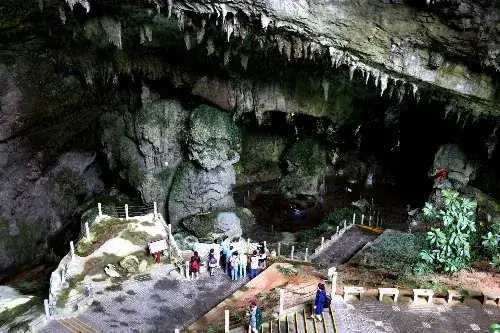
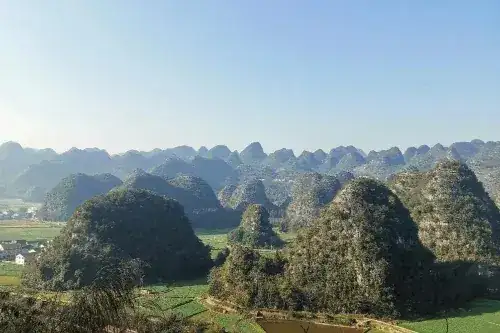
Anshun City is located in the south-central part of Guizhou Province and is one of the four prefecture-level cities in Guizhou. It administers one district and five counties (autonomous counties): Xixiu, Pingba, Puding, Zhenning, Guanling, and Ziyun, as well as three county-level administrative divisions: Huangguoshu Scenic Area, Anshun Economic and Technological Development Zone, and Liyang High-tech Industrial Park. It covers an area of 9,264 square kilometers. The city has a total population of over 2.523 million, of which ethnic minorities such as the Buyi, Miao, and Gelao account for 38.43%. The city boasts over 100 waterfalls and more than 1,200 surface caves. Towering peaks, crisscrossing rivers and canyons, forests, lakes, and underground springs abound, creating a breathtaking landscape that is rare in the world, all interwoven with the ancient mountain customs and mysterious mountain culture.
Anshun currently has three national key scenic spots: Huangguoshu Waterfall, Longgong Mountain, and Hongfeng Lake (Nanhu Lake); one national forest park: Jiulong Mountain; and three provincial-level scenic spots.
View detailed information about Anshun City >>
Honors Ranking:
In January 2026, it ranked 112th in the overall ranking of overseas online influence of Chinese mainland cities in 2025.
In May 2025, the 2025 China City Charm Ranking was released, and Anshun City ranked 243rd (a fifth-tier city).
In April 2025, it was named a national model city (county) for supporting the military and giving preferential treatment to families of servicemen.
In May 2024, the 2024 China City Commercial Attractiveness Ranking was released, with Anshun City ranking 227th.
In April 2023, the 2023 China City Commercial Attractiveness Ranking was released, with Anshun City ranking 208th.
In January 2023, it was named one of the tenth batch of national demonstration zones for ethnic unity and progress by the State Ethnic Affairs Commission.
In 2022, Anshun City's GDP totaled 108.092 billion yuan, ranking 9th among all cities and prefectures in Guizhou Province.
In August 2022, Anshun City was designated as one of the second batch of pilot cities nationwide to establish convenient living circles within 15 minutes.
In April 2022, Anshun City was included in the list of "Zero Waste Cities" to be built during the "14th Five-Year Plan" period.
View more honors and rankings of Anshun City >>
Historical background:
Qin was part of the territory of the Yelang Kingdom.
During the Han Dynasty, Yelang County was established, which belonged to Zangke Commandery.
The Tang dynasty first established Yanzhou, which was later renamed Puningzhou.
At the end of the Tang Dynasty, it was under the jurisdiction of the Cuan clan and belonged to the Nanzhao Kingdom.
During the Song Dynasty, it belonged to Shaoqing Prefecture.
In the seventh year of the reign of Emperor Xianzong of the Mongol Empire (1257), the Puding Ten Thousand Household was established. In the fifteenth year of the reign of Emperor Zhiyuan of the Yuan Dynasty (1278), it was changed to Puding Prefecture, which was under the jurisdiction of Qujing Pacification Commissioner's Office of Yunnan Province.
In the twenty-seventh year, the Luodian Pacification Commission was established and transferred to the jurisdiction of the Huguang Province.
In the seventh year of the Dade era (1303), it was renamed Puding Road, and the northeastern part belonged to the Bafan Shunyuan Pacification Commission.
Anshun Prefecture was established in the eleventh year of the Zhizheng era (1351), and the name Anshun originated from this.
In the fifteenth year of the Hongwu reign of the Ming Dynasty (1382), it was renamed Puding Prefecture and placed under the jurisdiction of the Yunnan Provincial Administration Commission. It was later transferred to the jurisdiction of the Sichuan Provincial Administration Commission.
View detailed historical evolution of Anshun City >>
Travel information can change. Check current opening hours, reservations and entry requirements before you travel.
Traveller discussion
Start the conversation with a helpful tip or a question.