
What are some good travel suggestions for Taiwanese people visiting Tibet?
What are some good travel tips for Taiwanese compatriots traveling to Tibet? (Edited 2022-04-22 16:55:17) Besides needing an entry permit, Taiwanese tourists traveling to Tibet must also travel in a group. They can choose to join a small group tour or form their own. Besides this, what other precautions should Taiwanese compatriots take when trave…
What are some good travel suggestions for Taiwanese people visiting Tibet?
Edited on 2022-04-22 16:55:17
Planning a long trip involves many considerations, especially when traveling to high-altitude regions like Tibet, where group tours are often necessary. What precautions should Taiwanese people take when traveling to Tibet? What are some suggestions for Taiwanese tourists visiting Tibet? Below is a summary.
Travel Tips for Taiwanese Residents to Tibet – Pre-trip Preparations
1. About high altitudes and altitude sickness (altitude sickness)
The average altitude of tourist areas in Tibet is around 3,500-4,000 meters, while the altitude in Taiwan is less than 1,000 meters. People going to high-altitude areas will experience altitude sickness to some extent. Therefore, it's important to be mentally prepared before going.
2. Regarding Tibet Entry Permits
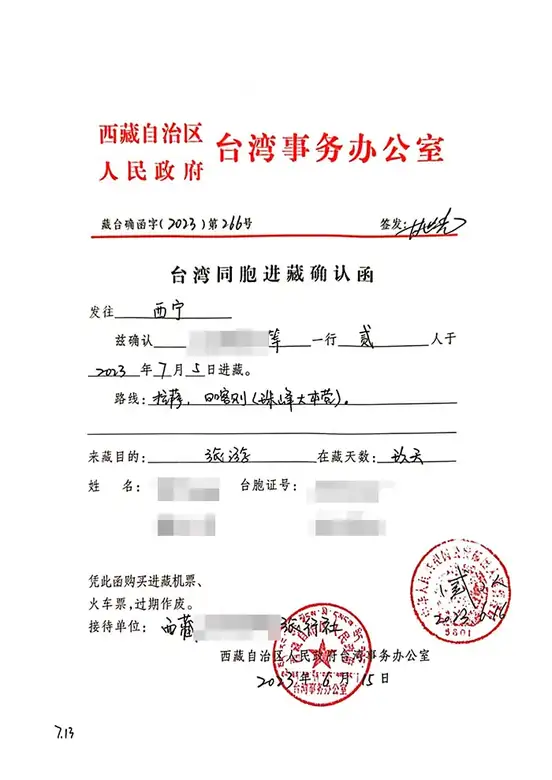
The Tibet Entry Permit for Taiwan Compatriots is the most important and essential document for Taiwanese tourists traveling to Tibet. Of course, a Taiwan Compatriot Permit is required to enter mainland China, and the Tibet Entry Permit is necessary to enter Tibet. Other documents are also required, but the travel agency will handle those for you, so don't worry.
Sample letter for Taiwan compatriots to enter Tibet
3. About the Qinghai-Tibet Railway
If you want to experience train travel in mainland China, the Qinghai-Tibet Railway is definitely the first choice. The journey from Xining takes 22 hours, which is relatively long and challenging, but it is indeed a rare and unique experience. You can see a lot of scenery, make friends on the train, and chat with different people.
The Qinghai-Tibet Railway is a relatively traditional and old-fashioned green train, not the most advanced Harmony Express. This railway was built relatively early and had limited conditions, so Harmony Express trains couldn't run on it. However, there are currently two railways in Tibet that use Harmony and Fuxing Express trains: one runs between Lhasa and Shigatse, the center of the Tsang region, and the other runs between Lhasa and Nyingchi, a lower-altitude area. Taiwanese tourists can travel on these two railways in Tibet, of course, accompanied by a tour guide.
4. About the Tibet Itinerary
When traveling to Tibet, excluding the time spent entering and leaving Tibet (it takes about 2-4 days round trip from Taiwan), you should have at least 7 days to stay and explore Tibet. You need at least 7 days to fully enjoy Tibet and see all of it. We generally recommend staying in Lhasa for 1-2 days before traveling to other areas, otherwise altitude sickness will make you lose all interest in sightseeing.
【Everest Journey】8-Day Tour of Lhasa, Yamdrok Lake, Shigatse, and Everest
Potala Palace + Jokhang Temple + Sala Monastery + Barkhor Street + Yamdrok Lake + Mount Everest + Tashilhunpo Monastery + Karola Glacier + Rongbuk Monastery + Tibetan Cultural Experience
Travel Tips for Taiwanese Residents to Tibet – During the Trip
1. About long-distance driving in Tibet
Tibet is a vast region with long distances between attractions. For example, the distance from Lhasa to Shigatse in the rear of Tibet is 266 kilometers, and the distance to Mount Everest is about 800 kilometers, which is almost the distance of circumnavigating Taiwan. Therefore, it requires a long drive, and many sections of the road are winding mountain roads with many twists and turns. The driving experience may not be good, and there is a high possibility of motion sickness. So Taiwanese tourists must be prepared and bring some motion sickness medication and small items to make the ride more comfortable, such as lumbar support cushions and headrests.
2. Regarding cold-weather protection in Tibet
Tibet has a high altitude, so the temperature is lower than that of Chengdu at the same latitude. In some mountain passes and lakeside areas in Tibet, the wind can be very strong, resulting in very low temperatures. Even in the hottest months of July and August, temperatures in lower altitude areas can still be quite low, so it is essential to prepare for wind and cold protection.
3. Regarding sun protection in Tibet
The ultraviolet radiation in Tibet is incredibly strong. Don't go bare-faced to brave it, or you might return from your trip with a deep tan or even a tanned, reddish complexion. Regardless of the season or sunshine level, always wear sunscreen. It's best to bring sun-protective clothing, a sun hat, and sun-protective sleeves.
4. Taboos regarding travel to Tibet
Photography is not allowed inside many monasteries in Tibet. Please remember this and always ask for permission before taking pictures of Tibetan monks or Tibetans, otherwise it is considered impolite.
When traveling to Tibet, please pay attention to the following points:
1. Avoid catching a cold before traveling to Tibet. People with high blood pressure, heart disease, or asthma are prohibited from traveling to Tibet. Rhodiola rosea can be taken before traveling to Tibet to effectively alleviate altitude sickness.
2. Before entering the plateau region, refrain from smoking and drinking alcohol to prevent upper respiratory tract infections. Avoid overexertion and ensure adequate rest. Consider taking ginseng or similar supplements to enhance the body's resistance to hypoxia. If you have a respiratory infection, ensure it is cured before entering the plateau region.
3. Maintaining an open-minded and optimistic attitude and building strong self-confidence can reduce the physical discomfort caused by altitude sickness.
4. Due to the cold climate and large temperature difference between day and night at high altitudes, be sure to prepare enough warm clothing to prevent catching a cold. Cold weather and respiratory infections can both trigger acute altitude sickness.
5. Upon arriving at high altitude, everyone will experience varying degrees of shortness of breath, chest tightness, and difficulty breathing due to oxygen deficiency. However, this does not mean you are not adapted to high altitude. If you take proper care of yourself, these symptoms will generally improve or disappear after 2-4 days.
6. Avoid overexertion and maintain a regular diet and lifestyle. In the first few days after arriving at high altitude, avoid frequent bathing to prevent catching a cold.
7. After entering Tibet, avoid drinking alcohol and smoking. Eat plenty of foods rich in vitamins, fruits, and vegetables, drink enough water, and keep your diet light. Do not eat too much at dinner. Keep warm by bringing a down jacket or windproof jacket.
Conclusion:
Tibet is a sacred place, and Taiwanese people should be fully prepared when traveling to Tibet, whether in the process of planning the trip or in the process of joining a tour group. Doing these things will make the trip smoother and more comfortable.
Related Articles
Introduction to Tibet Entry Permits for Taiwan Compatriots and Tibet Travel Guide
Are foreigners and Taiwanese allowed to travel on the Sichuan-Tibet Highway?
How do Taiwanese citizens apply for a Tibet Entry Permit? The latest application process for Tibet Entry Permits for Taiwanese tourists.
How can Taiwanese people find a reliable travel agency when traveling to Tibet?
Are Taiwanese allowed to travel to Tibet?
Can I travel to Tibet with a Taiwan Compatriot Permit?
How can Taiwanese compatriots purchase train tickets to Qinghai-Tibet?
How can Taiwanese compatriots travel to Tibet?
Can Taiwanese people with Taiwan Compatriot Permits and Temporary Residence Permits enter Tibet?
Are Taiwanese compatriots allowed to travel independently to Tibet?
Travel information can change. Check current opening hours, reservations and entry requirements before you travel.


Traveller discussion
Start the conversation with a helpful tip or a question.