
Turpan City
Turpan CityTurpan City (Uyghur: تۇرپان شەھىرى) is a prefecture-level city in the Xinjiang Uygur Autonomous Region, located in central Xinjiang at the eastern end of the Tianshan Mountains. It is an olive-shaped intermountain basin oriented
Turpan City
Turpan City (Uyghur: تۇرپان شەھىرى) is a prefecture-level city in the Xinjiang Uygur Autonomous Region, located in central Xinjiang at the eastern end of the Tianshan Mountains. It is an olive-shaped intermountain basin oriented east-west, surrounded by mountains on all sides. The city features a typical continental warm-temperate desert climate—rich in heat yet extremely dry, with scarce rainfall and frequent strong winds. The total area is 69,713 square kilometers. As of March 2024, Turpan administers 1 district and 2 counties. As of the end of 2024, the resident population was 698,200. In April 2015, the State Council approved the abolition of Turpan Prefecture and the establishment of prefecture-level Turpan City. Turpan enjoys a superior geographic location at the heart of the Eurasian continent, serving as the gateway to Urumqi and an important transportation hub on the New Silk Road and the Eurasian Continental Bridge. The Lanzhou-Xinjiang and Southern Xinjiang railways converge here, forming an integrated highway-railway-aviation transport system together with Turpan Airport and National Highway G30. Turpan is a renowned tourism city—the Ancient City of Gaochang and the Ancient City of Jiaohe have been inscribed on the World Cultural Heritage list. In October 2017, it was designated a National Garden City. In 2024, Turpan's GDP reached 64.042 billion yuan (approximately $8.9 billion), growing 9.1% year-on-year at constant prices.
Historical Evolution
Turpan was a major town on the ancient Silk Road, with human activity dating back 6,000-7,000 years to the Neolithic period. The indigenous Jushi people established several states in the Turpan Basin. During the Western Han Dynasty (138 BCE), Emperor Wu dispatched Zhang Qian as an envoy to the Western Regions. After five major campaigns known as the "Five Contests for Jushi" (108-60 BCE), the Han Dynasty established the Protectorate of the Western Regions in 60 BCE, with Zheng Ji as the first Protector-General, bringing the Western Regions under Han sovereignty. The Jushi state was divided into eight kingdoms, with the Jushi Front Kingdom centered at Jiaohe (present-day Ancient City of Jiaohe in Turpan).
During the Jin Dynasty, the Jushi Front Kingdom submitted to Jin rule. In 327 CE, the Former Liang ruler Zhang Jun conquered Gaochang and established Gaochang Commandery. The region subsequently changed hands among Former Qin, Later Liang, Western Liang, and Northern Liang regimes. In 460 CE, the Rouran destroyed Gaochang and enthroned Kan Bozhou as King of Gaochang, establishing a Han Chinese local dynasty and making Gaochang the political, economic, and cultural center of Turpan. The Qu-family Gaochang Kingdom (501-640 CE) governed the region, submitting to successive dynasties.
In 640 CE, the Tang Dynasty conquered Gaochang, ending its 180-year history, and established Xi Prefecture (Xizhou) with five counties. The Anxi Grand Protectorate was initially headquartered at Jiaohe. During the late Tang, the Tibetan Empire and the Uyghur Khaganate contested the region, with the Uyghurs ultimately taking control. In 866 CE, the Gaochang Uyghur Kingdom was established. In 1209, the Gaochang Uyghurs submitted to the Mongol Empire. The Yuan Dynasty administered the region through various offices. By the late Yuan period, Turpan was divided into three parts—Liucheng, Huozhou, and Turpan—the first recorded use of the name "Turpan."
During the Ming Dynasty, Turpan gained prominence. The Qing Dynasty established administrative structures including the Turpan Circuit. After the founding of the People's Republic of China in 1949, Turpan, Shanshan, and Toksun counties were peacefully liberated. In 1984, Turpan County was upgraded to a city. In April 2015, the State Council approved the establishment of prefecture-level Turpan City, comprising Gaochang District, Shanshan County, and Toksun County.
Administrative Divisions
As of March 2024, Turpan City administers 1 district and 2 counties: Gaochang District, Shanshan County, and Toksun County. The municipal government is headquartered at No. 495 Lüzhou East Road, Gaochang District.
Geography
Location and Terrain
Turpan City is located in central Xinjiang between 41°12′-43°40′N and 87°16′-91°55′E. It borders Hami to the east, connects with Bayingolin Mongol Autonomous Prefecture to the west and south, and faces Urumqi and Changji Hui Autonomous Prefecture across the Tianshan Mountains to the north. The total area is 69,713 square kilometers, including 2,085 square kilometers below sea level. Turpan is situated 183 kilometers from Urumqi.
The Turpan Basin is an olive-shaped intermountain basin surrounded by mountains, formed during the Himalayan orogeny approximately 30 million years ago. The basin floor at Aydingkol Lake is 155 meters below sea level—China's lowest basin and the world's second-lowest land depression after the Dead Sea (-391 meters). The Flaming Mountains and the eastern extension of the Bogda range traverse the central basin, dividing it into northern and southern halves.
Climate
Turpan has a typical continental warm-temperate desert climate with abundant sunshine (3,000-3,200 hours annually), extreme heat, and minimal rainfall. Annual average temperature is 13.9°C, with over 100 days exceeding 35°C. The summer extreme high reached 49.6°C, with ground surface temperatures often above 70°C—once recording 82.3°C. Annual precipitation averages only 16.4 millimeters, while evaporation exceeds 3,000 millimeters.
Hydrology and Natural Resources
Turpan has 14 major rivers, 9 originating within its territory and 5 flowing in from outside. Total water resources amount to 1.26 billion cubic meters. The city's forest area covers 346,780 hectares with 3.31% coverage. Nearly 30 nationally protected animal species inhabit the region. Turpan sits on the eastern Tianshan metallogenic belt with 68 discovered mineral types—coal, petroleum, natural gas, gold, iron, copper, and sodium nitrate reserves are particularly significant, with potassium nitrate, sodium nitrate, and smectite reserves ranking first in China.
Population
As of the end of 2024, Turpan's resident population was 698,200, an increase of 4,800 year-on-year. The urbanization rate reached 52.00%. The birth rate was 7.90‰ and the death rate 6.47‰. Turpan is home to 27 ethnic groups including Uyghur, Han, Hui, Kazakh, and Mongolian peoples.
Economy
Overview
In 2024, Turpan achieved a GDP of 64.042 billion yuan (approximately $8.9 billion), up 9.1% year-on-year. The primary, secondary, and tertiary industries contributed 7.564 billion yuan ($1.05 billion), 34.151 billion yuan ($4.74 billion), and 22.327 billion yuan ($3.10 billion) respectively, with the industrial structure adjusting to 11.8:53.3:34.9. Per capita GDP was 92,043 yuan (approximately $12,800). Fixed asset investment grew 28.8%. General public budget revenue reached 7.196 billion yuan ($1.0 billion), with tax revenue of 4.005 billion yuan ($556 million).
Primary Industry
In 2024, total agricultural, forestry, animal husbandry, and fishery output value reached 12.462 billion yuan, up 5.4%. Crop planting area was 98,370 hectares, with grape planting covering 63,280 hectares. Grape output reached 1.6272 million tons. Turpan has long been renowned as "China's Holy City of Grapes" and a "World Characteristic Wine Region."
Secondary Industry
Total industrial value-added reached 30.387 billion yuan in 2024, growing 18.0%. Above-scale industrial value-added grew 23.1%. Major sectors include mining (up 26.3%), manufacturing (up 26.0%), and utilities (up 4.7%). Above-scale industrial enterprises achieved revenue of 81.977 billion yuan. Construction industry value-added was 4.263 billion yuan, up 3.5%.
Tertiary Industry
The tertiary industry's value-added was 22.327 billion yuan, up 3.6%. Total retail sales of consumer goods reached 6.101 billion yuan. Total goods imports and exports amounted to $127.88 million, up 83.2%, with exports at $127.17 million. Financial institution deposits reached 41.594 billion yuan ($5.78 billion) and loans 39.804 billion yuan ($5.53 billion). Insurance premium income was 1.263 billion yuan ($175 million).
Social Affairs
Education
In 2024, Turpan had 137 schools of all types with 127,300 enrolled students and 162 kindergartens serving 20,500 children. The city had 43 high-tech enterprises and obtained 417 patent authorizations.
Healthcare
As of the end of 2024, Turpan had 415 medical and health institutions with 5,327 health technicians and 4,378 hospital beds.
Social Security
By the end of 2024, 165,200 people participated in urban employee basic pension insurance, and 588,600 in basic medical insurance. Welfare lottery sales reached 227 million yuan ($31.5 million).
Transportation
Turpan is served by the Lanzhou-Xinjiang high-speed railway, the Lanzhou-Xinjiang Railway, and the Southern Xinjiang Railway, with Turpan North Station and Shanshan Station within its territory. In 2024, highway freight transport volume was 14.117 million tons and passenger transport volume was 3.181 million. Turpan entered the high-speed rail era on November 16, 2014.
History and Culture
Turpan is an ancient Silk Road stronghold with over 4,000 years of cultural heritage, once a center of politics, economy, and culture in the Western Regions. Over 200 cultural sites have been discovered, yielding more than 40,000 artifacts. Turpan was a convergence point of four major cultural systems—Chinese, Indian, Greek, and Islamic—and seven major religions including Buddhism, Taoism, Manichaeism, and Islam.
The Turpan Grape Festival has been held annually on August 20 since 1990. Turpan Muqam, centered in Lukqin (Shanshan County), is considered one of the ancient sources of the Twelve Muqam of Xinjiang.
Scenic Spots
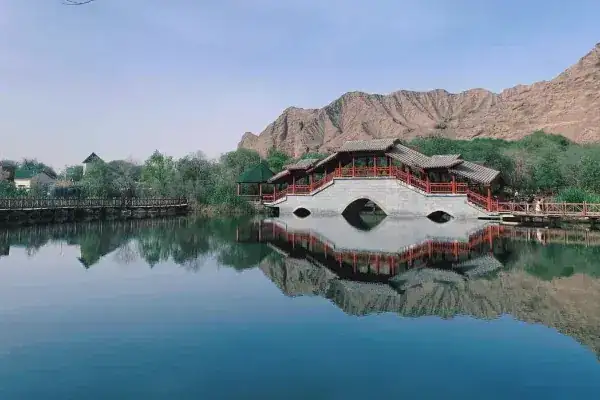
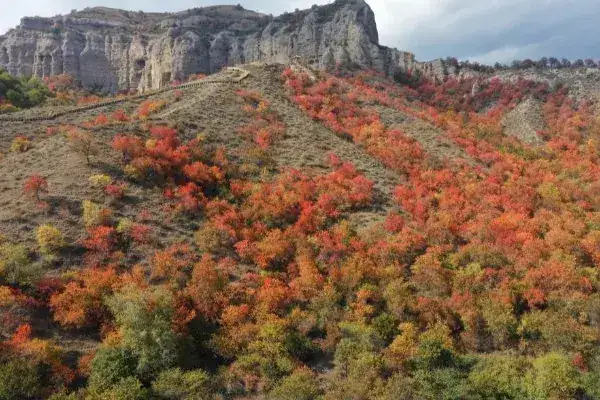
Turpan has 44 A-level scenic areas, including one 5A and ten 4A sites. Notable attractions include:
- Ancient City of Gaochang: Located 46 km southeast of Turpan, this city endured over 1,300 years before being abandoned in the 14th century. Designated a national key cultural relic protection unit in 1961.
- Ancient City of Jiaohe: Located 13 km west of Turpan, the former capital of the Jushi Front Kingdom and one-time seat of the Anxi Protectorate.
- Flaming Mountains: Located 10 km northeast of Turpan, 98 km long and 9 km wide, reaching 831.7 meters at its peak. Famous from the Journey to the West tale of Sun Wukong borrowing the Banana Fan.
- Bezeklik Thousand Buddha Caves: Situated on cliffs along the Murtuk River Valley, 45 km east of Turpan, one of Xinjiang's most famous Buddhist cave temple complexes.
- Astana Tombs: The public cemetery of the ancient Gaochang Kingdom, yielding over 10,000 precious artifacts including remarkably preserved mummies rivaling those of Egypt.
- Emin Minaret (Sugong Tower): Adjacent to the Turpan Junwang Mansion, built during the Qing Dynasty.
- Aydingkol Lake: The basin floor at 154.43 meters below sea level, the world's second-lowest land depression.
- Shanshan Sand Mountain Park: Built at the northern edge of the Kumtag Desert.
- Turpan Museum: The largest museum among Xinjiang's prefecture-level cities, housing 3,287 collections.
Honors
Turpan was designated a "National Garden City" (October 2017), selected among the "2017 China Characteristic Charm Cities 200" (December 2017), named a "National Double Support Model City" (October 2020), and listed as a second-batch National Cultural and Tourism Consumption Pilot City (October 2021). In April 2025, it was again awarded the "National Double Support Model City (County)" title.
Travel information can change. Check current opening hours, reservations and entry requirements before you travel.


Traveller discussion
Start the conversation with a helpful tip or a question.